What is section 61 of the immigration act
It can be hard to figure out how to get a visa, fill out an application, and understand the legal language when moving to New Zealand. Section 61 is one of the many parts of New Zealand’s immigration system that can help people who are in tough situations. Section 61 could be very important for your immigration journey if you’re already in New Zealand on a temporary visa that is about to run out or if something unexpected has come up that makes it impossible for you to leave the country.
This rule is in place to make a system that is otherwise very strict more flexible. It lets Immigration New Zealand (INZ) give temporary visas to people who might not be able to get them under normal visa categories. But what does Section 61 really mean? How do you go about getting it? How likely are you to succeed?
This complete guide will explain everything you need to know about Section 61 of the Immigration Act, including its history, how to use it, the fees and processing times, and examples from real life. By the end, you’ll know exactly how this rule works and if it could apply to your case.
Historical Context: The Reason for Section 61
Over the years, New Zealand’s Immigration Act has changed a lot to meet the country’s economic needs, humanitarian obligations, and border security needs. Section 61 was added as an optional clause to deal with cases that don’t fit into the usual visa categories.
The immigration system understands that life doesn’t always fit into neat boxes. People face medical emergencies, family crises, natural disasters, and other unforeseen circumstances that can’t be resolved through regular visa pathways. Section 61 gives immigration officers the power to use their judgment in these rare situations.
Over time, policy changes and case law have made this provision better. It’s become an important safety net in the immigration system, stopping real hardship while keeping New Zealand’s border controls strong.
What does Section 61 of the Immigration Act say?
Section 61 of the Immigration Act 2009 lets immigration officers give temporary visas to people who are in New Zealand illegally or whose current visa is about to run out. This rule is optional, so you don’t automatically have the right to get a Section 61 visa. Immigration officers look at each case on its own, taking into account the specific facts of the case.
This part has a few different uses:
Humanitarian reasons: If someone is in real trouble and has to leave New Zealand right away, Section 61 can help them temporarily.
Administrative flexibility: It deals with cases where someone is without a valid visa status because of technical problems or processing delays that weren’t their fault.
Public interest: The provision lets INZ take into account bigger things, like New Zealand’s obligations to other countries or the well-being of children who depend on them.
You should know that Section 61 does not lead to permanent residency. These visas are only good for a short time and are meant to help with short-term problems, not long-term immigration issues.
Main Parts of Section 61
Requirements for Eligibility
Not everyone is eligible for consideration under Section 61. Immigration officers usually look for strong reasons to use their discretion. Some of these might be:
- Medical emergencies that need to be treated right away in New Zealand
- For humanitarian reasons, like family violence or exploitation
- Things that are out of your control that keep you from leaving New Zealand
- Technical visa problems that weren’t your fault
- Situations where it would be very hard for you to leave New Zealand
Types of Section 61 Visas
There are different types of Section 61 visas, depending on your situation:
Temporary visa grants: These are short-term visas that let you stay in New Zealand while you work out your problems.
Visa extensions: give you more time on your current visa category if you can’t leave as planned.
Work rights: Some Section 61 visas let you work, but this isn’t always the case.
Important Requirements
To get a Section 61 visa, you need to show:
- The exceptional nature of your circumstances
- Why standard visa pathways don’t work for you
- Proof that backs up what you say
- Your character and your history of moving to another country
- How giving the visa serves the greater good
Costs for Section 61 Fees and Applications
Fees are one of the most common things people ask about Section 61 applications. As of 2024, the fees for Section 61 applications depend on the type of visa you want and whether you are applying from New Zealand or another country.
The usual fees for a Section 61 application are between NZD $320 and NZD $1,220, but the exact amount will depend on your situation. There may be extra fees for medical exams, police certificates, or other supporting documents.
Remember that paying the application fee doesn’t mean you’ll get approved. INZ looks at each case on its own and does not give back fees for applications that are not accepted. This means that you need to carefully fill out your application and make sure you have good reasons for asking for discretion.
In rare cases, some applicants may be able to get their fees waived, especially if they can’t apply because they can’t afford it. These waivers are granted rarely and require substantial evidence of your financial situation.
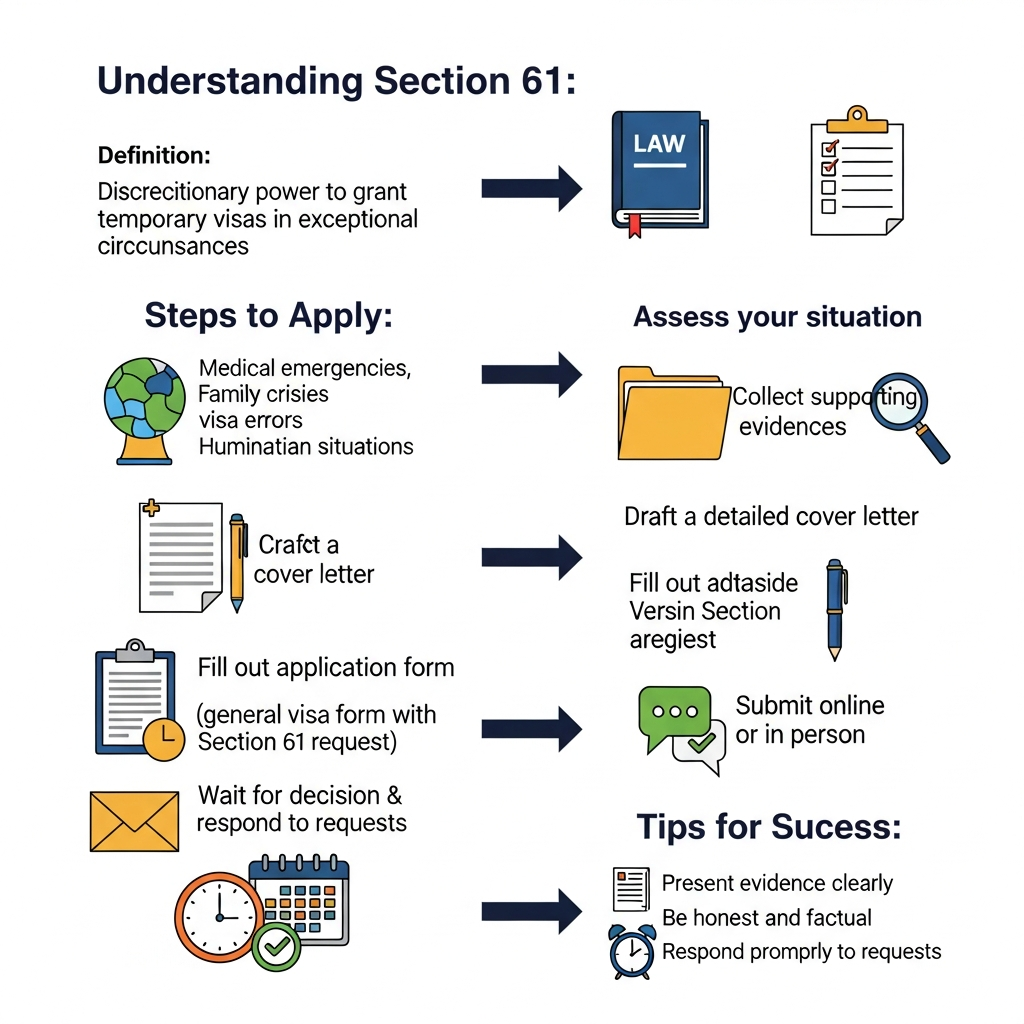
How to Apply for Section 61: A Step-by-Step Guide
Step 1: Look at your situation
Before you apply, think about whether your situation really deserves special consideration. Check out INZ’s operational guidelines and think about talking to an immigration advisor to see how likely you are to get what you want.
Step 2: Collect Proof
Applications for Section 61 that are strong have a lot of evidence. Get proof that backs up your case, like:
- Plans for treatment and medical reports
- Police reports or protection orders, if needed
- Letters from your employer or contracts of employment
- Statements from banks and records of money
- References for character
- Any other relevant documentation
Step 3: Write a long cover letter
Your cover letter is probably the most important part of your application. This is where you explain your situation, why you need a Section 61 visa, and why INZ should use its discretion to help you.
A good cover letter should:
- Clearly say that you are applying under Section 61
- Tell us what your current visa status is.
- Explain what happened that made you apply.
- Show why standard visa routes don’t work in this case.
- Show how granting the visa serves broader interests
- Talk about any worries you might have about your case
Step 4: Fill out the application form
There is no specific Section 61 application form from INZ. Instead, you usually fill out a general visitor visa application form and make it clear that you want to be considered under Section 61. Make sure all sections are completed accurately and honestly.
Step 5: Send in your application
You can usually apply online through the INZ website or in person at an INZ branch. Make sure you include all the necessary paperwork and pay the right amount.
Step 6: Wait for a Decision
Processing times vary significantly depending on the complexity of your case and INZ’s current workload. Keep in touch with INZ and answer any requests for more information right away.
Example of a Section 61 Request Letter
This is how to structure a Section 61 request letter:
In the first paragraph, write your full name, date of birth, and current visa status. Clearly say that you want to be considered under Section 61 of the Immigration Act 2009.
Background section: Tell us about your immigration history in New Zealand, such as when you got there, what visas you’ve had, and where you are now.
Circumstances section: Describe the exact events that led you to apply. Be honest, thorough, and provide dates, names, and specific events.
Evidence section: List the documents that back up your case and explain how each one does so.
Reasons section: Tell INZ why you think they should give you a Section 61 visa. Talk about humanitarian issues, unusual situations, or other strong reasons.
Final section: Restate your request and say that you are happy to give any other information that is needed.
Keep your letter professional, factual, and focused on the things that immigration officers look at when making a decision.
Time it takes to process Section 61
One of the most annoying things about Section 61 applications is not knowing how long the process will take. In contrast to regular visa applications, which have set processing times, Section 61 cases are looked at one at a time, and the times can be very different.
In simple cases with strong evidence, decisions might be made in 4 to 8 weeks. More complex cases involving significant investigation or legal considerations can take several months. Cases that need help from other government agencies or involve protection claims may take even longer.
Processing times are affected by a number of things:
Case complexity: Simple requests for visa extensions typically process faster than applications involving multiple issues.
Quality of evidence: Applications with clear evidence and good documentation move through the system faster than those that need more investigation.
INZ workload: Processing times go up when there are a lot of requests or when there aren’t enough staff members.
More questions: If INZ needs to check facts or get feedback from other agencies, there may be delays.
Keep your contact information up to date with INZ and respond quickly to any requests for information while you wait for a decision. You can contact INZ for an update if your application is taking longer than you thought it would. However, asking them a lot of times is unlikely to speed up the process.
The success rate for Section 61 INZ
Knowing the success rate of Section 61 applications can help you set realistic goals. It’s hard to give exact numbers because INZ doesn’t publish official statistics on the approval rates for Section 61.
However, immigration advisors and legal practitioners report that success rates vary significantly based on the strength of individual cases. Applications that are based on strong humanitarian reasons, strong evidence, and real exceptional circumstances are more likely to be approved than those that are based on weak or poorly documented claims.
There are a number of things that can affect your chances of success:
Strength of evidence: Applications that are backed up by credible, verifiable evidence do better than those that are based only on claims.
Immigration history: A positive immigration history with no compliance issues strengthens your application.
Nature of circumstances: Requests based on real humanitarian needs usually get more favorable treatment than requests based on convenience.
Quality of application: Well-prepared applications that clearly articulate why discretion should be exercised have better outcomes.
It’s important to remember that INZ takes Section 61 decisions seriously. Immigration officers know that these visas are not required and look at each case carefully in light of the relevant policy framework.
Understanding PPI Letters for New Zealand Immigration
You might come across the term “Potentially Prejudicial Information” (PPI) letter when you are applying for Section 61. This is a big part of how INZ makes decisions.
When immigration officers are thinking about denying your application because of information that could hurt your case, they send you a PPI letter. The letter lists this information that could be harmful and gives you a chance to respond before a final decision is made.
Getting a PPI letter doesn’t mean your application will be denied, but it does mean that there are issues that need to be fixed. If you get one, take it seriously and respond fully within the time frame given (usually 10 to 15 working days).
Your answer should:
- Directly respond to each point made in the PPI letter
- If you have more evidence, please send it.
- Clear up any confusion
- Explain things that make the situation better
- Show why the worries shouldn’t cause a drop
Many people who apply for PPI letters get help from professionals because the quality of their response can have a big effect on the final decision.
Case Studies from the Real World
Case Study 1: Medical Emergency
Sarah, a British tourist in New Zealand, had a bad accident that needed several surgeries and a long recovery period. Her visitor visa was about to run out, but her doctors told her not to travel abroad for at least six months.
Sarah applied for a Section 61 visa, providing detailed medical reports, specialist opinions, and evidence of her travel insurance coverage for medical costs. INZ gave her a six-month temporary visa, but only if she kept her health insurance up to date and left New Zealand as soon as she was medically cleared to travel.
This case shows how Section 61 can help people who are in real humanitarian situations where they can’t follow visa rules because of things that are out of their control.
Case Study 2: Violence in the Family
Maria arrived in New Zealand on a partnership-based work visa sponsored by her partner. After she got there, she was the victim of severe domestic violence, but she was afraid to go back to her home country because she didn’t have any support and was afraid of being shunned as a domestic violence survivor.
She applied for a Section 61 visa and sent in police reports, medical proof of her injuries, and letters of support from a group that helps victims of family violence. INZ gave her a temporary visa for 12 months with full work rights. This gave her time to become independent and look into longer-term visa options.
This case shows how Section 61 can help people who are in dangerous situations.
Case Study 3: Administrative Error
James sent in his application for a work visa long before his current visa ran out. His application wasn’t processed in time by INZ because of a mistake on their part, and his visa expired while it was still pending. This meant he was in New Zealand illegally, but it wasn’t his fault.
James’s boss wrote to INZ asking for Section 61 consideration, explaining the situation and how James’s inability to work would affect the business. INZ gave him a Section 61 visa to cover the time it would take to process his work visa application.
This case demonstrates how Section 61 can resolve instances where technical difficulties result in visa gaps.
Challenges and Criticisms of Section 61
While Section 61 serves an important purpose, it’s not without controversy and challenges.
Making decisions that aren’t consistent
Because Section 61 decisions are up to the immigration officer, they may come to different conclusions about similar cases. Both applicants and immigration advisors may find this perceived inconsistency frustrating.
Some people say that clearer rules would make things more consistent, while others say that discretion needs to be flexible to deal with the specific details of each case.
Delays in Processing
Because Section 61 assessments are tailored to each person, they can take a long time to process. While they wait for a decision, applicants often feel stuck and can’t make plans or move on with their lives.
No Right to Appeal
The Immigration and Protection Tribunal does not usually allow appeals of Section 61 decisions. This means that if your application is denied, you don’t have many ways to challenge it. Usually, you can only ask a court to review it on very limited grounds.
Worries about exploitation
Some people are worried that Section 61 could be abused by people who want to stay in New Zealand longer than they need to when they don’t have a real reason to do so. Because of this, people are asking for stricter enforcement of the provision.
Not much transparency
It’s hard for people who want to apply to know how likely they are to get a grant or understand how the provision works in real life because there aren’t any published statistics on Section 61 applications, approval rates, or common reasons for grants or declines.
Changes and updates that have happened recently
New Zealand’s immigration laws are always changing, and Section 61 has been changed by a number of policy changes in the last few years.
Changes to policies for 2021–2022
After the COVID-19 pandemic, INZ made specific rules about how to use Section 61 in situations related to the pandemic. This included thinking about people who couldn’t leave New Zealand because the borders were closed, flights were canceled, or they were worried about their health.
More Attention
INZ has been looking more closely at Section 61 applications in recent years, especially those that seem to be trying to get around normal visa requirements. Immigration officers now look more closely at whether applicants really do have exceptional circumstances or are just trying to stay longer.
Changes to the Operational Manual
The Operational Manual is updated regularly by INZ. This manual helps immigration officers make decisions. Recent updates have made it clearer what officers should think about when looking at Section 61 applications, such as how much weight to give different kinds of evidence and situations.
Putting technology together
INZ has made its online systems for submitting and tracking visa applications better. This includes Section 61 requests. The application process is still mostly done on paper, but better digital infrastructure has made it easier for applicants and immigration officers to talk to each other.
What you don’t know about Section 61 INZ
Fact 1: Not All Section 61 Visas Are the Same
A lot of people think that Section 61 leads to a standard temporary visa, but the conditions for these visas can be very different. Some give you the right to work, while others don’t. Some allow travel in and out of New Zealand; others require you to remain in the country. The specific conditions depend on your circumstances and the reasons for granting the visa.
Fact 2: You Can Use Section 61 Proactively
People often think of Section 61 as a last resort when something goes wrong. But if you find out about something that will keep you from following the rules of your visa, you can ask for Section 61 consideration in some cases. Sometimes, applying early can keep you from being in an illegal status.
Fact 3: Immigration History Matters Significantly
Your previous compliance with immigration instructions heavily influences Section 61 decisions. If you have broken the rules about visas, overstayed your welcome, or given false information in the past, immigration officers will be much less likely to use their discretion in your favor, even if you have strong reasons to do so now.
Fact 4: The “Public Interest” Test Is Wide
Immigration officers look at whether granting the visa is in the public interest when they look at Section 61 applications. This idea is bigger than most applicants think, and it can include things like New Zealand’s reputation around the world, its humanitarian duties, economic factors, and the well-being of children.
Fact 5: Getting professional advice has a big effect on the results.
You can apply for Section 61 on your own, but immigration advisors and lawyers say that applications that are well-prepared have a much better chance of being accepted. This is because professionals understand what evidence INZ needs, how to present your case effectively, and how to address potential concerns preemptively
What to Expect with Section 61 NZ Temporary Visas
You will get a temporary visa with certain conditions if INZ approves your Section 61 application. To keep your legal status, you need to know these conditions.
Common Visa Conditions
Duration: Section 61 visas are usually only good for a short time, like 3 to 12 months, depending on your situation. You can get extensions, but you have to apply again.
Work rights: You may or may not be able to work, depending on why the visa was given. Work rights might not be included in medical situations, but they are often included in cases of family violence.
Travel restrictions: Some Section 61 visas only let you enter New Zealand once. This means that if you leave New Zealand, you can’t come back on that visa. Some let you enter more than once. Carefully read the terms and conditions that apply to you.
Reporting requirements: If your visa was granted while certain issues were being worked out, you may need to regularly report to INZ or give them updates on your situation.
Pathway restrictions: Most of the time, Section 61 visas don’t let you live in the country. You’ll need to explore other visa options if you want to stay in New Zealand long-term.
Following the rules of your visa
Once you get a Section 61 visa, you must follow all of its rules exactly. Any violations could hurt your chances of getting a visa in the future and could even get your visa taken away.
Be sure to:
- Know all the rules that come with your visa.
- Make sure to keep copies of all your visa papers.
- Monitor your visa expiry date
- Plan what to do next well before your visa runs out.
- If you need to, keep in touch with INZ.
- If your situation changes, ask for help.
What Happens If Your Section 61 Application Is Declined?
Sadly, not every Section 61 application gets approved. If INZ turns down your application, you don’t have many choices:
Get out of New Zealand
If you are in New Zealand illegally and your Section 61 application is denied, you are usually expected to leave as soon as possible. If you stay in New Zealand without a valid visa, you could be deported and banned from getting a visa in the future
Ask for a second look
If you have new information or think there was a mistake in the assessment, you can ask INZ to look at its decision again in some cases. But just disagreeing with the decision isn’t enough to make it reconsider.
Review by the Court
If you believe INZ made a legal error in declining your application, you may be able to seek judicial review through the High Court. This is a complicated legal process that usually needs the help of a lawyer.
Look into other visa options
A visa application that was turned down under Section 61 might be approved under a different type of visa. Think about whether there is another type of visa that would work better for you.
Moving Forward: Knowing What You Can Do
Section 61 is there to make New Zealand’s immigration system more flexible, but it’s not a sure way to solve everyone’s visa problems. The provision is optional, which means that each case is looked at on its own merits and circumstances.
If you’re thinking about applying for Section 61, you should take the time to carefully look at your situation, gather strong evidence to back it up, and make your case clear and honest. A lot of the time, the strength of your application will decide if INZ will use its discretion in your favor.
Keep in mind that Section 61 is only for very special situations. If your situation doesn’t really meet this standard, it might be more realistic to look into regular visa options or accept that you need to leave New Zealand.