
What is design thinking in entrepreneurship
When starting a business, entrepreneurs have to deal with a lot of problems. The road to success can feel overwhelming, from figuring out what real customer problems are to coming up with new ways to solve them. Design thinking is a structured but creative way that changes how entrepreneurs deal with these problems, which leads to businesses that are more successful and focused on the needs of their customers.
Design thinking in entrepreneurship is a way of solving problems that puts people first. It helps business owners get to know their customers better, figure out what the problems are, and come up with new ways to solve them. Design thinking is different from traditional business methods because it starts with the people you want to help instead of the product or service.
This in-depth guide shows you how design thinking can change the way you run your business by giving you useful tips and examples that you can use right away.
A Simple Way to Understand Design Thinking
Design thinking is a process that teams use to learn about users, question their assumptions, redefine problems, and come up with new solutions. It is not a straight line. It helps entrepreneurs figure out how to build businesses that really matter to their customers.
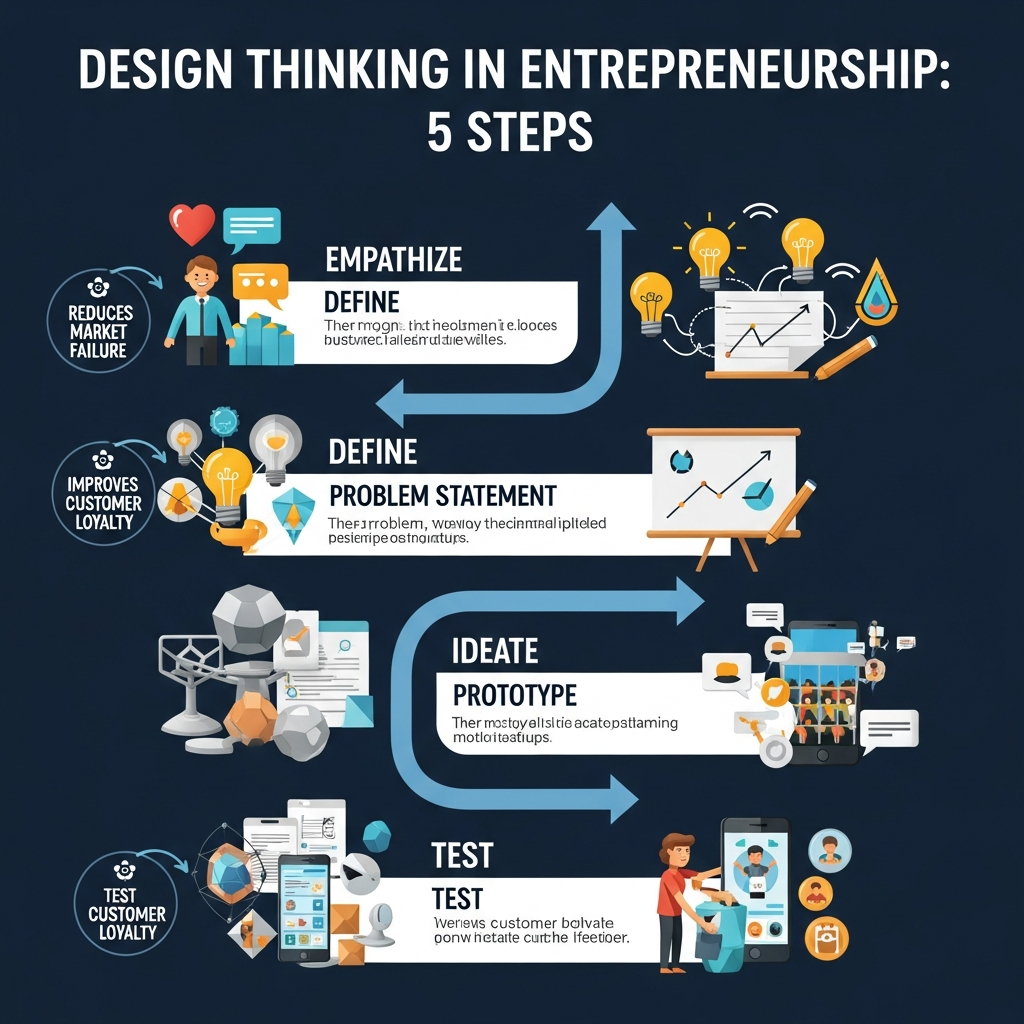
Five main steps make up the definition of design thinking entrepreneurship: Empathize, Define, Ideate, Prototype, and Test. Every stage builds on the one before it, making a complete structure for coming up with new ideas and solving problems.
Design thinking is especially useful for entrepreneurs because it stresses failing quickly and learning quickly. Design thinking encourages quick testing and feedback from real users instead of spending months or years working on a product by yourself.
Five Basic Ideas Behind Design Thinking
User-Centricity First and Foremost
Putting users at the center of every decision is the main goal of design thinking in business. Instead of asking, “What can we build?” you should always ask, “What do our customers really need?”
Accepting Uncertainty
Design thinking helps successful entrepreneurs get used to not knowing what will happen next. They know that the best answers often come from taking the time to think about problems that aren’t clear or are hard to understand.
Collaborative Innovation
Design thinking works best when there are many points of view. Entrepreneurs who follow these rules actively ask for feedback from team members, customers, and stakeholders who have different backgrounds and areas of expertise.
Learning by Doing
The method stresses learning by doing instead of making detailed plans. Before putting a lot of money into a business, entrepreneurs make prototypes, test their ideas, and get feedback.
Improvement over time
There is always more to learn about design thinking. Entrepreneurs keep improving their solutions based on new information and changing customer needs.
The Design Thinking Process in Starting a Business
Empathize: Knowing What Customers Want
At the empathize stage, business owners need to really understand what their customers are going through. This means doing interviews, watching how people act, and putting yourself in the customer’s shoes.
Successful entrepreneurs spend a lot of time figuring out not just what customers say they want, but also what they really do. This often shows differences between what people say they want and what they actually do, which opens up new ways to innovate.
Some activities that help people build empathy are:
- Talking to customers one-on-one
- Watching customers in their normal setting
- Making detailed maps of the customer journey
- Making empathy maps that show what customers think, feel, see, and do
Define: Setting up the Problem
The define stage takes all the information you’ve gathered about your customers and turns it into a clear problem statement. This is where business owners go from saying, “Here’s what we learned,” to saying, “Here’s the exact problem we’re solving.”
This is how a good problem statement should look: “[User] needs [need] because [insight].” For instance, “Busy parents need a faster way to make healthy meals because they have a hard time balancing their work and family nutrition goals.”
This shows how important design thinking is for starting a business. A lot of new businesses fail because they try to solve problems that don’t exist or aren’t big enough to need a solution. The define stage stops this expensive mistake.
Ideate: Coming up with answers
Entrepreneurs can start coming up with ideas for how to solve the problem once they know what it is. The ideate stage lets people come up with crazy ideas and puts off making decisions so that creative solutions can come up.
Some good ways to come up with ideas are:
- Brainstorming sessions like they used to be
- “How might we” questions for mind mapping
- Using other people’s ideas
- Thinking about the worst-case scenarios
The goal isn’t to find the perfect solution immediately, but to generate a wide range of possibilities that can be evaluated and refined.
Prototype: Building to Learn
Prototyping turns ideas that are hard to understand into real things. This stage is very important for entrepreneurs because it makes ideas real and possible to test without spending a lot of money.
There are many different types of prototypes:
- Drawings of app interfaces on paper
- Acting out customer service situations
- Simple landing pages to see if people want them
- Real-life models of products
- Storyboards that show how users interact with things
The most important thing is to make something that lets you test certain ideas about your solution with real people
Test: Checking Your Assumptions
At the test stage, prototypes are shown to possible customers to get their thoughts. It’s not about proving you’re right; it’s about figuring out what works and what doesn’t.
Testing that works includes:
- Observing how users interact with your prototype
- Asking specific questions about their experience
- Finding places where there is confusion or tension
- Collecting ideas for how to make things better
- Finding out how well people are doing or what they are doing
Testing often shows that your first ideas were wrong, which leads to changes that better meet the needs of customers.
Design thinking in business: Digital Payment Solutions in the Real World
Think about how payment apps have changed the way people handle money. Instead of starting with technology, successful companies began by understanding the frustration people felt with traditional banking and cash transactions. They watched how people really used money, found problems like long lines at the bank and lost cash, and then came up with fixes for those problems.
Services for delivering food
Design thinking is at work in the food delivery business. Entrepreneurs didn’t just make apps because they could. They looked at busy professionals, parents, and students to learn when, why, and how they wanted food delivered. Because they knew their customers so well, they were able to add features like real-time tracking, dietary filters, and group ordering.
Designing products that are good for the environment
Many eco-friendly startups use design thinking to balance environmental concerns with user convenience. These companies make products that are both eco-friendly and easy to use by putting themselves in the shoes of customers who want to be environmentally responsible but find it hard to switch to green options.
How Design Thinking Helps with Innovation
Less Chance of Market Failure
Entrepreneurs lower the risk of making things that no one wants by testing their ideas early and often. Design thinking helps you find and fix problems before they cost you a lot of money.
More loyal customers
Products and services made with design thinking tend to connect with users on a deeper level because they solve real problems and meet real needs.
Better team alignment
Design thinking is collaborative, so everyone on the team knows what the customer wants and what the business goals are. This makes product development more cohesive.
Quicker time to market
Design thinking has many steps, but the iterative approach often gets products to market faster because big problems are found and fixed early on.
More room for new ideas
Focusing on looking into different options and questioning assumptions leads to more unique and creative products and services.
Who Can Use Design Thinking?
Design thinking can be used in any field or type of business. These rules can be used by any business owner, whether they are
- Starting a tech business
- Starting a service business in your area
- Creating physical products
- Starting a non-profit group
- Opening a consulting business
The method changes to fit different situations, but its main goal is still to understand and meet people’s needs.
How to Use Design Thinking in Your Business Journey
Start small and grow
Instead of trying to redesign everything at once, start by using design thinking on one part of your business. This might be improving your onboarding process or developing a new feature.
Make Empathy a Part of Your Daily Life
Make it a point to talk to customers on a regular basis. Even as your business grows, make time each week to talk to customers directly.
Write down what you’ve learned
Write down all of your ideas, assumptions, and test results in great detail. This documentation is useful as you work on your project and helps you avoid making the same mistakes again.
Accept failure as a chance to learn
To do design thinking, you need to change the way you think so that failure is seen as useful information instead of a setback. Every prototype or test that doesn’t work gives you information that helps you make the next one better.
Changing Your Business with Design That Puts People First
Design thinking in business is more than just a way of doing things; it’s a big change in how businesses are built to meet people’s needs. Entrepreneurs come up with solutions that customers not only want but love by following the empathize-define-ideate-prototype-test process.
Design thinking helps innovation in more ways than just making new products or services. This approach builds organizational capabilities that help businesses adapt to changing market conditions and customer needs over time.
To be successful with design thinking, you need to be patient, curious, and really want to understand your customers. It’s not about having brilliant insights in isolation, but about systematically discovering what matters most to the people you serve.
Whether you’re just starting your entrepreneurial journey or looking to revitalize an existing business, design thinking provides a proven framework for creating meaningful solutions that drive both customer satisfaction and business success.


![How to Start an Ecommerce Business in NZ [2025 Guide]](https://businesskiwi.com/wp-content/uploads/2025/11/How-to-Start-an-Ecommerce-Business-in-NZ-644-300x200.png)