Crypto and digital assets in NZ: what regulations should you know, and is it worth it?

Cryptoassets and other digital assets have moved from the fringes of the financial system into mainstream discussion, including in New Zealand. Bitcoin, Ethereum, and similar assets are now widely known, yet their legal status, tax treatment, and practical risks remain poorly understood. For many people, interest in crypto is driven less by technology and more by uncertainty about where these assets sit within existing financial and regulatory frameworks.
This article explains how crypto and digital assets are currently treated in New Zealand, focusing on regulation, compliance obligations, and the risks that tend to be underestimated. It does not assess potential returns or suitability. Instead, it outlines how the system works in practice, and where uncertainty remains.
What counts as a crypto or digital asset in New Zealand
Cryptocurrencies are a subset of digital assets that rely on decentralised ledger technology, commonly referred to as blockchain. Unlike the New Zealand dollar, they are not issued by a central bank and do not represent legal tender. Ownership is recorded digitally, and transactions are validated through distributed networks rather than through traditional financial intermediaries.
In New Zealand regulatory discussions, the term digital assets is broader than cryptocurrency alone. It can include:
- cryptocurrencies such as Bitcoin and Ethereum
- tokens linked to platforms or services
- other blockchain-based representations of value
The key point is that these assets are treated as property, not currency, under current New Zealand settings.
Legal status: permitted, but not money
Cryptoassets are legal to buy, sell, and hold in New Zealand. However, they are not recognised as official currency, and businesses are not required to accept them as payment.
The Reserve Bank of New Zealand has consistently signalled that cryptoassets do not meet the core functions of money in a stable or reliable way. While the sector is monitored, it operates largely within existing financial and consumer law rather than under a standalone crypto regime.
This distinction matters because it affects how crypto interacts with contracts, payments, and consumer protections.
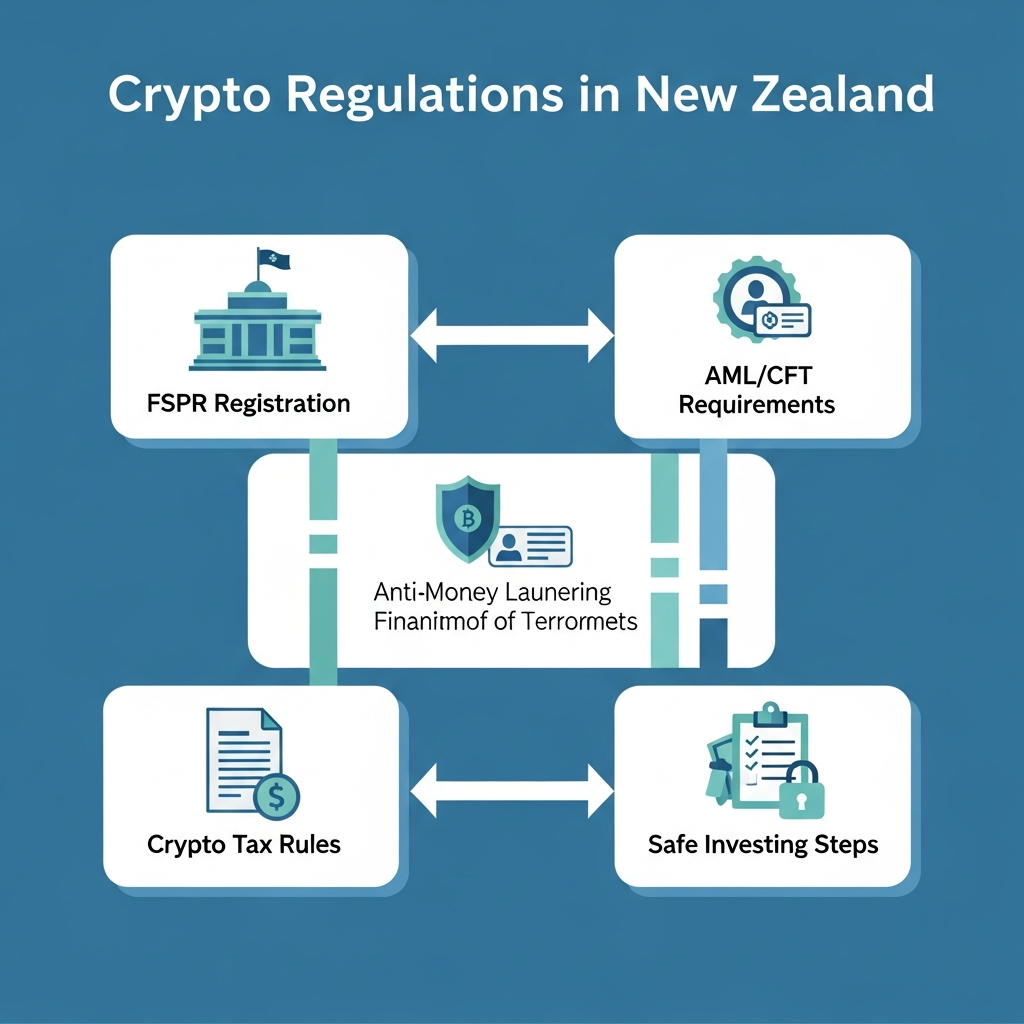
The regulatory framework that applies in practice
New Zealand does not have a single, dedicated “cryptocurrency law”. Instead, crypto activity is captured through a patchwork of existing regulation.
Financial markets oversight
The Financial Markets Authority oversees conduct in financial markets. While cryptoassets themselves are not automatically classified as financial products, crypto-related services can still fall under the FMA’s remit depending on how they are structured and promoted.
This creates a compliance environment that is functional but not always clear-cut.
Financial Service Providers Register (FSPR)
Crypto exchanges and platforms operating from or in New Zealand are generally required to be listed on the Financial Service Providers Register (FSPR). Registration signals that a business is known to regulators, but it is not an endorsement of financial soundness or consumer suitability.
In practice, FSPR registration is a baseline compliance requirement, not a quality guarantee.
Anti-Money Laundering and identity checks
Crypto service providers are subject to the Anti-Money Laundering and Countering Financing of Terrorism (AML/CFT) Act. This means:
- customer identity must be verified
- transactions are monitored
- suspicious activity may be reported
For users, this typically involves providing identification and personal information when using exchanges. While crypto is often described as anonymous, most regulated activity in New Zealand is not.
Tax treatment: where most mistakes occur
Tax treatment is one of the most significant areas of misunderstanding.
The Inland Revenue Department treats cryptocurrency as property, not as money. As a result, tax outcomes depend heavily on intent and behaviour rather than on labels.
In broad terms:
- Profits from selling, trading, or exchanging cryptoassets may be taxable
- Frequent trading activity may be treated as income-generating activity
- Mining and staking rewards may be taxable when received
What matters most in practice is record-keeping. Each transaction can create a tax event, and values are assessed in New Zealand dollars at the time of the transaction. Poor records are a common source of compliance risk.
Official guidance on crypto tax treatment is published by Inland Revenue and should be treated as the authoritative reference point, particularly as interpretations continue to evolve.
Business and operational exposure
From a business perspective, cryptoassets introduce complexity that is often underestimated.
Accounting and valuation
Crypto values can change rapidly, making balance-sheet treatment and income recognition challenging. Valuation timing alone can materially affect reported results.
Custody and access risk
Control of cryptoassets depends on access credentials. Loss of keys, platform failures, or service outages can result in permanent loss, with limited recourse.
Banking and counterparties
Some businesses report friction when dealing with banks, insurers, or payment providers if crypto exposure is involved. This can affect cash-flow management and operational continuity.
These risks exist regardless of market direction.
Volatility and uncertainty as structural features
Crypto markets are structurally volatile. Price movements can be driven by factors that sit outside traditional economic signals, including sentiment, technological changes, regulatory announcements, and platform-specific events.
In addition, the regulatory environment remains unsettled. Future changes in classification, disclosure requirements, or tax treatment could materially affect how crypto assets are treated in New Zealand. This uncertainty is not an anomaly; it is a defining characteristic of the sector.
Consumer protection and neutral information
Because cryptoassets sit outside traditional banking protections, consumer recourse is limited. Losses resulting from platform failure, fraud, or user error may not be recoverable.
For neutral, non-commercial information about financial rights and obligations, New Zealanders can refer to MoneyTalks, a government-supported financial capability service.
This type of guidance focuses on understanding risk and rights rather than promoting participation.
Why “is it worth it?” is the wrong question
Whether crypto is “worth it” depends on variables that are unpredictable and highly individual. From a publishing and regulatory perspective, the more relevant questions are:
- how cryptoassets are treated under New Zealand law
- what obligations apply
- where risks are concentrated
- how quickly rules and interpretations can change
Understanding those factors tends to be more valuable than attempting to assess potential outcomes.
Bringing the picture together
Crypto and digital assets occupy an uncertain space in New Zealand’s financial landscape. They are permitted, but not money. They are regulated, but not comprehensively. They are taxed, but often misunderstood. Above all, they introduce layers of volatility, compliance responsibility, and operational risk that differ markedly from traditional financial assets.
For New Zealand businesses and individuals, the most important consideration is not enthusiasm or scepticism, but clarity about how these assets interact with existing legal, tax, and financial systems. That clarity matters regardless of market conditions.