
Making AI’s potential work for marketing
The marketing world is changing quickly because of artificial intelligence. AI-powered tools promise to make things more personal than ever before, automate boring tasks, and give you deep insights into your customers. But a lot of marketers are finding that having a powerful AI tool doesn’t always mean getting better results. The real problem is figuring out how to turn AI’s huge potential into real, measurable business results.
This guide goes into great detail about how to use AI in your marketing in a smart way. We’ll explore how to move beyond the hype and use AI to create real value, drive growth, and gain a sustainable competitive advantage. You can make AI work for you in your next big marketing campaign if you know how to manage, integrate, and measure it correctly.
Knowing what AI does in modern marketing
The main idea behind AI in marketing is to use data and algorithms to make automated decisions that boost customer engagement and return on investment. This can mean anything from simple automation to complicated predictive modeling. Today, four of the most common ways that businesses use AI are to create content, personalize it, do predictive analytics, and automate customer service.
When integrated effectively, these applications offer significant benefits. AI can look at huge amounts of data to give each customer a unique experience on a large scale, which a human team could never do. It can take care of tasks that are done over and over again, like sending out email campaigns and posting on social media. This gives your team more time to think of new ideas and come up with strategies.
But it’s also important to know what the limits are. The data that AI tools are given is what makes them work. Bad data will lead to wrong conclusions and bad campaigns. Also, AI is great at optimization and analysis, but it doesn’t have real human creativity or emotional intuition. The best marketing strategies use AI to help people, not replace them.
How to Use AI Effectively
Buying an AI tool isn’t a plan. You need a clear plan for how to implement it that focuses on data, integration, and getting everyone on the same page in order to see real results.
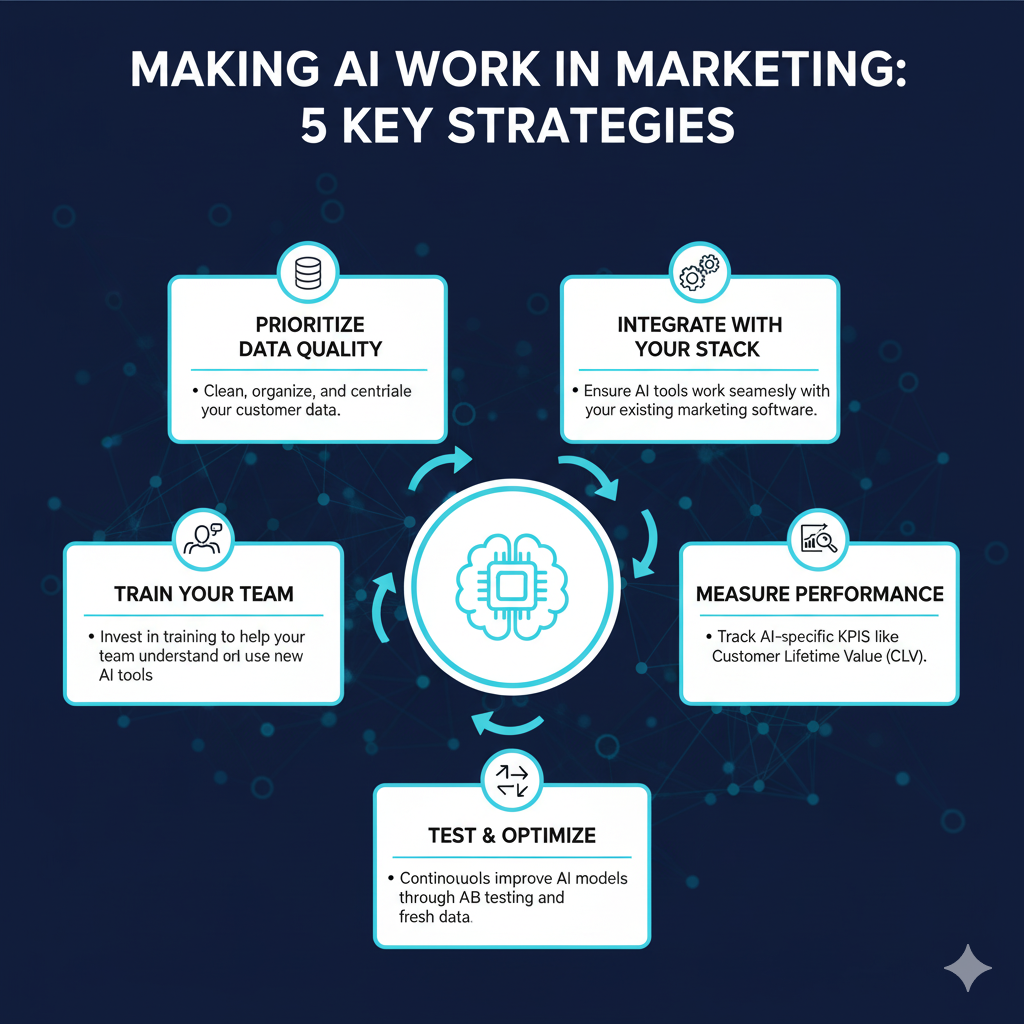
Put first Quality and Management of Data
For any AI project to work, it needs high-quality data. You need to make sure your data is clean, accurate, and well-organized before you can use AI for personalization or predictive analytics.
- Do a Data Audit: To begin, look at the data sources you already have. Find out where customer information is kept (CRM, analytics platforms, email lists) and check to see if it is complete and consistent.
- Set up a “Single Source of Truth”: To get a complete picture of each customer, put all of your data into one place, like a Customer Data Platform (CDP). This keeps data from being stored in separate places and makes sure that your AI models can get to all the information they need.
- Put Data Governance into action: Set clear rules for how data is gathered, kept, and used. This makes sure that data quality stays high and helps companies follow privacy laws like the CCPA and GDPR.
Add AI to the marketing tools you already have.
AI shouldn’t work alone. To get the most out of it, make sure it works well with the marketing tools and processes you already use.
- Find places where things can work together: Find out where AI can make your current systems better. For instance, is it possible for an AI tool to work with your email marketing platform to send messages that are tailored to each user’s actions? Can it connect to your CRM to help you score leads better?
- Pick Tools with Strong APIs: When choosing an AI vendor, look for platforms that have Application Programming Interfaces (APIs) that can be changed. This will help you link the AI tool to the other marketing software you use.
- Teach Your Team: Without skilled people to use it, technology is useless. Put money into teaching your team how to use the new AI tools and understand what they do. Foster a culture of experimentation where employees are encouraged to explore new ways to leverage AI.
How to Measure and Improve AI Performance
You need to show how AI will affect your bottom line in order to justify your investment. To do this, you need to set the right key performance indicators (KPIs) and promise to keep getting better all the time.
Important Performance Indicators for AI Success
Traditional marketing KPIs like conversion rates and website traffic are still useful, but AI-specific metrics can give you a better idea of how well it is working.
- Customer Lifetime Value (CLV): Personalization and retention efforts powered by AI should lead to a measurable rise in CLV.
- Marketing Attribution: Use AI-powered attribution models to find out more accurately which touchpoints are leading to conversions.
- How Accurate the Lead Score Is: If you’re using AI to score leads, keep track of how many of those leads end up becoming customers.
- Campaign Return on Investment: Find out how much more money you make from AI-driven campaigns than from your usual ones.
A/B Testing and Making Things Better All the Time
Your AI models need to change as the marketing landscape does. One of the best ways to improve the performance of your AI algorithms is to use A/B testing.
- Test AI-Powered Suggestions: You could, for instance, A/B test the product recommendations made by your AI against a control group to see if they result in more sales.
- Try out personalization: Try out different levels of personalization in your email campaigns or on your website to see what works best.
- Improve Predictive Models: Keep adding new data to your predictive models and check how accurate they are over time. This makes sure that your predictions stay accurate as the market changes.
Unlock the full potential of your marketing
To get real marketing results from AI, you need more than just cutting-edge technology. It needs a strategic plan based on accurate data, smooth integration, and strict measurement. You can make your campaigns more effective, build stronger relationships with customers, and drive long-term growth by seeing AI as a powerful tool that adds to your team’s knowledge.
Getting to AI-powered marketing is a long process, not a short one. It starts with small, focused projects that show value and then grows from there. If you follow the advice in this post, you can build a strong base for success and make sure your business is ready for the future of marketing.