What is immigration relief and how does it work?
It can be very hard to understand the U.S. immigration system, especially for people who are facing deportation or looking for a safe place to stay. For a lot of people and families, the phrase “immigration relief” is a sign of hope. It refers to a variety of legal protections that allow noncitizens to remain in the United States, either temporarily or permanently, when they might otherwise be required to leave.
The first step to making sure you have a stable future in the U.S. is to learn about these options. There isn’t just one way to get immigration relief; there are many different programs, each with its own rules for who can apply and how to do so. You may be able to get help if you are fleeing persecution, have lived in the U.S. for a long time, or have been the victim of a crime.
This guide goes into great detail about what immigration relief is, looking at the most common types and what you need to do to get them. We will go over the application process, talk about the pros and cons, and give real-life examples to show how these protections work. By the end, you will have a better idea of the immigration relief options that are out there and how to use them.
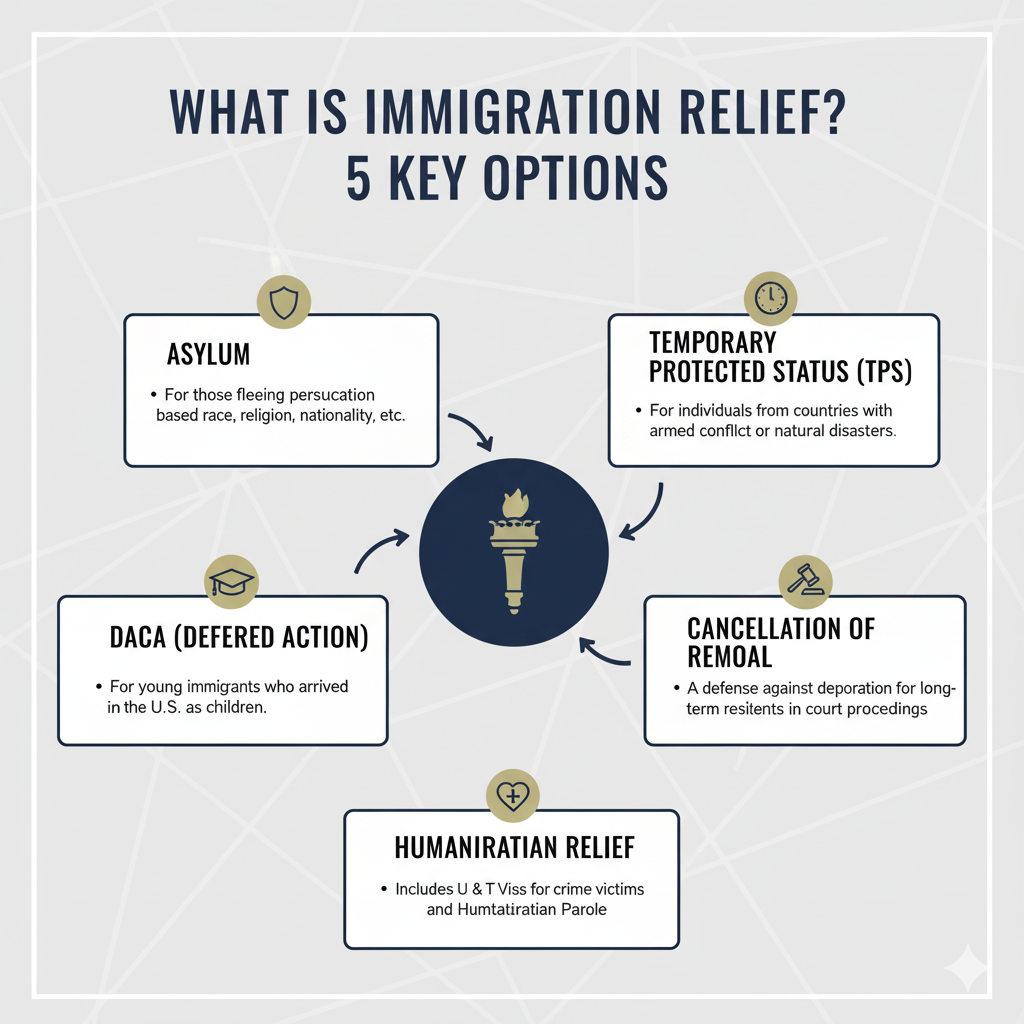
What Are the Main Types of Immigration Relief?
Under U.S. law, there are different types of immigration relief. Each program is meant to help with a certain situation, like a humanitarian crisis or a long-term stay. Here are some of the most important choices.
Refuge
Asylum is a type of protection given to people who can’t or won’t go back to their home country because they are being persecuted or have a good reason to be afraid of being persecuted. This persecution must be based on one of five protected grounds:
- Race, religion, and nationality
- Being a part of a certain social group
- Political viewpoint
Most of the time, you have to be in the US and file your application for asylum within a year of arriving. However, there are some exceptions to this rule. If you get asylum, you can stay in the U.S., apply for work authorization, and then apply for a Green Card (legal permanent residence).
Temporary Protected Status (TPS)
The Secretary of Homeland Security has designated certain countries (or parts of countries) as having Temporary Protected Status (TPS), which is a temporary immigration status for people from those countries. A country may be given TPS because of ongoing armed conflict, environmental disasters, or other unusual and temporary situations that make it unsafe for its citizens to come back.
TPS lets people live and work in the United States for a short time. If the unsafe conditions continue, the time can be extended. Please keep in mind that TPS does not automatically lead to a Green Card. However, it does give you a safe place to live and a legal job.
DACA stands for Deferred Action for Childhood Arrivals.
Deferred Action for Childhood Arrivals (DACA) is a program that keeps young immigrants who came to the U.S. as kids safe. DACA doesn’t give you legal status, but it does give you a temporary break from deportation and the chance to get a work permit. DACA recipients, often called “Dreamers,” can renew their status, allowing them to continue working and living in the US.
To be eligible, applicants must meet a number of requirements, such as their age when they entered the U.S., their continuous residency, and their educational or military service requirements. There have been legal challenges to the program’s future, so it’s important for both applicants and recipients to stay up to date on DACA news.
Removal Cancellation
Certain noncitizens who are going through removal (deportation) proceedings in front of an immigration judge can get Cancellation of Removal as a form of relief. It is a discretionary form of relief, which means that the judge will decide whether or not to give it based on the facts of the case. There are two main kinds:
- For people who have Lawful Permanent Resident (LPR) status: If an LPR has had a Green Card for at least five years, lived in the U.S. for at least seven years after being admitted in any status, and has not been convicted of an aggravated felony, they may be eligible.
- For people who don’t live here permanently: A non-LPR may be eligible if they have been physically present in the U.S. for a continuous period of at least 10 years, have been a person of good moral character, and can show that their removal would cause “exceptional and extremely unusual hardship” to a qualifying U.S. citizen or LPR spouse, parent, or child.
If you successfully get your removal canceled, the removal process will end and you will get a Green Card.
Choices for Humanitarian Relief
In addition to these common types, some programs help with urgent humanitarian needs.
Visas T and U for people who have been victims of crime
Some people who are victims of certain crimes may be able to get special visas that help them with immigration.
- T Visas are specifically for victims of severe forms of human trafficking. Victims must show that they have followed reasonable requests from law enforcement during the investigation or prosecution of the trafficking crime in order to be eligible for this type of immigration relief. The Department of Homeland Security (DHS) is the main agency that can give “Continued Presence” to trafficking victims. This is a temporary immigration status that lets them stay in the U.S. and help with the investigation.
- U Visas are for people who have been victims of certain crimes and have been physically or mentally abused a lot. They must also be willing to help law enforcement or government officials.
Both visas give you temporary legal status, the right to work, and a possible way to get a Green Card.
Humanitarian Parole
Humanitarian parole allows an individual who may be otherwise inadmissible to enter the U.S. Temporarily for urgent humanitarian reasons or for the benefit of the public. Getting urgent medical care, visiting a sick relative who is about to die, or getting away from danger are all examples of urgent humanitarian reasons. Humanitarian parole is given on a case-by-case basis and does not give you permanent immigration status. It’s important to keep up with the news about humanitarian parole because policies can change based on what happens around the world.
Who can apply and how to do so: A Step-by-Step Guide
There are different requirements and application processes for each type of immigration relief. This is a general overview, but it’s important to check the official USCIS website or talk to an immigration expert for more information.
Step 1: Find out if you are eligible
First, read the requirements for the specific help you want very carefully. This often includes:
- Residency and Presence: A lot of types of relief require you to be physically present in the U.S. for a certain amount of time.
- All applicants go through security and background checks. Most types of help are not available to people with a criminal record.
- Specific Situations: You have to meet certain requirements for the program, like being afraid of being persecuted for asylum or coming from a TPS-designated country.
Step 2: Get the Papers You Need
A strong application starts with good documentation. You will need to give a lot of proof to back up your claim. This could include:
- Passports, birth certificates, and national identity cards are all examples of identity documents.
- I-94 records, rental agreements, utility bills, and employment records are all proof of entry and residence.
- Evidence for Your Claim: For asylum, this could be news stories about your home country or statements from people who saw what happened. For cancellation of removal, it might be letters of support, tax records, and medical records showing hardship.
- Required Forms: Every application needs to be filled out correctly on the right USCIS forms. Form I-589 is used by people seeking asylum, and Form I-821 is used by people applying for TPS.
Step 3: Submit Your Application
You will send the application to USCIS or, if you are in removal proceedings, to the immigration court once you have filled out the forms and gathered all your documents. Be very careful about deadlines and fees for filing. Some applications let people who can’t pay the fee get it for free.
Step 4: Go to interviews and appointments
You might have to go to a biometrics appointment after you file to give your fingerprints and a picture. Most people who apply will also have to talk to an immigration officer or go to a hearing with an immigration judge. This is your chance to talk about your case in person and answer any questions.
Pros and Cons of Immigration Relief
Getting immigration relief can change your life, but you should know what it can and can’t do for you.
Pros:
- Protection from Deportation: The most important benefit is that you can stay in the U.S. legally.
- Work Authorization: If you get most types of relief, you can apply for an Employment Authorization Document (EAD), which lets you work legally.
- Access to Services: You may be able to get some public benefits, like a driver’s license or in-state tuition, depending on the type of relief you get and where you live.
- Some types of relief, like asylum and cancellation of removal, can lead directly to a Green Card.
Limitations:
- Temporary Status: TPS and DACA are two examples of temporary relief that do not lead directly to permanent residency. Their renewal depends on government policy.
- Limitations on travel: Travel outside the U.S. may be restricted. You often need to apply for advance parole before leaving, and re-entry is not always guaranteed.
- No Guarantee of Success: The application process can take a long time and be hard, and there is no guarantee that it will go well.
Real-Life Stories of Immigration Relief
The effects of immigration relief are most comprehensively understood through the narratives of individuals who have experienced the process.
- Case Study 1: The Journey of an Asylum Seeker
Maria, a journalist from a country with strict government censorship, fled to the U.S. after being threatened for writing about political corruption. She applied for asylum within a year of arriving, giving proof of the threats and articles that showed how dangerous it is for journalists in her home country. An asylum officer believed her fear of persecution after a stressful interview in which she talked about what had happened to her. Maria was given asylum, and now she works for a U.S. news organization where she can write without fear. - Case Study 2: A Family Saved by the Cancellation of Removal
Carlos had been in the U.S. for 15 years without being checked. He was married to a U.S. citizen and had two young children, one of whom had a serious medical condition that needed special care. Carlos’s lawyer asked for the removal to be canceled when he was put in removal proceedings. They showed a lot of proof that he had lived there for a long time, had good morals, and that his family would face “exceptional and extremely unusual hardship” if he were deported. The judge agreed, canceled the case, and Carlos is now a legal permanent resident.
Understanding the Legal System
The immigration system is known for being very complicated, and the laws are always changing. There is no official law called the “immigration forgiveness act,” and false information can spread quickly. Because the stakes are so high, it is highly recommended that you get professional legal help. An immigration lawyer with a lot of experience can help you:
- Find out all the possible types of immigration help that you might be able to get.
- Use the right evidence to make a strong case.
- Follow the rules and meet the deadlines.
- Be your lawyer in court and in interviews.
It is very important to know what will happen if you decide to stop an immigration process that you have already started. If you withdraw your application, it could make it harder for you to apply for other benefits in the future. Consulting an expert before you decide whether you can stop the immigration process is essential.
Your Next Steps
Anyone who wants to make a life in the United States needs to know about the different types of immigration relief. These legal protections give thousands of people hope and stability every year. They include asylum, TPS, DACA, and cancellation of removal. Knowing your options gives you the power to shape your future, even though the journey may be hard.
You are not alone if you are looking into immigration relief for yourself or someone you care about. The process is complicated, but if you get the right help and plan ahead, you can get a good result.