How much is business tax in nz

When you’re trying to grow your business, figuring out New Zealand’s business taxes can feel like a complicated puzzle. You might be asking yourself, “How much tax will my business really have to pay?” There isn’t just one number that answers the question. It depends on how your business is set up, how much money you make, and what kinds of transactions you do.
It’s not just the law that says you have to know your tax obligations; it’s also a key part of your financial plan. Getting it right helps you avoid expensive fines, keep your cash flow under control, and plan for growth that will last. This guide is meant to make the New Zealand business tax system easier to understand by dividing it into clear, manageable parts. We’ll talk about everything from different types of businesses and important taxes to deductions you can claim and smart ways to plan your taxes. This article will help you better understand how business taxes work in New Zealand and give you more confidence in handling your money.
Knowing what taxes you have to pay for different types of businesses
Your business structure has a direct effect on how much tax you pay and how you pay it. There are different rules, rates, and compliance requirements for each setup. Let’s look at the most common types of buildings in New Zealand.
Sole Trader
You are the business when you are a sole trader. You and your business operations are not legally separate.
- How Taxes Work: You pay income tax on the money your business makes as part of your own income. You will need to file an individual income tax return (IR3) that includes your business’s income and expenses..
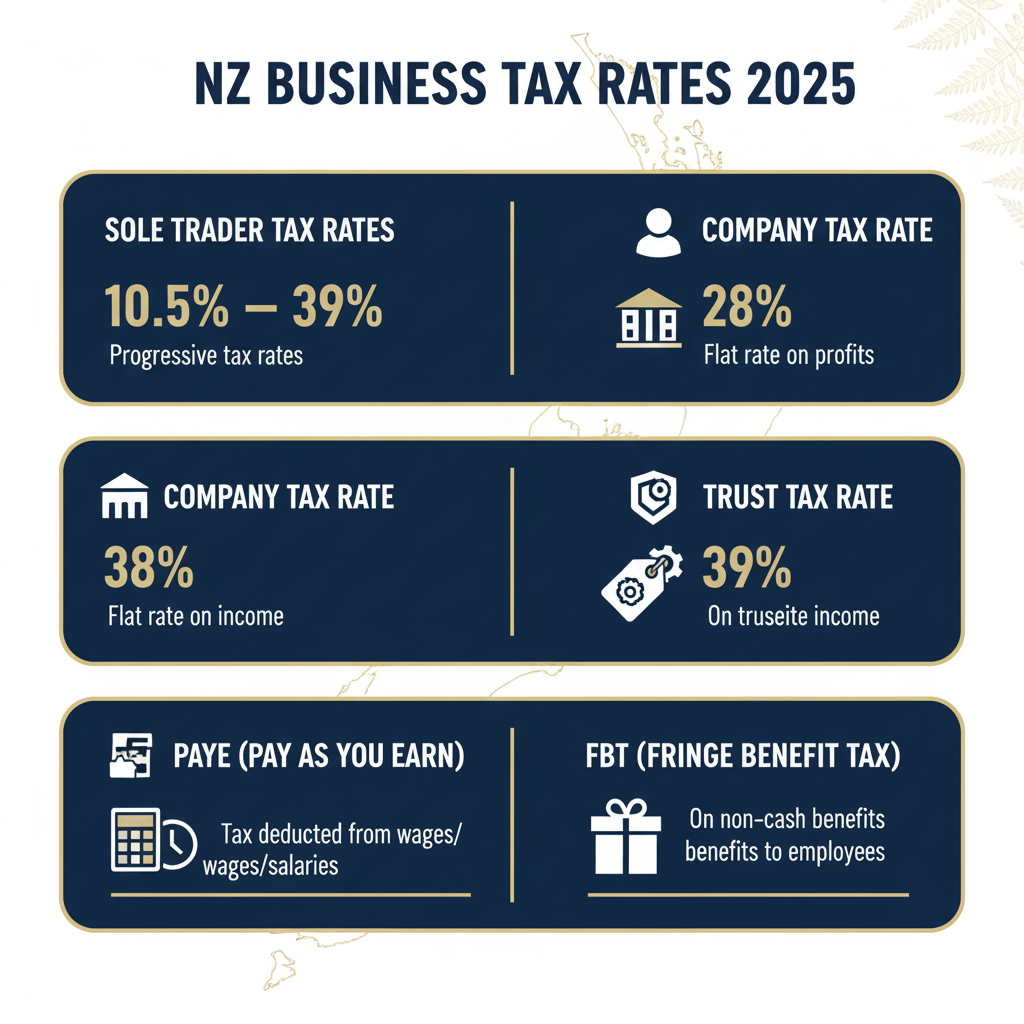
- Tax Rate: Your business’s profits are taxed at the highest rate you pay on your own income. The tax rates for sole traders and individuals are the same from 1 April 2025:
- As much as $15,600: 10.5% for $15,601 to $53,500: 17.5%: $53,501 to $78,100 30%
- 33% of people make between $78,101 and $180,000.
- 39% of people make more than $180,000.
- Important Things to Think About: You are responsible for paying off all of your business’s debts. From a tax point of view, this is the easiest structure to set up and run.
Partnership
A partnership is when two or more people (or businesses) work together to run a business. The partnership doesn’t have to pay income tax, but it does have to file a tax return.
- Tax Treatment: The partnership files an IR7 return to tell the IRS about its income and expenses. After that, the partners split the profit (or loss) according to the terms of their partnership agreement.
- Tax Rate: Each partner pays tax on their share of the profit at their own marginal tax rate, just like a sole trader.
- Important Things to Think About: Partners are typically jointly liable for business debts. A clear partnership agreement is very important for setting up how profits will be shared and who will be responsible for what.
Business
A business is a separate legal entity from the people who own it (the shareholders). This is a common way for businesses to grow and protect their owners from personal liability.
- Tax Treatment: The business pays taxes on its profits directly. It sends in an IR4 form for its company income tax.
- Tax Rate: The flat tax rate for businesses in New Zealand is 28%. This rate is for all of the company’s profits. The NZ company tax rate has changed in the past, but it has been steady at 28% for a few years now.
- Important Things to Think About: Shareholders may have to pay more taxes when the company gives them dividends as a way to share profits. Companies have more complicated reporting and compliance duties than sole proprietors or partnerships.
Trust
A trust is a legal agreement in which a person or company (the trustee) holds and manages assets for the benefit of other people (the beneficiaries).
- Tax Treatment: A trust sends in an IR6 return. The beneficiaries pay taxes on the income they receive at their own marginal rates. The trustee tax rate applies to any income that the trust keeps.
- Tax Rate: The trustee tax rate is 39%, which is higher than the previous rate of 33% (this went into effect on April 1, 2024). For deceased estates and disabled beneficiary trusts, there are some exceptions.
- Important Things to Know: Trusts can be hard to set up and run, but they give you a lot of options for protecting your assets and distributing your income.
A full breakdown of the most important business taxes
Businesses in New Zealand may have to register for and pay more than just income tax.
Income Tax
This is the main tax on the money your business makes. As was said above, the rate and way to file depend on how your business is set up. You usually pay provisional tax in installments throughout the year, which are like down payments on the tax bill you expect to get at the end of the year. This helps keep cash flow steady and keeps you from having to make a big payment all at once.
The Goods and Services Tax (GST)
Most goods and services sold in New Zealand are subject to a 15% GST.
- Who has to sign up? If your business made more than $60,000 in the last 12 months or you think it will make more than $60,000 in the next 12 months, you need to register for GST. You can still choose to register even if your sales are below this level.
- How does it work? If your business is registered for GST, you charge GST on your sales (output tax) and can get back the GST you pay on your business costs (input tax). You send in a GST return every one, two or six months and pay the difference between your output and input tax to the Inland Revenue Department (IRD). The IRD will give you back the difference if you’ve paid more GST than you’ve collected.
Pay As You Go (PAYE)
If you have workers, you have to take PAYE out of their pay. This is basically the employee’s income tax, which you collect for the IRD.
- How does it work? You figure out how much tax to take out of an employee’s pay based on their tax code and how much they make. You then file a return and pay the IRD the amount that was taken out of your paycheck every month. Other deductions that come out of PAYE include ACC levies, KiwiSaver contributions, and payments on student loans.
- How to Use a Business Tax Calculator: Tools like the IRD’s PAYE calculators can help you figure out the correct deductions for your employees, simplifying your payroll process.
Tax on fringe benefits (FBT)
FBT is a tax on some extra benefits you give to employees on top of their salary or wages. Think of it as a tax on the job’s “perks.”
- Some common fringe benefits are:
- Company cars are available for personal use.
- Loans with low interest rates.
- Goods or services that are paid for by the government.
- Payments made to an employee’s health insurance.
- How does it work? The employer pays FBT, not the employee. You file FBT returns every three or twelve months. If you give fringe benefits, it’s usually a good idea to get professional help because the rates and ways to figure them out can be hard to understand.
Tax Rate for Māori Authority
There is a special tax system for Māori authorities. Their income tax rate is 17.5%. When they give money to their members, the members may have to pay more taxes depending on their own situation.
Expenses and tax deductions that are allowed
Claiming all of your legitimate business expenses is one of the best ways to keep your tax bill low. If you have to pay for something in order to make money for your business, you can deduct it.
Expenses that can be deducted:
- Cost of Goods Sold: The direct costs of producing the goods your business sells.
- Costs of running the business:
- Rent for the space where you run your business.
- The total amount of money that employees make, before taxes.
- Utilities like the internet and electricity.
- Stationery and office supplies.
- Costs for advertising and marketing.
- Costs of owning a car: You can write off the costs of using a car for work. You will need to keep a logbook to keep track of when you use the car for business and when you use it for personal reasons.
- Costs of the Home Office: You can claim some of your household costs, like rent, mortgage interest, rates, and power, if you work from home. The amount you can claim depends on how much of your home you use for business.
- Depreciation: You can deduct the amount that your assets lose value each year. This is true for things like computers and machinery.
It is not up for debate that you must keep very detailed records, such as receipts, invoices, and bank statements. You can’t say you’ve spent money without proof.
Ways for Businesses to Plan Their Taxes
Planning your taxes well means being proactive, not reactive. It means making smart choices all year long to handle your taxes legally and effectively.
- Pick the Right Business Structure: Your original structure may not be the best for taxes anymore as your business grows. Check to see if a sole proprietorship, partnership, or company is still the best choice.
- Take care of provisional tax: Choose the provisional tax method that works best for your business’s cash flow: the standard method, the estimation method, or the ratio method.
- Time Your Income and Spending: If you can, you might want to wait to send out invoices so that you can push income into the next tax year, or you might want to move planned expenses up to this year to get more deductions.
- Maximise Deductions: Keep up with what you can claim. Don’t miss out on money by ignoring real costs.
- Consider a Look-Through Company (LTC): Think about a Look-Through Company (LTC): An LTC is a type of company where profits and losses are “looked through” and passed directly to the shareholders. This allows you to offset business losses against your other personal income.
- Invest in Tax-Efficient Ways: Consider how you structure your investments, including contributions to KiwiSaver, which can have tax benefits.
Punishments for Not Following the Rules
The IRD is very serious about following the tax laws. Not doing what you said you would do can cost you a lot of money and cause a lot of stress.
- Late Filing Penalties: A penalty is charged for filing a tax return after the due date.
- Late Payment Penalties: If you don’t pay your taxes on time, you’ll have to pay an initial late payment penalty, and then more penalties and interest will be added on top of that.
- Shortfall Penalties: If you don’t pay your taxes because you’re careless or trying to avoid them, you could get a shortfall penalty, which can be a large percentage of the amount you owe.
Being organized is the most important thing you can do to avoid penalties. Keep track of when things are due, file and pay on time, and if you’re having trouble, talk to the IRD as soon as possible. They might be able to set up a payment plan.