Best Car Finance NZ Guide: Compare Loans and Save

If you find the right car loan in New Zealand, you could save thousands of dollars over the life of the loan. Rates and lending policies move over time, so the deal worth taking is the one whose total cost stacks up best on the day you apply.
This complete guide explains everything you need to know about getting a car loan in New Zealand in 2026. You’ll learn how to compare different loan options, what lenders look for, and how to avoid making mistakes that could cost you a lot of money in the future. Rather than ranking loans, it explains how car finance works, what it currently costs at the biggest names, and how to compare any offer on its total cost.
Making smart choices about car financing will put you in control of your financial journey, whether you’re buying your first car or upgrading to a newer model. The right loan can make your monthly payments easy to handle or cause you a lot of stress.
Getting to Know the Basics of Car Loans
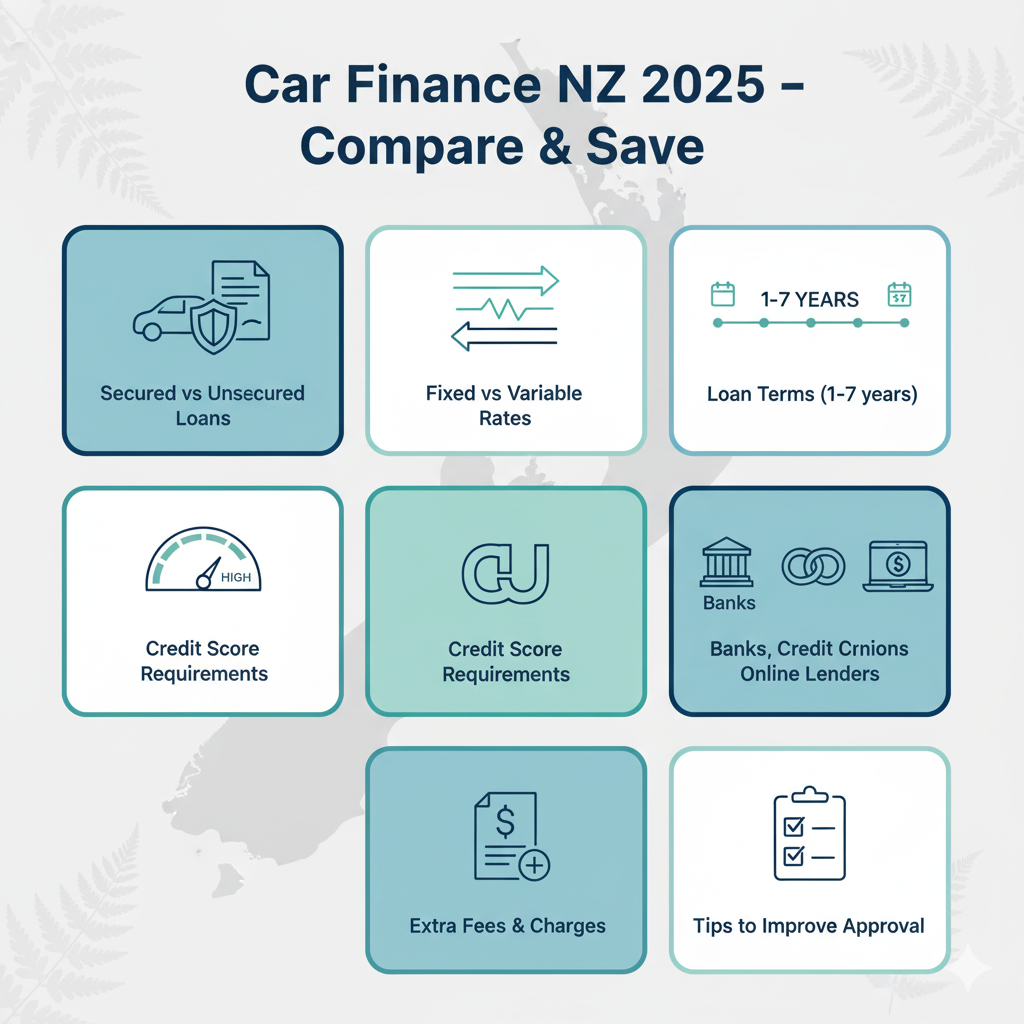
Car loans with and without collateral
When you take out a secured car loan, your car is used as collateral. This usually means lower interest rates and higher loan amounts. If you don’t make your payments, the lender can take back your car. This makes these loans less risky for banks and other financial institutions.
You don’t have to put up collateral for an unsecured car loan, but the interest rates are usually higher. These loans only look at your credit score and income, which makes it harder for some people to get approved.
Borrowers choose between the two based on the car, the amount and their own credit position. Some major lenders now route car buyers to an unsecured personal loan instead, as ASB does (see the bank section below).
Interest Rates That Are Fixed vs. Those That Are Variable
Your monthly payments will be the same every month with fixed interest rates. This stability makes it easier to plan your budget, but it could mean missing out if market rates drop a lot.
The official cash rate of the Reserve Bank of New Zealand and the state of the market both affect variable interest rates. You might benefit from lower rates, but higher rates could put a strain on your budget without warning.
Most car loans offered by the major lenders are fixed rate, so your repayments stay the same for the whole term. That reliability is the main reason borrowers choose them.
The Terms of a Loan and Their Effects
Terms at the major lenders run from six months to seven years (ASB) and from one to seven years for Kiwibank car loans, which are provided by Latitude (checked October 2026). Higher monthly payments but less interest paid overall are the result of shorter terms. Longer terms lower monthly payments but raise the total cost of borrowing.
When choosing your loan term, think about how long you want to keep the car. Owing more than the car’s worth (negative equity) becomes more likely with longer loan terms, especially for new vehicles that depreciate quickly.
Important Things to Think About When Picking a Car Loan
Fees and Interest Rates
It’s important to compare rates because they can be very different between lenders. Different banks, credit unions, and car finance companies offer different rates depending on your credit history and the car you’re buying.
Look beyond the advertised interest rate to the total cost of borrowing. Before you sign, the lender must give you a disclosure statement setting out the total cost of the loan, the repayments, the interest charged and every fee. Fees vary by lender. As examples checked in October 2026, Kiwibank car loans (provided by Latitude) charge a $199 establishment fee, while ASB charges no processing fee and no fee for repaying early. Some lenders do charge early repayment or break fees, so check before you sign.
Flexibility in Repayment
Things in life change, so look for lenders that let you change your payment schedule. Options like payment holidays, extra payments without penalties, and the ability to adjust payment frequency can prove invaluable.
Some lenders let you make payments every week, every two weeks, or every month. Paying fortnightly can help in a specific way: 26 fortnightly payments add up to 13 monthly payments a year, so you pay the loan off sooner and pay less interest, as long as your lender lets you set payments up that way.
Amount of the loan and deposit needed
How much you can borrow depends on the lender’s assessment of what you can afford. At the two big names below, loan amounts start from $2,000. A deposit still helps in a simpler way: the less you borrow, the less interest you pay overall.
Think about the whole amount you need, including things like registration, insurance, and any repairs or changes that need to be made right away. It might be cheaper to borrow money for these costs up front than to use credit cards or personal loans.
Requirements for a Credit Score
Your credit history affects both approval and the rate you are offered. Credit scores in New Zealand typically run from 1 to 1,000, and each credit reporting agency (Centrix, Equifax and Experian) calculates its own score, so the same person can have different scores with different agencies. Lenders offer better rates to borrowers they see as lower risk, but no agency score guarantees a particular rate.
Before you apply, check your credit report to find and fix any problems. Even small changes to your credit score can save you a lot of money over the life of the loan.
The Best Car Loans in New Zealand for 2026
Big Banks
The two biggest names work differently than many borrowers expect. ASB does not sell a separate car loan: its route is an unsecured personal loan at a single fixed rate of 13.90% p.a., with no processing fee and no early repayment charges, for borrowing over $2,000 (checked October 2026). Kiwibank car loans are provided by Latitude Financial Services, not lent by Kiwibank itself: 13.95% p.a. for Kiwibank home loan customers or 18.95% p.a. standard, fixed for the life of the loan, with a $199 establishment fee and no early repayment fees (checked October 2026).
Existing customers only sometimes get a pricing edge. The clear published example is above: Kiwibank’s home loan customers pay a lower rate on its Latitude car loans than other borrowers. ASB publishes one rate for everyone.
Building Societies and Credit Unions
Credit unions are owned by their members, and Sorted notes that a credit union might offer car loans with better terms to its current members. An existing relationship can help, though what is offered varies by institution.
Building societies and credit unions are worth including in your comparisons if you are already a member, alongside the banks and the specialists.
Companies that specialize in car finance
Dedicated car finance companies know a lot about the car market and often work directly with dealerships. They might approve loans that banks turn down, and they can sometimes process applications faster.
Some lenders only lend to certain types of people, like those who want to buy classic cars, commercial vehicles, or people with bad credit.
Online Lenders
Digital-first lenders compete on simple, fully online application processes. Judge them on the same total cost basis as any other lender.
When choosing online-only lenders, think about how much customer service and support you might need during the loan term.
Ways to Make It More Likely That You Will Get a Car Loan
How to Build and Keep Good Credit
Pay all of your bills on time, keep your credit card balances low, and don’t apply for credit cards too often. These actions show potential lenders that you know how to manage your money well.
If you don’t have a lot of credit history, you might want to build it up slowly with a credit card or a small personal loan before you apply for car financing.
Giving full and correct information
It’s very important that the information you give is correct because lenders check it. If there are differences between your application and the documents that go with it, it could take longer to get approved or be denied.
Before you start your application, make sure you have all the necessary paperwork, such as recent payslips and ID. The lender may also ask for bank statements.
Showing that you can afford it
Lenders must assess whether you can afford the repayments without getting into substantial hardship, and they will look at your income, expenses and existing debts before approving a loan. Make sure the proposed payments fit comfortably inside your own budget, not just the lender’s test.
When figuring out if you can afford a car, think about all the costs that come with it, like insurance, gas, maintenance, and registration.
How to Avoid Common Car Financing Mistakes
Taking out too many loans and what happens next
Taking out more money than you need or can afford can cause long-term stress. To lower the amount of your loan, think about getting a cheaper car or putting down more money.
Keep in mind that cars lose value quickly, especially new ones. If you borrow the most money, you might not have any equity for years.
Not paying attention to the fine print
Important terms and conditions in loan contracts affect your rights and responsibilities. Pay close attention to fees for early repayment, default, and insurance.
Some contracts may require insurance or extended warranties, which raise the total cost. Before you sign, make sure you understand these rules.
Two rights are worth knowing before you sign. You are entitled to a disclosure statement setting out the full cost of the loan, and you can cancel a credit contract within five working days of receiving that disclosure if you change your mind.
Not Looking Around
Lenders have very different interest rates and terms. Taking the time to compare your options could save you thousands of dollars over the life of your loan.
Just because you’re already a customer doesn’t mean your bank has the best deal. When you compare and negotiate on your own, you often get better results.
Other Ways to Pay for a Car
Loans for buying a car for yourself
Because personal loans aren’t backed by your car, they give you more freedom. This method works well for older cars that may not be able to get a regular car loan.
Interest rates on unsecured car loans are usually higher, but you own your car right away.
Dealer Finance Deals
Dealer car loans are usually provided by a finance company, with the dealer arranging the loan as part of the purchase. Dealer financing can be easy, but it might not always have the best rates or terms.
To make sure you’re getting the best deal, compare dealer financing offers with direct lender options.
Platforms for Peer-to-Peer Lending
A peer-to-peer lending service is an intermediary that matches people who want loans with people willing to fund them. Licensing under the Financial Markets Conduct Act is voluntary, but a licensed service must meet Financial Markets Authority standards, including checking borrower identity, assessing and disclosing repayment risk to lenders, and belonging to a dispute resolution scheme.
Terms and protections differ from bank lending, so check a platform’s licensing status and how it handles problems before borrowing through one.
Choosing the Best Option for Your Needs
Your personal situation, credit history, and financial goals will help you choose the best car loan option. Take time to understand your options and don’t rush into the first offer you receive.
If you’re having trouble with complicated loan terms, you might want to talk to a financial adviser who can help you work through them. Free help is also available from MoneyTalks financial mentors.
The New Zealand car finance market continues evolving, with new lenders and products regularly entering the space. Stay informed about current rates and terms to ensure you’re getting the best possible deal.
Before you sign, compare the total cost of each loan across its full term, including fees and charges, and check that the repayments would still fit your budget if your circumstances changed. Getting written quotes from more than one lender makes those comparisons clearer and helps you choose finance you can manage comfortably right through to the final payment.
Questions That Are Often Asked
Is it possible to get car financing in New Zealand without a down payment?
It depends on the lender and your assessment. Lenders decide how much they will lend based on your income and circumstances rather than a fixed share of the car’s price. A deposit still helps: any deposit reduces the amount you borrow, so you pay less interest overall, and the more of the car’s price you can save up first, the cheaper the loan.
In order to qualify for a car loan, what credit score do I need to have?
There is no single score that qualifies you. Lenders set their own criteria, usually based on age, residency, income and your credit history, and each credit reporting agency calculates its own score on its own scale. Some lenders who specialize in this area will work with people who have bad credit, but they may charge higher interest rates.
How long will it take to get a car loan?
Decisions can be fast. Kiwibank car loans (Latitude) aim to respond within 24 hours in most cases, and ASB aims to pay out the same day you sign (checked October 2026). More complex applications take longer.
Should I get a car loan with a fixed or variable rate?
Because they make it easy to plan your budget and know how much you’ll have to pay each month, fixed rates are popular for car loans. Variable rates may save you money at first, but they can go up without warning. Most car loans from the major lenders are fixed rate, which is part of why fixed is the common choice.
Is it possible to pay off my car loan early without any fees?
Many lenders in New Zealand let you pay off your loan early without any fees, but some do charge fees for doing so. Before you sign, read your loan agreement carefully and ask about the terms for paying it off early. Being able to make extra payments can lower the total amount of interest you have to pay by a lot.