Bad Credit Car Finance in NZ: What It Really Costs and How to Avoid a Loan You Cannot Afford

The quick answer
Yes, you can usually get car finance with a poor credit history. Lenders in that part of the market expect defaults and missed payments in an applicant’s past, and price for that risk instead of simply saying no. Expect a higher interest rate than a borrower with a clean record would pay, a smaller amount approved than you asked for, and often a deposit, a guarantor, or both. The cost difference is not small: on the same car, over the same term, a high rate can add thousands of dollars in interest.
Two things protect you. First, every lender, including the one a car dealer introduces you to, must follow the lender responsibility principles in the Credit Contracts and Consumer Finance Act 2003 (CCCFA): they have to check you can afford the repayments without substantial hardship, and that the loan suits your needs. Second, you have the same rights as any other borrower: disclosure before you sign, a cooling-off period, hardship changes later, and a free dispute resolution scheme if things go wrong.
What lenders see when they look at your credit history
When you apply for car finance, the lender will almost always check your credit report. A credit report is a record held by credit reporting agencies about how you have handled credit and bills. Consumer Protection lists what it can show: credit accounts you hold or have held, applications you have made, repayment history information, defaults where a debt went unpaid or to collection, court judgments, and insolvency records such as bankruptcy. Lenders use that history, along with your income and expenses, to judge how likely you are to repay.
Many reporting agencies also produce a credit score, a single number that summarises the report for a lender. There is no one official score: agencies calculate theirs differently, and Consumer Protection points out that your own report may not even include one. Sorted, the personal finance service run by Te Ara Ahunga Ora Retirement Commission, explains the effect plainly: your score is built from how well you have paid bills and repaid loans in the past, and the higher it is, the more likely you are to get cheaper credit. Our credit score guide goes deeper on how scores work and how to lift one over time.
Get your free report before anyone else runs a check
You are entitled to a free copy of your credit report from each credit reporting agency. Consumer Protection names the three agencies operating in New Zealand: Centrix, Equifax and Experian. The agency should deal with your request within 20 days, and if it will take longer it must tell you why. Urgent supply may cost a fee, so asking early is the cheaper move.
Read it looking for things you do not recognise: unknown credit accounts, missed payments you do not recall, defaults that are not yours. A default loaded against the wrong person, or left showing after a debt was settled, can cost you a higher rate on everything you borrow.
Fixing errors is free, and it happens before you apply
If something on the report is wrong, Consumer Protection sets out the process. Contact the credit provider that supplied the information, explain what is inaccurate and provide any evidence you have. The provider must investigate and correct errors, and the update then flows through to the credit reporters. You can also report the error to the reporting companies themselves, and if neither will act on a genuine error, you can complain to the Privacy Commissioner.
One thing fixing errors cannot do is erase a default that really happened. Consumer Protection gives the example of a man who paid off an old default and found it stayed on his record anyway. Under the Credit Reporting Privacy Code 2020, issued by the Privacy Commissioner, credit default information can be reported for up to five years from the date of the default, whether or not it has since been paid. Paying it still matters, because a report showing a default as paid looks better than one showing it outstanding, but the entry itself runs its five years.
The checks a lender must make before lending to you
The CCCFA’s lender responsibility principles are the law’s answer to lending that should never have happened. As the Commerce Commission summarises them, a lender must make reasonable inquiries, before the agreement is signed, to be satisfied it is likely you will repay without suffering substantial hardship, and that the loan will meet your requirements and objectives. Consumer Protection puts the practical side of it this way: the lender must help you understand the documents, help you determine affordability and suitability, and give you time to get independent advice.
In practice this means questions about your income, regular expenses, other debts and what the loan is for, usually backed by evidence such as payslips and bank statements. A lender who glosses over your answers, inflates your income on the form, or waves away expenses is not doing you a favour: they are failing a legal duty, and the failure tends to surface later as a loan you cannot service.
These duties apply in full when the finance is arranged at a car yard. The paperwork may be completed at the dealer’s desk, but the lender’s responsibilities do not shrink because a dealer made the introduction.
One more check worth doing yourself: a lender must be registered to legally provide consumer credit, and Consumer Protection’s advice is blunt: if they are not registered, they cannot legally give credit. You can search the Financial Service Providers Register, run by the Companies Office, and the lender’s disclosure statement must also name its dispute resolution scheme. Since 1 July 2026 the Financial Markets Authority, rather than the Commerce Commission, has been the regulator responsible for the CCCFA, as the Commission’s own website records.
How a bad credit car loan is priced and put together
No official body publishes a going rate for car loans to people with poor credit, because there isn’t one. The rate you are offered is set by the lender’s view of your risk, the car’s age and value, your deposit and the term. What can be described honestly is the structure, because every cost must appear in the disclosure statement you get before signing.
The interest rate. This is the big one, and for a borrower with defaults on file it will sit well above the rates advertised to prime borrowers. The disclosure statement must show the annual rate and how interest is calculated: Consumer Protection notes it is usually worked out on the daily unpaid balance and may not be charged in advance.
Credit fees. Expect an establishment fee at the start and often a monthly administration fee across the term. The CCCFA requires credit fees to be reasonable and to cover costs closely related to the reason for the fee. Lenders are not allowed to earn a profit from fees, and an unreasonable fee can be challenged and cancelled or reduced.
Default charges. If you miss payments, two costs can follow. Default interest is a higher rate charged on top of the normal rate, but Consumer Protection is clear about its limits: only while you are overdue, and only on the amount missed, not the whole loan. Default fees can also apply and must be disclosed before you sign.
Add-on products. Car yards make much of their money here. Mechanical breakdown insurance, payment protection insurance, extended warranties and accessories such as tow bars or alarms may all be offered at the desk and folded into the amount you borrow, which means you pay interest on them for the whole term. Consumer Protection’s list of what a disclosure statement must cover includes any extras you agree to buy, so check the statement line by line for items you did not ask for. You are allowed to say no to all of them.
Security and repossession. A car loan is almost always secured on the car itself: the contract gives the lender a security interest in the vehicle, specifically identified in the contract. Consumer Protection explains that a lender can only begin repossession if the contract provides for it, the item is subject to that security interest, and you are in default, and the lender must give you written warning in advance. If the car is sold for less than you owe, you can still be liable for the shortfall. Two related details: if the car is fitted with an immobiliser, the disclosure must explain how it works and what to do if it is activated in an emergency; and if the lender asks for a guarantor, usually a family member who becomes liable if you do not pay, disclosure must be made to them too.

The total cost trap, with a worked example
Repayments are usually quoted weekly or fortnightly because a smaller number feels manageable. The figure that decides whether a loan is a good idea is the total amount you will repay. Sorted’s borrowing guidance makes the same point: focus on the true cost of what you are buying, including interest and fees, not just whether the repayment fits this week’s budget.
The following example is illustrative only. The rates are round numbers chosen to show the arithmetic; they are not any lender’s rates.
Imagine you borrow $12,000 to buy a car, repaid monthly over four years, with no fees, so the interest rate is the only variable.
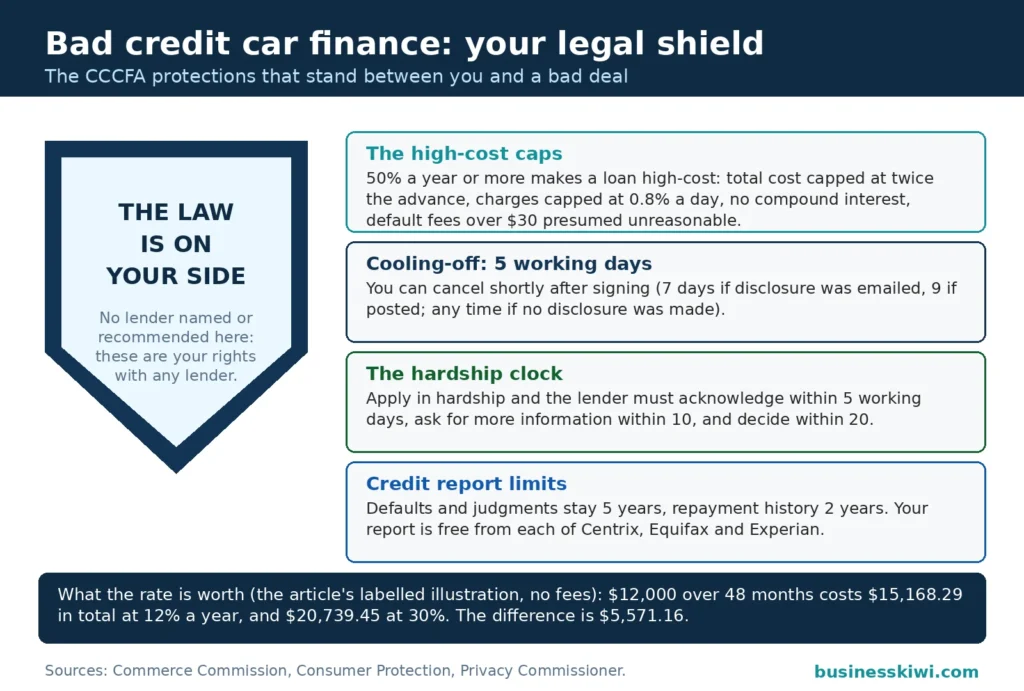
Same car, same term, same amount borrowed. At the higher rate you pay roughly $5,571 more in interest, and the total repaid climbs past $20,000 for a $12,000 car. Weekly, the repayments are about $73 and about $100, a gap that can look survivable across a kitchen table while hiding the extra five and a half thousand dollars across the term.
Two more traps sit inside that arithmetic. Cars lose value quickly, so a high-rate loan over a long term can leave you owing more than the car is worth; if the car is written off or sold, you can end up repaying a loan on a car you no longer have. And extending the term lowers each repayment but increases the total interest, so a dealer who answers your concern about cost by stretching the loan from three years to five is making it more expensive, not cheaper.
Where the legal ceiling sits: high-cost credit
Most car finance, even at the pricier end, sits below the threshold the law calls high-cost, but some fringe vehicle finance and top-up lending crosses it, so the ceiling is worth knowing.
The CCCFA treats a consumer credit contract as high-cost where the annual interest rate is 50 percent or more. For high-cost contracts, MBIE and Consumer Protection describe a set of hard caps. The total costs of borrowing, meaning all interest and credit fees together, cannot exceed the amount first borrowed, so you can never be required to pay back more than twice what you were advanced. The rate of charge is capped at 0.8 percent of the unpaid balance per day. Compound interest is banned, so interest cannot be charged on interest. Default fees above $30 are presumed unreasonable. A car loan quote anywhere near that territory is a warning sign about the lender, not a detail.
Below 50 percent, those specific caps do not apply, but the general protections still do: responsible lending, disclosure, reasonable fees, and the oppression provisions that let a court reopen an extremely unfair contract. Our small loans guide explains the high-cost rules in more depth, because they bite hardest on small, short-term borrowing.
Alternatives worth trying before you sign
Fix the record, then let time work. Correcting errors (see above) can change the rate you are offered next time. Where the bad marks are accurate, time is the remedy: under the Credit Reporting Privacy Code, defaults can be reported for five years from the date of default and judgments for five years from the date of judgment, while repayment history runs for two years. A default in its fourth year worries a lender less than a fresh one, and each month of on-time payments adds good history to set against it.
Buy a cheaper car, or save a deposit first. A smaller loan at a high rate does less damage than a bigger one. A deposit also cuts the amount borrowed, the interest charged and the risk of owing more than the car is worth, and it shows the lender recent saving discipline.
Talk to a bank or credit union anyway. A decline from one lender is not a decline from all of them, and your existing bank can see your recent account conduct, which sometimes counts for more than an old default. Consumer Protection also notes that people on low incomes may be eligible for low-cost loans, and points to Sorted’s list of microfinance providers, worth a look before accepting yard finance at a high rate.
If the problem is a repair bill, not a purchase. Borrowing at a high rate to fix a car you already own is sometimes avoidable. Work and Income lists car repairs among the costs a Recoverable Assistance Payment can help with, and an Advance Payment of Benefit may be made for repairs where the car is essential, for example for work or because there is no public transport. Work and Income’s guidance puts an advance for car repairs at generally up to $400: not enough for a new engine, but for a warrant failure it can be the difference between a small repayable advance and a large high-interest loan.
Dealer or private sale: a real trade-off. Private sales are often cheaper, and a cash private purchase may be the cheapest option of all. The protection gap is real, though. Consumer Protection explains that buying from a dealer brings the Consumer Guarantees Act: the car must be of acceptable quality, fit for purpose and as described, with a repair, replacement or refund available if it is not. Dealers must also be registered on the Motor Vehicle Traders Register and display a Consumer Information Notice on each used vehicle covering its history, price, condition, odometer reading and whether money is owing on it. None of that applies to a private seller, and if a previous owner still owes money on the car, the repossession risk over their debt sits with you.
Red flags and pressure tactics
- Guaranteed approval, no matter your history. No lender can honestly promise this, because the law requires an affordability assessment first.
- Being rushed. You should be given time to take the contract away and get independent advice. A deal available only if you sign today is designed to stop you comparing totals.
- Blank spaces or missing pages. Never sign a contract with blanks to be filled in later, and make sure the disclosure statement is complete. If proper disclosure was never made, the lender cannot enforce the contract until it is.
- Add-ons you did not ask for. Insurance products and accessories already priced into the paperwork. Ask for each line to be explained.
- Weekly payment framing. “Only $99 a week” tells you nothing about total cost. Ask for the amount borrowed, the interest rate, every fee, and the total amount repayable, all of which must be in the disclosure statement.
- A big balloon payment at the end. Some contracts keep regular payments low by leaving a large final payment. If you cannot say now where that lump sum will come from, the loan is not affordable, whatever the weekly figure suggests.

Your rights after you have signed
The disclosure keeps working for you. You can ask for loan information at any time, including the balance owing and payments left, and statements must be provided at least every six months for most credit contracts.
Cooling-off. At the start of a loan you have five working days to cancel the contract, in writing or electronically. The window is longer if the documents were not handed to you in person: seven working days if they were emailed or faxed, nine if posted. Saturdays, Sundays and public holidays do not count. If disclosure was never made at all, you can cancel at any time. Cancelling means unwinding the deal promptly and returning what you received, so act inside the window if you have doubts.
Hardship. If something unforeseen changes, such as illness, injury, losing your job or a relationship ending, you have the right to apply to the lender to change the contract: extend the term and reduce each payment, postpone payments for a set period, or both. The lender has to acknowledge your application within five working days, ask for any further information within ten working days, and decide within twenty working days. You generally cannot apply again on the same grounds within four months unless the lender agrees, and Consumer Protection notes you may first need to bring payments up to date if you have been in default for two months or more, or have missed four or more consecutive payments.
Complaints. Complain to the lender first. If that does not resolve things, every lender must belong to an approved financial dispute resolution scheme, a free and independent service that can look into complaints including inappropriate lending decisions, debt recovery and repossession actions, and hardship handling. You do not need a lawyer. The disclosure statement and the Financial Service Providers Register will tell you which scheme the lender belongs to, and a free financial mentor from MoneyTalks, the free money guidance helpline Consumer Protection points borrowers to, can help you prepare a complaint or talk to the lender for you.
Oppression. Beyond the specific rules, the CCCFA protects you from oppressive contract terms and lender behaviour. Whether conduct crosses that line is for a court to decide, but threats and extreme reactions to a single missed payment are Consumer Protection’s example of a lender acting unfairly.
Frequently asked questions
Can I get car finance if I have a default on my credit report?
Usually, yes. Specialist lenders and dealer-arranged finance exist for exactly this market. Expect a higher interest rate, a smaller approval, and possibly a deposit or guarantor. The default’s age and whether it shows as paid will influence the offer, and a default stays reportable for five years from the date it occurred.
Does the lender have to check whether I can afford the loan?
Yes. Under the CCCFA’s lender responsibility principles, the lender must make reasonable inquiries and be satisfied you can make the repayments without substantial hardship, and that the loan suits your requirements. That duty applies to dealer-arranged finance as much as to a loan you arrange yourself.
How long do I have to change my mind after signing?
Five working days from when disclosure is made, extended to seven working days if the documents were emailed or faxed to you and nine working days if they were posted. If the lender never made disclosure, you can cancel at any time.
Can the lender take my car if I miss payments?
If the contract gives the lender a security interest in the car and you are in default, yes, but the lender must give you written warning in advance and repossession is governed by CCCFA rules. Talk to the lender early instead: a hardship application made before things escalate protects you far better than silence.
Is there a legal limit on how much interest a car lender can charge?
For most car loans there is no fixed rate cap, but fees must be reasonable and the lender responsibility and oppression rules apply. Only contracts at an annual rate of 50 percent or more count as high-cost, and those carry hard caps: total interest and fees no more than the amount borrowed, a maximum rate of charge of 0.8 percent per day, and no compound interest.
Sources
- Commerce Commission, Borrowing money or buying goods on credit (fact sheet), and High-cost credit guidelines, comcom.govt.nz
- Commerce Commission, Transfer of responsibility for regulation of consumer credit, comcom.govt.nz
- Consumer Protection, Credit Contracts and Consumer Finance Act; Credit contracts: plain English definitions; Credit checks, scores and history; Buying a car from a dealer; Solving issues with your car dealer; Loans and lenders; Payment problems; Making a complaint about your financial service provider, consumerprotection.govt.nz
- Privacy Commissioner, Credit Reporting Privacy Code 2020, privacy.org.nz
- Sorted, What you really need to know before you use credit; Sorted Debt booklet, sorted.org.nz
- Work and Income, Recoverable Assistance Payment; Advance Payment of Benefit: car repairs, workandincome.govt.nz
Disclaimer
This article is general information about car finance and consumer credit law in New Zealand. It is not financial advice and does not consider your personal circumstances. Rates, fees and lending criteria change, and the examples here use illustrative figures only. Before borrowing, read the lender’s disclosure statement carefully, and consider free help from a financial mentor through MoneyTalks.
More guides to borrowing, credit and managing debt are in our Finance hub.