Small Loans in NZ: Costs, Rules and Safer Alternatives

A broken car, a power bill bigger than expected, a dentist appointment that cannot wait. When money is tight, an advert promising fast cash online can look like the simplest answer.
Slow down first. Small loans sold on speed are usually the most expensive way to borrow in New Zealand, and the law around them is stricter than many borrowers realise. It works in your favour, but only if you know it before you sign.
Quick answer
Fast cash loans, often called payday loans or cash loans, are small loans marketed on quick approval and quick payment, usually repaid over a short period. Consumer Protection describes them as tempting under pressure, particularly if other lenders have turned you away, but notes the overall cost tends to be much higher.
Three points matter most:
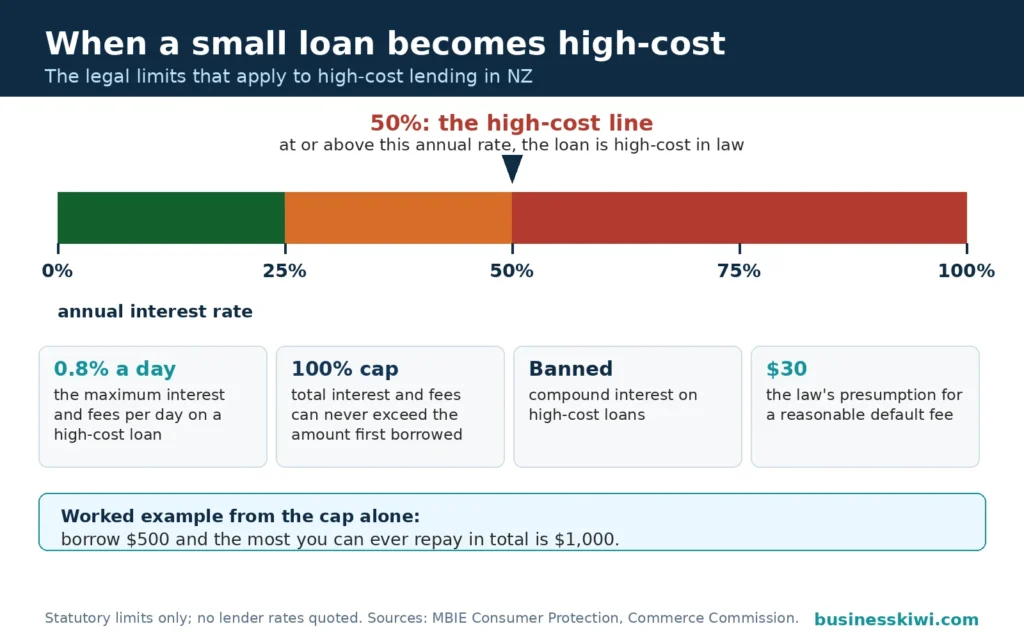
- A loan is classed as high-cost under the Credit Contracts and Consumer Finance Act 2003 (CCCFA) when its annual interest rate is 50 percent or more. Special caps then apply.
- Those caps mean total interest and fees cannot exceed the amount first advanced, the rate of charge cannot exceed 0.8 percent per day, and compound interest is banned.
- Anyone lending to consumers must be registered, certified or otherwise authorised, belong to an approved dispute resolution scheme, and check the loan is suitable and affordable before lending.
Speed is the product being sold, and you pay for it.
What fast cash and payday loans actually are
There is no separate legal category called a payday loan. It is marketing language for a small, short-term loan, and Consumer Protection uses payday loans and cash loans interchangeably. What matters legally is the price: once the annual interest rate reaches 50 percent or more, the contract falls into the high-cost regime below, with extra limits and disclosure duties.
Consumer Protection warns high-cost lenders often talk only about the weekly repayment. A manageable sounding repayment can hide a very high total cost. Always ask for the total amount you will repay, first payment to last, and compare that figure.
The legal framework that protects borrowers
The CCCFA sets lender responsibility principles across consumer lending, from mortgages and personal loans to agreed overdrafts, buy now pay later accounts and buying on credit. A lender must:
- Make reasonable enquiries so it can be satisfied the loan is likely to meet your needs and you can repay without suffering substantial hardship. That can involve asking what the loan is for, how much you need, and about your income and expenses.
- Give you key information in writing before you sign: the annual interest rate, all fees, the total amount to repay, any goods listed as security, how to cancel, how to apply for hardship, and its dispute resolution scheme.
- Help you understand what you are signing, keep information clear, charge only reasonable fees, and treat you fairly if things go wrong.
Lenders must also be registered on the Financial Service Providers Register, must be certified by the Commerce Commission or licensed or authorised by the Financial Markets Authority or the Reserve Bank if not exempt, and must belong to an approved dispute resolution scheme. Consumer Protection states unregistered lenders cannot make you pay interest, default fees and other borrowing costs.
The high-cost caps in detail
For high-cost loans, specific limits sit on top of the general rules. MBIE summarises the regime this way:
- Definition. A high-cost contract is one with an average annual interest rate of 50 percent or greater, or where the combined interest rate and default rate are likely to be 50 percent or more.
- Total cost cap. Total interest and fees stop at 100 percent of the amount first advanced, so you can never be required to repay more than twice what you first received.
- Daily rate cap. The maximum daily rate of charge is 0.8 percent of the unpaid balance in interest and fees per day when averaged across the loan term, in Consumer Protection’s wording.
- No compound interest. Compound interest is prohibited on high-cost loans, so interest cannot be charged on interest.
- Default fees. There is a rebuttable presumption that default fees over $30 are unreasonable. Consumer Protection puts it plainly for borrowers: default fees should be $30 or less unless the lender has a good justification.
- Repeat borrowing restrictions. High-cost lenders are restricted from lending to some repeat borrowers. Commerce Commission guidance describes, among others, borrowers who already owe money on a high-cost loan with another lender, or who have taken two or more high-cost loans in the last 90 days.
These caps limit the worst outcomes. They do not make a high-cost loan cheap.
A worked example using only the statutory cap
This example uses the legal cap only, not a lender’s price or quote.
Worked example (statutory cap only): You borrow $500 under a high-cost loan. Because total interest and fees can never exceed 100 percent of the amount first advanced, interest and fees can add up to at most $500. The most you can ever be required to repay is therefore $1,000 in total. The 0.8 percent per day cap separately limits how quickly charges build up.
The cap stops a $500 loan growing without limit, but still allows a $500 loan to cost another $500: legal is not the same as good value.
How costs build on ordinary small loans
Interest is only part of the bill. On smaller loans, fees often do much of the damage, because a fixed fee is a large percentage of a small amount borrowed briefly:
- Establishment fees to set the loan up. Consumer Protection lists these as a key reason payday style loans cost so much.
- Administration fees charged regularly while the loan runs.
- Default fees if you miss a payment, plus default interest. Consumer Protection explains default interest is a higher rate charged only while you are overdue and only on the missed or over-limit amount, not the whole loan. Interest may not be charged in advance.
- Other contract fees, which must be reasonable and closely related to the cost they cover. Lenders may not profit from fees, and unreasonable fees can be challenged.
Fees rolled into the loan balance create a further trap: you then pay interest on the fees as well. Sorted makes the same point for personal loans generally.
Repeat borrowing is where small loans turn into problem debt. A second loan taken to cover repayments on the first does not fix the underlying gap in the budget, and each new contract brings new fees. That is why the high-cost regime restricts lending to repeat borrowers. Borrowing to repay borrowing is a debt problem, not a timing problem.
Cooling-off rights and hardship applications
Cancelling shortly after signing
Consumer Protection states you have five working days to cancel the contract in writing or electronically, extended to seven working days if documents were sent by email or fax, and nine working days if they were posted. Saturdays, Sundays and public holidays are not working days. If no disclosure was made, you can cancel at any time.
Cancelling is not free, and it is not the same as returning goods. You must give written notice, repay any money advanced, and, where the contract financed something you bought and want to keep, pay the cash price within the time the rules allow. Your disclosure statement sets out the steps.
Applying for unforeseen hardship
If something unexpected makes repayments hard to afford, you can make a formal hardship application to your lender. Consumer Protection gives examples such as job loss, serious illness or injury, a relationship breakdown, or the death of a partner. The change must be one you could not reasonably have foreseen when you signed.
Apply in writing, by letter, email or the lender’s form. Say which change you want, explain the life event, and include proof where you can. The three changes you can ask for are a longer term with smaller payments, a payment holiday, or both.
Apply early, because there are limits, including that you generally must be less than two months behind. After you apply, the lender must give its decision and reasons within 20 working days, must not charge a fee just to consider the application, must explain how the change affects what you owe, and must suspend repossession action while a decision is made.
A hardship change will usually mean you pay more overall, because the debt runs longer, but it can prevent default fees and debt collection. If a lender refuses unfairly, complain to its dispute resolution scheme. You can also talk to your lender early: many lenders prefer to agree a changed plan than risk missed payments, Consumer Protection notes, and a free financial mentor can negotiate for you.
Repossession: what can and cannot be taken
Repossession only applies where goods are listed as security. Most small cash loans are unsecured, meaning no goods are listed, and Consumer Protection confirms that if you default on an unsecured loan the lender cannot take any of your possessions. Sorted makes the same distinction: an unsecured lender can pursue the debt and involve debt collectors, but cannot take your property.
Where goods are listed:
- A lender can only start repossession if the contract gives that right, the item has been specifically identified in the contract as security, and you are in default.
- Only items listed as security can be taken. A vague description is not enough, and lenders must not take personal or household necessities such as beds, cooking equipment, medical equipment or passports. Some essential household items cannot be taken as security at all.
- The lender must give written warning in advance. Consumer Protection’s repossession guidance describes a warning notice giving you 15 days from when you receive it to fix the problem, with details of the goods and how the issue must be fixed.
- Only licensed repossession agents can repossess items. Ask to see their licence and paperwork.
- Once a repossessed item is sold, your account is frozen, so no further interest and fees are added. Any remaining shortfall can still be pursued.
Never list goods worth far more than the loan as security. Sorted explicitly warns borrowers to be very wary of a lender who asks for a car or household goods as security for a small loan.

How to check a lender is legitimate
- Search the Financial Service Providers Register. Consumer Protection links borrowers to the register search for this purpose, and notes an unregistered lender cannot legally charge you interest and other borrowing costs. If the name does not appear, walk away.
- Check dispute resolution membership. Every lender must belong to an approved dispute resolution scheme and have its own complaints process. Ask the lender or search the register.
- Confirm certification or authorisation. Ask which body certifies, licenses or authorises the lender, and check it against the register entry.
- Insist on written disclosure before signing. You are entitled to a disclosure statement and copies of important documents, including the payment schedule, before you commit. Take the paperwork away and read it.
- Expect a real affordability assessment. A legitimate lender will ask about the loan’s purpose, your income and your expenses, and will check your credit score and credit history when deciding whether the loan is suitable and affordable. A process that asks almost nothing signals a lender skipping the checks the law requires.
- Compare the total cost. Lenders must make their standard terms and costs of borrowing publicly available for each loan type. Use that information rather than an advertised weekly figure.
Warning signs of a loan scam
The FMA has warned about fraudulent credit and lending providers, particularly around busy shopping periods. It describes operators advertising online or contacting people out of the blue, approaching people through social media or messaging platforms such as WhatsApp, Telegram or Facebook Messenger, and impersonating a legitimate local lender while using different phone numbers or lookalike email addresses.
- An upfront fee demanded to release the loan. The FMA describes advance fees, such as a deposit for the loan, as part of how these scams work, and warns that fake documents claiming a mandatory fee must be paid to release loan funds are characteristic of advance fee fraud. A genuine establishment fee is disclosed in the contract, not demanded in advance by transfer.
- Guaranteed approval, no credit check, no proof of income. The FMA lists these claims as a feature of loan scams. Sorted gives the same warning: if a lender offers approval without any credit check, back away, because licensed lenders must assess your ability to repay.
- Too good to be true terms. Extremely low rates or unusually low or zero establishment fees are bait, in the FMA’s description.
- Payment to an overseas account or in cryptocurrency. The FMA specifically warns about businesses claiming to be based in New Zealand that ask for payments this way.
- Contact only through social media or messaging apps, free email addresses, or overseas phone numbers.
- Pressure to act immediately, or a request to set up a direct debit authority before you have a proper contract and disclosure.
- Official-looking documents supplied by the operator. The FMA has warned about false letters using its own logo and staff names. Verify a lender through the register yourself, not through documents the person contacting you supplies.
If you have already paid money or shared bank or identity details, contact your bank as soon as possible and report the matter.

Safer alternatives to try first
Work through these before a high-cost loan. Several cost nothing.
Check Work and Income first. It can help with urgent or unexpected costs, and you do not have to be receiving a benefit to be eligible. It will look at your income and assets. Its options include a Special Needs Grant, an Advance Payment of Benefit if you already receive a benefit, and a Recoverable Assistance Payment if you do not. Some payments must be repaid and others do not. Its published phone number is 0800 559 009.
Talk to the company you owe. If the pressure is a specific bill, ring the provider before the due date and ask about a payment plan or extra time. A power company, landlord, council or existing lender would often rather agree a realistic plan than chase an unpaid account. Get any agreement in writing, and talk to an existing lender about changing repayments before adding a new, more expensive debt.
Consider a bank or credit union small loan, described generally. Sorted explains personal loans are available from banks, credit unions and other lenders, and that bank, building society and credit union rates are often lower than other lenders, with fewer fees. That is a general comparison, not a promise about any product, rate or approval. You must be a member to borrow from a credit union, and a credit check will be required.
Look at community and no-interest or low-interest loan schemes. Consumer Protection points people on lower incomes towards microfinance as an alternative to an expensive payday loan, describing it as a low-interest or no-interest option, and links to Sorted’s list of microfinance providers. Eligibility varies, so contact a provider directly, or ask a financial mentor to help you find a scheme that fits.
Get free budgeting help before you borrow. MoneyTalks is a free helpline that connects you with a trained financial mentor: 0800 345 123, or text 4029, as Sorted lists it. A mentor can check you are receiving everything you are entitled to, talk to lenders for you, and tell you whether a loan solves the problem or just moves it.
When debt is already a problem
Start with a free financial mentor through MoneyTalks on 0800 345 123. Consumer Protection lists what mentors can do: help you work out what you can afford, talk to lenders for you, check whether a lender acted unfairly, help you budget, and help you complain to a dispute resolution scheme.
KiwiSaver is sometimes raised here. Inland Revenue explains you may be able to withdraw KiwiSaver savings early for significant financial hardship, you need evidence, and in most cases you apply to your scheme provider, not Inland Revenue. It is a high threshold, limited in what can be withdrawn, and it reduces your retirement savings, so treat it as a last resort to discuss with a financial mentor.
For debts that cannot be repaid at all, the Insolvency and Trustee Service administers formal options: the No Asset Procedure, the Debt Repayment Order and bankruptcy. Each has serious consequences, including an impact on your credit record, and each suits different circumstances. Get independent advice from a financial mentor before choosing any of them.
If a lender has broken the rules, complain to the lender first, then to its dispute resolution scheme, and report lender conduct to the Commerce Commission.
Frequently asked questions
Are payday loans legal in New Zealand?
Yes, but it is heavily restricted. A loan at 50 percent or more is a high-cost loan under the CCCFA, which brings in the total cost cap, the daily rate cap, the ban on compound interest, limits on default fees and restrictions on repeat borrowing. The lender must also be registered, certified or authorised, belong to a dispute resolution scheme, disclose key information and assess affordability.
What is the most I can be charged on a $500 high-cost loan?
Using the statutory cap only, total interest and fees cannot exceed the amount first advanced. On a $500 loan that is $500, so the most you can ever repay in total is $1,000. Charges cannot build faster than the 0.8 percent per day cap allows, and compound interest is banned.
Can a lender approve me without checking whether I can afford it?
No. Lender responsibility principles require reasonable enquiries, and the lender must be satisfied the loan meets your needs and you can repay without substantial hardship. Guaranteed approval with no credit check is a pattern the FMA associates with loan scams, and a sign a lender is not doing what the law requires.
What can I do if I signed a loan yesterday and now regret it?
Act immediately: you have five working days to cancel in writing or electronically, seven working days if documents were emailed or faxed to you, and nine working days if they were posted. Check your disclosure statement for the steps, give written notice, and be ready to repay any money advanced. If no disclosure was made, you can cancel at any time. If the period has passed, talk to the lender and a free financial mentor through MoneyTalks about other options, including hardship.
Can a lender take my car or household goods if I miss payments on a small cash loan?
Only if those goods are listed as security in your contract. Most small cash loans are unsecured, and on an unsecured loan the lender cannot take your possessions. Where goods are listed, they must be specifically identified, household necessities such as beds and cooking equipment cannot be taken, you must be given a written warning notice, and only a licensed agent can repossess them.
Sources
Official sources, checked on 7 October 2026: Consumer Protection (MBIE), Loans and lenders; What lenders must do; the Credit Contracts and Consumer Finance Act page; Payment problems; and Debt collection and repossession, all at consumerprotection.govt.nz. MBIE, high-cost credit contracts provisions, mbie.govt.nz. Commerce Commission, high-cost lending review release and High-Cost Credit Guidelines, comcom.govt.nz. Financial Markets Authority, loan scam warnings and scam basics, fma.govt.nz. Sorted, Personal loans guide, sorted.org.nz. Work and Income, Urgent costs, workandincome.govt.nz. Insolvency and Trustee Service, No Asset Procedure, insolvency.govt.nz. Inland Revenue, KiwiSaver significant financial hardship withdrawals, ird.govt.nz.
Disclaimer
This article is general information about small loans and consumer credit in New Zealand. It is not financial advice, legal advice, or a recommendation to borrow or to choose any product or provider. Rules and eligibility can change, so check the official sources above and consider advice specific to you. Free help: MoneyTalks on 0800 345 123 (text 4029) can connect you with a free financial mentor. Work and Income is on 0800 559 009. If you think a lender has broken the law, complain to the lender, then to its dispute resolution scheme, and you can contact the Commerce Commission.
See the Finance hub.