Reverse Mortgages in NZ: How They Work, What They Cost and Who Offers Them

The short answer
A reverse mortgage is a loan for older homeowners that is secured against your home but does not require regular repayments. Instead of paying interest each month, the interest is added to the loan balance, so the amount you owe grows over time. The loan is normally repaid when you sell the home, move out permanently (for example, into long-term residential care) or pass away.
In New Zealand the two bank providers are Heartland Bank, which sells its product as the Heartland Reverse Mortgage, and SBS Bank, which sells its version as the SBS Unwind reverse equity mortgage. Both set a minimum age of 60, both charge a floating (variable) interest rate, and both include a no negative equity guarantee, meaning you or your estate should never have to repay more than the home sells for, provided you have met the conditions of the loan.
Because no repayments are made, the debt compounds. That is the central trade-off: the product can release cash from your home while you keep living in it, but it steadily reduces the equity you will leave behind.

How a reverse mortgage works
With an ordinary home loan you borrow money and pay it back in instalments, so the balance falls. A reverse mortgage runs the other way: you borrow against the value already built up in your home, make no scheduled payments, and the balance rises as interest is charged on it. Each month, interest is calculated on everything you owe, including interest added in earlier months. This is called compounding, and it is why the balance grows faster the longer the loan runs.
You stay on the title and the home remains yours. You also stay responsible for the ongoing costs of owning it: council rates, house insurance and maintenance. Both lenders make that responsibility a condition of the loan.
How much you can borrow is covered below. In short, you can only access a percentage of your home’s value, and that percentage rises with age.
Who offers reverse mortgages in New Zealand
Heartland Bank
Heartland Bank is the larger of the two providers and sells the product as the Heartland Reverse Mortgage (also known as Heartland Seniors Finance). Its published fact sheet (effective 29 September 2026) sets out the main terms:
- Borrowers are aged over 60, with a maximum of two borrowers. Heartland says one borrower aged 55 to 59 may be permitted if the other borrower is over 60.
- The property must be residential, of conventional construction, in good repair and your main home. It must be mortgage free, or any existing mortgage must be able to be cleared from the reverse mortgage itself. The minimum property value is $250,000, and location restrictions apply.
- The interest rate published in the fact sheet is 8.25% per annum. It is variable, so it can move up or down, and interest is calculated on the outstanding balance and added to the loan monthly.
- Voluntary repayments can be made at any time with no extra fee, as long as at least $5,000 remains owing unless you repay in full. There is no redraw.
SBS Bank
SBS Bank offers its reverse equity mortgage under the name SBS Unwind, alongside an older product called SBS Advance. It is set up as a flexible facility you draw on up to your limit, rather than a single fixed advance:
- Everyone who will live in the home as a “Nominated Resident” must be at least 60. There can be one or two Nominated Residents, and they can include a spouse or partner, or beneficiaries of a trust that owns the house.
- The interest rate is floating, not fixed. SBS’s published rates page shows 8.24% per annum for both the SBS Unwind and SBS Advance floating rates, effective for new lending from 31 July 2026.
- Interest is charged monthly and added to the loan balance. You can make repayments at any time.
Both rates sit well above standard home loan floating rates, which is normal for this type of lending: the lender may wait decades to be repaid, with nothing coming in meanwhile. Because the rates float, the rate you start on will not be the rate you pay throughout. For background on where New Zealand interest rates may be heading, see our mortgage rate predictions guide.
Ways to take the money
Heartland publishes three ways to draw funds, which can be combined:
- Lump sum. An initial advance when the loan settles. A minimum of $10,000 (before fees) must be drawn.
- Monthly advance. A regular monthly payment to top up your income, for a term of up to ten years. The minimum is $300 per month, and a one-off establishment fee applies.
- Reserve facility. Money set aside for future needs, drawn on as required. For applications from 28 September 2026 this is the Flexi Reserve Facility: it covers anticipated expenses over the next 24 months, allows drawdowns of at least $2,500, and needs no further approval once set up. Earlier applications used a Cash Reserve facility, where each drawdown needs Heartland’s approval. No interest is charged on reserve money not yet drawn.
SBS describes Unwind more simply: it is a flexible facility, and you draw as much or as little of your approved limit as you wish. SBS says you may be able to increase your limit later, particularly if your property value rises, but warns that if you borrow the maximum for your age at the start, compounding interest may leave no room to borrow more later.
Borrowing only what you need, when you need it, makes a real difference to the end cost, because interest is only charged on what you have actually drawn (plus any fees added to the loan).
How much can you borrow
Both lenders publish age-based limits.
Heartland estimates its maximum as a percentage of the home’s value worked out from the youngest borrower’s age minus 40. Its fact sheet table runs:
Heartland stresses this is an estimate, not an automatic entitlement.
SBS publishes a lower starting point: you may be eligible to borrow 10% of your home’s value at age 60, rising to 30% at age 80, with a maximum of 50%, all based on the youngest Nominated Resident’s age when the loan is taken out.
On a $700,000 home, 30% is $210,000. Treat these scales as ceilings, not offers: borrowing the maximum at the outset leaves the least room for interest to accumulate before the equity runs thin.

What it costs
Interest and compounding
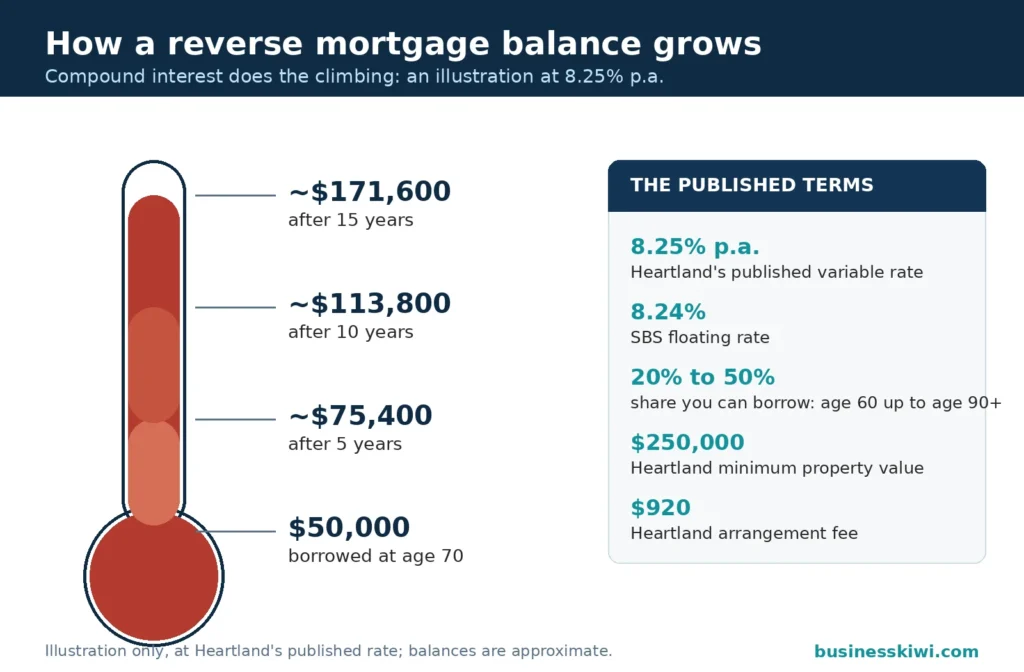
Interest is the main cost by a wide margin. To show what compounding does, here is a worked example using Heartland’s published rate of 8.25% per annum, with interest added monthly as its fact sheet describes. It assumes a 70-year-old borrows $50,000 as a single lump sum, makes no repayments, draws nothing further, and the rate never changes. The rate is variable in reality, so treat this as an illustration of the pattern, not a promise.
The debt roughly doubles in nine to ten years at this rate. After 15 years you would owe about three and a half times what you borrowed, even though you received no further money after day one. This is why both the amount you draw and the number of years the loan runs matter so much, and why drawing small amounts later rather than a large amount now usually costs less overall.
Fees
Fees are smaller than the interest but not trivial, and most are deducted from your first drawdown or added to the loan, where they then attract interest themselves.
Heartland’s fact sheet (effective 29 September 2026, fees include GST) lists:
- Arrangement fee: $920
- Valuation: an initial online valuation (i-val) costs $17.14; a full market valuation, where required, is priced individually, with an indicative cost of $850 to $1,500
- Monthly advance establishment fee: $120 (one-off, only if you take the monthly advance option)
- Equity protection fee: $55 (only if you take that option)
- Further advance fee: $455, and a variation fee of $375 if the loan terms are changed
- Administration fee: $23 each time Heartland pays rates or insurance costs on your behalf
- Mortgage discharge fee: $270 when the loan is fully repaid
SBS publishes a separate Reverse Equity Mortgage Fees and Charges schedule (effective 10 October 2024). Its main items are:
- Loan application fee: nil
- Lender legal fee: $828 for individual or joint borrowers, or $885.50 where a trust is involved
- Discharge fee: $40 per security
- Other external adviser costs the bank incurs: charged at actual cost
On top of lender fees, budget for your own solicitor. Heartland requires you to obtain independent legal advice before the loan settles, and your lawyer’s bill is yours to pay; neither lender publishes a figure for it, because it depends on the firm you use. Sorted, the personal finance service run by Te Ara Ahunga Ora, the Retirement Commission, also strongly advises getting independent financial advice before signing, which may carry its own fee.
The no negative equity guarantee
Both lenders promise that the loan will not leave you or your estate owing more than the home is worth when it is sold.
SBS calls its version a Loan Repayment Guarantee: if the sale of your home does not cover the loan, SBS will not require you or your estate to make up the shortfall. Heartland offers the same protection, and its fact sheet makes clear the loan is repaid from the net sale proceeds, with whatever is left over kept by you or your estate.
The guarantee rests on you holding up your side of the agreement, which includes:
- keeping the property well maintained and in good repair
- keeping it insured
- paying all rates and other outgoings on time
- living in it as your main home, and not doing structural alterations without telling the lender first, in Heartland’s case
If the guarantee did not exist, a long-running loan in a flat property market could consume all the equity and leave a debt behind. With it, the risk of the balance outrunning the value sits with the lender, provided the conditions have been met.
Protecting a share of equity
Both lenders also let you ring-fence part of your home’s value:
- Heartland’s equity protection option lets you choose a percentage of the eventual net sale proceeds (up to 50%) that you or your estate are guaranteed to receive when the loan is repaid, for the one-off $55 fee. Heartland can cancel the option if there is a continuing default.
- SBS’s Equity Protection lets you agree a Protected Equity Percentage of your home’s value that remains yours regardless of the amount owing or movements in the property’s value. Choosing it reduces the maximum you can borrow.
Heartland also offers a 30-day cooling-off period: change your mind within the first 30 days and you can repay the loan, including interest and valuation fees, and have the arrangement fee and other fees refunded in full.
When the loan has to be repaid
There is no fixed term, but the loan falls due when your time in the home ends. Heartland describes the total loan, including accumulated interest and charges, as repayable when you move permanently from your home, which usually means selling the property, moving into long-term care, or passing away. Heartland allows 12 months from when you move out to repay the loan.
SBS gives a similar list: repayment is due when the last Nominated Resident moves out, passes away, or the home is sold. Its Lifetime Occupancy Guarantee means a Nominated Resident can stay for the rest of their life, so if one partner moves into care and the other stays in the house, the loan does not fall due until that second person leaves too.
Repayment normally comes from selling the property, but it can come from other funds if you or your estate have them. Whatever is left after the loan is repaid goes to you or your estate.
Voluntary repayments are allowed along the way. Heartland charges no fee for them (subject to the $5,000 minimum balance rule), and SBS says repayments can be made at any time. Paying even the interest as it accrues, if you can afford to, keeps the balance flat and preserves far more equity.
Risks and downsides
Less to leave behind. This is the consequence most families feel. The loan reduces the equity in your home every month, so there will be less, possibly much less, for your children or other beneficiaries. Sorted advises talking the decision through with family before signing, and lenders are expected under the Responsible Lending Code to ask whether you want to leave equity in the property for your estate.
Compounding over a long retirement. A loan taken at 62 could run for 25 years or more, and at recent rates a balance can multiply several times over in that span. House prices may rise and offset some of the growth, but Sorted advises looking at worst-case projections and not assuming your property will increase in value.
Your home must stay your home. The loan is built around you living in the property. If you move in with family, move into care, or sell up, repayment is triggered. Heartland’s 12-month repayment window softens this, but the loan still has to be cleared.
Benefits and entitlements. NZ Super itself is not generally affected by owning your home, but a reverse mortgage changes your asset picture, and cash drawn down and held in the bank can count as an asset for some purposes, particularly if you later apply for the Residential Care Subsidy, which is asset tested. The rules are detailed and change over time, so check your own position with Work and Income before borrowing, especially if residential care is a realistic prospect.
Rates can rise. Both products are floating. If interest rates climb and stay high, your balance will grow faster than any illustration you were given at the start.
Less flexibility later. The mortgage sits over your property, so you cannot take another loan against the home, and if you borrowed the maximum for your age you may have no room to draw more when an urgent cost, such as major repairs or care costs, turns up.
Default conditions still apply. Failing to insure the home, pay rates or maintain it can put you in default. Heartland notes a default interest rate may apply in limited circumstances, and SBS publishes a default interest rate of 4.00% per annum charged above the reverse mortgage rate if a payment due is missed.
Alternatives worth weighing up
- Downsizing. Selling and buying somewhere smaller or cheaper frees up cash permanently, with no interest cost. Sorted notes the trade-offs: moving costs, leaving your community and support networks, and possibly moving further from services.
- Selling a share of your home. Sorted also describes debt-free equity release, sometimes called home reversion, where you sell a portion of your home to a company in return for income over a set period (Sorted’s example has payments over 10 years, with the company later receiving its share, typically 35%, when the property is sold). You are selling ownership rather than borrowing, so the questions to ask are different.
- An ordinary home loan or top-up. If you still have income and could service repayments, a standard loan is cheaper. The catch is that lenders must assess affordability, and the repayments may be the thing you are trying to avoid.
- Family arrangements. Some families help informally, or a family member may contribute towards costs in return for a documented share in the property. Get any such arrangement written up with legal advice, for everyone’s protection.
- Doing nothing, or spending other savings first. Using savings or KiwiSaver funds before borrowing against the house avoids compounding interest altogether, though it reduces your readily available reserves.
Getting advice before you sign
A reverse mortgage is difficult to unwind and can run for decades, so advice is not a formality.
Heartland requires independent legal advice: its loan documents go to your solicitor, who must advise you before you sign. It also strongly recommends independent financial advice, and discussing the decision with a trusted friend or family member. SBS operates under the same responsible lending framework, under which a lender considering a reverse mortgage must ask about your future needs and objectives, including aged care and whether you want to leave equity in the property.
Sorted’s guidance lines up with this: talk it over with family, get independent financial and legal advice, understand the fees and interest charges fully, and test the cost projections against a worst-case scenario rather than an optimistic one.
FAQs
Which banks offer reverse mortgages in New Zealand?
Two banks currently market reverse mortgages in New Zealand: Heartland Bank, with the Heartland Reverse Mortgage, and SBS Bank, with its SBS Unwind reverse equity mortgage. Both are available to homeowners aged 60 and over.
What interest rate do NZ reverse mortgages charge?
Both providers use floating rates. Heartland’s fact sheet effective 29 September 2026 lists 8.25% per annum, and SBS’s published rates page shows 8.24% per annum for its Unwind and Advance reverse equity loans, effective for new lending from 31 July 2026. Both rates are variable, and interest is added to the loan monthly rather than paid.
Can I lose my home with a reverse mortgage?
You keep ownership and both lenders guarantee you can live in the home for life, as long as you meet the loan conditions: keeping it insured, maintained and your main residence, and paying rates. The loan only falls due when the last borrower or Nominated Resident moves out permanently, sells, or passes away. The no negative equity guarantee also means you or your estate will not owe more than the home sells for, provided the conditions were met.
How much can I borrow at age 70?
Heartland’s scale allows up to 30% of the home’s value at age 70. SBS works to a maximum that rises from 10% at age 60 to 30% at age 80 and up to 50% at the top end. On a $700,000 home, 30% is $210,000. These are maximums, not entitlements, and the lender still assesses your property and circumstances.
Will a reverse mortgage affect my NZ Super?
A reverse mortgage does not change your basic entitlement to NZ Super, but money you draw and hold as savings can count in asset tests for other support, including the Residential Care Subsidy if you later need long-term care. Because the rules are detailed, confirm your position with Work and Income before you borrow.
Sources
- Heartland Bank, Reverse Mortgage Fact Sheet (effective 29 September 2026), heartland.co.nz
- Heartland Bank, Reverse mortgage draw down options, heartland.co.nz
- SBS Bank, Reverse equity mortgages (SBS Unwind), sbsbank.co.nz
- SBS Bank, Loan, interest and investment rates (Reverse Equity Mortgage rates), sbsbank.co.nz
- SBS Bank, Reverse Equity Mortgage Fees and Charges Schedule (effective 10 October 2024), sbsbank.co.nz
- Sorted (Te Ara Ahunga Ora Retirement Commission), How to plan, save and invest for retirement, sorted.org.nz
- Consumer Protection (MBIE), Responsible Lending Code, consumerprotection.govt.nz
More money and borrowing guides are in our Finance hub.
Disclaimer
This article is general information about how reverse mortgages work in New Zealand, based on the providers’ published product information at the time of writing. Interest rates, fees and product terms change, so confirm the current details with the lender before relying on them. It is not financial advice and does not take your personal circumstances into account. A reverse mortgage is a significant, long-term decision: speak to a licensed financial adviser and get independent legal advice before signing anything.