Switching Home Loans in NZ: Refinancing Costs, Break Fees and When It Pays

The quick answer
Switching your home loan to a new bank is called refinancing. It means your old loan is repaid in full and closed, and a new loan is drawn down with the new lender. That differs from refixing, where you stay with your current bank and lock in a new fixed rate when the old one expires.
A switch only pays when the interest you save beats everything it costs to move: the break fee on any fixed loan you end early, your old bank’s discharge fee, legal fees, any application fee at the new bank, a valuation if the new bank wants one, and possibly repaying some of a cash contribution from when you took out the current loan. Add those up, work out how many months of interest savings cover them, and compare that with how long you expect to keep the new loan. If the break-even point sits well inside that horizon, switching is worth a serious look. If it does not, refixing where you are is usually the smarter move.
Switching and refixing are not the same thing
People use the words loosely, but the two transactions work very differently.
Refixing happens inside your existing loan. When a fixed term ends, your bank offers you new fixed rates and you pick one. No new application, no discharge, no lawyers, and no break fee, because nothing is being repaid early.
Refinancing closes the old loan entirely. The new bank runs a full application, assesses your income and spending as if you were a new borrower, registers its own mortgage over your property, and your old bank’s mortgage is discharged. Because the old loan is repaid on a set settlement day, anything still inside a fixed term is being broken, and that is where break fees come from.
That distinction drives the whole decision. A refix costs nothing and can be done at every rate expiry. A refinance can unlock a better rate, better loan features or a cash contribution, but it carries real transaction costs and a fresh credit assessment. Comparing the two fairly means comparing total cost, not the headline rate.
Break fees, explained properly
A break fee (banks also call it an early repayment charge, an early repayment adjustment or, at ANZ, an Early Repayment Recovery) is compensation for the loss a lender makes when a fixed rate loan is repaid before the fixed term ends.
When you fix, your bank funds that loan in wholesale money markets at rates linked to your fixed term. If market rates have fallen since you fixed, the bank can only re-lend the repaid money at the lower current rates, so it loses the difference for the rest of your term. The break fee is an estimate of that loss. Consumer Protection’s mortgage guidance makes the same basic point: changing your rate or term partway through can trigger break fees. The fee is a feature of breaking a fixed contract, not a penalty for leaving a bank.
The broad calculation, as banks describe it and as the law frames it, runs like this:
- Take the difference between your fixed interest rate and the wholesale rate the bank could now get for the time left on your fixed term.
- Apply that difference to the amount being repaid early.
- Multiply by the time remaining on the fixed term.
A large balance, a big rate fall and a long time left to run produce a large fee. A small balance with a few months to go produces a small one. Kiwibank’s fees booklet puts it in general terms: its fixed rate break costs vary with current interest rates and how long the fixed term has left to run. ASB says the same about its Early Repayment Adjustment.
Two consequences follow from how the fee is built. First, if interest rates have risen since you fixed, the bank can re-lend at higher rates and makes no loss, so the break fee is usually nil or close to it. Breaking in a rising rate market can therefore cost nothing in break fees, though the other switching costs still apply. Second, the fee moves daily with wholesale markets. A quote is a snapshot, not a promise, and the final figure is set on the day the loan is actually repaid.
What the law says about break fees
Home loans sit under the Credit Contracts and Consumer Finance Act 2003 (CCCFA). The Act gives you the right to repay your loan in full at any time. On a full repayment, section 51 caps what the lender can charge: the unpaid balance, interest and fees only up to the repayment date, an administration fee that reasonably covers the lender’s costs, and a further fee or charge that cannot exceed a reasonable estimate of the lender’s loss from the early repayment, worked out under section 54.
Section 54 gives lenders two routes for estimating that loss. They can use the safe harbour formula set out in the Credit Contracts and Consumer Finance Regulations, or their own appropriate procedure. Commerce Commission guidance on credit fees adds the practical detail that a prepayment fee can only be charged on the fixed rate portion being repaid early. It cannot be charged on floating rate lending, and on a split loan it is apportioned to the fixed part only. A separate administration fee for processing the prepayment must also be reasonable.
In practice this means three things for a borrower. The fee must be tied to the lender’s actual interest rate loss, not set as a flat penalty. It applies only to fixed lending. And you are entitled to ask your lender for the figure before you commit to anything. Sorted advises anyone thinking of breaking a fixed loan to ask their bank to put the break fee in writing, because only your current lender can give you the exact number. Do that first, before you fall in love with another bank’s advertised rate.

The full cost of switching
Break fees get the attention, but they are only one line in the bill. Sorted’s refinancing guide lists the same set of costs: break fees, repayment of cash incentives, exit or discharge fees, solicitor fees, new valuations and application fees. Here is each one.
Break fee. As above. Anything from nil to many thousands of dollars, depending on rate movements, balance and time left fixed. Get it in writing from your current bank.
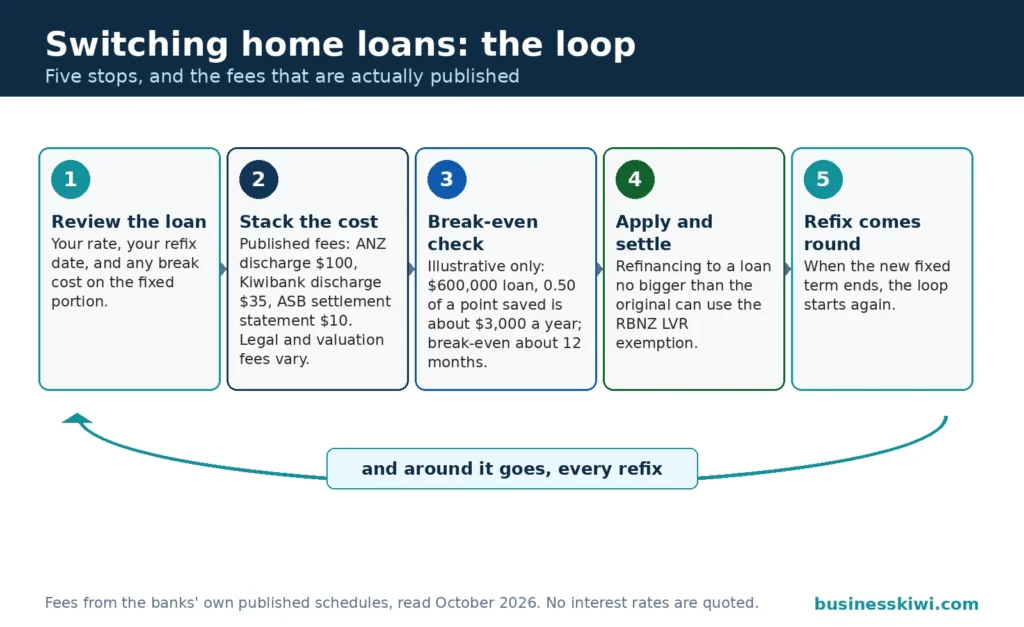
Discharge fee. Your old bank charges to prepare and register the discharge of its mortgage. Published figures from the banks’ own fee schedules, checked on 7 October 2026, show how much these vary. ANZ’s Fees and Charges booklet (effective 1 September 2026) lists a Discharge or Execution fee of $100. Kiwibank’s Personal Banking Fees and Limits booklet lists a discharge of security fee of $35 per request for a full discharge. ASB charges a $10 settlement statement fee when your solicitor requests the settlement statement as part of releasing your mortgage. Your bank’s figure sits in its own fees booklet and on the settlement statement.
Legal fees. A solicitor or conveyancer handles the discharge of the old mortgage and the registration of the new one, and moves the money on settlement day. Lawyers set their own fees and no regulator publishes a standard figure, so get a quote. This is usually the largest of the fixed costs after any break fee.
Application or establishment fee at the new bank. Some banks charge one, some do not, and they are often negotiable for switching customers. ANZ’s current fees booklet lists no application fee for home loans. Ask for the fee to be confirmed in writing as part of any offer, and ask whether it will be waived.
Registered valuation. The new bank may require a registered valuation of your property, particularly where your equity is thin or the property is unusual. The bank orders it and you pay the valuer’s charge, which varies with the property and the firm. There is no published standard price, so any figure quoted is specific to your property.
Cash contribution clawback. If your current bank paid you a cash contribution when you took out the loan, leaving inside the clawback period usually means repaying some or all of it. This belongs in the cost stack even though it is easy to forget, and the cashback section below deals with it in more detail.
Low equity costs. If you are borrowing more than 80 percent of the property’s value, expect a low equity margin or premium on the new loan. ASB, for example, publishes low equity margin bands that add to the interest rate at higher loan-to-value ratios. That extra margin is a real cost of the new loan and belongs in your comparison.

The break-even maths
The decision reduces to one division: total switching costs divided by the monthly interest saving. The answer is the number of months the new loan needs to survive before you are actually ahead.
Work through this illustrative example. The rates are round numbers chosen for the maths, not a quote from any bank.
- Loan balance: $600,000
- New rate is 0.50 percentage points lower than your current rate
- Gross interest saving: about $3,000 in the first year (0.50 percent of $600,000), roughly $250 a month, easing slightly as the balance falls
Now the costs, again illustrative apart from the discharge fee, where the ANZ figure is real:
- Break fee: $1,500
- Legal fees: $1,000
- Discharge fee: $100
- Application fee: $400 (if not waived)
- Total: $3,000
$3,000 of costs against about $250 a month of savings gives a break-even of roughly 12 months. Hold the new loan for three years and you are ahead by around $6,000 on these numbers. Sell the house or refinance again inside the first year and the switch lost money.
Sensitivity matters more than precision here. If the break fee were $6,000 instead of $1,500, the total cost becomes $7,500 and break-even stretches to about 30 months. If the rate gap were only 0.25 points, the monthly saving halves to about $125 and the original $3,000 cost stack takes roughly 24 months to recover. Run your own numbers with your written break fee quote.
One more refinement. Keeping your repayments at the old, higher level after switching turns an interest saving into faster debt reduction, which compounds the benefit. Dropping repayments to the new minimum stretches the loan out and can eat the saving entirely.
A word on cashback offers
New banks often dangle a cash contribution to win your loan. Treat it as one input in the maths, never as the reason to switch. The money is real, but it comes with a clawback term, commonly several years, and repaying it early becomes part of your cost stack if you move again. A generous cashback attached to a mediocre rate can easily be worth less than a smaller offer on a sharper rate. The full picture, including typical clawback structures and the amounts banks have been offering, is in our guide to mortgage cash back.
The switching process, step by step
- Get your numbers from your current bank. Ask for a break fee estimate in writing and a settlement figure. Ask whether any cash contribution is still inside its clawback period and what would be repayable.
- Approach the new bank with the full picture. Give them the balance, the property, your income and the break fee.
- Apply formally. The new bank assesses you as a new borrower: income, expenses, credit history, property value. Under the CCCFA’s lender responsibility principles, the lender must check the loan is suitable for you and that you can afford it. Approval is not a formality.
- Accept the offer and instruct your solicitor. Once you accept, your solicitor prepares the new mortgage documents and a discharge authority for the old loan. Do not discharge anything until the new loan is unconditionally approved and the documents are ready.
- Settlement day. The new loan is drawn down, the money flows through your solicitor, the old loan is repaid in full (including the break fee as calculated that day), the old mortgage is discharged and the new one registered against the title.
- Rebuild your banking plumbing. Salary credits, automatic payments, direct debits and insurance payments tied to the old bank need to move. Offset and revolving credit arrangements end with the old loan, so rethink any balances parked against them. Work through statements for a month or two afterwards to catch anything still pointing at closed accounts.
KiwiSaver is not tied to your mortgage lender. Moving your home loan does not move your KiwiSaver scheme, and switching banks does not require you to change provider.
Refixing first: the cheaper answer more often than you would think
Before paying anything to move, test what staying looks like. Your current bank knows it can lose you at every fixed term expiry, and retention pricing exists even if it is not advertised. The conversation costs nothing: tell them the rate and terms you have been offered elsewhere, and ask what they can do. Banks would generally rather sharpen a rate than process a discharge.
Staying also avoids the hidden costs. No break fee if you refix at expiry. No legal fees. No valuation. No new clawback clock unless you take a fresh cash contribution. If your current bank gets within a small margin of the rival offer, the gap rarely survives the cost stack, and refixing wins on the maths.
Refinancing pulls ahead when the rate gap is wide and durable, when you need features your bank does not offer (an offset account, different split structure, better extra repayment terms), when your equity position has improved enough to access pricing your current bank will not match, or when a cash contribution on top of a genuinely better rate tips the total decisively.
When switching does not pay
Plenty of switches should never happen. The common ones:
- Small balances. A $150,000 loan saving 0.50 points gains about $750 a year. A normal cost stack swallows that for two years or more.
- Short horizons. Planning to sell, move overseas or repay the loan within a year or two leaves little time to clear break-even, and a fresh clawback term may still be running when you exit.
- A large break fee. If rates have fallen hard since you fixed and years remain on the term, the fee can exceed several years of savings at the new rate. Waiting for the fixed term to expire is often the cheapest strategy available.
- Your circumstances have changed. The new bank assesses you fresh. Reduced income, a new dependent, recent self-employment or a patchy repayment history can mean approval at a worse rate, or no approval at all.
- Your LVR has moved against you. If the property’s value has fallen or the balance has not reduced much, you may land in low equity territory at the new bank, with margins that erase the rate advantage.
- Decline risk after breaking. The dangerous sequence is breaking the old fixed loan before the new one is unconditionally approved. If the new application is then declined, you have paid a break fee for nothing and sit on a floating rate. Get the new approval locked in first, in writing, before anything is discharged.
LVR rules and the fresh assessment
A refinance is new lending, and the new bank applies its own criteria along with the Reserve Bank’s macroprudential rules. The Reserve Bank’s loan-to-value ratio restrictions currently allow banks to put no more than 25 percent of new owner-occupier lending above an 80 percent LVR, and no more than 10 percent of new investor lending above a 70 percent LVR. Debt-to-income restrictions sit alongside them.
One rule works in switchers’ favour. The Reserve Bank lists refinancing among the exemptions from the LVR restrictions where the new loan does not exceed the original loan value. That exemption does not oblige any bank to approve you, and banks apply their own lending criteria regardless. It simply means a like-for-like refinance is not competing for the bank’s limited high-LVR quota.
Affordability is the real gate. The new bank stress-tests your repayments at a rate above the one you will actually pay, counts your living costs and other debts, and checks the figures against its policy. Working out how much can I borrow under those tests before you apply tells you whether the switch is even available.
FAQs
Can I break my fixed rate home loan at any time?
Yes. The CCCFA gives you the right to repay a loan in full at any time. Your lender can charge an administration fee and a fee capped at a reasonable estimate of its loss from the early repayment. On floating rate lending there is no interest rate loss, so no break fee applies.
How do I find out my exact break fee?
Ask your current bank. It is the only party that can calculate the figure for your loan, and Sorted advises getting it in writing or by email before you decide anything. The amount changes as wholesale rates move, so the final figure is set on the day the loan is repaid.
Does switching banks affect my KiwiSaver?
No. KiwiSaver is a separate product from your home loan. Refinancing your mortgage does not move your KiwiSaver account, even if both sit with the same bank, and you do not need to change KiwiSaver providers to change lenders.
Will I need a new valuation to refinance?
Sometimes. The new bank may require a registered valuation, particularly if your equity is under 20 percent or the property is hard to compare with recent sales. If it does, the bank orders the valuation and the cost falls on you. Ask during the application so the cost goes into your break-even maths.
Is it better to refix or refinance?
Refixing costs nothing and suits most people at most rate expiries. Refinancing pays when the total benefit, meaning the interest saving over the time you will hold the loan plus any cash contribution, clearly exceeds the full cost of switching. Run the break-even calculation with your written break fee before deciding.
Sources
- Consumer Protection (MBIE), Mortgages and home loans, consumerprotection.govt.nz, checked 7 October 2026
- Credit Contracts and Consumer Finance Act 2003, sections 43, 51 and 54, legislation.govt.nz
- Commerce Commission, Consumer Credit Fees Guidelines and During the loan consumer guide, comcom.govt.nz
- Reserve Bank of New Zealand, Loan-to-value ratio restrictions, rbnz.govt.nz, checked 7 October 2026
- Sorted (Retirement Commission), How to refinance your mortgage, sorted.org.nz, checked 7 October 2026
- ANZ, Fees and Charges booklet, effective 1 September 2026, anz.co.nz
- Kiwibank, Personal Banking Fees and Limits booklet, media.kiwibank.co.nz
- ASB, Home loan interest rates and fees, asb.co.nz, checked 7 October 2026
More guides like this one sit in our Finance hub.
Disclaimer
This article is general information about how home loan switching works in New Zealand. It is not personalised financial advice and it does not take your situation into account. Interest rates, fees and bank policies change, and every figure here should be confirmed with the lender concerned before you act. For advice on your own loan, talk to your lender or a licensed financial adviser.