On a Benefit and Need Cash Fast? Work and Income Advances vs Payday Loans

The short answer
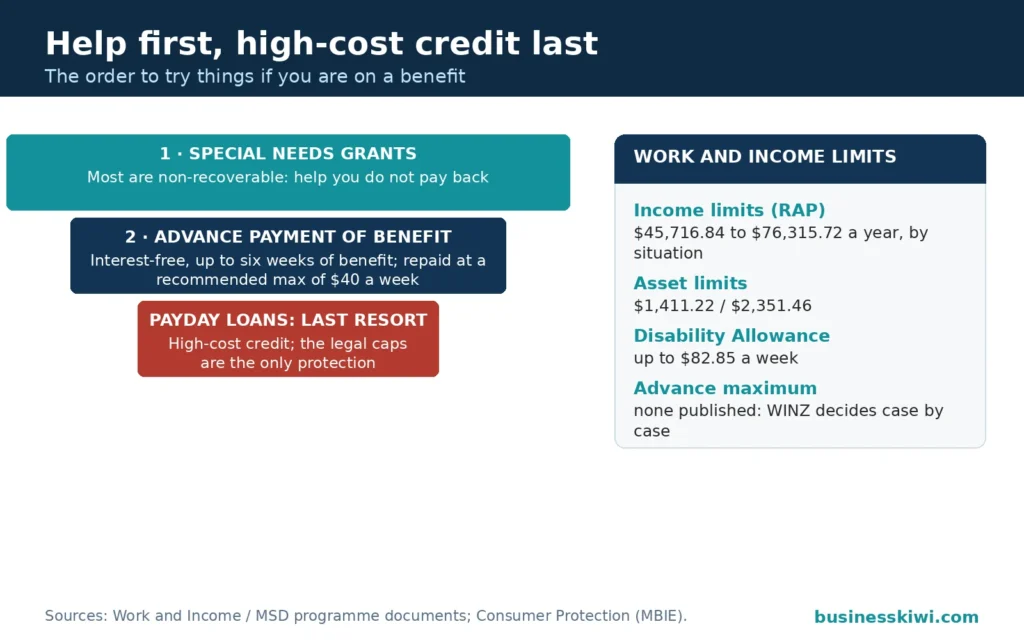
If you receive a benefit and an urgent cost lands on you this week, ring Work and Income before you ring anyone else. A beneficiary can usually get an Advance Payment of Benefit for an essential one-off cost. It carries no interest, and you repay it through small deductions from your future benefit payments. People who are not on a benefit but earn a low income may qualify for a Recoverable Assistance Payment instead, which is also interest free. A Special Needs Grant can cover urgent essential costs such as food, and most of these grants do not have to be paid back at all.
Compare that with a payday or high-cost loan. Even with the legal caps that now apply in New Zealand, a high-cost loan can still cost you up to twice what you borrowed. A $500 advance from Work and Income costs you $500 in total. A $500 high-cost loan can legally cost up to $1,000 in total. That gap is the whole story of this guide.
Start with Work and Income’s urgent costs help
Work and Income has a dedicated set of payments for urgent or unexpected costs. Which one fits depends on whether you are already receiving payments from them.
If you are on a benefit, the options are a Special Needs Grant or an Advance Payment of Benefit. If you are not on a benefit, the options are a Special Needs Grant or a Recoverable Assistance Payment. All of them are applied for by calling 0800 559 009. Work and Income will talk through your situation, work out which payment fits, and tell you what information you need to provide.
You do not need to walk in knowing the name of the right payment. Knowing that the help exists, and asking before you borrow anywhere else, is the part that matters.

Advance Payment of Benefit: the main option if you are on a benefit
An Advance Payment of Benefit is a one-off payment for an essential or emergency cost you cannot pay for another way. To get one you must be receiving a main benefit such as Jobseeker Support, a pension, or Orphan’s or Unsupported Child’s Benefit. The money has to be paid back. Work and Income recovers it by deduction from your benefit, a little at a time, rather than asking you to find a lump sum.
What an advance can cover
Work and Income publishes a long list of costs an advance can help with. It includes appliances and furniture, bedding, beds, chairs and tables, fridges, freezers and washing machines, car repairs, a child car seat, clothing, dental treatment, dentures and hearing aids, glasses, electricity, gas and water costs, essential home repairs, school costs including stationery and uniforms, ambulance subscription fees, funerals and tangihanga, safety footwear, travel when you are stranded, Tenancy Tribunal fees, and help with the costs of ending a tenancy early. That list is not exhaustive, and the test is whether the cost is essential or an emergency in your situation.
How much you can get
There is no single dollar figure published for advances. How much you can get depends on your situation and what you need the money for, and Work and Income assesses each application case by case. The Ministry of Social Development describes benefit advances as up to six weeks’ worth of benefit payments, which gives you a sense of the scale, but the actual amount is set by your need and your circumstances. Any Work and Income debt you already owe is also weighed up, because existing debt affects access to further advances.
How you pay it back
Repayment comes out of your benefit automatically, in regular deductions. Two protections are worth knowing. First, no interest is charged, so the balance only ever goes down. Second, MSD’s own policy manual sets a recommended maximum recovery rate of $40 a week for clients receiving income support, covering advances, recoverable Special Needs Grants and benefit overpayments combined, unless you volunteer to pay more. When MSD sets a recovery rate it is required to consider your ability to meet your own needs and your dependants’ needs, and whether the rate would cause undue hardship. If deductions are making life impossible, that is a conversation you are entitled to have with them.
How to apply
Call 0800 559 009 and explain what the cost is. Work and Income will tell you what information or evidence they need. If your application is approved, you will be given a payment card if you do not already have one, and the money is loaded onto it. You have 7 days to spend the money before it expires. The card works like an Eftpos card at supermarkets and stores, and you can log in to MyMSD to check the balance and the expiry date.
Recoverable Assistance Payment: if you are not on a benefit
A Recoverable Assistance Payment is the equivalent help for people who do not receive a benefit. It is interest free, recoverable financial assistance for an essential or emergency cost you cannot pay another way. You need to be a New Zealand citizen or permanent resident, normally live in New Zealand and intend to stay.
Eligibility turns on income and assets, and Work and Income publishes the current limits. Annual income before tax must be less than $45,716.84 if you are single and 16 or 17, less than $52,541.32 if you are single and 18 or over, less than $76,315.72 for a couple with or without children, less than $63,756.68 for a sole parent with one child, and less than $67,171 if you are a sole parent with two or more children. Cash assets must be worth less than $1,411.22 if you are single, or less than $2,351.46 for a couple or a sole parent. Assets for this test do not include the things you need for day-to-day living, such as your home and car. They do include money in the bank or a second property.
The list of costs it can cover is much the same as for an advance, and it also includes a driver licence. The amount is again assessed case by case rather than set at a fixed maximum. One point that catches people out: any existing Work and Income debt reduces the maximum you can receive, and if your total debt is already at or above that maximum, a further payment is generally not available unless your circumstances are exceptional. A payment also cannot be made if you would have no means of repaying it. Applying works the same way: call 0800 559 009, and approved money is loaded onto a payment card with 7 days to spend it.
Special Needs Grants: help that usually does not need repaying
A Special Needs Grant covers a cost that is immediate and essential, or an emergency, where you have no other way to pay. You can be on a benefit or not. You need to be a New Zealand citizen, a permanent resident or hold a residence class visa, and normally live here. For emergency costs, Work and Income will also consider whether you knew the cost was coming, whether you could have covered it yourself, and how the grant will help your situation.
The income and asset limits are the same tests used across these payments. Weekly income before tax must be less than $879.17 for a single 16 or 17 year old, $1,010.41 for a single adult, $1,467.61 for a couple, $1,226.09 for a sole parent with one child, or $1,291.75 for a sole parent with two or more children. The asset limits are $1,411.22 for a single person and $2,351.46 for a couple or sole parent.
The most important thing to know about these grants is that most of them are non-recoverable. MSD’s own description of the system states plainly that most Special Needs Grants do not need to be paid back. Food is the classic example: if you have no money in the bank and no other way to pay for food, Work and Income may be able to help. Other costs the grant can cover include dental treatment, bedding, a driver licence, health travel costs, ambulance fees, medical treatment and medical equipment. How much you get depends on your situation and the cost involved. Apply by calling 0800 559 009. Approved amounts are loaded onto a payment card, you have 7 days to spend them, and you can track the balance and expiry in MyMSD.
Other Work and Income help worth asking about
An urgent cost is sometimes a symptom of a weekly budget that no longer adds up. Two ongoing payments are worth knowing about, because both can lift your regular income rather than just covering one bill.
Temporary Additional Support helps with ongoing essential costs when your regular expenses leave you short. It can take in accommodation costs such as rent or board, employment costs such as public transport to work or childcare, essential household items, and health and disability costs. It is not taxed, the amount depends on your situation, and it can be paid for up to 13 weeks at a time. You do not have to be on a main benefit to be considered.
Disability Allowance is a weekly payment for regular, ongoing costs that exist because of a disability or health condition, things like doctor visits, medicines, counselling, medical alarms, or extra power and heating costs. The disability needs to be likely to last at least 6 months and the costs must not be fully covered by another agency. You do not have to be on a benefit to qualify, income limits apply, and Work and Income pays up to a maximum of $82.85 a week.
When you contact Work and Income about any of this, ask them to check what else you might qualify for. Their own guidance points people to a “Check what you might get” tool for exactly this reason. Plenty of people are missing payments they are entitled to simply because nobody has run the full check.
If you already owe Work and Income money
Advances, recoverable grants and benefit overpayments all sit in the same bucket: Work and Income debt. If you are on a benefit, the debt is recovered through regular deductions from your payments. If you have been overpaid, you will be told the reason, the amount, and your review and appeal rights. If you apply for a review or appeal of a debt or its recovery rate, recovery action is suspended until the outcome is known.
Coming off a benefit does not wipe the slate. The debt remains, and you will need to make your own arrangements to repay it. The reassuring parts are real: Work and Income does not charge interest or penalties on the debt, even while you are repaying it off-benefit. If you miss a repayment, you get a reminder letter, not a penalty. Their Client Support Debt Management team can set up a repayment plan based on what you can afford, and repayments can be deducted from wages when you start a new job if you let them know before you begin. Ignore the debt entirely and the picture changes: after trying to contact you, they can take legal steps to recover it without your consent, including deductions from your wages or your bank account, and unpaid debt can affect what financial help you can get from them in the future. Talking early is very much in your favour.

The payday loan alternative, and what it really costs
Payday loans and other high-cost loans are marketed hard at people whose income arrives on a predictable date, and benefit income fits that description exactly. “Beneficiary loans” with fast or guaranteed approval are a recognised sales pitch in this market. Before you sign anything, it helps to know the legal limits, because they are the only thing standing between you and a much worse outcome.
Under the Credit Contracts and Consumer Finance Act, a high-cost loan is one with an annual interest rate of 50 percent or more. For these loans the law says a lender cannot ask you to repay more than twice the amount you borrowed, which caps total interest and fees at 100 percent of the amount borrowed. Interest and fees cannot exceed 0.8 percent of the unpaid balance per day, averaged across the term. Compound interest is banned, so interest cannot be charged on interest. Default fees for missed payments must be $30 or less. Every lender must also assess whether a loan suits your needs and whether you can afford the repayments without suffering substantial hardship, and lenders must be registered on the Financial Service Providers Register and belong to an approved dispute resolution scheme. An unregistered lender cannot legally charge you interest or fees at all.
Those caps matter, but read what they still allow. Borrow $500 on a high-cost loan and the law lets the total repayable reach $1,000. The same $500 through a Work and Income advance costs you $500, repaid gradually by deduction. Our small loans guide covers the loan rules and caps in full if you want the detail. The caps are a safety net, not a bargain.
Warning signs to watch for
Treat any lender advertising specifically to beneficiaries as a reason to slow down, not speed up. Guaranteed approval is a red flag: a lender who promises approval before checking affordability is skipping a legal duty, not doing you a favour. Be wary of repayment setups designed to take money from your account the moment your benefit lands, before food and rent are covered. You can cancel a direct debit at any time through your bank, a right Consumer Protection confirms, but it is better not to hand over that control in the first place. Check any lender on the Financial Service Providers Register before borrowing; if they are not on it, walk away. And if a lender discourages you from talking to Work and Income or a financial mentor first, that tells you what you need to know.
Free help before you borrow
You do not have to sort this out alone, and the help is free. MoneyTalks is a free financial helpline on 0800 345 123 that can talk through your options and connect you with a local financial mentor. Financial mentors provide free one-on-one support: they can look at your whole budget, deal with lenders on your behalf, check you are receiving everything you are entitled to, and help you build a plan that lasts longer than one hard week. MoneyMates groups and local Citizens Advice Bureau services can help in similar ways. None of these services will judge you, and none of them will try to sell you a loan.
If you are comparing other ways to handle money stress, the guides in our Finance hub cover borrowing costs, budgeting basics and debt options in plain language.
Frequently asked questions
Do I have to pay back a Work and Income advance?
Yes. An Advance Payment of Benefit is recoverable, which means Work and Income deducts it gradually from your future benefit payments until it is cleared. No interest is added, so you only ever repay the amount you received. MSD policy sets a recommended maximum recovery rate of $40 a week for people on income support, unless you choose to pay more.
How much can I get as an advance?
There is no fixed dollar amount published. The amount depends on your situation and the essential cost you are facing, and MSD describes advances as up to six weeks’ worth of benefit payments. Debt you already owe Work and Income can reduce what you can access, so it pays to ask even if you already have a balance.
Can I get help if I am working and not on a benefit?
Quite possibly. A Recoverable Assistance Payment is designed for people not on a benefit whose income and assets are under the published limits, and Special Needs Grants are open to non-beneficiaries too. Temporary Additional Support and Disability Allowance also do not require you to be on a main benefit.
Does a Special Needs Grant have to be paid back?
Usually not. Most Special Needs Grants are non-recoverable, including help with food. A small number of specific grants are recoverable, and Work and Income will tell you at the time if yours is one of them.
What happens to my Work and Income debt when I start work?
The debt stays with you, but no interest or penalties are charged on it. Contact the Client Support Debt Management team before you start your new job, and they can arrange a repayment plan you can afford, including deductions from your wages if that suits. Not repaying can affect future help from Work and Income, so keep them in the loop.
Sources
- Work and Income, Advance Payment of Benefit: https://www.workandincome.govt.nz/products/a-z-benefits/advance-payment-of-benefit.html
- Work and Income, Recoverable Assistance Payment: https://www.workandincome.govt.nz/products/a-z-benefits/recoverable-assistance-payment-grant
- Work and Income, Special Needs Grant: https://www.workandincome.govt.nz/products/a-z-benefits/special-needs-grant.html
- Work and Income, urgent or unexpected costs: https://www.workandincome.govt.nz/eligibility/urgent-costs
- Work and Income, Temporary Additional Support: https://www.workandincome.govt.nz/products/a-z-benefits/temporary-additional-support
- Work and Income, repaying debt if you are not getting a benefit or pension: https://www.workandincome.govt.nz/on-a-benefit/debt/repaying-debt-not-on-a-benefit
- Ministry of Social Development, Recoverable Assistance Programme and benefit fact sheet documentation (interest free assistance; most Special Needs Grants non-recoverable)
- Consumer Protection (MBIE), Credit Contracts and Consumer Finance Act and payday loans guidance: https://www.consumerprotection.govt.nz/help-product-service/borrowing-money/loans-and-lenders
- MoneyTalks, free financial helpline 0800 345 123: https://www.moneytalks.co.nz
Disclaimer
This article is general information about the payments and rules described, based on official sources checked in October 2026. It is not financial advice, and it cannot account for your individual circumstances. Payment amounts, limits and eligibility are assessed by Work and Income case by case and can change. Before making a decision, check your own position with Work and Income on 0800 559 009, or talk to a free financial mentor through MoneyTalks on 0800 345 123.