What Is PIE Tax in NZ? Portfolio Investment Entities and PIR Rates Explained

The short answer
A portfolio investment entity, usually shortened to PIE, is a type of investment fund that pools money from lots of investors and invests it on their behalf. Most KiwiSaver schemes and a large share of managed funds sold in New Zealand are PIEs.
PIE tax is simply the tax a PIE pays on the income it earns for you. Instead of that income being taxed at your personal marginal tax rate, the fund works out your share of its earnings and taxes it at your prescribed investor rate, or PIR. For resident individuals the PIR is 10.5%, 17.5% or 28%, depending on your income over the previous two tax years.
The feature people like most is that PIE tax is normally final. If your PIR is correct, the tax the fund pays settles your liability on that income. The income counts as excluded income, and you do not need to put it in your tax return.
What counts as a PIE?
A PIE is not a product in its own right. It is a tax status that Inland Revenue grants to an entity that meets the eligibility rules and elects to become one. The entities that can elect include a managed fund such as a unit trust or a superannuation fund, a company, a benefit fund, a life fund and a group investment fund.
In everyday investing, you will meet PIEs in two main places:
- KiwiSaver schemes. The great majority operate as PIEs, and all of the default schemes are PIEs.
- Managed funds. Most unit trusts and investment funds offered to retail investors in New Zealand are set up as PIEs, including cash funds, bond funds, diversified funds and share funds.
Because the PIE label is about tax rather than about what the fund holds, two funds with near identical investments can be taxed quite differently if one is a PIE and the other is not. The product disclosure statement for a fund will tell you whether it is one.
The different types of PIE
Not every PIE taxes its investors the same way. Inland Revenue groups them into a few types, and the type decides how your tax is calculated.
Multi-rate PIEs are the ones this article is mostly about. A multi-rate PIE (Inland Revenue shortens it to MRP) calculates tax using each investor’s own PIR, so two people in the same fund can be taxed at different rates. Most KiwiSaver schemes and managed funds are multi-rate PIEs.
Listed PIEs are exchange-listed companies registered as PIEs. They do not use PIRs: the PIE itself pays tax at its own basic rate (28% for a company) and pays dividends, which resident individuals can choose whether to include in their tax return. Listed PIE dividends are not subject to resident withholding tax.
Widely-held KiwiSaver schemes are the other flat-rate case worth knowing about. A KiwiSaver scheme is either a widely-held superannuation scheme, whose earnings are taxed at a flat 28% regardless of your income, or a PIE, where your PIR applies instead. Your provider’s product disclosure statement says which type you are in. Benefit fund PIEs and some life fund PIEs also sit outside the multi-rate system, with tax worked out at the entity’s basic rate.

What is a PIR?
Your prescribed investor rate is the tax rate your multi-rate PIE uses on your share of the fund’s income. Inland Revenue sets three rates for New Zealand tax resident individuals: 10.5% for people on lower incomes, 17.5% for people in the middle, and 28% for everyone else. There is also a 0% rate in the system, but resident individuals cannot simply choose it. More on that below.
Two things about the PIR catch people out. First, it is capped at 28%, well below the top personal tax rate of 39%. A high earner investing through a PIE pays no more than 28% on that fund income, which is one of the main reasons PIEs were created back in 2007 alongside KiwiSaver. Second, your PIR is based on your income in the last two income years, not what you earn today, so a pay rise or a drop in income can take a while to flow through.
When you join a multi-rate PIE you give the fund two things: your IRD number and your PIR. If you do not give the fund a PIR, it must tax your income at the default rate of 28%. If you are a new investor and do not provide your IRD number within six weeks, the PIE is required to close your account and return your money, less any tax calculated at the 28% default rate.
Working out your PIR: the two tests
Inland Revenue works your PIR out using two measures of income, tested against either of the two previous income years:
- Your taxable income. That is income such as salary, wages and anything else you would include in your tax return. It cannot be a negative amount.
- Your taxable income plus your PIE income. That is your taxable income plus the PIE income attributed to you, minus any attributable PIE loss. A net PIE loss does not reduce your taxable income for the first test.
You run the tests on each of the previous two years separately, and if either year produces a lower rate, that lower rate is your PIR. Inland Revenue’s example: to find your PIR for the 2026 income year, you use your income details for the 2024 and 2025 years. Most individuals have a 31 March year end, so you are looking at the two tax years that ended on the two most recent 31 March dates before the year the rate applies to.
Here are the current thresholds, as Inland Revenue publishes them in its factsheet for resident individuals (IR855, April 2025):
The last two rows work the other way around from the first three. You only land on 28% if the pattern holds across both years, that is, if neither of the two years gets you a lower rate.
Notice how low these thresholds sit: the PIR scale tops out quickly, so plenty of full-time workers with a salary above $53,500 in both of the last two years will correctly be on 28%.
If you would rather not do this by hand, Inland Revenue has a “find my prescribed investor rate” questionnaire and calculator on its website, and you can also work your rate out in myIR.
Two worked examples
The examples below are illustrative only, using round numbers to show how the tests work.
Example one: a part-time worker. Sarah works part time while studying. In one of the last two income years her taxable income was $12,000 and her KiwiSaver fund was attributed $800 of PIE income, a combined total of $12,800. Both figures fall inside the first row of the table, so her PIR is 10.5%. If her fund had taxed her at the 28% default rate because she never gave it her PIR, she would have paid far more than she owed.
Example two: a full-time salary earner. Wiremu earns a salary of $52,000 and has $4,000 of attributed PIE income from a managed fund, a combined total of $56,000. His taxable income is under $53,500 and his combined total is under $78,100, so the third row of the table applies and his PIR is 17.5%. If his salary moves above $53,500 and stays there for both test years, his PIR will step up to 28%.
What the wrong rate costs you
A too-high PIR is a common and quiet mistake: the fund keeps deducting tax, your balance keeps moving, and nothing looks wrong. Say your fund attributes $1,000 of income to you over a year. At the 28% default rate the tax is $280. At a correct PIR of 17.5% it is $175, so you have overpaid by $105. At 10.5% it is $105, an overpayment of $175. Scale that across a KiwiSaver balance producing thousands of dollars of attributed income a year, over a working lifetime, and it becomes real money. A too-low rate creates the opposite problem: you keep more in the fund during the year, but the shortfall is squared up in your tax assessment afterwards. The right rate avoids both the bill and the slow leak.
The end-of-year PIE calculation
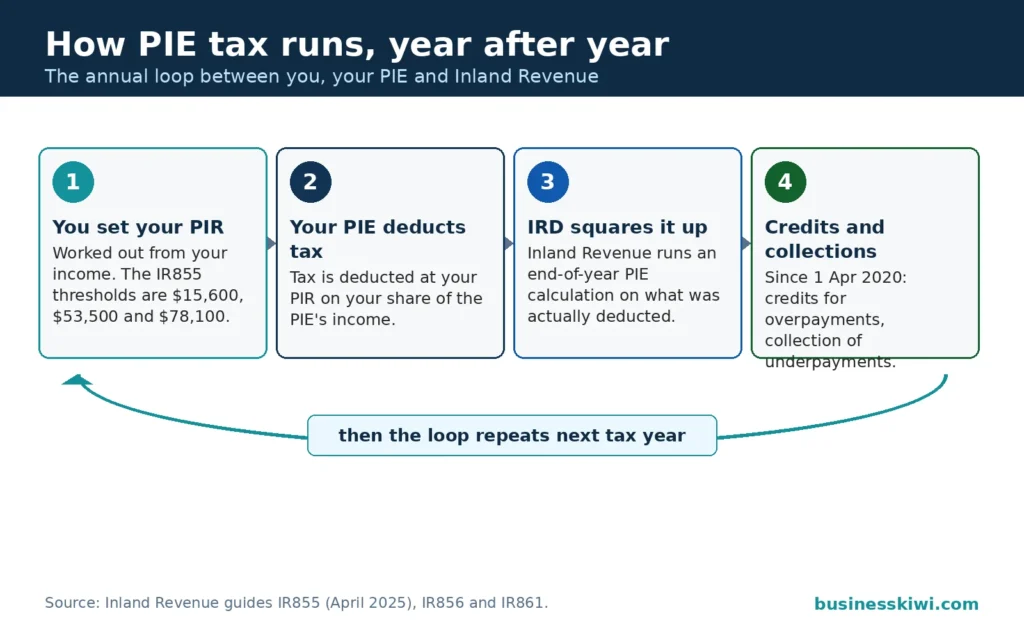
Inland Revenue runs a separate PIE calculation as part of your annual income tax assessment. Your attributed PIE income and loss are not added into your taxable income. Instead, Inland Revenue pre-populates a PIE income section (in myIR, or in the PIE calculation boxes in the paper IR3) with the details your funds report to it, and checks whether the PIR you were taxed at was correct for the year.
If the correct PIR was applied to all of your PIE income for the full year, nothing further happens. The tax stays final, and distributions paid to you by a multi-rate PIE are excluded income that never goes in your return. If the wrong rate was applied, the difference flows into your assessment:
- PIR too low. The underpayment is added to the tax you have to pay. Because the calculation happens at assessment time, credits you hold, such as foreign tax credits or imputation credits, can be used against the extra liability.
- PIR too high. The overpayment comes back as a credit, added to any refund due or subtracted from tax you owe on other income.
Older advice still circulates on this point, so the history matters. For the 2020 and earlier tax years, a too-high PIR genuinely meant no refund. Inland Revenue changed the process from 1 April 2020 so both underpayments and overpayments are dealt with through the PIE calculation in your assessment. The fund itself still will not refund you directly mid-year, but the money is no longer lost if you were overtaxed.
The KiwiSaver connection
KiwiSaver is where most New Zealanders first meet PIE tax, usually without realising it. If your scheme is a PIE, your provider taxes your investment earnings at the PIR you give it: 10.5%, 17.5% or 28%. There is no tax on the money you withdraw from KiwiSaver; the tax happens inside the fund, on the earnings, as they arise.
That is also why the fund choice and the tax setting are separate decisions. Our guide to KiwiSaver funds explains the fund types themselves. Your PIR is the tax layer over whichever fund you pick, driven by your personal income history rather than the fund. Providers ask you to check each year that you are still on the right PIR, and it is worth doing: a change in circumstances, such as moving from study into full-time work or dropping to part-time hours, can mean your rate should change once the two-year look-back catches up.
Can you use the 0% rate?
Mostly, no. Inland Revenue’s guidance for resident individuals is blunt: you cannot choose a PIR of 0%, and there are only limited situations where a zero rate is applied to an individual at all. The situations it does recognise are narrow:
- Transitional residents in a zero-rate PIE. People who have newly become New Zealand tax residents and hold the four-year temporary tax exemption on most foreign income can notify a 0% PIR if they invest in a foreign investment zero-rate PIE, for the period of their transitional residence.
- Exiting investors. A quarterly multi-rate PIE may zero-rate the income of an investor who exits mid-quarter, with the real rate applied later by Inland Revenue in the assessment.
Outside those cases, the 0% rate belongs to other kinds of investors: companies, incorporated societies and PIEs themselves are zero-rated investors, which is covered next.
Companies, trusts and joint investors
Companies. A New Zealand resident company investing in a PIE is a zero-rated investor and should give the PIE a PIR of 0%. That does not make the income tax-free. The company must include all income or loss from a multi-rate PIE in its own company tax return, where it is taxed under the normal company rules, and it can claim tax credits such as RWT or imputation credits in that return. Distributions the company receives from the PIE are not included in the return again. A non-resident company has a PIR of 28%, unless it is a notified foreign investor in a foreign investment PIE.
Trusts. Resident trustees get a choice, set out in Inland Revenue’s factsheet for trustees (IR856): 28% as a final tax, 17.5%, or 0% with the PIE income and tax credits going into the trust’s own tax return instead. Trustees of testamentary trusts can also choose 10.5%. The choice exists so trustees can pick a rate reflecting the tax position of the trust’s beneficiaries. A trustee can use different PIRs for different funds, but not within the same fund.
Joint investors and partnerships. Where an investment is held jointly or by a partnership, each holder has tax obligations for their own share of the income, and each person should give the fund their own IRD number and PIR. The fund applies the highest notified rate to the investment. Inland Revenue then splits the income and tax details equally between the holders it knows about; if your shares are not equal, you need to adjust the split in myIR or contact Inland Revenue. If one holder was taxed at a higher rate than their own PIR, the difference can come back through the end-of-year PIE calculation.
PIE tax compared with RWT
The other withholding system most people meet is resident withholding tax, which applies to interest and dividends from New Zealand bank accounts and investments. Our explainer on resident withholding tax covers that system in full. The two sit side by side in many portfolios, so it helps to see the differences clearly.
The practical takeaway: for money in bank deposits, RWT is unavoidable and the rate choice is yours to manage. For money in funds, the PIE structure caps your rate at 28% and, with the right PIR, keeps the income out of your return altogether.

How to change your PIR
Changing your rate is simple. You notify your PIE of the correct PIR, and you can do that at any time during the year; Inland Revenue says the fund may be able to backdate the change. Review your rate each year, and whenever your income pattern shifts: finishing study, changing jobs, taking parental leave or retiring can all move you between the bands once the two-year look-back catches up.
Inland Revenue can also step in: if it identifies that you are on the wrong rate, it may advise the fund of the rate it considers appropriate. And if you have never given a fund your PIR, it is taxing you at 28% in the meantime, so telling a new fund your rate when you join is the easiest win in this whole area.
FAQs
Do I have to include PIE income in my tax return?
No, not in the standard case. Attributed income from a multi-rate PIE is not included in your taxable income, and distributions from the PIE are excluded income. Inland Revenue runs a separate PIE calculation as part of your assessment, using information your funds report to it, to check the right PIR was applied. Listed PIE dividends are an exception: you can elect to include them if you want to claim imputation credits.
What happens if I never told my fund my PIR?
The fund must tax your attributed income at the default rate of 28%. That may be higher than your correct rate. Give the fund your PIR as soon as you can; if the wrong rate was applied across a year, Inland Revenue’s end-of-year PIE calculation will adjust for the difference in your assessment.
My income dropped this year. Can I use a lower PIR straight away?
Not on the strength of this year alone. Your PIR is based on either of the two previous income years, and you take the lower rate the two years produce. A lower income year starts to help once it becomes one of the two look-back years, and one low year inside the window is enough to qualify you for the lower rate.
Is KiwiSaver taxed at my PIR or at a flat rate?
It depends on your scheme type. If your KiwiSaver scheme is a PIE, which includes all of the default schemes, your earnings are taxed at your PIR. If your scheme is a widely-held superannuation scheme instead, earnings are taxed at a flat 28%. Your provider’s product disclosure statement tells you which type your scheme is, and either way you pay no tax on withdrawals.
Can my company or trust use a 0% PIR?
A New Zealand resident company can, and should: resident companies are zero-rated investors with a PIR of 0%, and they then account for the PIE income in the company tax return. Resident trustees can also choose 0%, with the income and credits then going into the trust’s return, or pick 17.5% or a final 28% instead. Resident individuals cannot choose 0% outside the narrow transitional resident and exit situations described above.
Sources
- Inland Revenue, IR855 “Information for resident individuals who invest in PIEs”, April 2025, ird.govt.nz
- Inland Revenue, IR856 “Information for trustees who invest in PIEs”, ird.govt.nz
- Inland Revenue, IR861 “Prescribed investor rate”, ird.govt.nz
- Inland Revenue, “Find your prescribed investor rate (PIR)”, ird.govt.nz
- Inland Revenue, “New Zealand resident individuals’ portfolio investment entity income”, ird.govt.nz
- Inland Revenue, “How your KiwiSaver income is taxed”, ird.govt.nz
- Inland Revenue, “Listed portfolio investment entity (PIE)”, ird.govt.nz
- Inland Revenue, “Company portfolio investment entity income”, ird.govt.nz
- Inland Revenue, “Using the right resident withholding tax (RWT) rate”, ird.govt.nz
Disclaimer
This article is general information about how PIE tax and prescribed investor rates work in New Zealand. It is not tax advice and does not take your personal circumstances into account. Tax settings change, and the right PIR depends on your own income history, so check your position with Inland Revenue’s PIR calculator or talk to a tax professional before making decisions.
More guides like this one are in our Finance hub.