Australian GST for NZ Businesses: Rates, Registration and the A$75,000 Rule

Selling into Australia looks deceptively simple from this side of the Tasman. Same language, similar business culture, customers a short flight away. The tax side is where Kiwi businesses get caught out. Australia runs its own goods and services tax, administered by the Australian Taxation Office (ATO), and it reaches across the border. If you sell goods, services or digital products to Australian customers, Australian GST can apply to those sales even though your business is based entirely in New Zealand, and in many cases you are the one expected to collect it.
This guide explains how Australian GST works for a New Zealand business: the rate, the registration threshold, the simplified registration option built for offshore sellers, the special rules for low value goods and digital products, and how all of it sits alongside your New Zealand GST obligations.
The quick answer
Australian GST is charged at 10 percent. A New Zealand business generally has to register for GST in Australia when two things are true: it is carrying on a business or enterprise, and its GST turnover from sales connected with Australia is A$75,000 or more (A$150,000 for non-profit organisations). Registration is with the ATO, separate from your New Zealand GST registration. Below that threshold you can usually stay unregistered, although voluntary registration is allowed. Special rules bring sales of low value goods (customs value of A$1,000 or less), imported services and digital products to Australian consumers squarely inside the system, so an online seller with no Australian office, warehouse or staff can still be caught.
How Australian GST works
The mechanics will feel familiar, because the design is close to New Zealand’s. A registered business charges GST on its sales, claims credits for the GST included in the price of its business purchases, and reports the difference to the tax authority. In Australia that report is the business activity statement, usually called the BAS. If the GST you collected on sales is more than the credits you can claim, you pay the difference to the ATO. If your credits are larger, the balance works in your favour.
The key number is 10 percent, and the maths runs slightly differently from home. Because GST is one tenth of the GST-exclusive price, the GST sitting inside a GST-inclusive Australian price is one eleventh of that price. The ATO puts it this way: GST is 1/11th of the amount you charge for sales connected with Australia.
Worked example 1: taking GST out of an inclusive price. You sell a product to an Australian customer for A$220, GST included. The GST component is A$220 divided by 11, which is A$20. The remaining A$200 is your GST-exclusive amount.
Worked example 2: adding GST to an exclusive price. You quote an Australian business customer A$1,650 plus GST for a service. Ten percent of A$1,650 is A$165, so the invoice total is A$1,815. Check it backwards: A$1,815 divided by 11 is A$165, which is the GST included in the total.
By contrast, New Zealand GST is 15 percent, so do not let your New Zealand pricing habits carry across. An Australian price built with New Zealand GST maths will be wrong in both directions.

When a New Zealand business must register in Australia
The ATO’s rule for non-residents has two limbs. You must register if you are carrying on a business or enterprise and your GST turnover meets the registration threshold of A$75,000 or more from sales connected with Australia. Sales connected with Australia is the organising idea: it captures goods delivered into Australia, services and digital products sold to Australian consumers, and low value imported goods, whether or not you ever set foot in the country.
What counts toward the A$75,000
Your GST turnover for this test is your total business income from Australian sales, with some specific carve-outs. The ATO excludes:
- sales of imported services, digital products and low value imported goods made to Australian businesses that are registered for Australian GST
- sales that are not connected with Australia
- GST included in your sales (so you count turnover net of the GST component)
- sales that are not subject to GST, and input-taxed sales such as most financial supplies
That first exclusion is practically important. Selling A$200,000 of software subscriptions sounds like a clear registration trigger, but if every customer is a GST-registered Australian business, those sales may not count toward the threshold at all, because business customers sit outside the consumer rules covered later in this guide. Selling the same subscriptions to Australian consumers is a different story: those sales count in full.
Current turnover, projected turnover
The ATO tests the threshold two ways, and you have to watch both. Your current GST turnover is your turnover for the current month plus the previous 11 months. Your projected GST turnover is the current month plus the next 11 months. If either measure reaches A$75,000, you are required to register. In practice, one large contract can put you over on the projected measure before the money arrives, so the time to register can be earlier than many businesses expect.
Selling through a marketplace
If all of your Australian sales go through an online marketplace or other electronic distribution platform, the platform operator may be responsible for the GST, and the ATO states you may not need to register at all. If you sell both through a platform and directly, only your direct sales count toward your own threshold. Check the arrangement before assuming either way, because responsibility follows the sales channel.
Voluntary registration
You can register voluntarily below the threshold. Some businesses do this so they can claim GST credits on Australian costs, which is only possible under standard registration. The commitment is real, though: once registered, voluntarily or otherwise, the ATO expects you to stay registered for at least 12 months.
When registration ends
If you sell or close the business, or restructure, apply to cancel within 21 days and lodge a final GST return or BAS. Failing to cancel when required carries the same penalty exposure as failing to register.
Two ways to register: simplified or standard
The ATO offers non-resident businesses two registration types, and choosing between them is the main practical decision in this area.
Simplified GST registration
Simplified registration was designed for offshore sellers of services, digital products and low value goods. You register as what the ATO calls a limited registration entity. The features, as the ATO publishes them:
- No Australian business number (ABN). You use an ATO reference number, called an ARN, instead.
- No proof of identity is required.
- You lodge a simplified GST return and pay quarterly, through the ATO’s Online services for non-residents.
- Payment is electronic, by SWIFT transfer or credit or debit card.
- You cannot issue tax invoices.
- You cannot claim GST credits, including credits for GST paid on goods you import.
That last point is the trade-off. Simplified registration is cheap and light, but if you pay significant Australian GST on business inputs, none of it comes back. Simplified registration is also not available if you import goods and warehouse them in Australia before selling them. A business holding stock in an Australian warehouse needs standard registration.
Standard GST registration
Standard registration is the full version. You need an ABN, which means extra proof of identity steps for a non-resident. In return you can issue tax invoices, claim GST credits, and you report through a regular BAS, monthly or quarterly. Two practical wrinkles the ATO flags for offshore businesses: you cannot lodge electronically from outside Australia, and you may need an Australian registered tax agent to handle lodgement.
For most small New Zealand sellers whose only Australian activity is online sales to consumers, simplified registration is the intended path. Standard registration makes sense when you hold Australian stock, sell mainly to businesses that expect tax invoices, or have large Australian input costs worth claiming.

Selling physical goods: the low value imported goods rules
Since 1 July 2018, Australian GST has applied at the point of sale to imported goods with a customs value of A$1,000 or less. These are called low value imported goods. Customs value is not quite the sticker price: it is the price of the goods excluding freight and insurance charged for transport from the place of export. Two numbers matter for every parcel: the customs value, which decides which side of the threshold the goods fall on, and the total amount charged to the customer, because GST is charged on the total, delivery included.
The ATO’s own example makes the point. A pair of jeans is sold for A$350 in total, including A$50 of shipping and insurance. The customs value is A$300, so the jeans are low value goods. The GST is charged on the full A$350 the customer paid, not on the A$300 customs value.
Who charges the GST depends on how the sale happens. The ATO allocates the obligation to the merchant who sells the goods, to the electronic distribution platform the sale goes through, or to a redeliverer, a business that brings the goods into Australia on the customer’s behalf (for example, a freight forwarder that gives the shopper an overseas address). Where a platform is responsible, the individual seller usually is not.
Goods above the threshold are handled the old way. Consignments with a customs value over A$1,000 are taxed at the border, where the importer is charged GST, any customs duty and clearance charges. There is a trap for split orders: if several low value goods are shipped together as one consignment and their combined customs value is over A$1,000, the whole consignment is taxed at the border instead of at the point of sale. Alcohol and tobacco products are always taxed at the border, regardless of value.
From the customer’s side of the counter, the visible difference is simple. For low value goods, the Australian buyer pays GST in the price and should not face a second GST charge when the parcel arrives, provided the seller has handled its obligations and the shipment is documented correctly.
Selling services and digital products to Australia
Australia extended GST to imported services and digital products sold to Australian consumers from 1 July 2017. The ATO uses the term inbound intangible consumer supplies, and the net is wide. It covers streaming and downloads of movies, music, television and games, e-books, apps and software, online courses and webinars, website design and publishing, data storage, gambling and online dating services, booking services for Australian events and accommodation, memberships of professional associations, and professional services such as legal, accounting, architectural and consultancy work supplied to consumers.
If your New Zealand business sells any of these to Australian consumers and your Australian-connected GST turnover reaches A$75,000, registration is required, and simplified registration is built for exactly this case.
Business customers are treated differently. You do not charge GST on these sales where the customer is an Australian business registered for GST and gives you their ABN and a statement that they are registered. The ATO expects your systems to identify these transactions and to keep the ABN and statement evidence you relied on, because that evidence is your defence if the ATO asks why no GST was charged. You can check an ABN using the ABN Lookup tool on the Australian Business Register. Where the business customer rules apply, the Australian customer may have to account for the GST itself under Australia’s reverse charge arrangements rather than you charging it.
Charge GST wrongly here and the error compounds. If you charge GST to a registered business customer that should not have been charged, the customer can end up taxed twice, once by you and once through its own obligations, which is a fast way to sour a commercial relationship.
The New Zealand side of the same sale
None of this changes your New Zealand position, and the two systems run in parallel rather than instead of each other. Exports are zero-rated for New Zealand GST. Goods you export, and services you supply to non-residents who are outside New Zealand when the services are performed, including remote services, are charged GST at 0 percent rather than 15 percent. Zero-rated is not the same as exempt: you still report the sales in your New Zealand GST return, and you can still claim input tax on the costs of making those sales. Inland Revenue expects you to be able to show your customer is not a New Zealand resident, using evidence such as a billing address, bank details or IP address.
So a typical transaction looks like this. You sell a A$550 software subscription to a consumer in Brisbane. For New Zealand purposes the sale is a zero-rated export and no New Zealand GST is charged. For Australian purposes it is an imported digital product sold to a consumer, it counts toward your A$75,000 threshold, and once you are registered you charge 10 percent Australian GST on it. Two tax systems, one sale, no double charge, provided you have each side set up correctly.
If your New Zealand turnover is near the registration line, or you are unsure whether your exports are being zero-rated correctly, start with GST registration, which covers the NZ$60,000 registration threshold and how New Zealand registration works.
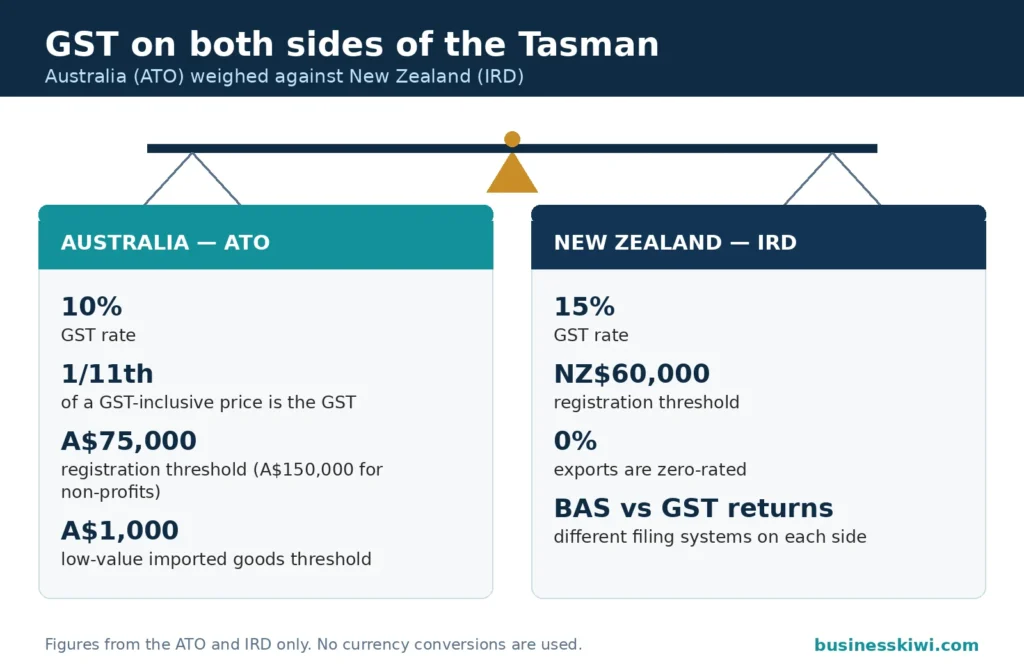
Australian GST and New Zealand GST side by side
The table hides one difference worth spelling out. New Zealand’s threshold is based on your total taxable activity, wherever the customers are. Australia’s test for a non-resident looks only at sales connected with Australia. A business can be small at home and still trip the Australian threshold on Australian sales alone, or the reverse.
BAS, payments and record keeping
Under standard registration, GST is reported on the BAS. Most businesses report quarterly. The ATO’s quarterly due dates are 28 October for the July to September quarter, 28 February for October to December, 28 April for January to March, and 28 July for April to June. Monthly BAS, where it applies or is chosen, is due on the 21st of the following month. Simplified registration runs on its own quarterly cycle: lodge the simplified GST return and pay by the quarterly payment date through Online services for non-residents.
Record keeping is not optional decoration. The ATO requires records showing the date, amount and description of each transaction, its purpose, and the GST information for it, and most records must be kept for five years. For non-resident sellers there is an extra layer: your systems must be able to identify your Australian transactions, including sales where you did not charge GST because the customer gave you an ABN and a registration statement. Keep that customer evidence with the transaction records.
If you do not register when you should
Distance is not a shield. The ATO runs an active compliance programme for offshore sellers, using data matching, financial and customs data, online investigations, and information shared by other countries under tax treaties. Even though your business is based offshore, the ATO is explicit that you have the same rights and obligations as an Australian business.
If the ATO decides you have not complied, it can register you itself, work out your GST liability from third-party information such as bank records, and issue an assessment that includes an additional 75 percent administrative penalty, plus the general interest charge on amounts owed from earlier periods. Failing to apply for registration when required is itself penalised, carrying a penalty of 20 penalty units, and the same applies to failing to cancel a registration when required. Beyond assessment, the ATO can intercept funds in Australia that are destined for you, register the debt in a court in your country, and, where a tax treaty allows, ask Inland Revenue to help collect it. Deliberate failures can also lead to prosecution.
FAQs
Do I need to register for Australian GST if I only sell through an online marketplace?
Probably not, if every Australian sale goes through the platform. The ATO treats the platform operator as responsible for GST on sales made through it, and those sales do not count toward your A$75,000 threshold. Sales you make directly, through your own website for example, are yours: they count toward the threshold and carry the registration obligation.
How do I work out the GST included in an Australian price?
Divide the GST-inclusive price by 11. GST is 10 percent of the exclusive price, which makes it one eleventh of the inclusive price. A$330 inclusive contains A$30 of GST. To add GST to an exclusive price, multiply by 10 percent: A$300 plus A$30 of GST is A$330.
What counts toward the A$75,000 threshold?
Your GST turnover from sales connected with Australia: the current month plus the previous 11 months, or the current month plus the next 11 months on a projected basis, whichever reaches the threshold. Sales of imported services, digital products and low value goods to GST-registered Australian businesses are excluded, as are sales not connected with Australia and any GST included in your prices.
Can I claim GST credits if I use simplified registration?
No. Under simplified registration you cannot claim GST credits on anything, including GST paid on goods you import into Australia, and you cannot issue tax invoices. If claiming credits matters to your margins, standard registration is the route, with its ABN, identity checks and BAS lodgement.
Do I charge New Zealand GST as well as Australian GST on the same sale?
No. Sales to Australian customers are generally zero-rated exports for New Zealand GST, so you charge 0 percent New Zealand GST and keep your input tax claims. Australian GST, where it applies, is a separate charge under a separate system. Charging 15 percent New Zealand GST on an export by mistake prices you out of the market and is wrong in law.
Sources
Australian Taxation Office, How Australian GST works (GST for non-resident businesses), ato.gov.au. Australian Taxation Office, Simplified GST registration, ato.gov.au. Australian Taxation Office, Standard GST registration, ato.gov.au. Australian Taxation Office, GST on low value imported goods, ato.gov.au. Australian Taxation Office, GST on imported services and digital products, ato.gov.au. Australian Taxation Office, Our compliance approach to imported services, digital products and low value imported goods, ato.gov.au. Australian Taxation Office, Due dates for lodging and paying your BAS, ato.gov.au. Australian Taxation Office, Overview of record-keeping rules for business, ato.gov.au. Inland Revenue, Zero-rated supplies, ird.govt.nz. Inland Revenue, Registering for GST, ird.govt.nz.
More guides like this one are collected in our Finance hub, covering tax, banking and business money topics for New Zealand readers.
Disclaimer
This article is general information only. It explains how Australian and New Zealand GST rules apply to New Zealand businesses selling into Australia, based on material published by the Australian Taxation Office and Inland Revenue at the time of writing. It is not tax advice and does not take your circumstances into account. GST rules in both countries change, and the right answer for your business depends on what you sell, who you sell it to and how you sell it. Before registering, deregistering or changing how you price Australian sales, confirm the current rules on ato.gov.au and ird.govt.nz or get advice from a tax professional qualified in the relevant country.