Avanti Finance: What It Offers, Who It Lends to and How It Works

The short answer
Avanti Finance is a New Zealand-owned non-bank lender that has operated since 1989. It lends for cars, personal expenses, homes and businesses, and most of its lending reaches customers through mortgage advisers, finance brokers and car dealers rather than through a branch network. It describes itself as a specialist lender, the type of lender often called a second tier lender, because it assesses borrowers whose income, work pattern or credit history may not fit a main bank’s standard criteria. Its consumer interest rates and fees are published on its own website, and the rate you are offered is set case by case after an assessment. Borrowing always costs money, so with Avanti, as with any lender, the figure that matters is the total amount you will repay and whether the repayments fit your budget.
What Avanti Finance is
Avanti Finance was founded in New Zealand in 1989 by Glenn Hawkins and Stephen Eltringham. The name is the Italian word for “go forward”, and the business began in auto lending before widening into other types of credit. It remains New Zealand-owned. Glenn Hawkins chairs its board, and the group chief executive is Fred Ohlsson.
The wider group includes Branded Financial Services, which was amalgamated into Avanti Finance in November 2024, Bexhill Funding Group and Motorcentral Technologies. Avanti bought the Finance Central loan book from Limelight Group, trading as Thorn Finance, in April 2023. Its own About page states that the KPMG FIPs Specialist Lending Report 2023 ranked it New Zealand’s second largest specialist lender.
The scale is significant for a non-bank. Avanti’s investor page puts its loan book at more than $3.7 billion as at May 2026, with a team of more than 320 people across New Zealand and Australia. It lends across property, auto, personal and business in New Zealand, and offers auto finance in Australia. It is a member of the Financial Services Federation, the industry body for non-bank lenders, and states a commitment to responsible lending.
One structural point matters for borrowers. Avanti is not a registered bank and does not fund itself mainly from everyday customer deposits. Its investor material describes funding raised from institutional and wholesale investor markets, including mortgage and asset-backed securities programmes. Its investment offers are for wholesale investors only, not retail savers.
What a second tier, or non-bank, lender means
“Second tier lender” is industry language, not a legal category. It generally means a lender that sits outside the registered banks, which are treated as the first tier. Finance companies and specialist lenders like Avanti make up much of the second tier. Avanti’s own term for itself is “specialist lender”.
The practical difference is who these lenders will consider. Avanti says life does not always fit neatly into standard lending criteria, and that its role is helping people access finance that fits their circumstances. That can include self-employed borrowers, people with variable income, people whose credit history has marks on it, and recent arrivals on work visas. In exchange for that flexibility, second tier pricing is usually higher than bank pricing, and every application is priced on its own risk profile.
What does not change is the law. For consumer lending, the Credit Contracts and Consumer Finance Act 2003 (CCCFA) applies to Avanti in the same way it applies to a bank. The lender responsibility principles, disclosure duties and hardship rights described later in this article are legal obligations, not optional extras.
What Avanti Finance offers
Avanti publishes four lending lines. The table below summarises them as the company itself describes them.
| Loan type | What it covers, as Avanti describes it | Security, as Avanti states it |
|---|---|---|
| Personal loans | Debt consolidation, unexpected costs, weddings, funerals, holidays and top-ups of existing loans | Unsecured, no security required |
| Auto loans | Cars bought from dealers, at auction, through Trade Me or from private sellers, with pre-approval available | The vehicle is the security |
| Home loans | First homes, investment property, renovations, construction, bridging finance and debt consolidation | Security over property is always required |
| Business loans | Business lending across New Zealand, with applications taken online | Rates and fees available on application |
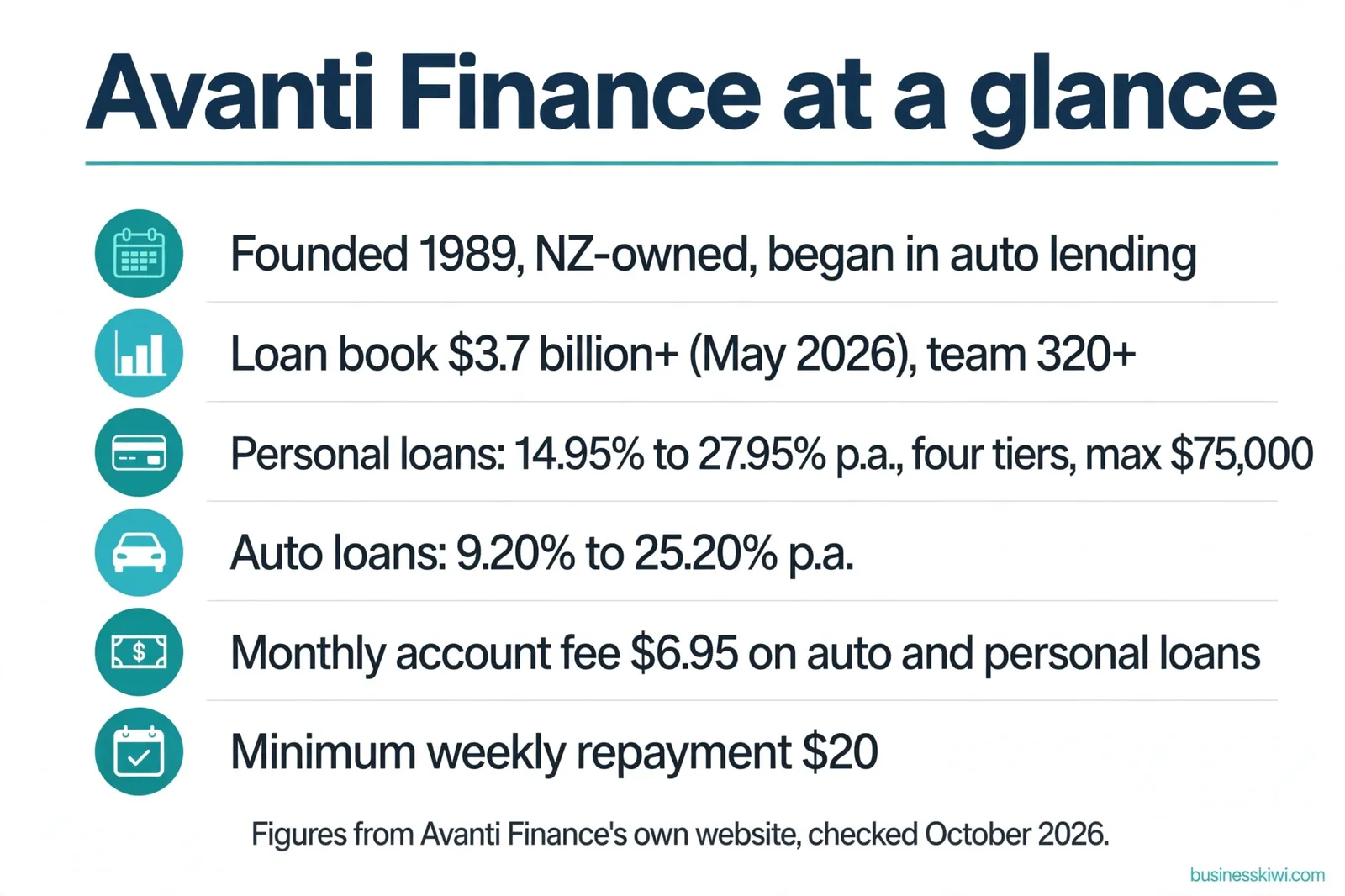
Personal loans are unsecured and are for personal, domestic or household purposes. Avanti lists debt consolidation, unexpected costs, weddings, funerals and holidays among the common uses, and existing customers can apply for a top-up. Payment protection insurance is offered alongside the loan, and its cost can be built into the repayments. Avanti’s published product guide for brokers prices personal loans in four tiers set by its own scorecard rating. The maximum amounts run from $75,000 in the top tier down to $20,000 in the fourth tier, with maximum terms of 84 months in the first three tiers and 60 months in the fourth.
Auto loans can be arranged before you buy, through pre-approval, or at the point of sale. Avanti says it works with hundreds of car dealerships, and it also finances auction, Trade Me and private purchases. Mechanical breakdown insurance, payment protection insurance and GAP insurance are offered with vehicle loans.
Home loans cover first homes, investment property, renovations and construction, including cost overruns, plus bridging finance, debt consolidation and tax bills. Applications run through a mortgage adviser or a callback request rather than a full online application, and the company notes on that page that its recommendations about its own products are not regulated financial advice.
Business lending is part of the published range, and the company’s FAQ page confirms business loan applications can be made online. Unlike the consumer products, business and other non-consumer pricing is not published in the consumer schedules. The rates and fees page states that fees for non-consumer loans are available on application and that commercial and property development rates are available on request.
Who it lends to
You must be 18 or older to apply. Beyond that, Avanti does not publish a simple checklist of who qualifies. It assesses each application against its responsible lending criteria. For its published rates, it says the assessment weighs up the type of loan, the security offered if any, your income and financial commitments, your work status and your credit history. For property loans it also considers the loan-to-value ratio and the purpose of the loan.
Two published details give a sense of the borrower profile. Its personal lending product guide limits personal loans to personal, domestic or household purposes, so they cannot be used for business. The same guide covers certain work visa holders, who need at least 13 months left on their visa. The overall picture is a lender set up for borrowers whose situations need individual assessment rather than a standard bank decision.

How applying and funding works
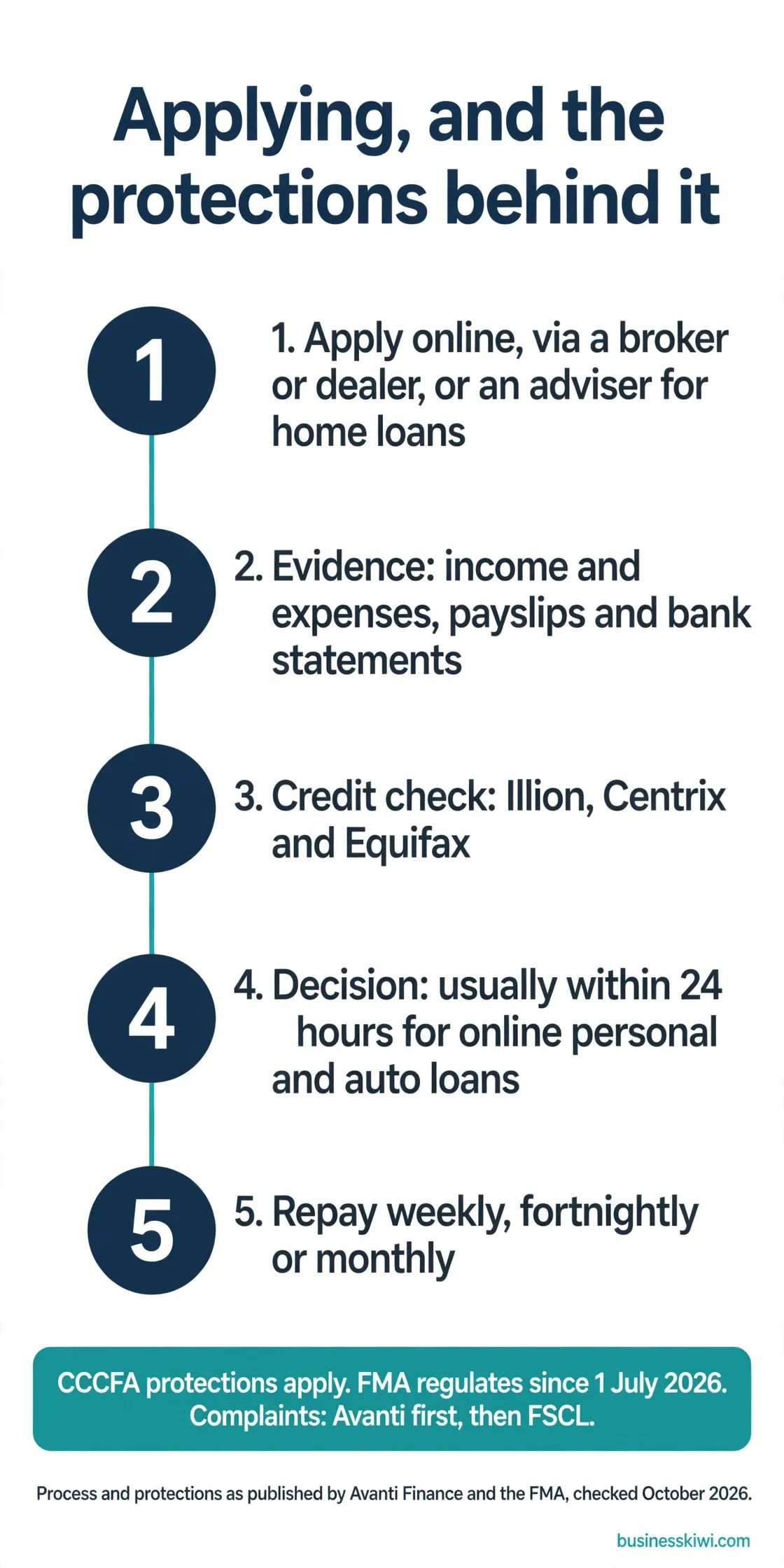
You can apply online for an auto, personal, business or debt consolidation loan. You can also apply through a finance broker or an automotive dealer. Home loans start with a form or a mortgage adviser.
Avanti asks for information about your income and expenses, which can include payslips and bank statements. It runs credit checks with the three New Zealand credit reporting agencies it names: Illion, Centrix and Equifax.
On timing, the company says its personal lending team responds to enquiries within two business hours. For online personal and auto applications, it says a decision is usually given within 24 hours once all the required information has been received. Home loan decisions take longer, usually two to five working days.
Repayments can be weekly, fortnightly or monthly, and the minimum weekly repayment is $20. You can repay early, but prepayment fees may apply, and a settlement quote stays valid for seven days. If you change your mind after signing, the cancellation notice periods in its FAQ are five working days for notice given in person, seven for emailed notice and nine for posted notice. If you hit financial difficulty, the company points borrowers to its hardship support rather than simply defaulting.

Rates, fees and the total cost
Avanti publishes its consumer interest rate ranges and fee schedules, and it is open that the exact rate is decided after assessment. The published consumer ranges, stated on its rates page as current at 15 September 2026, are:
- Auto loans: fixed rates of 9.20% to 25.20% p.a., with a note that the rate may include a margin paid to the introducer who arranged the loan.
- Personal loans: fixed rates of 14.95% to 27.95% p.a. for unsecured loans. Within that range, its product guide sets four tiers, from 14.95% to 18.95% at the top tier up to a flat 27.95% in the fourth tier.
- Residential long-term property loans: a variable base rate of 6.85% p.a. or 8.00% p.a. depending on the loan type, plus a margin of up to 2.15%, with published fixed rates running from 7.30% to 9.85% p.a. across its one-year to three-year fixed terms. Maximum loan-to-value ratios are 90% for owner-occupied homes and 80% for investment property.
- Short-term property loans: fixed rates of 7.89% to 13.49% p.a. for first mortgage loans, and 13.85% to 14.95% p.a. for caveat or second mortgage loans.
The fee schedules, effective from 26 August 2025, include an establishment fee of $205 for an auto loan, and $140 for an unsecured personal loan, rising to $230 if a vehicle secures the personal loan and $530 if property does. Property loan establishment fees are $530, or $775 for residential long-term loans. There is a monthly account fee of $6.95 on auto and personal loans, and $9.85 on property-secured personal loans and property loans. Other charges include a $9.10 Personal Property Securities Register fee on vehicle loans, a dealer fee of up to $500, a $23 prepayment administration fee plus any prepayment fee calculated under the statutory process, and a $117 loan restructure fee.
Default costs are where second tier loans get expensive. Avanti charges an arrears management fee of $60 a month and a dishonour fee of $10 a month, with a $142 repossession administration fee and $240 if court proceedings are issued on vehicle and personal loans. Default interest is charged at your annual rate plus 10% p.a. on auto, personal and most property loans, and plus 5% p.a. on residential long-term property loans. Most fees are charged to the loan itself, which means they also attract interest.
For context, the CCCFA treats a loan as high-cost when its rate reaches 50% p.a. or more, and extra caps then apply. None of Avanti’s published consumer ranges comes near that threshold. Even so, the top of its personal loan range is far above bank personal loan pricing, so the total repayment figure in your disclosure statement is the number to judge any offer by.
Regulation and borrower protections
Avanti Finance Limited is company number 659638, and its own consumer loan agreement states its Financial Service Providers Register number as FSP41821. Lenders must be registered to provide consumer credit, and they must belong to an approved dispute resolution scheme.
Since 1 July 2026, the Financial Markets Authority (FMA) has been the regulator for the CCCFA, taking over from the Commerce Commission under the Credit Contracts and Consumer Finance Amendment Act 2026. The old lender certification system was replaced by licensing under the Financial Markets Conduct Act, and lenders that were certified at the changeover were automatically transitioned to a licence.
The lender responsibility principles require Avanti, like every consumer lender, to check that a loan is suitable and affordable, to make reasonable enquiries about your income and expenses, to disclose the full cost of borrowing before you sign, to charge only reasonable fees, and to treat you fairly if you get into difficulty. If you believe a lender has broken those rules, you can ask for the contract to be changed or cancelled, and you can complain.
Avanti’s complaints page sets out its process: acknowledgement within two working days, a target of resolving complaints within five working days, and up to 20 working days where more time is needed. If the complaint is still unresolved, its page gives the contact details for FSCL, the Financial Services Complaints scheme, which is its external dispute resolution scheme. You also have a legal right to apply for a hardship variation if an unforeseen event makes repayments unaffordable.
What to check before borrowing from any non-bank lender
- Check the lender is on the Financial Service Providers Register. An unregistered lender cannot legally provide consumer credit or charge you interest and fees.
- Read the disclosure statement before signing. It must show the interest rate, every fee, any security taken, and the total amount you will repay.
- Compare total cost, not the weekly repayment. A smaller weekly payment over a longer term can cost much more overall.
- Check the default interest rate and default fees. These decide what a missed payment really costs you.
- Know what security you are giving. A loan secured on your car or home puts that asset at risk if you cannot pay.
- Ask about early repayment costs before you sign, especially on fixed rate loans.
- Take the contract away and get advice if anything is unclear. Free financial mentors are available through MoneyTalks, and Consumer Protection publishes plain English explanations of credit contract terms.
For smaller borrowing, our small loans NZ guide covers how those loans work and what they cost. Our guide to evaluating credit cards and personal loans shows how to compare any loan offer on total cost. Your credit score in NZ affects the rate any lender offers you, so it is worth checking before you apply. More money guides like this one sit in our Finance section.
Frequently asked questions
Is Avanti Finance a bank?
No. Avanti is a non-bank specialist lender. It is not a registered bank, it does not take retail deposits, and it funds its lending mainly through institutional and wholesale markets. For consumer loans it is regulated under the CCCFA, with the FMA as regulator since 1 July 2026.
What does second tier lender mean?
It is industry shorthand for lenders outside the registered banks. Second tier lenders such as finance companies and specialist lenders often consider borrowers whose income, work pattern or credit history does not meet a bank’s standard criteria. Avanti calls itself a specialist lender. The term is not a legal category, and the same consumer credit law applies.
What loans does Avanti Finance offer?
Four lines: unsecured personal loans, auto loans secured on the vehicle, home loans secured on property, including bridging and construction lending, and business loans. Personal loans can be used for things like debt consolidation, unexpected costs, weddings, funerals and holidays. Business and commercial pricing is provided on application rather than published.
What interest rates does Avanti Finance charge?
It publishes ranges rather than a single rate. At the time of writing, secured auto loans run from 9.20% to 25.20% p.a., unsecured personal loans from 14.95% to 27.95% p.a., and residential property loans from a variable base rate of 6.85% p.a. plus a margin. Your rate is set after an assessment of your circumstances and credit history.
Who can apply for an Avanti loan?
You must be 18 or older. Avanti assesses your income, expenses and commitments, your work status and your credit history, and for property loans the loan-to-value ratio and purpose. Personal loans are for personal, domestic or household purposes only. Certain work visa holders can apply if their visa has at least 13 months remaining.
How long does an Avanti application take?
For online personal and auto loans, Avanti says a decision is usually given within 24 hours once it has all the information it needs, and its personal lending team responds to enquiries within two business hours. Home loans take longer, usually two to five working days for a decision.
What can I do if I have a complaint about Avanti Finance?
Complain to Avanti first. It says it will acknowledge your complaint within two working days and aims to resolve it within five, or up to 20 where more time is needed. If it remains unresolved, you can take it to FSCL, the Financial Services Complaints scheme listed on Avanti’s complaints page. Dispute resolution schemes are free for consumers.
The bottom line
Avanti Finance is one of New Zealand’s larger non-bank lenders, operating since 1989 across personal, auto, property and business lending. It sits in the second tier: it will assess borrowers a bank may not, and it prices that flexibility case by case, with published consumer ranges and fees that sit well above bank pricing at the top end. Its regulatory position is the standard one for a consumer lender, registered, licensed under the post-2026 CCCFA regime and covered by an external dispute scheme. Whether any specific Avanti offer is good value can only be judged from the total repayment figure in the disclosure statement for that loan.
Sources
- Avanti Finance, About Us: https://www.avantifinance.co.nz/about-us/
- Avanti Finance, Personal Loans: https://www.avantifinance.co.nz/products/personal-loans/
- Avanti Finance, Auto Loans: https://www.avantifinance.co.nz/products/auto-loans/
- Avanti Finance, Home Loans: https://www.avantifinance.co.nz/products/home-loans/
- Avanti Finance, FAQs: https://www.avantifinance.co.nz/FAQs/
- Avanti Finance, Rates & Fees: https://www.avantifinance.co.nz/rates-fees/
- Avanti Finance, Personal Lending Product Guide (for broker use, effective 18 September 2025): https://www.avantifinance.co.nz/wp-content/uploads/2022/02/Product-Guide-Avanti-Personal-250918.pdf
- Avanti Finance, Feedback & Complaints: https://www.avantifinance.co.nz/feedback/
- Avanti Finance, Investors: https://www.avantifinance.co.nz/investors/
- Avanti Finance, Consumer Property Loan Agreement (template, last reviewed September 2025): https://www.avantifinance.co.nz/wp-content/uploads/2022/02/Avanti-Consumer-Property-Long-Term-Loan-Agreement-Oct-2021.pdf
- Financial Markets Authority, Credit Contracts and Consumer Finance Act (CCCFA): https://www.fma.govt.nz/business/legislation/cccfa/
- Consumer Protection (MBIE), What lenders must do: https://www.consumerprotection.govt.nz/help-product-service/borrowing-money/what-lenders-must-do
- Consumer Protection (MBIE), Loans and lenders: https://www.consumerprotection.govt.nz/help-product-service/borrowing-money/loans-and-lenders
This article is general information about Avanti Finance and about how non-bank lending works in New Zealand. It is not financial advice, and it is not a recommendation to borrow from Avanti Finance or from any other lender. Interest rates and fees change, and the figures in this article are the ranges Avanti published on its own website at the time of writing. Check the current rates, fees and terms with the lender, read the disclosure statement for any loan you are offered, and consider free, independent help from a financial mentor before you sign.