Withholding Tax NZ: What It Is, the Systems Behind It, and How You Get Credit for the Tax Taken Out

The short answer
Withholding tax is income tax taken out of a payment before the money reaches you. The person or organisation paying you deducts the tax, sends it to Inland Revenue, and pays you the balance. It is not a separate tax and it is not an extra tax. The amount withheld is credited against your final income tax bill when Inland Revenue squares up your tax position at the end of the year. If too much was taken out, the excess comes back as a refund. If too little was taken out, you have a bill to pay.
New Zealand runs several withholding systems side by side. Which one applies depends on the kind of income and, in some cases, on whether the person receiving it is a New Zealand tax resident. The four systems most people meet are resident withholding tax on interest and dividends, non-resident withholding tax on payments going overseas, PAYE on salary and wages, and withholding on schedular payments made to contractors.
What withholding tax means
In a withholding system, tax is collected at the source of the income rather than after the income has been spent or saved. The payer works out the tax on each payment, deducts it, and accounts for it to Inland Revenue. You receive the net amount, and the tax deducted is recorded against your IRD number as a credit.
There are practical reasons for collecting tax this way. It spreads the cost of income tax across the year instead of landing in one large bill. It also puts the collection job in the hands of the organisations making the payments, such as banks and employers, which is why withholding covers the income types that flow through third parties: wages, interest, dividends and many contract payments.
Withholding is an estimate, not the final word. The rate applied to a single payment cannot know your total income for the year, your other income sources, or the expenses you can claim. That is why every withholding system ends with a square-up. Inland Revenue compares the tax you actually owe for the year with the credits already collected on your behalf, and settles the difference either way.
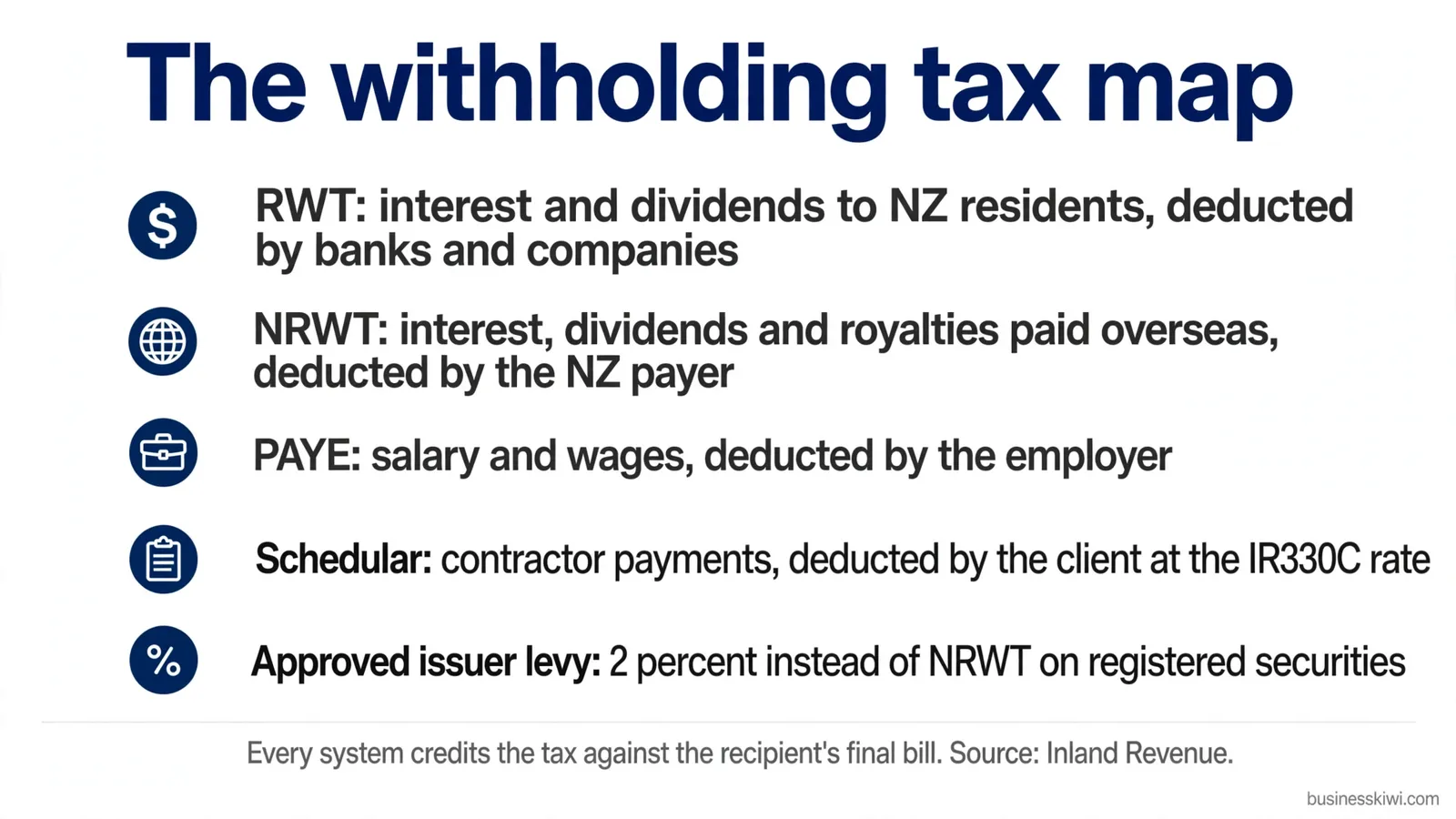
The main withholding systems in New Zealand
Four systems do most of the withholding in New Zealand. They share the same basic pattern, a payer deducts tax and the recipient gets credit for it, but each has its own income types, its own rates and its own rules.
Resident withholding tax on interest and dividends
Resident withholding tax, usually shortened to RWT, applies when New Zealand tax residents earn interest or dividends from New Zealand bank accounts and investments. The bank, fund manager or company paying the income deducts the tax before paying you, so the amount that lands in your account is already net of tax.
For interest, residents using their IRD number choose the rate their payer applies, picking from the rates Inland Revenue lists so the deduction lines up with their own income tax rate. If you give your payer no rate choice, interest is deducted at a default rate of 33%. If you have not given your interest payer your IRD number at all, a non-declaration rate of 45% applies. Companies, trusts and Māori authorities work from their own rate options, and some taxpayers hold a valid RWT exemption, in which case their IRD number sits on Inland Revenue’s exemption register and no RWT comes off their payments.
Dividends work more simply. The RWT rate on dividend payments is 33%, deducted by the company before the dividend is paid. Dividends may also carry imputation credits, which represent tax the company has already paid, and those credits can offset the RWT deducted.
The detail of RWT, including rate elections for each taxpayer type, exemption rules and payer obligations, is a large topic in its own right. This article keeps RWT at the map level: it is the withholding system for residents’ interest and dividend income.
Non-resident withholding tax
Non-resident withholding tax, or NRWT, is the mirror image of RWT. It is withheld from New Zealand payments of interest, dividends and royalties made to non-residents and foreign investors. Inland Revenue describes these payments as non-resident passive income. The New Zealand payer registers as an NRWT payer, deducts the tax from the payment, and sends the deductions to Inland Revenue. For the overseas recipient, the NZ payer is the one who pays their New Zealand tax.
The rate depends heavily on double tax agreements. Where the recipient’s country has an agreement with New Zealand, the treaty rate for that income type applies, and some treaty rates are a final tax while others operate as a minimum that still goes into a return. Where no agreement rate applies, where the country is not listed, or where the payer does not know the recipient’s residence, Inland Revenue’s additional rates apply: 15% on interest, 30% on dividends and 15% on royalties.
There is one well-known alternative. An approved issuer pays interest at a zero rate of NRWT and instead pays a levy of 2% on the interest of each security it registers with Inland Revenue. This approved issuer levy is widely used where a New Zealand borrower pays interest to an overseas lender. The levy can be claimed as a deduction in the issuer’s New Zealand tax return if the interest itself is deductible.
PAYE on salary and wages
PAYE, short for pay as you earn, is the withholding system almost every employee in New Zealand knows, even if they never use the word withholding. Your employer deducts income tax from your salary or wages each pay day and pays it to Inland Revenue on your behalf.
The amount deducted follows the tax code you declare when you start work, using the Tax code declaration form IR330. Employees with a student loan have their repayments deducted through the same payroll process when their tax code provides for it. Because the deduction is recalculated every pay, PAYE tracks your earnings through the year, and for many employees it lands close enough to their final liability that their end-of-year assessment is small.
PAYE is withholding in everything but name. The employer is the payer, the wages are the income, and the tax deducted is credited to the employee in exactly the same way as RWT deducted by a bank.
Schedular payments for contractors
Schedular payments are payments to contractors for activities and services where the work mainly consists of labour, and tax is withheld from them before the contractor is paid. Contractors can be individuals, partnerships, trusts or companies, resident or non-resident. Inland Revenue’s examples include an IT project manager supplied through a labour hire business, a builder contracted to a labour hire firm, a freelance journalist paid for an article, a salesperson paid commission, a director paid directors’ fees, a cleaning partnership, and companies supplying labour to the agricultural, horticultural and viticultural sectors. Some competition prize money is also treated as a schedular payment.
The contractor tells the payer their rate on the Tax rate notification form IR330C. There are three routes: use the standard rate for the activity, which the form’s flow chart identifies; apply to Inland Revenue for a tailored tax rate; or choose your own rate. A self-chosen rate must be at least 10%, and at least 15% if you are a non-resident on a temporary work or entry visa. Contractors outside the schedular rules can also opt in by agreement with their payer under the voluntary schedular payments rules, where the standard rate is 20% unless the contractor chooses another rate.
One figure matters to every contractor: if you do not give your payer a completed IR330C, the payer must deduct at the no-notification rate of 45%. Contractors remain responsible for their own tax return, can claim their business expenses against schedular income, and face an end-of-year bill if the rate they declared was too low for their actual income. Inland Revenue can also impose a prescribed withholding rate where a contractor has not declared the right rate and has left tax unpaid.

Who deducts the tax and sends it to Inland Revenue
In every withholding system the duty to deduct sits with the payer, not the recipient. Banks and fund managers deduct RWT. Companies deduct RWT from dividends and NRWT from payments to overseas shareholders and lenders. Employers deduct PAYE and schedular withholding, and businesses paying contractors deduct schedular tax. Payers of non-resident passive income register with Inland Revenue for that role.
The money deducted is never the payer’s to keep. Payers must pass deductions to Inland Revenue by the due dates that apply to them, and late or missing payments expose the payer, not just the recipient, to penalties and interest. Employers must also file employment information every time they pay their staff, a process known as payday filing, and keep full wage records for 7 years. Investment income payers report the interest and dividends they pay, and the tax withheld on them, to Inland Revenue on a regular cycle after each payment.
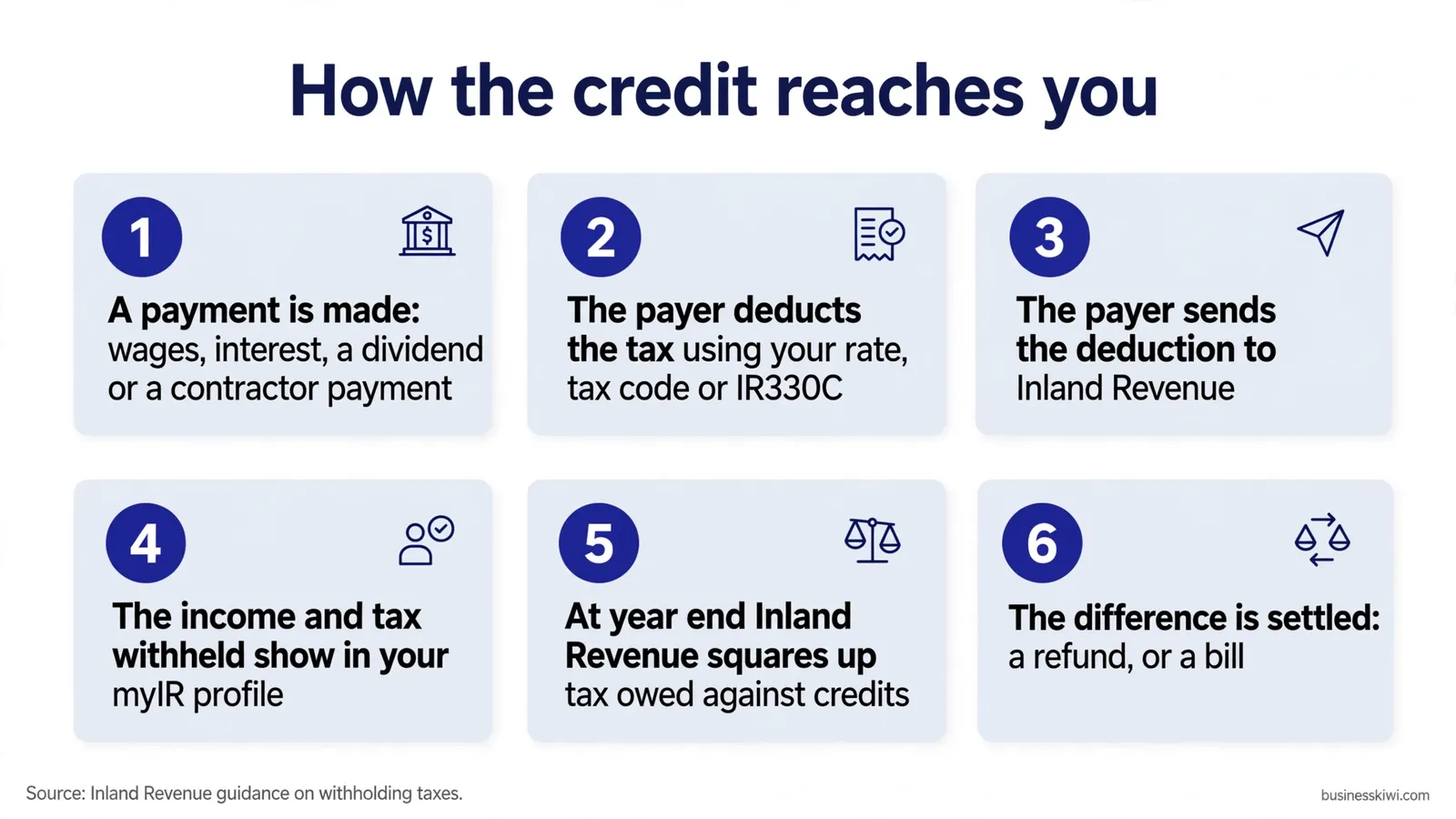
How the credit reaches you
Withheld tax is tracked against your IRD number, which is why giving payers the correct number matters so much. As the year runs, the investment income paid to you and the tax deducted from it build up in your income profile in myIR, broken down by income type and by the payer who reported it. Income from a joint account is split equally between the account holders who provided valid IRD numbers, and the allocation can be corrected when your assessment is completed if the even split does not match reality.
At the end of the tax year, Inland Revenue completes the square-up. It works out your total income and the tax properly payable on it, then sets the withholding credits against that amount. Over-withholding produces a refund. Under-withholding produces a tax bill. The same credit logic runs through every system: PAYE deducted by an employer, RWT deducted by a bank, and schedular tax deducted by a client all land in the same end-of-year calculation.
If your assessment looks wrong, check the income and credits shown in myIR against your own records first. A wrong IRD number given to a payer is a common cause of missing credits, and Inland Revenue may tell a payer your correct number where you have given them an incorrect one.

Common confusions
Withholding tax is not an extra tax. The deduction is a prepayment of the income tax you would owe on that income anyway. Nothing is taxed twice: the withheld amount is credited in full against your final bill, and any excess over your final bill is refundable.
RWT and NRWT are decided by the recipient, not the income. Interest paid to a New Zealand tax resident attracts RWT. The same interest paid to a non-resident is non-resident passive income and attracts NRWT instead. Residency of the person receiving the payment is the switch between the two systems, which is why payers need to know where their investors and lenders are tax resident.
Withholding is not provisional tax. Provisional tax is the other main way income tax is paid during the year, and nobody deducts it for you. Provisional taxpayers work out instalments themselves and pay them to Inland Revenue during the year. Under the standard option those instalments are based on the previous year’s residual income tax with an uplift, rather than being calculated payment by payment. Income with no payer to withhold from it, such as most self-employed and rental income, is typically where provisional tax applies. The two systems can sit side by side in one person’s tax life, and both are credited in the same end-of-year square-up.
Watch-outs
Give every payer your IRD number. Missing numbers trigger the harshest defaults in the system: 45% non-declaration on interest, and 45% no-notification withholding for contractors who do not hand over an IR330C.
Choose rates that match your real income. A rate set too low feels painless during the year and arrives as a bill at assessment time. A rate set too high ties up your money until the refund is processed. Tell your payer when your circumstances change, because the payer can only deduct on the information it holds.
Contractors should treat the IR330C as part of starting any contract, not paperwork for later. Employees should check their tax code fits their situation, especially where they have more than one job. Payers carrying withholding obligations should diarise their filing and payment dates, since the penalties for deducting tax and failing to pass it on are serious.
Overseas investors and the New Zealand businesses paying them should check the double tax agreement position before applying a rate. Treaty rates differ by country and by income type, and some are final taxes while others are minimums.
Related guides: our full guide to resident withholding tax covers RWT rates, exemptions and certificates in depth, and our tax code guide explains the code employees declare when starting work. For more money and tax guides, browse the Finance section.
Frequently asked questions
Is withholding tax a separate tax from income tax?
No. Withholding tax is income tax collected early, at the point a payment is made. The amount deducted is credited against your income tax for the year, so it forms part of the same tax bill rather than sitting on top of it.
What is the difference between RWT and NRWT?
Residency of the recipient decides which applies. RWT is deducted from interest and dividends paid to New Zealand tax residents by banks, fund managers and companies. NRWT is deducted from interest, dividends and royalties paid from New Zealand to non-residents, and its rates are shaped by double tax agreements.
Who sends the withheld tax to Inland Revenue?
The payer does. The bank, employer, company or business making the payment deducts the tax and passes it to Inland Revenue by the due dates for that system. You receive the net payment and a credit for the tax deducted, recorded against your IRD number.
What happens if too much tax is withheld during the year?
The excess is refunded at the end-of-year square-up. Inland Revenue totals your income and your correct tax, sets the withholding credits against it, and returns the difference. Persistent over-withholding usually means a rate or tax code needs adjusting with your payer.
Can contractors choose their own withholding rate?
Yes, within limits. On the IR330C form a contractor can use the standard rate for their activity, apply for a tailored rate, or choose their own rate. A self-chosen rate must be at least 10%, or at least 15% for a non-resident on a temporary work or entry visa. No completed form means the payer must deduct 45%.
Is PAYE a withholding tax?
Yes. PAYE is withholding applied to salary and wages. Your employer deducts the tax from each pay using the tax code you declared on your IR330, files employment information each payday, and pays the deductions to Inland Revenue. The deductions are credited to you at the end of the year like any other withholding.
What is the approved issuer levy?
It is an alternative to NRWT on interest. An approved issuer registers securities with Inland Revenue and pays interest to overseas lenders at a zero rate of NRWT. Instead of the withholding tax, the issuer pays a levy of 2% on the interest of each registered security.
The bottom line
Withholding tax in New Zealand is one idea delivered through four systems: tax is taken out at the point of payment, sent to Inland Revenue by the payer, and credited against your final income tax bill. RWT covers residents’ interest and dividends, NRWT covers interest, dividends and royalties paid overseas, PAYE covers salary and wages, and schedular withholding covers many contractor payments. Get your IRD number and your rate or tax code right with each payer, and the end-of-year square-up should hold no surprises.
Sources
- Inland Revenue, Resident withholding tax (RWT): http://www.ird.govt.nz/income-tax/withholding-taxes/resident-withholding-tax-rwt
- Inland Revenue, Using the right resident withholding tax (RWT) rate: http://www.ird.govt.nz/income-tax/withholding-taxes/resident-withholding-tax-rwt/using-the-right-rwt-tax-rate
- Inland Revenue, Non-resident withholding tax (NRWT): http://www.ird.govt.nz/nrwt/nrwt-payers
- Inland Revenue, Non-resident withholding tax (NRWT) rates for double tax agreement countries or territories: http://www.ird.govt.nz/income-tax/withholding-taxes/non-resident-withholding-tax-nrwt/deduct-nrwt-at-the-right-rate/nrwt-rates-for-dta-countries
- Inland Revenue, Approved issuer: http://www.ird.govt.nz/roles/approved-issuer
- Inland Revenue, About schedular payments for contractors: http://ird.govt.nz/income-tax/withholding-taxes/schedular-payments/about-schedular-payments-for-contractors
- Inland Revenue, Work out and declare my tax rate for schedular payments: http://www.ird.govt.nz/income-tax/withholding-taxes/schedular-payments/getting-schedular-payments/work-out-and-declare-my-tax-rate-for-schedular-payments
- Inland Revenue, Choosing to get voluntary schedular payments: http://www.ird.govt.nz/income-tax/withholding-taxes/schedular-payments/schedular-payment-special-cases/choosing-to-get-voluntary-schedular-payments
- Inland Revenue, Employing staff: http://www.ird.govt.nz/employing-staff
- Inland Revenue, Provisional tax standard option: http://www.ird.govt.nz/income-tax/provisional-tax/provisional-tax-options/standard-option
This article is general information about withholding tax in New Zealand and how the main withholding systems work. It is not personal tax advice and it does not cover every withholding situation, rate or exemption. Withholding rates and rules change, and the right treatment depends on your own circumstances, residency status and income types. Check the current guidance on the Inland Revenue website, or talk to a qualified tax adviser, before acting on anything in this article.