Tax Rates NZ: NZ Rules, Rates & Practical Examples

New Zealand taxes personal income progressively: income is divided into bands, and each band is taxed at its own rate. The rates and thresholds on this page are the ones Inland Revenue (IRD) shows as applying from 1 April 2025. They applied for the 2025–26 tax year (1 April 2025 to 31 March 2026) and remain in force for 2026–27 (1 April 2026 to 31 March 2027), because IRD publishes no replacement table after the “from 1 April 2025” table.
This page is general information about how NZ tax rates work. It is not personal tax advice, and individual circumstances (tax credits, student loans, KiwiSaver, multiple income sources) change the final amount a person pays.

Quick answer: NZ personal income tax rates
| Taxable income (for each dollar in this band) | Tax rate |
|---|---|
| $0 – $15,600 | 10.5% |
| $15,601 – $53,500 | 17.5% |
| $53,501 – $78,100 | 30% |
| $78,101 – $180,000 | 33% |
| $180,001 and over | 39% |
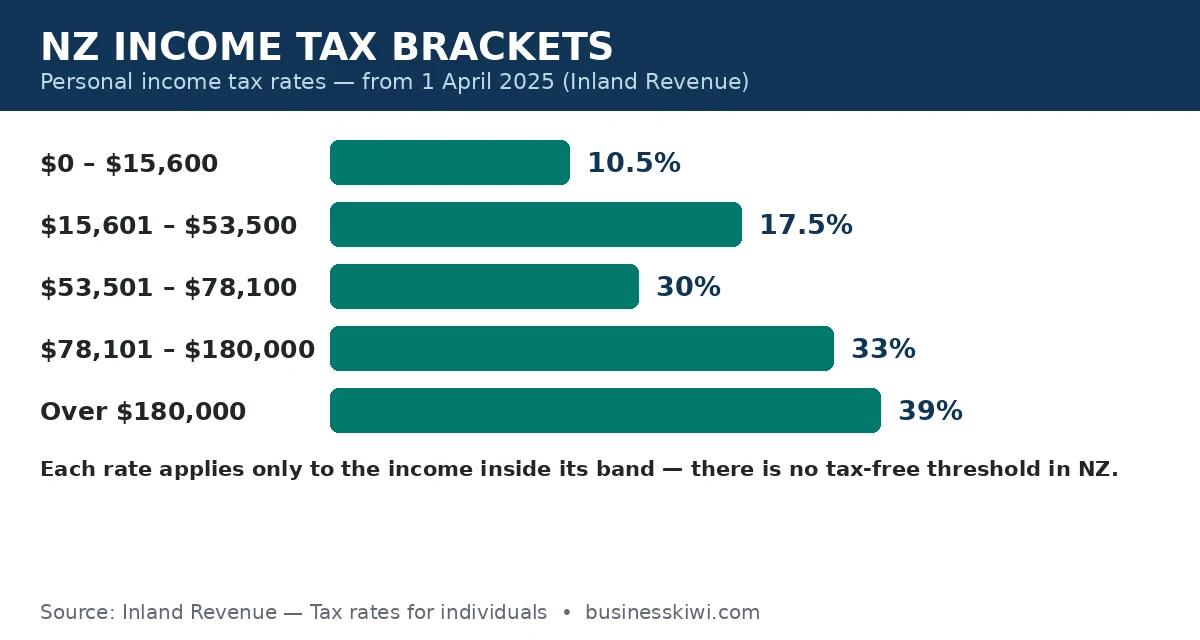
Source: Inland Revenue, “Tax rates for individuals”, table headed “From 1 April 2025”.
Three points matter when reading this table:
- The rate applies per dollar within the band, not to all income. Earning $80,000 does not mean paying 33% on $80,000. Only the $1,900 earned above $78,100 is taxed at 33%.
- There is no tax-free threshold. Unlike some other countries, New Zealand taxes income from the first dollar, at 10.5%.
- These are rates on taxable income. Taxable income is total income minus any allowable deductions. For most employees it is close to gross salary or wages; for self-employed people it is business income minus business expenses.
To work out an exact figure for a specific income, the free Income Tax Calculator NZ applies these bands automatically.
What changed on 31 July 2024, and why older tables look different
The current thresholds have applied in their present form since 1 April 2025, but they were introduced part-way through the previous tax year. The Government adjusted the personal income tax thresholds from 31 July 2024. Before that change, the bands were $14,000, $48,000, $70,000 and $180,000.
Because the change happened four months into the 2024–25 tax year, IRD applied composite (blended) rates for that year. Its published 2024–25 table therefore contains unusual rates such as 12.82%, 21.64% and 30.99%, which are averages of the old and new thresholds across the year. Those blended rates applied only to the 2024–25 year. From 1 April 2025 the clean five-band table above applies, and it is the table to use for both 2025–26 and 2026–27.
Anyone comparing an older article, payslip or calculator against this page may see those blended figures. That is the most common reason published “tax rates NZ” tables disagree with each other.
How marginal tax brackets actually work
New Zealand’s system is described as progressive, or marginal. Each rate is charged only on the income that falls inside its band. Two terms explain most of the confusion around NZ tax rates:
- Marginal rate: the rate paid on the next dollar earned. A person earning $80,000 has a marginal rate of 33%, because the next dollar they earn falls in the $78,101–$180,000 band.
- Effective (average) rate: total tax divided by total income. Because the lower bands are taxed at 10.5% and 17.5%, the effective rate is always lower than the marginal rate (except in the first band, where they are the same).
Example: tax on a salary of $80,000
The following is a worked example using the rates from 1 April 2025. It is an illustration of the calculation method, not a statement about any individual’s tax position. It covers income tax only; the ACC Earners’ levy is shown separately below.
| Band | Income in this band | Rate | Tax |
|---|---|---|---|
| $0 – $15,600 | $15,600 | 10.5% | $1,638.00 |
| $15,601 – $53,500 | $37,900 | 17.5% | $6,632.50 |
| $53,501 – $78,100 | $24,600 | 30% | $7,380.00 |
| $78,101 – $80,000 | $1,900 | 33% | $627.00 |
| Total | $80,000 | $16,277.50 |
The effective rate on $80,000 is therefore $16,277.50 ÷ $80,000 = 20.35%, even though the marginal rate is 33%. A pay rise that pushes income into a higher band never reduces take-home pay, because the higher rate touches only the dollars above the threshold, not the income below it.
Tax at other income levels (examples)
Using the same method, income tax alone at several other salaries is:
| Gross salary (example) | Total income tax | Effective rate | Marginal rate |
|---|---|---|---|
| $50,000 | $7,658.00 | 15.32% | 17.5% |
| $60,000 | $10,220.50 | 17.03% | 30% |
| $80,000 | $16,277.50 | 20.35% | 33% |
| $120,000 | $29,477.50 | 24.56% | 33% |
These examples exclude the ACC Earners’ levy, KiwiSaver contributions, student loan repayments and any tax credits, all of which sit alongside income tax rather than inside it.
PAYE: how the rates are collected from wages and salary
Most employees never pay income tax in a lump sum. Under PAYE (pay as you earn), the employer deducts tax from each pay using the employee’s tax code and sends it to Inland Revenue. The tax code tells the employer which income the job represents and whether other deductions apply:
- M is the standard code for a main source of income.
- ME is used where the person is eligible for the Independent Earner Tax Credit.
- An SL suffix is added where the person has a student loan, so repayments are deducted as well.
- Secondary codes (below) are used for a second source of income.
IRD squares up each person’s tax at the end of the tax year. Where the wrong code or rate has been used during the year, the end-of-year assessment produces either a refund or an amount to pay. IRD states this directly: a person might get a refund or have tax to pay at the end of the year if they have been taxed at the wrong rate, which is why it emphasises using the correct tax code.
PAYE deductions are not only income tax. Two further amounts commonly come out of wages:
The ACC Earners’ levy
Employees pay the ACC Earners’ levy on top of income tax. It is collected through PAYE and is charged at a flat rate, on earnings up to a maximum that is reset each year. Inland Revenue’s published table (amounts include GST) gives:
| Tax year | Earners’ levy rate | Maximum earnings the levy applies to | Maximum levy payable |
|---|---|---|---|
| 2025–26 | $1.67 per $100 (1.67%) | $152,790 | $2,551.59 |
| 2026–27 | $1.75 per $100 (1.75%) | $156,641 | $2,741.22 |
Source: Inland Revenue, “ACC earners’ levy rates”.
Continuing the example above: on an $80,000 salary in 2026–27, the Earners’ levy is 1.75% × $80,000 = $1,400 for the year, because $80,000 is below the maximum earnings level. Combined income tax and levy would be $16,277.50 + $1,400 = $17,677.50, leaving $62,322.50 before any KiwiSaver contributions or student loan repayments.
The levy is not income tax and is not a tax credit against it; it funds ACC’s Earners’ Account, which covers non-work injuries. ACC publishes its own consultation figures excluding GST ($1.52 per $100 for 2026–27), which is why ACC and IRD figures can look different while describing the same levy: the amount actually deducted from wages is the GST-inclusive IRD figure.
Tax on a second job: secondary tax
Where a person has more than one source of income, the second source is taxed using a secondary tax code. The purpose, as IRD puts it, is to help the person pay the right amount of tax across both incomes so they do not get a bill at the end of the year. Secondary tax applies a flat rate to the second income, chosen by reference to the person’s estimated total income from all sources:
| Estimated total annual income (all sources) | Secondary tax code | Secondary tax rate (before ACC levies) |
|---|---|---|
| $0 – $15,600 | SB | 10.5% |
| $15,601 – $53,500 | S | 17.5% |
| $53,501 – $78,100 | SH | 30% |
| $78,101 – $180,000 | ST | 33% |
| $180,001 and over | SA | 39% |
Source: Inland Revenue, “Tax rates for individuals: Secondary tax codes and rates”.
Secondary tax often feels high because it is charged at one flat rate on every dollar from the second job, rather than being spread across the bands. It is a withholding mechanism, not an extra tax: the person’s actual liability for the year is still calculated on total income using the standard bands, and any overpayment is refunded through the end-of-year assessment. IRD also offers tailored tax codes and tailored tax rates in specific situations, including for salary, wages, New Zealand Superannuation and Veteran’s Pension, where the standard codes would produce a clearly wrong result.
Tax on interest and dividends: resident withholding tax (RWT)
Interest and dividends from New Zealand bank accounts and investments have resident withholding tax deducted by the payer before the money is received. The rates mirror the personal bands. According to Inland Revenue:
- Individuals who have given their payer their IRD number may use an RWT rate of 10.5%, 17.5%, 30%, 33% or 39%, intended to match their income tax rate.
- If an individual does not choose an RWT rate, the default rate of 33% applies to interest payments.
- If the payer has not been given the person’s IRD number, interest is taxed at the non-declaration rate of 45%.
- Dividends are generally taxed at an RWT rate of 33%, with imputation credits attached by the company taken into account in the end-of-year assessment.
- Companies that have notified their status and IRD number may use 28%, 33% or 39%; if no rate is chosen, the default is 28%.
Source: Inland Revenue, “Resident withholding tax (RWT)” and “Using the right resident withholding tax (RWT) rate”.
RWT is a prepayment, not a final tax for most people. If the rate chosen during the year does not match the person’s actual income tax rate, IRD’s end-of-year square-up can produce a bill or a refund.
Investment income through funds: PIE tax and PIRs
Many managed funds and KiwiSaver schemes are portfolio investment entities (PIEs). Income from a multi-rate PIE is taxed at the investor’s prescribed investor rate (PIR) rather than at the personal marginal rate. For New Zealand resident individuals, Inland Revenue lists three PIRs: 10.5%, 17.5% and 28%. There is no 30%, 33% or 39% PIR. 28% is the maximum.
In outline, the PIR depends on income in either of the previous two income years:
- 10.5% where taxable income (excluding PIE income) was $15,600 or less and taxable income including PIE income was $53,500 or less.
- 17.5% where taxable income (excluding PIE income) was $53,500 or less and taxable income including PIE income was $78,100 or less.
- 28% in all other cases for resident individuals.
If an investor does not give the PIE their PIR, the default rate of 28% is applied. If the PIR used is too low, further tax may be payable at the end of the year. PIE tax at the correct rate is generally treated as final for resident individuals, which is why the PIR thresholds use look-back years instead of the current year’s income.
Source: Inland Revenue, “New Zealand resident individuals’ portfolio investment entity income” and “Prescribed investor rate” (IR861).
Company tax rate
Companies pay tax on their profit (income minus expenses) at a flat rate. Inland Revenue’s “Tax rates for businesses” page gives:
| Business type | Income tax rate |
|---|---|
| Most companies | 28% |
| Māori authorities | 17.5% |
| Non-profit organisations registered and incorporated under the Incorporated Societies Act 1908 | 28% |
| Self-employed people | The tax rates for individuals |
| Unincorporated organisations | The tax rates for individuals |
The company rate is flat: there are no company tax bands. Tax paid by a company generates imputation credits that can be attached to dividends, so shareholders are not taxed twice on the same profit in full. After its first year, a company generally pays tax during the year in instalments as provisional tax.
Trust tax rates
Trusts are taxed differently depending on whose income it is:
- Beneficiary income (income the trustees allocate to a beneficiary) is taxed at that beneficiary’s own personal tax rates.
- Trustee income (income the trustees retain in the trust) is taxed at the trustee rate of 39%. Inland Revenue’s Tax Policy special report records the increase of the trustee rate to 39% for the 2024–25 and later income years (from 1 April 2024 for most trusts), aligning it with the top personal rate.
- A de minimis exception applies: where a trust’s trustee income (after deductible expenses) does not exceed $10,000 in a year, that trustee income is taxed at 33% instead of 39%.
Special rules also apply in cases such as deceased estates, disabled beneficiary trusts and income allocated to minor beneficiaries, and trustee income above shows only the headline position. Trust taxation is an area where the detail changes outcomes materially, so trustees dealing with anything beyond a simple case will generally need the IRD trust guidance or professional advice specific to the trust.
Source: Inland Revenue Tax Policy, “Special report: 39% trustee tax rate” (April 2024); Inland Revenue, “Tax rates for businesses”.
GST is a separate tax
Goods and services tax is not an income tax and does not use the bands on this page. GST is charged at 15% on most goods and services in New Zealand, and businesses generally deal with it through GST returns rather than income tax returns. It is covered separately. See the free NZ GST Calculator for adding GST to, or removing it from, an amount.
Common misunderstandings about NZ tax rates
“Moving into a higher tax bracket means taking home less pay.”
This is not how marginal rates work. Only the dollars above a threshold are taxed at the higher rate. On a rise from $78,100 to $80,000, only the extra $1,900 is taxed at 33%; the first $78,100 is taxed exactly as before.
“My tax rate is 33%, so a third of my pay goes in tax.”
The marginal rate is not the share of income paid. In the $80,000 example above, the marginal rate is 33% but the effective rate is 20.35%. The two figures answer different questions: marginal rate prices the next dollar earned; effective rate describes the whole income.
“Secondary tax is an extra tax on a second job.”
Secondary tax is withholding at a flat rate, designed to approximate the person’s correct overall rate across all income. Total liability is still calculated on total income under the standard bands, and overpayments are refunded in the end-of-year assessment.
“The ACC levy is part of income tax.”
The Earners’ levy is a separate charge collected through the same PAYE deduction. It has its own rate ($1.75 per $100 for 2026–27), its own maximum earnings level, and it funds ACC rather than general government spending.
“Companies are taxed in bands like people.”
They are not. Company tax is a single flat rate of 28% on profit, regardless of how large the profit is.
“Trust income is all taxed at 39% now.”
Only trustee income above the de minimis level is taxed at 39%. Income allocated to beneficiaries as beneficiary income is taxed at each beneficiary’s personal rates, and trustee income of $10,000 or less is taxed at 33%.
Keeping the figures current
Income tax thresholds, the trustee rate and levy settings are set by legislation and do change: the personal thresholds moved on 31 July 2024 and the trustee rate moved on 1 April 2024. Inland Revenue publishes the current tables, and its “from 1 April 2025” personal table is the reference point for the 2025–26 and 2026–27 years covered here. Figures on this page were checked against the Inland Revenue and ACC sources listed below on 5 October 2026. Where a rate is date-sensitive (the ACC Earners’ levy in particular changes every 1 April) the tax year is stated alongside the figure so the reader can see exactly which year it belongs to.
This page contains general information only. It does not take any individual’s circumstances into account. Anyone whose situation involves multiple income sources, a trust, overseas income or a significant change in earnings can check their specific position with Inland Revenue or a qualified tax professional.
Frequently asked questions
What are the current NZ income tax rates?
From 1 April 2025, personal income is taxed at 10.5% on the first $15,600, 17.5% on income between $15,601 and $53,500, 30% between $53,501 and $78,100, 33% between $78,101 and $180,000, and 39% on income over $180,000. These rates applied for 2025–26 and remain in force for 2026–27, per Inland Revenue’s published table.
When did the current tax brackets start?
The current thresholds took effect part-way through the 2024–25 year, from 31 July 2024. Because the change fell mid-year, IRD used blended composite rates for 2024–25 (for example 12.82% and 21.64% in parts of the table). The clean five-band table has applied since 1 April 2025.
How much tax is paid on a salary of $80,000 in NZ?
Income tax alone on $80,000 is $16,277.50 under the current bands, an effective rate of 20.35%. In 2026–27 the ACC Earners’ levy adds $1,400 (1.75%), before any KiwiSaver contributions or student loan repayments. The breakdown by band is shown in the worked example on this page, and the Income Tax Calculator NZ reproduces the calculation for other amounts.
Is there a tax-free threshold in New Zealand?
No. New Zealand has no personal tax-free allowance. Income is taxed from the first dollar at 10.5%. Some people receive the Independent Earner Tax Credit through the ME tax code, but that is a credit, not a tax-free band of income.
What is the difference between a marginal rate and an effective rate?
The marginal rate is the rate applied to the next dollar of income: for someone earning $100,000, that is 33%. The effective rate is total tax divided by total income, which is lower because the first $15,600 is taxed at only 10.5% and the next bands at 17.5% and 30%. On $120,000, for example, total income tax is $29,477.50, an effective rate of 24.56%, against a marginal rate of 33%.
Why is so much tax taken from a second job?
A second income is taxed at a flat secondary rate based on total income from all sources: for example 30% under code SH where total income is between $53,501 and $78,100. It looks steep because it applies to every dollar from that job. It is withholding rather than a separate tax, and any excess is refunded when IRD completes the end-of-year assessment.
What tax rate applies to interest from a bank account?
Interest has resident withholding tax (RWT) deducted by the bank. Individuals who have provided their IRD number can choose 10.5%, 17.5%, 30%, 33% or 39% to match their income tax rate. If no rate is chosen, the default is 33%; if the bank does not have the customer’s IRD number, the non-declaration rate of 45% applies.
What is the company tax rate in NZ?
Most companies pay a flat 28% on profit. There are no graduated company bands. Māori authorities pay 17.5%. Self-employed people are not taxed as companies. They are taxed at the individual rates.
What is the tax rate for a trust?
Income retained by trustees (trustee income) is taxed at 39%, except that trustee income of $10,000 or less in a year is taxed at 33% under the de minimis rule. Income allocated to beneficiaries is taxed at each beneficiary’s personal rates instead. Special rules cover cases such as deceased estates and minor beneficiaries.
Does the ACC Earners’ levy count as income tax?
No. It is a separate levy collected through PAYE alongside income tax. For 2026–27 it is $1.75 per $100 of earnings (GST-inclusive, per Inland Revenue), charged on earnings up to $156,641, giving a maximum levy of $2,741.22.
Sources
All rates in this article were checked against the following official sources on 5 October 2026:
- Inland Revenue: Tax rates for individuals (personal income tax rates from 1 April 2025 and for 2024–25; secondary tax codes and rates): https://www.ird.govt.nz/income-tax/income-tax-for-individuals/tax-codes-and-tax-rates-for-individuals/tax-rates-for-individuals
- Inland Revenue: ACC earners’ levy rates (levy rates, maximum earnings and maximum levy by year, GST-inclusive): https://www.ird.govt.nz/income-tax/income-tax-for-individuals/acc-clients-and-carers/acc-earners-levy-rates
- Inland Revenue: Resident withholding tax (RWT) (how RWT works; 33% dividend rate; 45% non-declaration rate): https://www.ird.govt.nz/income-tax/withholding-taxes/resident-withholding-tax-rwt
- Inland Revenue: Using the right resident withholding tax (RWT) rate (individual rate options 10.5%–39%; 33% default; company options 28%/33%/39% and 28% default): https://www.ird.govt.nz/income-tax/withholding-taxes/resident-withholding-tax-rwt/using-the-right-rwt-tax-rate
- Inland Revenue: New Zealand resident individuals’ portfolio investment entity income (PIRs of 10.5%, 17.5% and 28%; 28% default): https://www.ird.govt.nz/income-tax/income-tax-for-individuals/types-of-individual-income/portfolio-investment-entity-income-for-individuals/nz-residents
- Inland Revenue: Prescribed investor rate, form IR861 (PIR thresholds of $15,600 / $53,500 / $78,100): https://www.ird.govt.nz/-/media/project/ir/home/documents/forms-and-guides/ir800—ir899/ir861/ir861.pdf
- Inland Revenue: Tax rates for businesses (companies 28%; Māori authorities 17.5%; self-employed and unincorporated organisations at individual rates): https://www.ird.govt.nz/income-tax/income-tax-for-businesses-and-organisations/tax-rates-for-businesses
- Inland Revenue Tax Policy: Special report: 39% trustee tax rate, April 2024 (trustee rate of 39% from 1 April 2024; de minimis trusts with trustee income of $10,000 or less taxed at 33%): https://www.taxpolicy.ird.govt.nz/-/media/project/ir/tp/publications/2024/2024-sp-39-trustee-tax-rate.pdf
- Inland Revenue: GST (goods and services tax) (GST charged at 15%): https://www.ird.govt.nz/gst
- ACC: Levy results (Earners’ levy excluding GST: $1.45 per $100 for 2025–26 and $1.52 per $100 for 2026–27, explaining the difference from the GST-inclusive IRD deduction figures): https://acc.co.nz/about-us/our-levies-2/levy-results