Car Insurance NZ: Cover, Costs & What to Compare
Car insurance is one of the few major financial products in New Zealand that you are not legally required to have, yet it protects you against one of the largest bills an ordinary household can face. A single moment’s inattention can leave you liable for someone else’s repairs, and your own can run to many thousands of dollars. This guide explains the three types of car insurance sold in NZ, what each covers, how excess and values work, what drives the price, and how to compare policies beyond the premium.
This is general information based on guidance from Consumer Protection, the Insurance Council of New Zealand (ICNZ) and the Financial Markets Authority (FMA). It is not personalised financial advice, and it does not recommend any insurer or product.
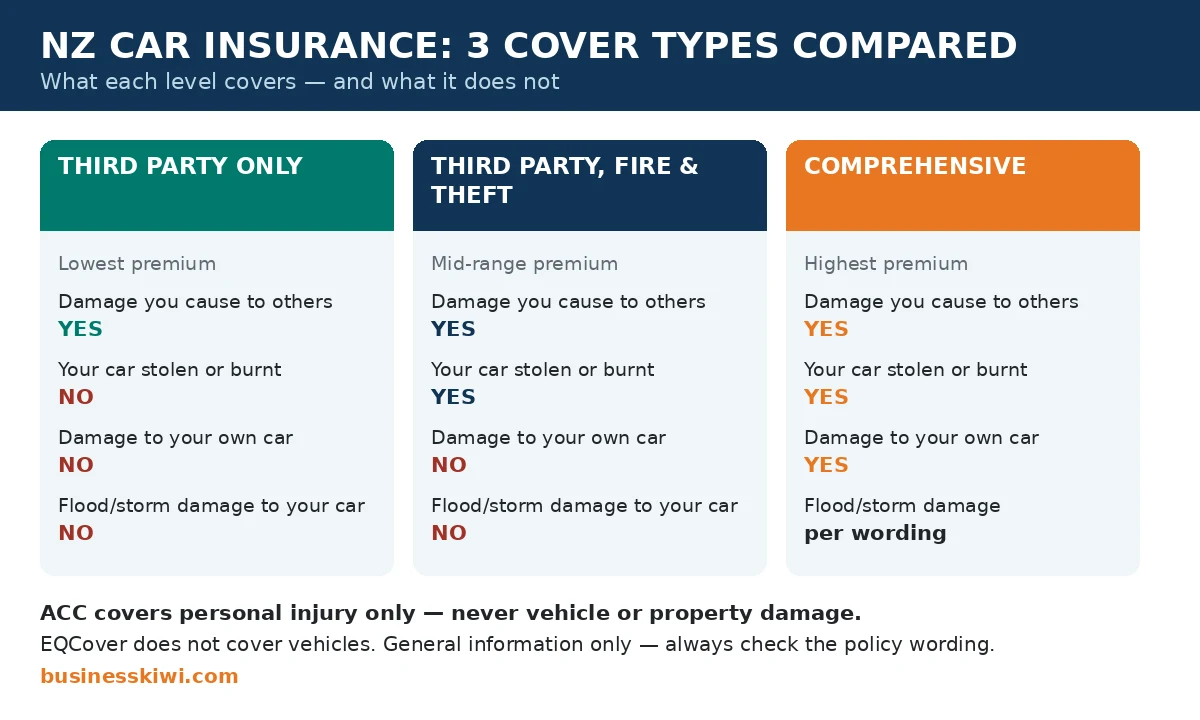
Car insurance in NZ at a glance
| Cover type | Damage you cause to others | Your car stolen or burnt | Damage to your own car | Weather/flood damage to your car | Typical cost position |
|---|---|---|---|---|---|
| Third party only | Yes | No | No | No | Lowest premium |
| Third party, fire and theft | Yes | Yes | No | No | Mid-range premium |
| Comprehensive | Yes | Yes | Yes | Yes, per policy wording | Highest premium |
The cheapest policy is not automatically the right one. The right question is: which losses could you not afford to pay for yourself?
Is car insurance compulsory in New Zealand?
No. Unlike many countries, New Zealand has no legal requirement to insure your vehicle, and there has never been a compulsory scheme for property damage here. You can legally drive uninsured, but if you cause a crash, you are personally liable for repairing or replacing the other person’s car and any other property you damage, and you wear the full cost of damage to your own vehicle.
The reason New Zealand can take this approach is ACC. ACC provides no-fault cover for personal injury from accidents, including injuries from road accidents, funded through levies: motorists pay the Motor Vehicle levy partly at the petrol pump (currently 6 cents per litre on petrol) and partly through the vehicle licence (rego) fee. Because ACC, rather than your insurer, funds injury treatment and rehabilitation, NZ premiums only need to cover vehicles and property, not personal injury claims.
The critical point: ACC never pays for damage to cars or property. If you are uninsured and damage another vehicle, ACC will not help you: that debt is yours.
One exception: if you buy a car on finance, your finance agreement may require comprehensive insurance for the term of the loan. That is a contractual condition, not a legal requirement to drive.

The three types of car insurance explained
Third party only
Third party cover is the least expensive type of car insurance, according to ICNZ. It covers your legal liability if you damage someone else’s vehicle or property, for example, if you run into the back of another car, or lose control and damage a fence. If another driver hits your car and admits fault, their insurer should pay for your repairs.
What it does not cover is any damage to, or loss of, your own car, not in a crash you cause, not if it is stolen, not if it is damaged by weather. It suits a low-value car you could afford to replace yourself, where the main risk is damage you might do to others.
Third party, fire and theft
This adds two protections for your own car on top of third party cover: your car is covered if it is stolen, and if it is damaged by fire. Everything else about your own car is still on you, if you back into a pole or are hit by an unidentified driver, there is no cover for your repairs. It suits cars worth a few thousand dollars, where theft is a realistic concern but the owner accepts the risk of accidental damage.
Comprehensive
Comprehensive is the broadest and generally the most expensive cover. It includes everything above, plus accidental loss or damage to your own vehicle, whether the accident was your fault or someone else’s, and other costs such as salvaging your vehicle from an accident scene and towing it to a repairer, as ICNZ describes. Depending on the wording, it typically also responds to storm, flood and other weather damage, fire, theft and vandalism.
Many NZ comprehensive policies also include what ICNZ calls an uninsured motorist extension (sometimes called innocent party protection): if an identified uninsured driver damages your car and acknowledges their involvement, the insurer may waive your excess and preserve your no-claims discount. Terms vary by insurer, so check the wording.
Agreed value vs market value
Whichever cover type you choose, your car is insured on one of two value bases:
- Market value: what your vehicle was worth immediately before the loss, in Consumer Protection’s words, the value just before the damage occurred. Insurers usually establish it using pre-accident valuations, taking account of age, condition, mileage and modifications.
- Agreed value: a fixed amount agreed with the insurer when you take out the policy and at each renewal. If the car is written off, that amount is the payout basis, which gives certainty.
Agreed value removes the argument about what the car was “really” worth, but the premium reflects the higher, fixed sum insured. Market value policies are generally cheaper, but the payout falls as the car depreciates, and the Insurance & Financial Services Ombudsman (IFSO) notes many people are surprised to find a total-loss payment below the sum insured on their schedule, because most policies settle total losses at market value. Check which basis your policy uses, and check the agreed value at every renewal: ICNZ warns insurers may change it at renewal, and second-hand values move, so last year’s figure may no longer be accurate.
A car is a “write-off” (total loss) when repair costs exceed what it is worth, not necessarily when it is physically beyond repair. If the vehicle is structurally damaged, ICNZ explains the insurer will generally require deregistration before settling, to keep unsafe vehicles off the road.
What car insurance usually does not cover
Exclusions are where claims go wrong, so read this part of any wording carefully. Common ones in NZ motor policies:
- Wear and tear, mechanical or electrical breakdown, and gradual damage. Insurance covers sudden, accidental damage, not a gearbox that wears out. Mechanical breakdown insurance is a separate add-on product, and a car that deteriorates over time is the owner’s responsibility.
- Driving outside your licence conditions. ICNZ warns that if you are in an accident while driving outside your licence restrictions and that contributed, the insurer may not cover you.
- Undisclosed business use. Private policies may allow occasional business use, but fare-paying passengers or deliveries (including rideshare) usually need a commercial policy or an extension. If the insurer does not know, a claim can be at risk.
- Undisclosed modifications and drivers. Disclose modifications, who will drive the car, and drivers’ accident and conviction history. ICNZ: disclose everything that may affect the insurer’s decision, whether or not you are asked.
- Failing to take reasonable care. Your contract obliges you to take reasonable care to avoid accidents and theft, locking the car and keeping it roadworthy are basics (Consumer Protection).
- Accessories beyond policy limits. Roof racks, tow bars and child car seats count as accessories and may only be covered up to a limit unless specified.
Does insurance cover earthquake or flood damage to your car?
EQCover, provided by the Natural Hazards Commission Toka Tū Ake, covers residential homes and some land, not vehicles, and no government scheme repairs your car after an earthquake, flood or storm.
For vehicles, natural disaster damage falls to your own policy, in practice comprehensive cover, since the third party options exclude flood and storm damage to your own car. As the Auckland floods and Cyclone Gabrielle showed, ICNZ’s industry snapshot recorded about $1.7 billion in motor-related claims for 2023.
What affects the price of car insurance?
Two groups of factors set your premium: things about you and your car, and conditions across the whole insurance market.
Your risk profile
- Cover type and sum insured. Comprehensive costs more than third party; a higher agreed value costs more than a lower one.
- Your excess choice. A higher excess means you share more of the risk, and Consumer Protection confirms this lowers the premium, but it is real cash you must find at claim time.
- Driver age and licence. Premiums are generally higher for drivers under 25 or not on a full licence. Consumer Protection states this directly, and ICNZ notes young drivers are statistically more likely to be in accidents. Many policies add special terms or an extra excess for claims involving under-25 drivers.
- Claims and driving history. A clean licence and not making claims make the biggest difference to what you pay, according to Consumer Protection.
- The car, and where it lives. Type, age, value, security features and parking all matter, as do location (theft and accident frequency) and business use.
- Who is named on the policy. Naming specific drivers can reduce the premium, but anyone not named may not be covered to drive.
Market-wide factors
ICNZ attributes rising premiums in recent years to the rising cost of extreme weather events, growing asset values, inflation in the vehicle repair sector (modern cars carry expensive sensors that cost more to repair and calibrate), higher reinsurance costs, and the rising cost of doing business. Government levies and GST also form part of the final price. That is why premiums can rise at renewal even if you have not claimed.
So what do NZ drivers actually pay?
There is no official single “average” car insurance premium, and any average hides very different cars, drivers and regions, treat averages as context, not as a quote. A low-value car insured third party only for an experienced driver will usually sit far below that figure; a late-model car comprehensively insured in a city, with a young driver on the policy, will usually sit well above it. The only figure that matters for your budget is a quote for your own circumstances, which is why comparing like-for-like quotes is essential.
Excess, explained with an example
The excess is the amount you pay towards a claim before the insurer pays the rest. If your claim is accepted, the insurer will ask you to pay an excess, apart from some windscreen claims, expect one whatever policy type you hold, as Consumer Protection explains. Some policies also have additional excesses that stack on top: for example, an extra young-driver excess.
Illustrative example only, not a quote: Your comprehensive policy has a standard excess of $500. You reverse into a post and the repair bill is $2,400. Your claim is accepted, you pay the $500 excess, and your insurer pays the remaining $1,900. If an under-25 driver had been driving and your policy has an additional $500 young-driver excess, you could pay $1,000 in total and the insurer $1,400: check your schedule for the excesses that apply to you.
Two consequences follow. For minor damage costing less than your total excess, there is nothing to claim. And choose a high excess only if you could pay it at short notice: a cheaper policy you cannot afford to claim on is poor value.
Optional add-ons: what you might be offered
Insurers sell extras on top of the core policy. Common ones in NZ include windscreen and glass cover (often excess-free), roadside rescue, rental or courtesy car cover, excess waiver, and key and lock cover.
Consumer Protection’s advice is worth following exactly: before adding extra cost to your premium, ask whether it is in your budget and whether you really need the added protection. Add-ons offered when you buy a car on finance, such as asset protection, credit contract insurance and payment protection insurance, deserve particular scrutiny: they are easy to accept without noticing, and they add to the amount you finance.
How to compare car insurance policies
Comparing on premium alone is the most common mistake: two policies at the same price can pay out very differently. Line any car insurance comparison in NZ up against the same checklist:
- Cover type: third party, third party fire and theft, or comprehensive. Compare like with like.
- Value basis: agreed or market value, and the actual sum insured. Is it realistic for your car’s current value?
- Total excess picture: standard excess plus any age, licence or inexperienced-driver excesses that stack on top.
- Included as standard: windscreen cover, towing, salvage, uninsured motorist extension, courtesy car, and their limits.
- Key exclusions: business use, modifications, named-driver restrictions, and any “what we don’t cover” items matching your real life.
- Claims process: can you choose your repairer? How are claims lodged and assessed?
- Discounts actually applied. The FMA advises asking your insurer, in writing: how is my premium calculated, are all applicable discounts included, and is this still the right product for me? Its reviews found customers overcharged and discounts never applied. Ask about multi-policy discounts if you hold house or contents cover with the same insurer, but verify the discount is genuinely there.
- The insurer behind the policy. Since 31 March 2025, insurers serving NZ consumers must hold an FMA financial institution licence and publish their fair conduct programme summary. ICNZ members must also follow the Fair Insurance Code.
BusinessKiwi’s wider Finance, Tax & Money guides cover related household decisions, and our companion guides to house insurance and income protection insurance will sit alongside this page, vehicle, home and income cover are usually budgeted together, and the comparison habits here apply to all three.
How making a claim works
- At the scene: check everyone is safe and call emergency services if needed. Exchange name, address, phone, insurer, registration and licence details with other drivers, and photograph the damage.
- Notify your insurer promptly, with the facts, photos and any police report or witness details.
- Assessment. The insurer assesses liability and damage. Repair costs are checked and authorised before repairs go ahead; repairers may be from the insurer’s network.
- Excess and repairs. You pay the applicable excess (unless it is waived, for example where an at-fault driver is identified), and repairs proceed.
- Total loss settlements. If the car is written off, the insurer settles at the agreed value or market value, per your policy basis. A structurally damaged car will generally be deregistered as part of settlement. Note that after a total-loss claim the policy usually ends (ICNZ), and pro-rata refunds are not normally given, monthly payers may have instalments deducted from the settlement.
- If you disagree with a decision: complain to the insurer first. If it is not resolved, you can go to the insurer’s dispute resolution scheme, free, independent schemes such as the Insurance & Financial Services Ombudsman (IFSO). The FMA is clear you are entitled to fair treatment; the Fair Insurance Code sets the standard for ICNZ members.
Common mistakes to avoid
- Auto-renewing without checking. Values, agreed amounts, drivers and discounts change. ICNZ’s renewal checklist prompts you to re-check your car’s value, any change to the agreed value, driving offences, modifications, business use, address changes and under-25 drivers.
- Never updating the sum insured. An unrealistic value distorts both the premium and the payout.
- Choosing an excess you cannot afford to pay. The premium saving is not worth an unusable policy.
- Not disclosing something small. A modification, a young driver who “only drives it occasionally”, a side-hustle delivering food, undisclosed facts are exactly what claims are declined over.
- Buying add-ons by default, especially at a car yard, where extras get bundled into finance.
- Letting an un-named person drive. If your policy names specific drivers to save money, anyone outside that list may not be covered.
- Assuming ACC or EQC will help with the car. ACC is injury only; EQCover is homes and land only. Vehicle damage is your policy, or your pocket.
Car insurance NZ: frequently asked questions
Is car insurance compulsory in New Zealand?
No. There is no legal requirement to hold car insurance in NZ, and no compulsory third party scheme for property damage. The only compulsory injury scheme is ACC, funded through levies. Insurance may still be required by your finance agreement if the car is bought on finance.
Does ACC pay for damage to my car?
No. ACC covers personal injury from accidents: treatment, rehabilitation and related support. It never covers damage to vehicles or other property. That is what motor insurance, or your own savings, must cover.
Which type of car insurance is cheapest?
Third party only is generally the least expensive, because it covers only damage you cause to others. Third party, fire and theft sits in the middle, and comprehensive is generally the most expensive because it also covers accidental damage to your own car.
What is the difference between agreed value and market value?
Agreed value is a fixed amount set with your insurer at the start of the policy and each renewal, it is the basis of a total-loss payout, so you know where you stand. Market value is what the car was worth immediately before the loss, assessed at claim time, so the payout reflects depreciation and can disappoint if you expected the schedule figure.
Does comprehensive car insurance cover flood or earthquake damage?
Generally yes, subject to your policy wording, one of the main gaps between comprehensive and the third party options, which exclude natural disaster damage to your own car. EQCover does not cover vehicles at all; it covers homes and some land.
What happens if an uninsured driver hits me?
If the driver is identified and acknowledges their involvement, many NZ policies include an uninsured motorist extension that may cover your damage while waiving your excess and protecting your no-claims discount. If the driver cannot be identified, comprehensive cover can still respond (subject to your excess), while third party policies generally cannot.
Will making a claim increase my premium?
It can. Claims history is one of the factors insurers use, and Consumer Protection identifies not making claims as one of the biggest influences on what you pay. A claim may also affect a no-claims discount. For damage costing little more than your excess, do the arithmetic before claiming, but never let that stop you reporting an incident your policy requires you to disclose.
How can I lower my car insurance premium?
The main levers, per Consumer Protection and the FMA: choose a higher excess you can genuinely afford; keep a clean licence and claims record; name specific drivers; tell your insurer about secure parking and alarms; consider a lower cover level for a genuinely low-value car; ask whether multi-policy discounts apply and confirm they have actually been applied; and compare quotes at renewal rather than auto-renewing.
Sources
- Consumer Protection (MBIE): Car insurance: cover types, values, excess, paying less, disputes. https://www.consumerprotection.govt.nz/help-product-service/cars/paying-registering-insuring-car/car-insurance
- Insurance Council of New Zealand: Motor Insurance: What You Need to Know (policy types, uninsured motorist extension, young drivers, disclosure, write-offs) and Insurance Basics / Renewal Checklist. https://www.icnz.org.nz/individuals/motor/ · https://www.icnz.org.nz/individuals/the-basics/
- Insurance Council of New Zealand: Industry snapshot (2023 data): motor-related claims of $1.7 billion; premium drivers. https://www.icnz.org.nz/wp-content/uploads/2024/10/ICNZ-Fact-Sheet-2023_2_0-1.pdf
- Financial Markets Authority: Insurance: insurer licensing from 31 March 2025, fair conduct, Fair Insurance Code, disputes. https://www.fma.govt.nz/consumer/everyday-finance/insurance/
- ACC: Paying levies if you own or drive a vehicle: Motor Vehicle levy, petrol (6c/litre) and rego. https://www.acc.co.nz/about-us/our-levies-2/paying-levies-if-you-own-or-drive-a-vehicle
- Natural Hazards Commission Toka Tū Ake: EQCover covers homes and land, not vehicles. https://www.naturalhazards.govt.nz/news/all-insured-kiwi-homes-have-doubled-their-eqcover/
- Insurance & Financial Services Ombudsman: Vehicle insurance: agreed vs market value, write-offs. https://www.ifso.nz/information/vehicle-insurance
General information only. Policies differ between insurers and change over time, always read the policy wording and schedule for any policy you are considering, and seek personalised advice from a licensed financial adviser if you need a recommendation.