Tax Return NZ: Who Files One, What Goes In It and How the Process Works

For something so many New Zealanders talk about each winter, the tax return is widely misunderstood. Plenty of salary earners never file one at all, and that is not them dodging an obligation. It is how the system is designed to work. Other people, often those who picked up a side income, a rental property or some contract work during the year, do have to file, sometimes without realising it.
Most individual returns relate to the tax year ending 31 March, and Inland Revenue publishes the current filing dates each year, so check those rather than relying on last year’s. This guide covers the part that changes much less often: what a tax return is, who has to file one, what goes in it, how the filing process works step by step, and what happens once it is in.
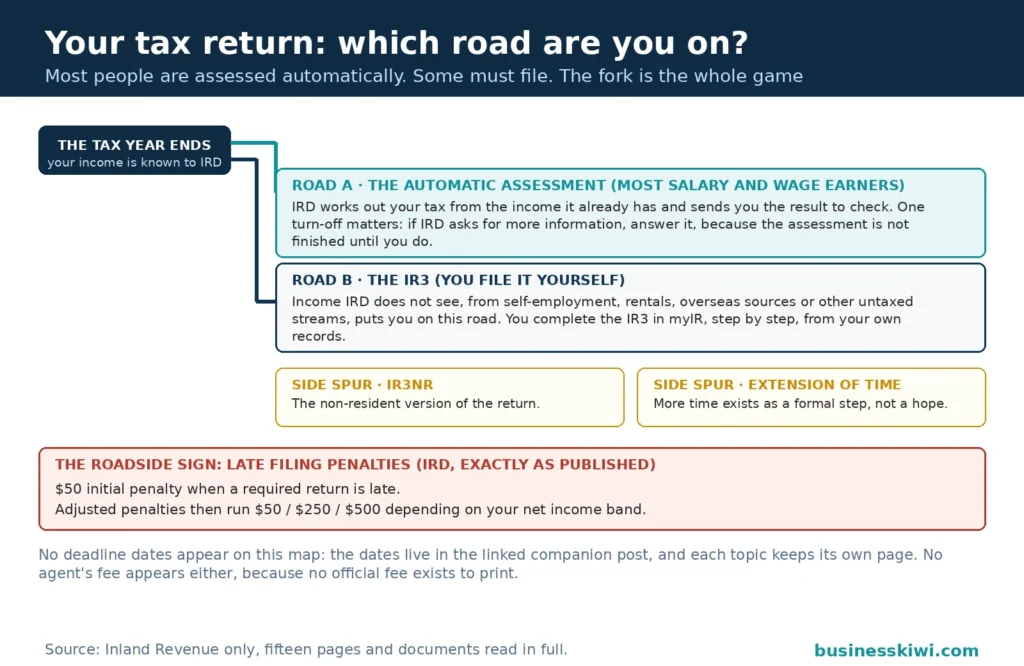
What a tax return actually does
A tax return is a report of everything you earned in a tax year, the expenses you are claiming against that income, and the tax you have already paid along the way. Its job is to square things up. Tax deducted during the year through PAYE, resident withholding tax and similar mechanisms is worked out in real time, based on the information available at the moment you are paid. It is an estimate, not a final answer.
At the end of the year, Inland Revenue compares the tax you actually paid with the tax payable on your total income from all sources. One of three results follows. You have paid too much and are due a refund. You have paid too little and have tax to pay. Or the two figures match and nothing further is owed either way. That comparison is the square-up that happens at the end of the financial year, and every individual gets one, whether or not they personally file anything.
There are two routes to that result. For most salary and wage earners, Inland Revenue works the calculation out itself and issues an income tax assessment. For everyone else, the individual files an Individual income tax return, the IR3.

The automatic assessment: when Inland Revenue does the work
You will generally receive an automatic income tax assessment if your only income is salary, wages or investment income that has already been taxed, such as bank interest. Inland Revenue lists the income types that fit this group: salary and wages, portfolio investment entity (PIE) income such as KiwiSaver, NZ Superannuation, schedular payments for contractors, income-tested benefits such as Jobseeker Support and Sole Parent Support, interest and dividends, taxable Māori authority distributions, and benefits under an employee share scheme where your employer gives you shares as part of your pay.
The system works because the people who pay you report to Inland Revenue as the year goes on. Employers, banks and investment providers all send in income and tax information, so by the time the year ends Inland Revenue usually holds enough to run the calculation itself.
An automatic assessment is not a document to file away unread. It is built from the information Inland Revenue holds, and that information can be wrong or incomplete, so check it when it arrives. You need to tell Inland Revenue if any of the details are incorrect. Keep your contact details and bank account details current too, since those are what Inland Revenue uses to reach you and to pay any refund.
The request for more information
Some people in the assessment group receive a request for more information instead of a finished assessment. Inland Revenue sends these where it thinks you may have other income to tell it about, expenses to claim against your income, schedular payments, or ACC attendant care payments.
This is still part of the assessment process, not a tax return. Check the details Inland Revenue has provided and report anything missing or incorrect, any income over $200 (before tax) that is not showing, changes to your contact or bank account details, and any expenses you can claim. If Inland Revenue does not hear from you within 45 days, it will complete your assessment on the basis that the information it holds is correct, then send you the finalised result.
Who has to file an IR3
The core rule is simple. You need to complete an individual income tax return at the end of the tax year if you received more than $200 (before tax) in income that Inland Revenue has not been told about, even if that applied for only part of the year.
Inland Revenue’s IR3 guide makes the same point from the other direction: if you received any income apart from salary, wages, schedular payments, interest, dividends and taxable Māori authority distributions, you must complete an IR3. The types of income that trigger a return include:
- self-employment income, including a side business run alongside a job
- rental income, including from services such as Airbnb and Bookabach
- overseas income, which residents are taxed on whether or not the money comes into New Zealand
- income from a taxable property sale
- income from an estate, trust or partnership
- royalties
- foreign investment fund (FIF) income
- cash jobs and other payments where no tax was deducted
- shareholder-employee salary where no PAYE was deducted
Some situations require a return even where the income itself is ordinary. You will need an IR3 if you arrived in or left New Zealand partway through the year and had other income, if you are looking after the estate of someone who has died and a final return is required, if you were declared bankrupt and do not meet the criteria for an automatic assessment, or if you changed your balance date partway through the year.
If Inland Revenue sends you a return to complete, in myIR or on paper, that is not optional either. If you believe you have been sent one by mistake, contact Inland Revenue, which will update your details if a return is not needed.
The return types at a glance
The IR3 is the standard individual return for New Zealand tax residents. Non-residents have their own version, the IR3NR. You may need to file an IR3NR if you were a non-resident taxpayer for the full tax year and you received income from New Zealand that was not taxed, or that was taxed at the wrong rate. There is an exception worth knowing: if your only New Zealand income was interest, dividends or royalties, and non-resident withholding tax was deducted at the correct rate, or the interest was zero-rated under the approved issuer levy rules, you do not need to file one.
If you were a non-resident for only part of the year, you file an IR3 rather than an IR3NR, showing your New Zealand income for the non-resident period and your New Zealand and overseas income for the period you were a resident.
Other taxpayers have returns of their own. Estates, for example, file an estate income tax return: income a person received up to the time of their death generally goes in their final individual return, with income received after death going in the estate’s return. Companies, trusts and partnerships likewise report on their own return types, but those sit outside this guide, which is about individuals.
What goes into an IR3
Income that already had tax deducted
The first part of the return covers income where tax was taken out before you received it: salary and wages, a student allowance, main benefits, ACC payments related to earnings, NZ Superannuation and other pensions, and employee share scheme benefits. These figures come from your Summary of Income, which brings together what your employers and other payers reported. If you file in myIR, this information is already in the return. Check it: if the Summary of Income is wrong or an employer is missing, the return needs the corrected totals.
Schedular payments, the withholding arrangement used for many contractors, sit in their own part of the return: the gross payments and the tax deducted both go in, and expenses relating to those payments are claimed there too.
Interest and dividends
New Zealand interest goes in as the gross amount earned, with the resident withholding tax (RWT) deducted shown as a credit. Dividends work from the dividend statement the company or unit trust sends you, which shows the amount you received, any imputation credits and any RWT credits. Add those together and you have the gross dividend to declare, with the credits counted against your tax. Imputation credits exist because the company has already paid tax on the profits the dividend came from; the credit stops the same income being taxed twice in full. Keep your interest and dividend statements rather than sending them in. Inland Revenue may ask to see them later.
PIE income
Income from portfolio investment entities, which includes most KiwiSaver funds, is taxed during the year at your prescribed investor rate, or PIR. The IR3 includes a PIE calculation that checks whether the rate your provider used was the right one for your income. If your PIR was too low, there may be extra tax to pay; if it was too high, PIE tax may be refunded through the return. You need your investor statements, your Summary of Income or your myIR details to complete this part.
Income Inland Revenue does not know about yet
This is the part of the return only you can complete. Depending on the income type, extra forms are completed as part of the return: a financial statements summary (IR10) for business income, a rental income schedule (IR3R) for rent, a bright-line property sale form (IR833) for a taxable property sale, and an overseas income summary (IR1261) for overseas income and the tax credits claimed on it. Overseas income is converted into New Zealand dollars, and the overseas summary is broken down by type of income and by country.
Tax credits
Against the tax calculated on your taxable income, the return counts the tax you have already paid: PAYE, RWT, schedular payment deductions and imputation credits among them. Two other credits are worth understanding at overview level. A foreign tax credit may be available where you have already paid tax in another country on overseas income, claimed through the overseas income summary, with any double tax agreement between New Zealand and that country relevant to how it applies. The independent earner tax credit is a credit for people in a middle income band who meet the eligibility conditions, calculated as part of the return.
Donation tax credits sit slightly apart. They are claimed separately, either on the tax credit claim form or by submitting donation receipts in myIR, rather than inside the IR3 itself.
Inland Revenue calculates the tax on your taxable income using the published income tax rates, then applies your credits to reach the amount refundable or payable.
Expenses and deductions: what can and cannot be claimed
The most common misconception about the IR3 is that employees can claim the costs of doing their job. As a rule, you cannot claim expenses against salary and wages. Inland Revenue’s IR3 guide is explicit that expenses cannot be claimed against income from salary or wages, and it applies the same bar to a few other taxed-at-source income types.
There is, however, a short list of expenses that people whose income is already taxed can claim:
- the fee you paid someone, such as an accountant or tax agent, to complete and file your return or assessment
- commission charged on your interest or dividend income, but not bank fees, which Inland Revenue treats as a private expense
- interest on money borrowed to buy shares or to invest, where the investment will produce taxable income
- premiums on loss of earnings insurance, where the payout from the policy would be taxable income
- interest you have paid Inland Revenue for late payment of tax, claimed in the year you paid it
People in business play by different rules because their return reports a net result. The self-employed claim their business expenses against their business income, summarised in the financial statements summary that accompanies the return; landlords claim expenses related to their rental property in the rental schedule. In plain terms, if you are self employed, the figures in your return come from your business records, in effect your profit and loss statement for the year. Contractors on schedular payments claim the expenses of earning that income in the schedular payments part of the return.
Whatever you claim, keep the evidence. Inland Revenue may ask for proof, such as an invoice from your accountant or a receipt for insurance premiums. For the GST registered, expenses go into the IR3 without the GST portion, because that GST is claimed in the GST return instead.

Filing step by step in myIR
Step 1: Gather what you need. Before you start, check your contact details and bank account are up to date, as Inland Revenue advises. You will need your income details for the tax year, details of any expenses you want to claim, and statements covering interest, dividends and any overseas, rental or business income.
Step 2: Wait until your income information has arrived. Inland Revenue receives information from employers, banks and investment providers after the year ends. If anyone who paid you has to send information about those payments, you may need to wait before filing so the return can be pre-populated. Filing earlier means the pre-filled figures will be incomplete.
Step 3: Open your return. Inland Revenue will let you know when your return is ready, by email or text if you use myIR, or by sending a paper return in the post. Returns completed in myIR are usually processed faster. If you need to file but have not been sent a return, you can request one through myIR.
Step 4: Check the pre-populated income. The taxed income Inland Revenue knows about, such as salary, wages, interest and PIE income, is included automatically in myIR, or provided through your Summary of Income if you file on paper. Go through it against your own records, and correct anything wrong or missing rather than filing around it.
Step 5: Add what Inland Revenue does not know. Enter your untaxed income and complete the extra forms that apply, such as the rental schedule or overseas income summary. If you received Working for Families payments or have a student loan, there is also an adjust your income process for the adjustments those require.
Step 6: Add expenses and credits, then submit. Enter the expenses you are claiming, check the credits shown, including RWT and any foreign tax credits, then review the whole return and submit it.
Step 7: Read your notice of assessment. After you file, Inland Revenue sends a notice of assessment confirming it has your return and showing any refund due or tax to pay. If you realise you made a mistake, tell Inland Revenue as soon as possible. You should also let it know when you start receiving a new type of income, or stop receiving an existing one, which you can do in myIR.
Records: what to keep, and for how long
Good records make a return straightforward, and they are also your protection if Inland Revenue reviews your return later. Inland Revenue’s position is that tax records must be kept for at least seven years, in English or te reo Māori unless another language has been approved, and offshore or cloud storage of records also needs Inland Revenue approval.
In practice, keep your Summary of Income, payslips, interest and dividend statements, invoices and receipts for anything you claim, bank statements, and the records behind rental, business and overseas income figures, including proof of any overseas tax paid. Paper records, electronic records or a mix of both are acceptable.
Common mistakes, and how they happen
Inland Revenue’s own end-of-year guidance names the usual reasons people end up with an unexpected tax bill: being on an incorrect tax code, having multiple incomes without the secondary tax code being used correctly, using the wrong PIR for investments, and earning other income while receiving paid parental leave payments. These are during-the-year problems that only surface at the square-up.
The filing stage has its own traps. The biggest is assuming the pre-populated figures must be right and submitting without checking; they are only as good as what payers reported. Close behind is leaving out income that is not showing, even though anything over $200 that Inland Revenue has not been told about has to be reported, on an IR3 or on a request for more information alike. Other regular errors include claiming expenses that cannot be claimed, such as work costs against wages or bank fees treated as claimable commission, filing before all your payer information has arrived, letting a request for more information sit unanswered past the 45 days Inland Revenue allows, and forgetting that overseas income is taxable here even if tax was already paid on it overseas. A foreign tax credit may reduce the New Zealand tax, but it does not remove the need to declare the income.
Tax agents and extensions of time
You do not have to file alone. Many people use a tax agent, and there are two practical points to know. First, the fee an agent charges for completing and filing your return is itself one of the expenses an individual can claim. Second, agent arrangements affect timing. Extension of time arrangements let tax agents spread return filing across the year, and Inland Revenue’s IR3 guide notes that if you have a tax agent you may have until 31 March of the following year to complete your return. There are no official agent fee figures; what agents charge is a matter between you and them.
If you file your own return and cannot meet the normal date, you can apply for an extension of time yourself. Individuals, trusts and companies can all apply. The application is made in myIR, from your income tax account, and you need to say why you are requesting the extension and when you expect to have filed by. An extension of time lets you file later than when your return is due; it is not a way to avoid filing.
If you file late, or not at all
Late filing penalties apply to income tax returns by law. Inland Revenue may charge a penalty where you file late without an extension of time or a valid reason. For income tax, the amount depends on your net income. The penalty is initially charged at $50, and once the late return is filed it is adjusted to the actual net income for the year: $50 where net income is under $100,000, $250 where it is between $100,000 and $1 million, and $500 where it is over $1 million.
The consequences of getting a return wrong are broader than late filing. Inland Revenue’s IR3 guide warns that you may face penalties and prosecution if you are required to file and do not, if you give false or misleading information, including leaving income out, if you deliberately omit details so the return misleads, or if you file late. Interest can also apply where tax is paid late, separate from filing penalties.
Frequently asked questions
Do I need to file a tax return if I only earn a salary?
Usually not. If your only income is salary, wages or investment income that has already been taxed, Inland Revenue will generally work out your tax for you and send an income tax assessment. You still need to check it and tell Inland Revenue if any detail is wrong.
What is the difference between an income tax assessment and an IR3?
With an assessment, Inland Revenue calculates your end-of-year tax from the information it already holds. With an IR3, you report your income and expenses yourself and the return calculates whether you are due a refund or have tax to pay. A request for more information is part of the assessment process, not a return.
I received a request for more information. What do I do?
Check the details Inland Revenue has provided, report any income over $200 that is not showing, update your contact or bank details if they have changed, and add any expenses you can claim. If you do not respond within 45 days, Inland Revenue finalises your assessment using the information it already has.
Can I claim my work expenses as an employee?
Generally no. Expenses cannot be claimed against salary and wages. The claimable list for people on taxed income is narrow: return preparation fees, commission on interest and dividend income (not bank fees), interest on money borrowed to invest in something producing taxable income, loss of earnings insurance premiums where the payout would be taxable, and interest paid to Inland Revenue for late tax.
I earned some cash on the side. Do I have to declare it?
Yes. Cash jobs and other untaxed payments are income. If your income that Inland Revenue has not been told about comes to more than $200 before tax for the year, you need to file an IR3 and declare it.
What happens after I submit my IR3?
Inland Revenue sends you a notice of assessment confirming your return and showing whether you are due a refund or have tax to pay. If you spot a mistake in what you filed, tell Inland Revenue as soon as possible rather than waiting for it to be picked up later.
Can I get more time to file my return?
Yes, in the right circumstances. You can apply for an extension of time in myIR, giving your reason and the date you expect to file by. If you use a tax agent, extension of time arrangements may give you until 31 March of the following year.
How long do I need to keep my tax records?
At least seven years. Keep your income statements, receipts and invoices for expenses claimed, bank statements and the records behind any rental, business or overseas income, in English or te reo Māori, in case Inland Revenue asks to see them.
This article is general information only, based on Inland Revenue guidance at the time of writing. It is not tax advice and does not account for your individual circumstances. Tax settings and Inland Revenue processes can change, so check the current position with Inland Revenue or talk to a qualified tax adviser before acting on anything here.
Sources
- Individual income tax return – IR3, Inland Revenue, ird.govt.nz
- Complete my individual income tax return – IR3, Inland Revenue, ird.govt.nz
- Individual income tax return guide 2026 (IR3G), Inland Revenue, ird.govt.nz
- When we work out your tax for you: income tax assessments, Inland Revenue, ird.govt.nz
- Income tax assessment – more information required, Inland Revenue, ird.govt.nz
- I received an income tax assessment, Inland Revenue, ird.govt.nz
- Timelines at the end of the tax year, Inland Revenue, ird.govt.nz
- End of tax year: know what to do, Inland Revenue, ird.govt.nz
- Income tax returns are due 7 July, Inland Revenue, ird.govt.nz
- Income tax return for non-resident individual taxpayers – IR3NR, Inland Revenue, ird.govt.nz
- Overseas income, Inland Revenue, ird.govt.nz
- Non-business expenses, Inland Revenue, ird.govt.nz
- Record keeping, Inland Revenue, ird.govt.nz
- Late filing penalties, Inland Revenue, ird.govt.nz
- Apply for an extension of time, Inland Revenue, ird.govt.nz