
Tax Code ME: What It Means, Who Can Use It and What It Does to Your Pay

The quick answer
Tax code ME is the main-job tax code for employees who qualify for the independent earner tax credit (IETC). If you are a New Zealand tax resident, your income is between $24,000 and $70,000 a year, and neither you nor your partner receives Working for Families, a main benefit, NZ Super or a veteran’s pension, ME is very likely your code. Choosing it on your tax code declaration (IR330) reduces the PAYE deducted from your pay by up to $10 a week, up to $520 a year, because the credit is paid to you through your pay packet instead of being sorted out after the tax year ends. If you have a student loan, the same code with the loan added is ME SL. Everyone else on a main job uses M, or M SL with a student loan.
Nothing about your tax rates changes on ME. The code does one job only: it delivers a credit you are entitled to, a little at a time, all year.
What the ME code actually is
New Zealand’s main tax codes look almost identical on a payslip, and that is where the confusion starts. M is the standard main-employment code. ME is the same code with one addition, the E, which stands for the independent earner tax credit. When your employer runs payroll on ME or ME SL, the credit is already built into Inland Revenue’s PAYE tables and calculator, so your employer deducts slightly less tax each pay and does no extra maths to make it happen. The money is not a bonus and it is not your employer being generous. It is a tax credit Parliament set for middle-income earners who do not receive other government support, and the code is simply the delivery mechanism.
That design has a practical consequence worth knowing. Because the credit arrives through your pay, it also disappears through your pay if your situation changes and you stop qualifying. People get caught when they keep using ME after a pay rise pushes them over the limit, or after Working for Families starts in the household, and then face tax to pay when Inland Revenue squares up the year. The sections below cover both directions: how to get on ME if you qualify, and when you must come off it.
Who can use tax code ME
Four tests decide whether ME is your code, and you need to pass all four. They come from Inland Revenue’s rules for the independent earner tax credit, because eligibility for the credit and eligibility for the code are the same thing.
You are a New Zealand tax resident. The credit is for NZ tax residents only. If you have just arrived or you are leaving the country part-way through a year, your position may be different, and Inland Revenue’s residency guidance is the place to check.
Your income is between $24,000 and $70,000 a year. Income here means your total income from all sources for the tax year, 1 April to 31 March, not just your main salary. Below $24,000 there is no credit at all. The full credit runs to $66,000, then it shrinks and reaches zero at $70,000, which the next section works through.
Neither you nor your partner is entitled to Working for Families. This is the test most often missed. Entitlement is what counts, and it runs through a partner as well: if your partner is entitled to Working for Families tax credits, or to an overseas equivalent, you cannot use ME even if the payments never come into your own bank account. The IR330 itself carries this warning in its notes.
You do not receive a main benefit, NZ Super, a veteran’s pension, or an overseas equivalent of any of them. The credit is aimed at people whose income comes from work rather than government support. A student allowance is not on this list, and neither is ACC weekly compensation on its own, but a main benefit from Work and Income is.
If you pass all four tests and your main job pays more than $24,000, the mechanics are simple: fill in an IR330, choose ME (or ME SL if you have a student loan) for your main job, and hand the form to your employer before your next payday. Inland Revenue also has a “What tax code should I use?” tool on its site that walks through the same questions if you want to double-check yourself.

What ME is worth, and where it runs out
The independent earner tax credit is worth up to $520 a year. On the ME code that shows up as a reduction in PAYE of up to $10 a week, which is why a payslip on ME and a payslip on M for the same salary differ by about the price of a coffee each week, then quietly add up to real money across a year.
The full credit is paid on incomes from $24,000 to $66,000. Above $66,000 it abates at 13 cents for every extra dollar earned, and it is gone completely at $70,000. Three points on that scale show how it behaves, using Inland Revenue’s published settings:
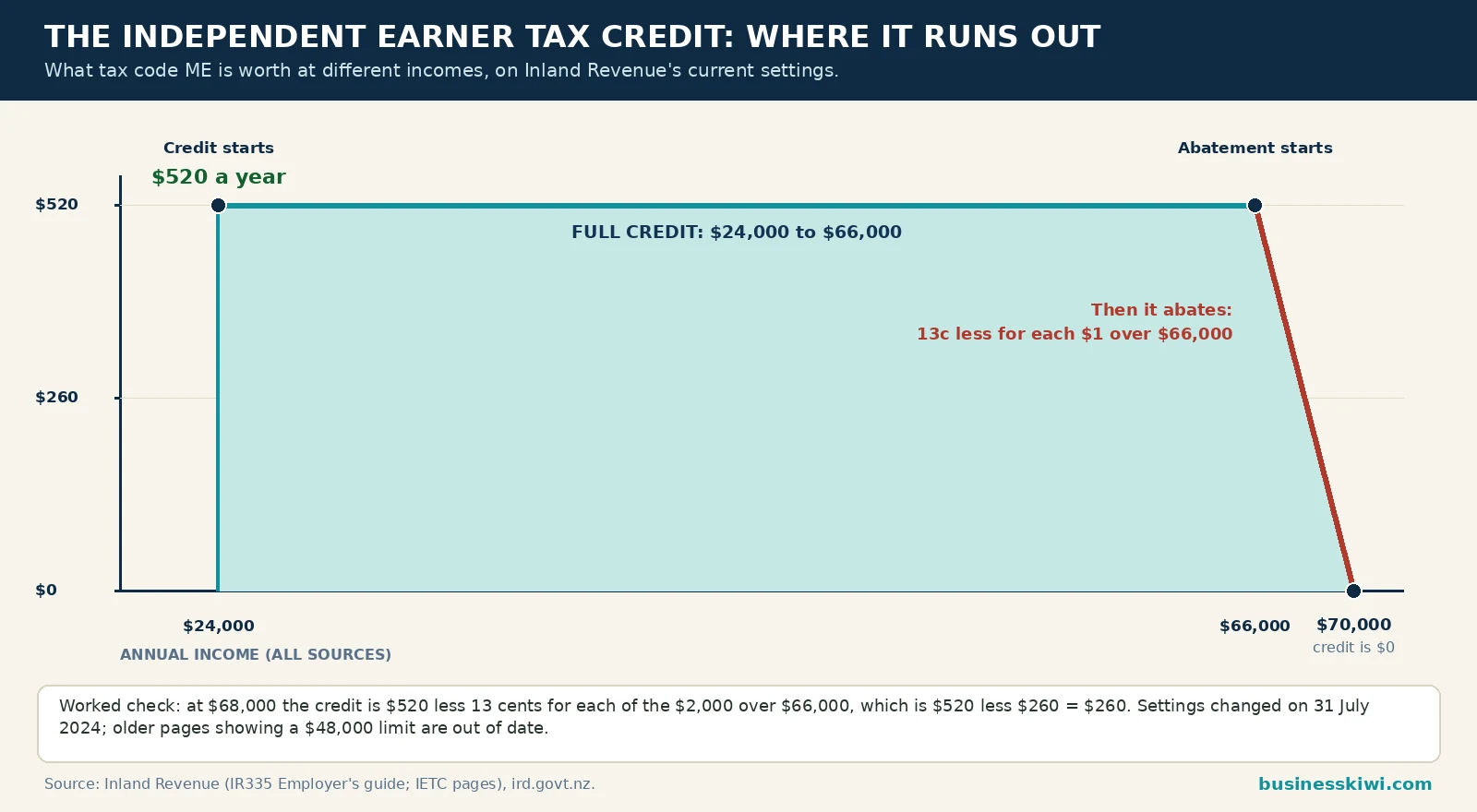
- On $50,000 a year, you receive the full $520, about $10 a week off your PAYE.
- On $68,000 a year, you are $2,000 into the abatement zone. The credit is $520 less 13 cents for each of those $2,000 dollars, which is $520 less $260, so $260 for the year.
- On $70,000 a year, the credit has fully abated and ME gives you nothing over M.
If you want to see the difference on your own pay, our income tax calculator lets you compare take-home pay figures directly.
One more thing, because it trips people up when they search. Older Inland Revenue documents and plenty of older web pages describe this credit as running from $24,000 to $48,000, abating from $44,000. Those were the settings for more than a decade, but the thresholds changed on 31 July 2024, lifting the top of the range to $70,000. The old figures are history, not a disagreement, and the current settings are the ones in this article.
ME or M: how to choose
ME and M sit on the same tax rates. Nothing about the bands your income is taxed at changes between them, and our guide to tax rates covers those bands in full if you need them. The only difference between the two codes is the credit. So the choice is not really about the codes at all. It is about whether you qualify for the credit, and whether you want it paid weekly or annually.
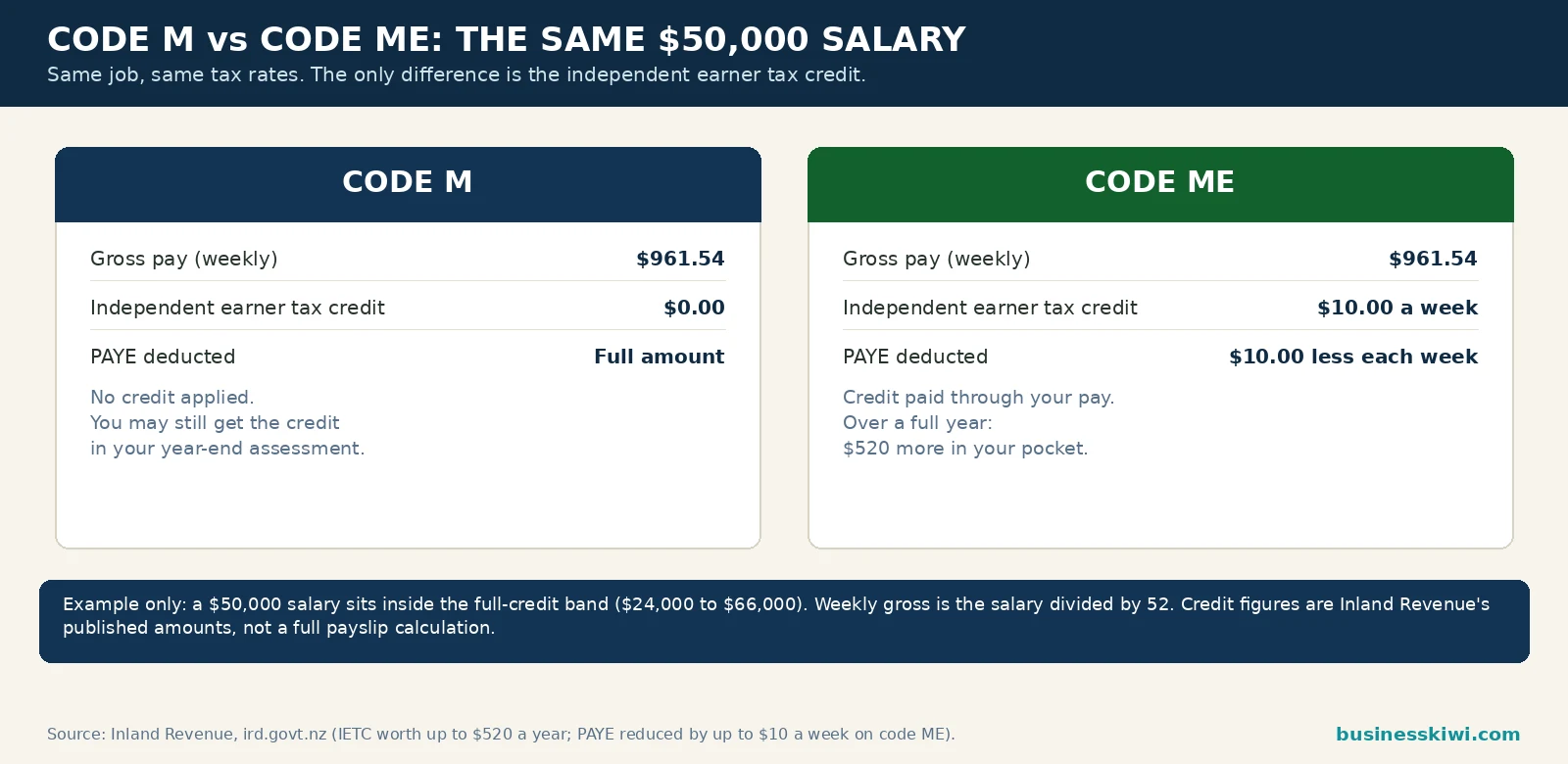
That framing helps with the commonest dilemma, which is genuine uncertainty. Plenty of people cannot say in April exactly what they will earn by March, especially with overtime, variable hours or a possible second job in the picture. Inland Revenue’s answer to that is refreshingly relaxed: if you are not sure whether you qualify, you can stay on M or M SL, and your entitlement is calculated in your income tax assessment at the end of the year instead. You receive the same credit if you were entitled to it, just later and in one lump, usually inside a tax refund. Using ME when you turn out not to qualify is the risky direction, because the shortfall becomes tax to pay. Using M when you did qualify costs you nothing but patience.
The student loan version follows the same logic. ME SL is ME with student loan repayments added, and M SL is the equivalent without the credit. Loan repayments are deducted at 12 percent of what you earn over the repayment threshold for your pay period, whichever main code you are on.
If your main job pays less than $24,000
A part-time main job under $24,000 with other income on top is a special case, because the credit is assessed on your total income but the code can only be used on your main job. If your main job itself pays less than $24,000 while your total income sits between $24,000 and $70,000, Inland Revenue gives you two routes. You can leave your code as it is and receive the credit at the end of the year through your income tax assessment. Or you can apply for a tailored tax code, which Inland Revenue sets for your circumstances so the right amount comes out during the year. What you cannot do is simply put ME on a main job that pays under $24,000 and expect the payroll maths to land correctly.
Moving from a benefit into a job
The credit is deliberately designed to reward the move into work, and the rules handle the transition month with some care. Your IETC starts from the month after your benefit stops. You get no credit for months in which you received a benefit, so someone who was on a benefit for three months of the year and working for the other nine can receive nine months of credit.
If you start your job in the same month your benefit ended, Inland Revenue asks for two IR330 forms. The first, when you start the job, uses code M or M SL. Then, after your last pay in that starting month, you give your employer a second IR330 choosing ME or ME SL, which switches the credit on from the following month. Two forms feels like bureaucracy, but it is what stops the credit being paid for a month it does not cover, and the correction would otherwise land in your year-end assessment anyway. Because the credit is worked out in whole months, small over- or under-payments around job changes are normal, and the annual assessment evens them out.
ME and a second job
You can only ever use one main tax code at a time. ME belongs on your main or highest source of income, and a second job always takes a secondary code, chosen by your estimated total income from all sources. Inland Revenue’s current secondary codes are:
The rates are before ACC earners’ levy, which Inland Revenue collects inside PAYE at $1.75 per $100 of income up to $156,641. Add SL to the secondary code if you have a student loan. Two warnings belong with this table. First, the income in the left column is your total from every source, not what the second job pays, and picking the code from the second job’s pay alone is the classic route to a year-end bill. Second, a second job does not affect your right to use ME on the main job as long as your total income stays inside the $24,000 to $70,000 band and the other three tests still pass. Cross $70,000 in total, though, and the credit is gone, which brings us to leaving ME.
When you must come off ME
Codes are not set-and-forget, and ME has more exit triggers than most. Give your employer a new IR330 moving you to M or M SL when any of these happen:
- Your total income rises above $70,000, whether through a pay rise, more hours, a bonus pattern that becomes regular, or a second job.
- You or your partner becomes entitled to Working for Families.
- You start receiving a main benefit, NZ Super or a veteran’s pension.
- You start a new job. Every new job means a fresh IR330 anyway, and the new salary decides the code. If the new job takes you past the limit, M is the code from day one.

Inland Revenue can also act on its own. If it sees an unsuitable code in use, such as a main code running on two income sources at once, it can ask your employer or payer to change it, and it will notify you that it has done so. Treat that letter as a prompt to check the whole position, not just the code it names.
And if no IR330 is handed in at all, none of this applies: your employer must deduct tax at the non-declaration rate of 45 percent until the form arrives. That rate catches new starters every week, and it is the most expensive tax code mistake in the country precisely because it is made by doing nothing.
Frequently asked questions
What does ME stand for on a tax code?
The M means the code applies to your main or highest source of income. The E flags that the independent earner tax credit is being paid through your pay. ME is one code, chosen on the IR330 tax code declaration, and ME SL is the same code for people with a student loan.
How much is tax code ME worth?
Up to $520 a year, delivered as up to $10 a week less PAYE. The full amount applies on incomes between $24,000 and $66,000. From $66,000 it reduces by 13 cents per extra dollar and reaches zero at $70,000.
Can I use ME if my partner gets Working for Families?
No. Entitlement to Working for Families by either you or your partner rules out the independent earner tax credit, so your code is M, or M SL with a student loan. The same applies to an overseas equivalent of Working for Families.
I am not sure if I qualify. Should I use ME anyway?
Inland Revenue’s own advice is that you can stay on M or M SL and have your entitlement calculated in your income tax assessment at the end of the year. You still receive the full credit you were entitled to, just later. Using ME when you did not qualify turns the difference into tax to pay.
Does ME change my tax rate?
No. ME and M use identical tax rates and bands. The code only adds the independent earner tax credit to your PAYE calculation. Your take-home pay rises because a credit is being applied, not because your income is taxed more lightly.
Why do some websites say the credit stops at $48,000?
They are describing the old settings. Before 31 July 2024 the credit ran from $24,000 to $48,000 and abated from $44,000. The thresholds were lifted on that date, and Inland Revenue’s current pages give $24,000 to $70,000 with abatement from $66,000.
Can I use ME for two jobs at once?
No. Only one main code can run at a time. ME goes on your main job, and any second job uses a secondary code (SB, S, SH, ST or SA) based on your total income from all sources. Using a main code on two jobs is one of the situations where Inland Revenue will step in and have a code changed.
Sources
Inland Revenue, Getting the independent earner tax credit (IETC) if you earn only salary or wages, ird.govt.nz: who chooses ME or ME SL and on which job, the under-$24,000 main job options, the whole-months basis, starting a new job, and receiving the credit through the year-end assessment. Inland Revenue, Getting the independent earner tax credit (IETC) if you move from a benefit to a job, ird.govt.nz: the credit starting the month after a benefit stops, the two IR330 forms in the transition month, and no credit for months on a benefit. Inland Revenue, About tax codes, ird.govt.nz: one main code for the main or highest income source, the secondary tax codes and rates table, the 45 percent non-declaration rate, new IR330 forms for code changes, Inland Revenue changing an unsuitable code, and the ACC earners’ levy of $1.75 per $100 up to $156,641. Inland Revenue, Employer’s guide (IR335): the credit reducing PAYE by up to $10 per week, abatement of 13 cents per dollar over $66,000 to nil at $70,000, the eligibility conditions including the Working for Families and benefit tests, and the stay-on-M option when unsure. Inland Revenue, Tax code declaration (IR330) and its notes: one code per income source and the note that people entitled to Working for Families, NZ Super or a veteran’s pension use M and are not eligible for ME.
For more guides on Kiwi tax and pay, see the Tax hub.
Disclaimer
This article is general information about how the ME tax code and the independent earner tax credit work in New Zealand. It is not tax advice for your situation. Eligibility depends on your full circumstances, including your partner’s entitlements and all of your income sources. If you are unsure which code applies to you, use Inland Revenue’s tax code tool on ird.govt.nz or talk to Inland Revenue or a tax adviser before you hand in an IR330.
