Profit and Loss Statement NZ: Format, Example and What Each Line Means

Two questions sit underneath almost every decision a business owner makes. What did we actually earn? And what did it cost us to earn it? A profit and loss statement is the document that answers both, in order, for a set period of time. It takes everything the business brought in, subtracts what it spent to bring that money in, and lands on a single figure at the bottom: the profit, or the loss, for the period.
Business.govt.nz, the government’s business guidance site, describes a profit and loss report as a summary of how much you have earned and spent over a financial year, and notes that it is sometimes called an income statement. That short definition carries an important point. A profit and loss statement is always about a period, a month, a quarter or a year. It is never a snapshot of a single day. Run one for the year ended 31 March and it tells the story of those twelve months, not the position on 31 March itself.
Owners use the statement to judge whether the business model is working, whether prices cover costs, and where money leaks away. Banks and other lenders use it too. Business.govt.nz makes the point that you need accurate information about your business finances if you want to apply for a loan or attract investment, and a current profit and loss statement is one of the first documents a lender will ask to see. Inland Revenue sits in the background of the whole exercise. The figures in your statement feed the tax return you file each year, and the records behind the statement have to be kept and produced if Inland Revenue asks. Getting the statement right is therefore not just good housekeeping. It is the base layer for pricing decisions, lending applications and your tax obligations.
The structure of a profit and loss statement, line by line
Every profit and loss statement follows the same broad shape, whether it is produced by accounting software or built in a spreadsheet. Income sits at the top. Costs come out in a deliberate order, and a series of subtotals appear along the way. Each subtotal answers a different question, which is why the order matters. Skipping straight to the bottom line throws away most of the information the statement holds.
Revenue
Revenue is the top line: the money the business earned from selling its goods or services during the period. For a retailer it is sales through the till and online. For a builder it is progress payments and completed work invoiced. For a consultant it is fees. Revenue is recorded when it is earned, a point covered in more detail in the section on cash and accrual accounting below.
One distinction matters here. Revenue is the business’s own earnings. Money the business collects on behalf of someone else is not revenue, and the clearest example is GST, covered later in this article.
Cost of goods sold
Businesses that sell products carry a cost of goods sold line, sometimes called cost of sales. It captures the direct cost of the items sold: what the stock cost to buy or make, adjusted for stock on hand at the start and end of the period. The usual calculation is opening stock, plus purchases, minus closing stock. Services businesses often have no stock, so this line may be small or absent, although some show direct job costs such as materials and subcontractors here instead.
Gross profit
Gross profit is revenue minus cost of goods sold. It shows what is left from each sale after the direct cost of that sale, before any of the overheads of running the business. Divide gross profit by revenue and you get the gross margin, a percentage that owners watch closely because it moves when prices, supplier costs or product mix change. A falling margin with steady sales is an early warning that costs are creeping or discounting is biting.
Operating expenses
Next come the operating expenses, the day to day costs of running the business rather than the direct cost of what was sold. Typical groupings in a New Zealand statement include wages and salaries, employer KiwiSaver contributions, rent, vehicle running costs, fuel, repairs and maintenance, insurance, power and phone, accounting and legal fees, advertising, and office costs.
Inland Revenue draws a line through this section that is worth understanding. Its depreciation guidance separates revenue expenses from capital expenses. Revenue expenses are the everyday items, such as stationery, rent and power, and they are deducted in the year they are incurred. Capital expenses buy assets kept for longer than a year, such as computers, vehicles and machinery. Those do not appear here as a lump sum. Instead, their cost flows through the statement gradually as depreciation, which has its own line further down.
Other income
Not everything a business receives comes from trading. Interest earned on a business bank account is the common example, and some statements show items such as a gain on selling an old asset in this section too. Keeping other income separate from revenue stops the top line from flattering the core trading result.
Operating profit
Operating profit is gross profit, plus other income, minus operating expenses. It is the result from the business’s ordinary activities before financing costs and depreciation are taken into account. Lenders and buyers often focus here because it strips out the effect of how the business happens to be funded. Two identical businesses, one with a loan and one without, can show the same operating profit and quite different bottom lines.
Interest and depreciation
Interest on business borrowing is shown after operating profit. Depreciation follows. Inland Revenue defines depreciation as the loss in value of an asset as it gets older, and businesses claim that loss as a deduction each tax year on capital assets they own, lease or buy under hire purchase and use in the business. Inland Revenue sets the rates, and there are two calculation approaches, diminishing value and straight line, but the point for reading a statement is simpler. Depreciation is a real cost of using up equipment and vehicles, even though no cash leaves the bank account when it is recorded. Generally, businesses must claim depreciation on their capital assets, and Inland Revenue needs to be told if you decide not to depreciate an asset.
Net profit before tax, tax and net profit after tax
Take interest and depreciation away from operating profit and you reach net profit before tax. The tax line and the final figure, net profit after tax, need a word of care, because presentation depends on the type of business. A company is a taxpayer in its own right, so a company statement often shows an income tax expense line and a net profit after tax. A sole trader is not separate from their business for tax purposes, so a sole trader statement usually stops at net profit before tax. The tax on that profit is the owner’s personal tax, worked out in their own return. The worked example below shows both lines so the full shape is visible, with the tax figure labelled as assumed.

A worked example
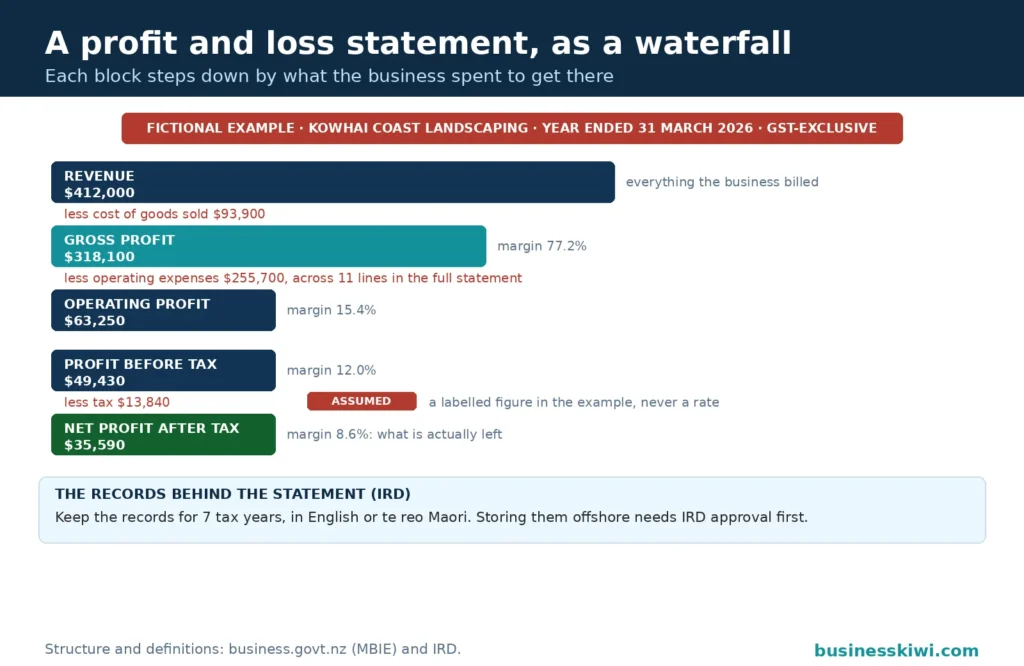
The statement below is for a fictional business, Kōwhai Coast Landscaping, for the year ended 31 March 2026. Every figure is invented for illustration, stated in New Zealand dollars and exclusive of GST, and chosen so the arithmetic is easy to follow. It is not based on any real business.
Read the subtotals as a set of ratios and the statement starts talking. The gross margin is 77.2 percent ($318,100 divided by $412,000), high because this is a labour based business where most delivery cost sits in wages further down, rather than in materials. Operating profit is 15.4 percent of revenue. Net profit before tax is 12.0 percent of revenue, and net profit after tax is 8.6 percent. None of those percentages is good or bad on its own. Their value is in comparison, against last year, against the budget, and against what similar businesses achieve. A margin that slides two or three points over a year is a question that needs an answer, and the statement’s structure tells you where to look: above the gross profit line if the gross margin moved, in the expense groupings if it did not.
GST and the profit and loss statement
New owners often ask why the sales figure in their statement does not match the money that came through the till or the invoices they sent. GST is usually the reason. Business.govt.nz explains the mechanics plainly: GST is a tax of 15 percent that a registered business collects from its customers on the government’s behalf. It is not the business’s money. Because the business also claims back the GST it pays on its own purchases, GST washes through the accounts rather than forming part of income or costs.
The practical result is that a GST registered business prepares its profit and loss statement exclusive of GST. Revenue is shown without the GST charged on top. Expenses are shown without the GST the business will claim back. The GST itself is tracked separately and settled with Inland Revenue through GST returns. This is why the worked example above is stated exclusive of GST, and why comparing a statement with bank deposits will never reconcile dollar for dollar.
A business that is not GST registered has no GST to strip out. It cannot claim GST back on purchases, so the GST inside a supplier’s price is simply part of the cost, and its statement is prepared on the prices actually paid. Registration is compulsory once turnover passes the threshold Inland Revenue sets, and voluntary registration is possible below it, so the GST treatment of a statement follows the business’s registration status at the time.
Cash or accrual: when income and expenses count
A profit and loss statement has to decide when a sale or a cost belongs to the period. Two approaches exist. Under the cash approach, income counts when the money arrives and expenses count when they are paid. Under the accrual approach, income counts when it is earned and expenses count when they are incurred, even if the invoice is settled weeks later. Accrual is the standard approach for a statement that is meant to show performance, because a cash based picture swings wildly with payment timing. A quiet month for receipts can look like a bad month for trading when the work was actually done, and billed, the month before.
The tax system broadly follows the accrual approach too. Inland Revenue’s financial arrangements rules, which govern things like loans and foreign currency accounts, usually require income and expenses to be spread over the term of an arrangement rather than recognised all at once, with a wash-up calculation, called a base price adjustment, when the arrangement ends. The same guidance carves out an exception for smaller taxpayers. A cash basis person does not have to use a spreading method and can report income and expenses under a financial arrangement as cash moves. From the 2025-26 income year, a person qualifies as a cash basis person if their accrual based income and expenditure from all financial arrangements is under $200,000, or their total financial assets and liabilities are under $2 million. The base price adjustment at the end of an arrangement usually still applies. For most small businesses, the everyday effect of all this is modest but real: a sale invoiced in March belongs to the year ended 31 March even if the customer pays in April, and a bill received in March is a cost of that year even if it is paid late.
How the profit and loss statement differs from the other two statements
Three reports make up the standard set, and business.govt.nz describes each by what it captures. The profit and loss statement covers performance over a period. The balance sheet is a snapshot of the business’s financial position at a specific date: what it owns, what it owes, and the owner’s stake in it. The cash flow report tracks the actual money moving in and out of the business’s bank accounts.
The differences are not academic. A business can post a healthy profit and still run out of cash, because profit counts sales that customers have not yet paid for and ignores cash outflows that are not expenses, such as loan principal repayments and buying a vehicle outright. Equally, a business can be cash rich in a month when it traded poorly, if old invoices were finally paid. Reading the three statements together is what gives a full picture. The profit and loss statement on its own answers the profitability question, and only that question.
Sole trader or company: where the bottom line goes
The statement looks much the same for any structure, but the bottom line leads to different places. For a sole trader, business and owner are the same taxpayer. Business.govt.nz states it directly: a sole trader’s net profit is taxed through their own IRD number, based on how much they earned in the financial year, and a sole trader must file an IR3 income tax return at the end of each year. The profit from the statement flows into that return, where it is taxed at the income tax rates that apply to individuals, alongside any other income the owner has. If the business makes a loss instead, the loss is reported in the IR3 and can generally be carried forward to reduce income in a later year.
A company is a separate legal person and a separate taxpayer. Its profit stays inside the company until it is paid out, and the company reports its result in its own return, the IR4. A company loss is likewise reported in the IR4, and carrying it forward depends on meeting the shareholder continuity test. One filing question catches people out. Most small New Zealand companies do not lodge financial statements with the Companies Office at all. Under the Companies Act 1993, that obligation falls on large companies, which must file annual audited financial statements, and on Financial Markets Conduct reporting entities, which lodge audited statements under their own Act. The Companies Office applies size tests for “large” that turn on total assets and total revenue across the two preceding accounting periods, with different thresholds depending on ownership. An ordinary small company prepares its statements for its shareholders, its bank and its tax return, not for public filing.

The records a profit and loss statement stands on
A statement is only ever as good as the records beneath it, and Inland Revenue’s expectations here are specific. Its record keeping guidance requires businesses to keep records of income and expenditure, including records of cash and non-cash sales and expenses, and to keep all records, electronic ones included, for at least seven tax years. Records must be in English or te reo Māori unless Inland Revenue approves otherwise. Storing records outside New Zealand, including with an overseas cloud provider, needs Inland Revenue’s approval, held either by the business or by the storage provider. Inland Revenue checks records when it audits a business, so the invoices, receipts, bank statements and asset records behind each line of the statement need to survive long after the statement itself is printed.
In practice, that means the statement should be built as you go, not reconstructed in a rush at the end of the financial year. Whether you keep the books yourself, use accounting software or hand the work to a bookkeeper, the habit that matters is capturing each transaction once, with its evidence attached, while it is fresh.
Common mistakes, and what a lender looks for
Business.govt.nz’s finance guidance names several mistakes that show up again and again in small business finances, and most of them land directly on the profit and loss statement. Not having proper access to your own business records is the first. Spending money that was set aside for bills and tax is another, and it often hides inside a statement that looks profitable while the tax account is empty. Invoicing late and not chasing debtors distorts the revenue line and starves cash flow at the same time. Ignoring the warning signs of operating at a loss, and buying things the business cannot afford, round out the list, along with not getting advice when the numbers stop making sense.
Statement specific errors compound those. Mixing personal spending into business expenses overstates costs and understates profit, and can create problems in a tax return. Leaving depreciation out flatters the result, and Inland Revenue generally expects it to be claimed on capital assets. Preparing the statement on GST inclusive figures, when the business is registered, inflates both revenue and expenses and makes margins meaningless. Comparing periods prepared on different bases, cash one year and accrual the next, manufactures trends that do not exist.
When a bank reads your statement, it is testing whether the numbers can be trusted and whether the business earns enough to service debt. Accurate, current figures are the entry requirement: business.govt.nz notes that you need accurate information about your finances to apply for a loan or attract investment, and lenders routinely ask for a year to date statement rather than last year’s finished one. A statement that ties back to filed tax returns, keeps GST out of the figures, shows depreciation, and is consistent from period to period gives a lender very little to argue with.
Frequently asked questions
What is the difference between gross profit and net profit?
Gross profit is revenue minus the cost of goods sold, so it shows what is left after the direct cost of what you sold. Net profit is what remains after every cost has come out: operating expenses, interest, depreciation and, where it is shown, tax. Gross profit measures how well you price and buy. Net profit measures the whole business.
Is a profit and loss statement the same as an income statement?
Yes. The two names describe the same report. Business.govt.nz defines the profit and loss report as a summary of how much you have earned and spent over a financial year, and notes it is sometimes called an income statement. Some accounting software uses one name, some the other.
How often should I prepare a profit and loss statement?
At minimum, one is needed for each financial year, because its figures feed your tax return. Most owners get more value from preparing one monthly or quarterly, while the period is still close enough to act on. Lenders also ask for current figures, so a year to date statement is worth having ready rather than assembled under pressure.
Does a profit and loss statement include GST?
For a GST registered business, no. The GST charged on sales is collected on the government’s behalf and the GST paid on purchases is claimed back, so revenue and expenses are stated exclusive of GST and the tax is settled separately through GST returns. A business that is not registered cannot claim GST back, so GST inside a price is simply part of its costs.
Can a business make a profit and still run out of cash?
Yes, and it is common. The statement counts income when it is earned, not when the customer pays, and it leaves out cash outflows that are not expenses, such as loan principal repayments and asset purchases. The cash flow report, which tracks money in and out of the bank account, is the statement that shows whether cash is actually there.
Do sole traders need a profit and loss statement?
A sole trader needs the figures even if they never print a formal statement. The net profit is taxed through the owner’s own IRD number and reported in the IR3 return filed each year, so the statement, or the records that produce the same totals, is the working document behind the return. It is also what a bank will ask for if the owner applies for lending.
What records do I need to prepare a profit and loss statement?
You need the evidence behind every line: sales records, invoices, receipts, bank statements and asset purchase records. Inland Revenue requires business records, including electronic records, to be kept for at least seven tax years, in English or te reo Māori, and it checks records on audit. Good records make the statement quick to prepare and defensible if it is ever questioned.
Does my company have to file its profit and loss statement with the Companies Office?
Usually not. Only large companies, as defined by the Companies Office’s asset and revenue tests, must file annual audited financial statements, and Financial Markets Conduct reporting entities must lodge audited statements as well. A typical small company keeps its statements for shareholders, its bank and its IR4 tax return instead.
This article is general information about how profit and loss statements work in New Zealand. It is not accounting, tax or legal advice for your situation. Figures in the worked example are fictional and shown for illustration only. If you are preparing statements for a loan application or a tax return, an accountant or tax adviser can check them against your circumstances.
Sources
- Inland Revenue, Record keeping, ird.govt.nz
- Inland Revenue, Financial arrangements rules (FA rules), ird.govt.nz
- Inland Revenue, Depreciation, ird.govt.nz
- Business.govt.nz, Business finance basics, business.govt.nz
- Business.govt.nz, Tax basics for sole traders, business.govt.nz
- Business.govt.nz, If your business is operating at a loss, business.govt.nz
- Companies Office, Who needs to submit financial statements, companiesoffice.govt.nz