Verbal Warning NZ: What It Means, the Fair Process and Your Rights

The short answer
A verbal warning in New Zealand is an employer telling an employee, face to face, that their conduct or performance is not up to standard and must improve. It is the lightest formal step an employer can take, but it still counts.
The surprise for most people is that New Zealand law does not require a set number of warnings before dismissal, and Employment New Zealand actually advises employers to avoid verbal warnings unless the employment agreement requires them. This guide explains what a verbal warning is, when an employer can give one, the fair process that must come first, how long it lasts, and what you can do if you think it was unfair.
What a verbal warning is
A verbal warning is a spoken warning given to an employee about their behaviour or performance at work. It is used when the issue is not serious enough to justify dismissal, but is serious enough that the employer wants it formally noted. Common reasons include repeated lateness, not following a reasonable instruction, careless work, or a first instance of minor misconduct.
The word verbal describes how the warning is delivered, not how seriously it should be taken. A verbal warning is still a formal step. It tells the employee three things: what the problem is, what needs to change, and what could happen if it does not change. If the problem continues, the employer can point back to the verbal warning as the first step in a process that may end in a written warning, a final warning, or dismissal.
There is one practical difference between a verbal warning and a written one. A verbal warning is spoken, so there is no document for either side to point to later unless someone writes it down. That is exactly why it causes so many disputes. The employee may remember the conversation differently from the manager. The manager may not be able to prove the warning was given, or what exactly was said. Employment New Zealand puts this plainly: verbal warnings are difficult to prove, and they can be contested.

The first thing to know: the law does not require three warnings
Many New Zealanders believe an employer must give three warnings, verbal, then written, then final, before dismissing someone. That is not what the law says. It is a workplace custom, not a legal rule.
Employment New Zealand states that there is no specific requirement in employment law to give employees a series of warnings before dismissal. What the law does require is a fair process and a good reason. The test the Employment Relations Authority and the Employment Court apply comes from section 103A of the Employment Relations Act 2000. It asks whether the employer’s actions, and how the employer acted, were what a fair and reasonable employer could have done in all the circumstances at the time the dismissal or action occurred.
In a performance situation, Employment New Zealand recommends giving at least a written warning and a final written warning before terminating an employee, because that gives the employee time and support to reach the required standard. But that is a recommendation, not a legal minimum. In a case of serious misconduct, such as theft, violence, or a serious safety breach, an employer can move to dismissal without any warning at all, as long as a fair process is followed first. Our guide to serious misconduct in New Zealand explains that path in detail.
The number and type of warnings that are appropriate depend on the circumstances. Employment New Zealand lists the factors an employer should weigh: how difficult the tasks are, the impact of the ongoing problem on the organisation, the employee’s length of service, how much effort the employee has made to improve, whether the employer contributed to the problem, for example through unclear expectations, and whether personal issues such as a health condition are involved.
When an employer can give a verbal warning
An employer can give a verbal warning when an employee’s conduct or performance falls below the expected standard and the issue is not serious enough for a written warning or dismissal. The two situations are different, and Employment New Zealand treats them differently.
Misconduct is about behaviour. It includes things like lateness, not following a lawful instruction, inappropriate language, or breaching a workplace rule. Disciplinary action is the right response to misconduct, and a warning can be one step in that process.
Poor performance is about the standard of the work itself. It includes work that is too slow, full of errors, or below the quality the role requires. Performance problems are usually managed through performance management, not discipline. That means clear expectations, support, training, and a real opportunity to improve. A warning can still be part of a performance process, but the focus is forward looking: what needs to improve, by when, and what help the employee will get.
Before giving any warning, the employer must check the employment agreement and any workplace policies. Many agreements set out a set process for warnings and dismissal, and the employer has a contractual and good faith obligation to follow it. If the agreement says verbal warnings come first, the employer must use them. If the agreement says nothing about warnings, the employer has more freedom, but still must follow a fair process.
The fair process that must come first
A warning is only as good as the process behind it. Under the Employment Relations Act 2000, every disciplinary action, including a warning, must be justified and carried out in a fair way. Employment New Zealand sets out what a fair process means, and it applies to verbal warnings just as much as to written ones.
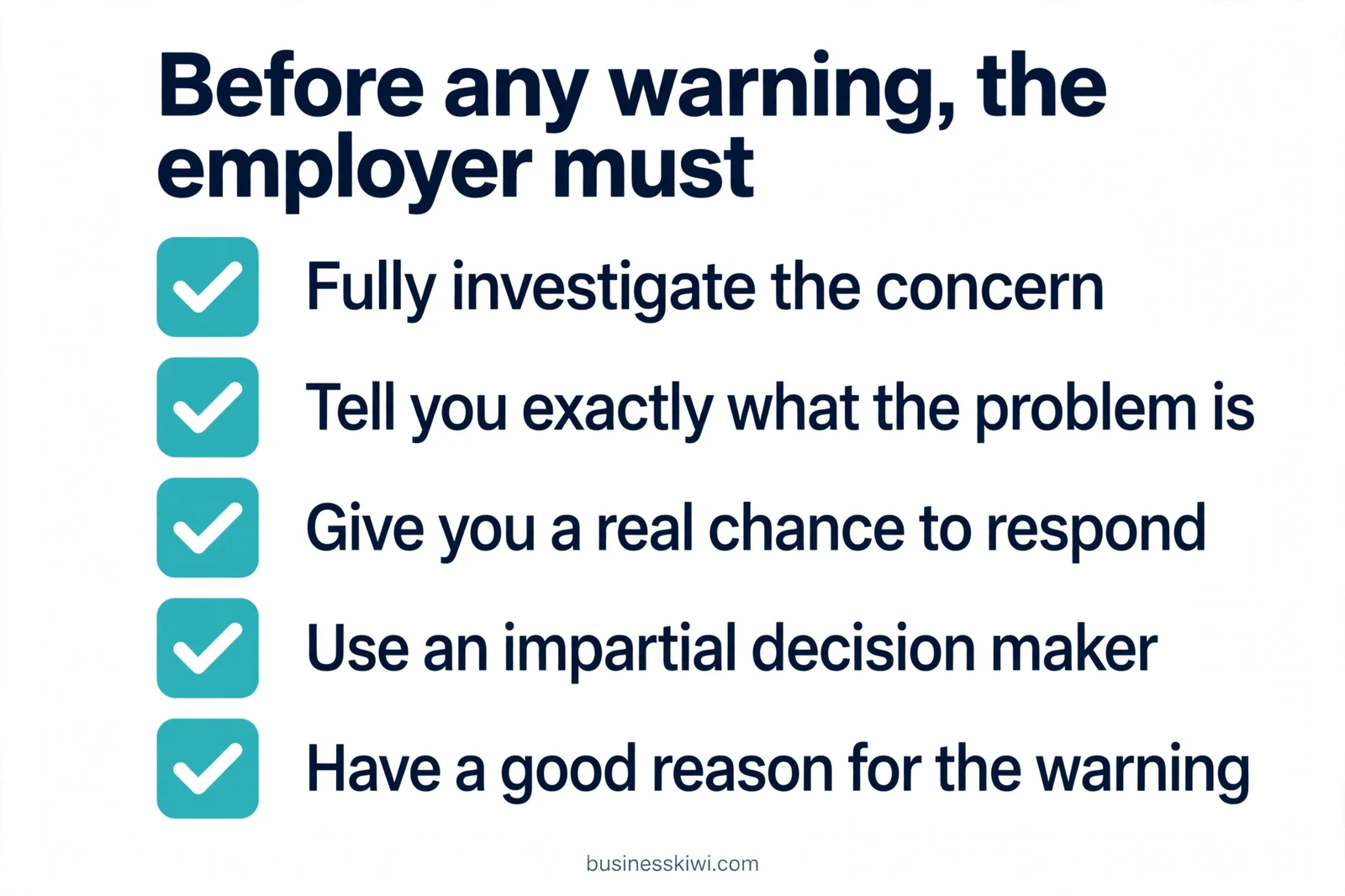
First, the employer must fully investigate the concern. That means finding out what happened before deciding what to do. An investigation can be simple, such as checking a timesheet or talking to a witness, or it can be complex. Either way, it must be carried out in good faith and follow the principles of natural justice, which means not jumping to conclusions. The employee should be told the details of the allegation, given a reasonable opportunity to respond, and have their explanation fully considered before any conclusion is reached.
Second, the employer must properly raise the concern with the employee. That means communicating exactly what the problem is, providing all relevant information, and making clear that disciplinary action is a possibility. The employee must be told what evidence the employer is relying on, for example interview notes or statements from others.
Third, the employee must be given a reasonable opportunity to tell their side of the story, and the employer must genuinely consider what they say. The employee should also be told they may have a representative or a support person present at any disciplinary meeting, and be given an opportunity to seek independent advice throughout the process.
Fourth, the decision maker should be as impartial as possible, with the appropriate level of authority. The employee should have an opportunity to explain or respond to the person who will make the final decision. No decision should be made on what action to take until after the employee’s response has been heard and considered.
Fifth, the employer must have a good reason for the warning, and all parties must meet their good faith obligations. Good faith means dealing with each other openly, honestly, and fairly, and not acting in a misleading or deceptive way.
Employment New Zealand also notes that employers do not have to complete the process perfectly. Small errors may not make the whole process unfair. What matters is whether, in all the circumstances, a fair and reasonable employer would have done what this employer did.
Why Employment New Zealand says to avoid verbal warnings
Here is the part that surprises employers most. Employment New Zealand advises that if the employment agreement does not require verbal warnings, it is best to avoid them. The reason is practical: it is difficult to ensure a clear process has been followed, and a verbal warning can be contested.
A verbal warning is often given on the spot, in the moment, after an informal conversation. That is exactly the situation where fair process is most likely to be skipped. The employee may not have been told the full allegation in advance. They may not have had a chance to bring a support person. They may not have been told that disciplinary action was a possible outcome. If any of those steps are missing, the warning can be challenged as an unjustified disadvantage, which is one of the grounds for raising a personal grievance under the Employment Relations Act 2000.
Employment New Zealand suggests a different option for informal situations. If an employer feels the need to warn an employee informally, they may choose to say they are issuing a caution. A caution is a clear message that something needs to change, without the formal weight of a warning and without the same risk of a later dispute about what process was followed.
That does not mean verbal warnings are unlawful. They are lawful, and they are common. But they are the weakest form of warning precisely because they leave the least evidence. Employment New Zealand’s own disciplinary process flowchart lists “verbal warning confirmed in writing” as one of the possible outcomes of a disciplinary process. The words “confirmed in writing” are the key. A verbal warning that is written down, with the date, the issue, what was said, and what improvement is expected, is far harder to dispute than one that exists only in two people’s memories.
What a verbal warning should record
If a verbal warning is given, it should be recorded. The record protects both sides. For the employer, it is proof that the warning happened and that the employee was told what to improve. For the employee, it is a clear statement of what is expected and by when, which they can refer back to.
A good record of a verbal warning includes:
- The date and time of the conversation.
- Who was present, including any support person.
- The specific issue discussed, with dates and examples rather than general statements.
- What the employee said in response.
- What improvement is expected and by when.
- What will happen if the problem continues.
- How long the warning will stay on the employee’s file.
The employee should be given a copy of the record, or at least a written summary of the warning. If the employee disagrees with the record, they should say so at the time and ask for their view to be noted. That note can matter later if the warning is ever challenged.
It is also good practice for the employer to keep the record on the employee’s file and to tell the employee it is there. A warning that sits in a manager’s drawer, unknown to the employee, is of little use to anyone and can look unfair if it surfaces months later as a reason for further action.
How long does a verbal warning last
New Zealand law does not set a fixed period for how long a warning stays live. There is no rule that says a verbal warning lasts six months, or a year, or any other set time. The warning itself should state how long it will remain on the employee’s file and be relied on. If it does not state a timeframe, the position becomes unclear over time.
In practice, most warnings are given a timeframe in the warning letter or record, so that everyone knows where they stand. Once that time has passed without further problems, the warning should no longer be held against the employee. An old warning that is pulled out months or years later to justify a new disciplinary step is open to challenge, because the employee had no reason to think it was still live.
The safest approach for both sides is simple. The warning should say, in plain words, how long it stays on file. The employee should check that it does, and ask if it does not. And once the period has passed cleanly, both sides should treat the matter as closed, unless the same problem happens again.
Verbal vs written vs final warnings
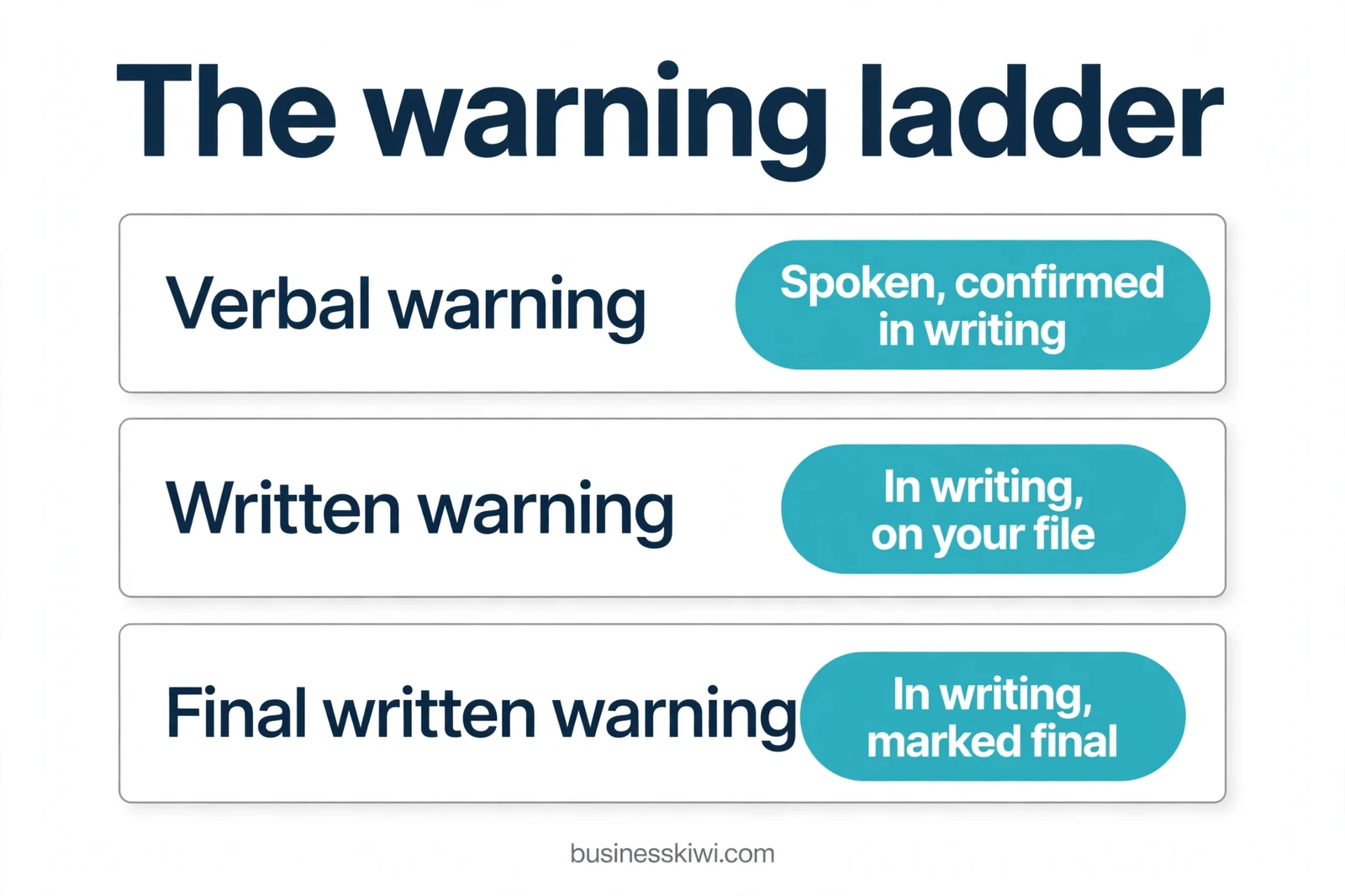
The three types of warning sit on a ladder. Each step is more serious than the last, and each one should be used in the right situation.
| Warning type | How it is given | When it is used | What it means |
|---|---|---|---|
| Verbal warning | Spoken to the employee, should be confirmed in writing | A first, minor issue, or where the employment agreement requires it | A formal notice that something must improve; the lightest step |
| Written warning | In writing, placed on the employee’s file | The issue continues after a verbal warning, or the issue is more serious | A formal record that the problem is serious and further action may follow |
| Final written warning | In writing, clearly marked as final | The issue continues after a written warning, or the issue is serious | The last step before dismissal; if the problem happens again, dismissal is likely |
The ladder is a guide, not a legal rule. An employer does not have to climb it one rung at a time in every case. A serious issue can go straight to a written or final warning. A very serious issue can go straight to dismissal, after a fair process. What matters is that the step taken is one a fair and reasonable employer would take in the circumstances.
It is also worth knowing that a final warning does not automatically mean dismissal will follow. It means that if the behaviour happens again, or the performance does not improve within the time given, the employer may move to dismissal. Any dismissal still has to pass the section 103A test: a good reason and a fair process.
What to do if you disagree with a warning
Being given a warning you think is unfair is stressful, but there are clear steps you can take. The first step is the simplest: talk to your employer. Ask for the warning in writing, including the reasons for it and the evidence relied on. Ask what exactly needs to improve and by when. Sometimes a conversation clears up a misunderstanding, and the warning is withdrawn or changed.
If talking does not resolve it, put your concerns in writing. Set out what you disagree with, what you believe actually happened, and what you would like the employer to do. Keep a copy. A written record of your response protects you if the matter goes further, and it gives the employer a fair chance to reconsider.
If the warning was given without a fair process, or without a good reason, you may have grounds to raise a personal grievance. A personal grievance is a formal action under the Employment Relations Act 2000. An unjustified warning is specifically listed as an example of unjustified disadvantage, one of the grounds for a personal grievance. Our guide to personal grievances in New Zealand explains the full process.
The time limit matters. You must raise a personal grievance with your employer within 90 days of the issue arising, or coming to your attention, whichever is later. Raise it in writing, clearly stating what your complaint is and why you believe you have a grievance. Give enough detail for your employer to respond. If you do not raise it clearly enough, you may not be able to take legal action later.
Once a grievance is raised, there are several ways to resolve it. Employment New Zealand offers free, impartial mediation, where an independent mediator helps both sides reach a solution. You can also go to the Employment Relations Authority, which looks into the facts and makes decisions based on the merits of the case, not on technicalities. You can file a claim with the Authority without first talking to your employer or going to mediation, although the Authority may suggest mediation first. You have three years after first raising the grievance with your employer to lodge a claim with the Authority.
One important limit applies to high earners. Since 21 February 2026, employees who earn $200,000 or more a year do not have the same dismissal protections as other employees. In most cases they cannot raise a personal grievance for unjustified dismissal, or for unjustified disadvantage where it relates to dismissal. They can still raise a personal grievance on other grounds, such as discrimination or harassment. There is a 12 month transition period, so employees who were in the same job immediately before 21 February 2026 and are dismissed before 21 February 2027 can still raise a grievance if they do so within 90 days. The protections can also be kept if the employee and employer agree in writing to opt back in.

Common mistakes with verbal warnings
The most common employer mistake is giving a verbal warning on the spot, without any process. A manager who has just found a problem tells the employee there and then that they are on a verbal warning. No investigation, no written allegation, no chance to respond, no support person. That is the kind of warning most likely to be challenged, and it is the reason Employment New Zealand advises employers to avoid verbal warnings unless the agreement requires them.
The second employer mistake is giving a verbal warning and writing nothing down. Months later, when the same problem comes up again, the employer relies on a warning that only exists in the manager’s memory. The employee says it never happened, or happened differently. Without a record, the employer has no way to prove the warning was given, and the disciplinary process can fall apart.
The third employer mistake is using a verbal warning for the wrong kind of issue. A verbal warning is for minor problems. Using it for something serious, or using it as a substitute for dealing with a serious problem properly, can backfire. If the issue is serious, it should be dealt with through a proper disciplinary process, with a written warning or dismissal as the outcome.
The most common employee mistake is ignoring the warning. A verbal warning is easy to shrug off because nothing was put in writing. But if the problem continues, the employer will move to the next step, and the verbal warning will be part of the record. Treat a verbal warning as a clear signal: something needs to change, and the clock is running.
The second employee mistake is not asking for the warning in writing. If your employer gives you a verbal warning, ask for a written summary. Ask what the issue is, what improvement is expected, by when, and how long the warning will stay on file. If the employer will not put it in writing, write your own note of the conversation, with the date and what was said, and keep it.
The third employee mistake is waiting too long to act. If you believe a warning was unfair, the 90 day clock for raising a personal grievance starts running from when the issue arose or came to your attention. Do not wait months to raise it. Get advice early, from your union if you have one, from Community Law, or from an employment lawyer.
For more on work and rights in New Zealand, browse the Business and Industry section.
Frequently asked questions
Does a verbal warning count in New Zealand?
Yes. A verbal warning counts as a formal step in a disciplinary or performance process, especially if it is confirmed in writing and kept on the employee’s file. What makes it weaker than a written warning is the lack of a paper trail. If it is not recorded, it is much harder for the employer to prove it was given.
How many warnings do you get before being fired in NZ?
There is no legal number. New Zealand law does not require a set number of warnings before dismissal. Employment New Zealand recommends at least a written warning and a final written warning before terminating an employee for poor performance, but that is a recommendation, not a rule. In cases of serious misconduct, dismissal without any warning is possible after a fair process.
Can my employer give me a verbal warning without telling me first?
No, not fairly. A fair process requires the employer to investigate the concern, tell you exactly what the problem is, give you the relevant information, and give you a reasonable opportunity to respond before deciding. A warning given without those steps can be challenged as an unjustified disadvantage.
Can I refuse a verbal warning?
You cannot refuse to hear it, but you can disagree with it. Ask for the warning in writing, put your response in writing, and keep a copy. If you believe the warning was unfair, you can raise a personal grievance, normally within 90 days. You do not have to sign anything you disagree with.
How long does a verbal warning stay on your file?
There is no set period in law. The warning should state how long it will stay on your file. Once that time has passed without further problems, it should no longer be held against you. If no timeframe is stated, ask your employer to confirm one in writing.
Does a verbal warning mean I will be fired?
No. A verbal warning is the lightest formal step. It means your employer wants something to change, and it is a signal that further action could follow if the problem continues. It does not mean dismissal is coming, but it does mean you should take the issue seriously and improve within the time given.
Can I bring a support person to a warning meeting?
Yes. Employment New Zealand’s fair process guidance says the employee should be told they may have a representative or a support person present at any disciplinary meeting. This applies to meetings about warnings as well as meetings about dismissal. If you were not told you could bring a support person, that can be relevant to whether the process was fair.
This guide is general information only. It is not legal advice. Employment law depends on the facts of each situation, and the rules can change. If you have been given a warning, or you are an employer thinking about giving one, get advice from your union, Community Law, an employment lawyer, or Employment New Zealand before you act.