Contesting a Will in New Zealand: Who Can Challenge It and How

The short answer
Yes, you can contest a will in New Zealand, but only in certain situations and only if you act within strict time limits. A will is not set aside simply because it feels unfair. You need a recognised legal ground, such as a claim under the Family Protection Act 1955, a broken promise to leave you something, or proof that the will was not made properly.
This guide explains who can challenge a will, the grounds the courts accept, the deadlines that apply, what the process looks like, and what it costs.
This article is general information only. It is not legal advice. Will disputes are complex, the time limits are strict, and the outcome depends on the facts of each case. Talk to a lawyer experienced in estate disputes before you take any step.
What contesting a will means in New Zealand
Contesting a will means asking the High Court to change what happens to a deceased person’s estate. The court does not throw the will away and start again. Instead, it looks at one specific question: does the law give you a right to more than the will provides, or is the will itself invalid?
There are two different kinds of challenge. The first kind accepts that the will is valid but says the outcome is wrong for you. A Family Protection Act claim and a testamentary promises claim both work this way. The second kind says the will should never have been accepted at all, because the will-maker lacked capacity, was pressured into signing, or did not sign it properly. If that kind of challenge succeeds, the will is declared invalid and an earlier will may take its place, or the estate is shared under the rules that apply when there is no will.
You do not need to be named in the will to contest it. You need to be in one of the groups the law recognises, and you need a ground the court accepts. A feeling that the division was unfair, on its own, is not enough.

Who can contest a will
Not everyone who is disappointed by a will can challenge it. The law limits claims to people in defined relationships with the person who died.
Family Protection Act claims
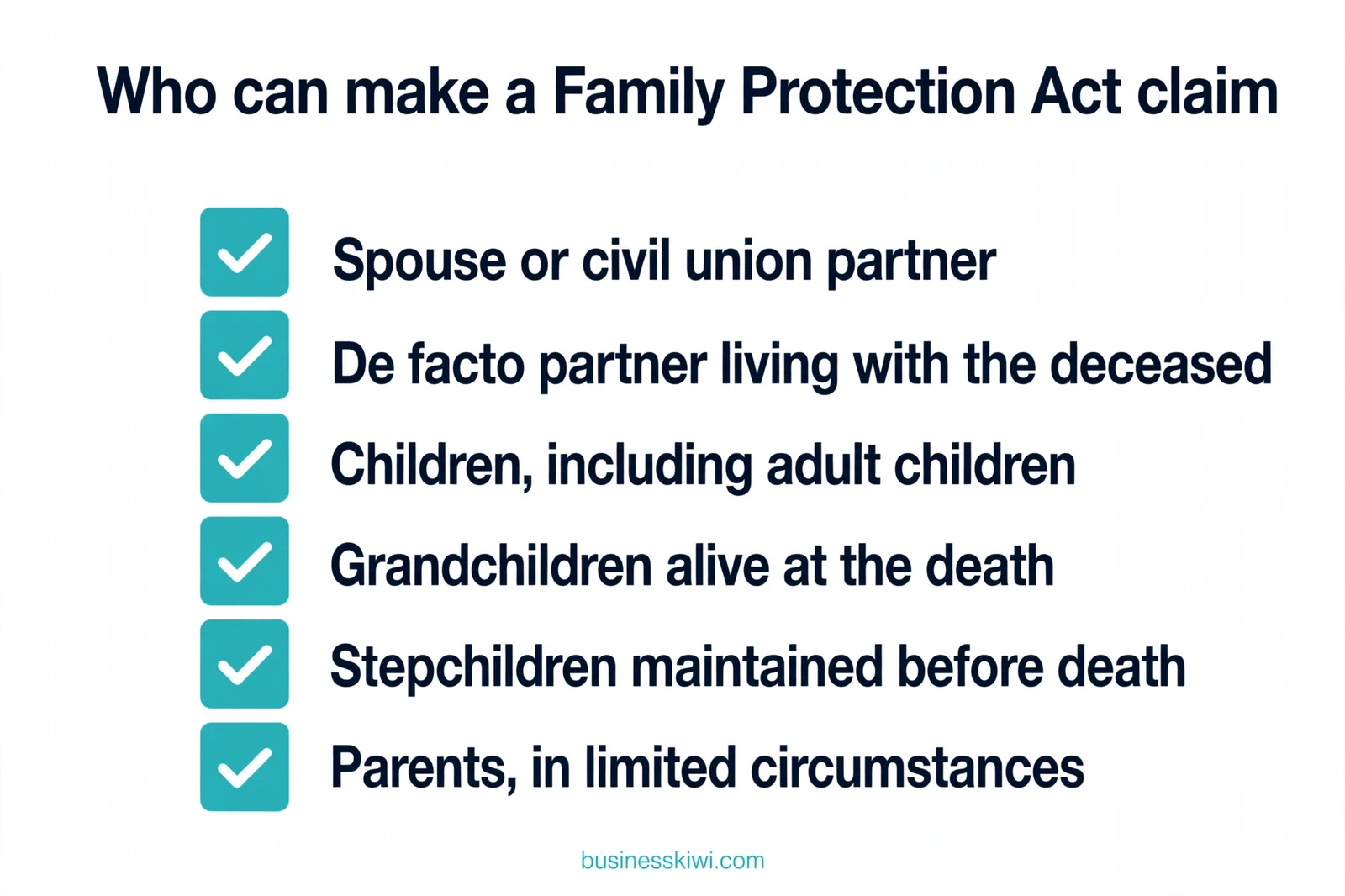
Under section 3 of the Family Protection Act 1955, the following people can apply to the court if the will does not provide for their proper maintenance and support:
| Who can apply | Condition |
|---|---|
| Spouse or civil union partner | Surviving partner of the deceased |
| De facto partner | Living with the deceased at the time of death |
| Children | Including adult children |
| Grandchildren | Alive at the time of the death |
| Stepchildren | Only if the deceased maintained them immediately before death |
| Parents | Only in limited circumstances: if the deceased was providing for them immediately before death, or if there is no surviving spouse, civil union partner, de facto partner or child |
Friends, nieces and nephews, siblings, carers and other relatives cannot make a Family Protection Act claim, even if they were close to the person who died. If you are outside this list, your only path may be a different kind of claim, such as a testamentary promises claim, and only if the facts fit.
Other kinds of claim
A testamentary promises claim is open to anyone who was promised something in return for services they provided. A relationship property claim is open only to a surviving spouse, civil union partner or de facto partner. A challenge to the validity of the will can be brought by anyone with an interest in the estate, including a person who would inherit under an earlier will or under the intestacy rules if the challenged will were set aside.
If you are not sure whether you qualify, a lawyer can usually tell you quickly from the facts. The first step is working out which category you fall into, because each one has different rules, different evidence and different deadlines.
The main grounds for contesting a will
Most will disputes in New Zealand fall into one of six grounds. Work out which one fits your situation before you do anything else, because the ground decides what you must prove and what the court can do.
1. Inadequate provision under the Family Protection Act
This is the most common ground. The Family Protection Act 1955 says that a person who dies has a moral duty to provide for the proper maintenance and support of close family members. If the will fails in that duty, the court can order further provision from the estate.
Two points matter. First, “proper maintenance and support” means more than bare survival. The courts have said it includes sustaining and providing comfort, recognition of belonging to the family, and recognition of being an important part of the deceased person’s life. Second, the court does not rewrite the will to match what it thinks is fair. Under section 4 of the Act, the court orders only as much as is necessary to repair the breach of the moral duty. There is no presumption of an equal division.
What the court considers includes the size of the estate, the financial position and needs of the person claiming, the nature and strength of the moral duty owed, the contributions the claimant made to the estate or to the deceased person’s life, the reasons the will-maker gave for the division, and the claims of other family members. A will-maker who explains their reasons in the will does not make the will unchallengeable, but a clear explanation is evidence the court will weigh.
Adult children can claim under this Act. The law presumes that parents owe a moral duty to their children even into adulthood, so a child who is left out entirely will usually have a claim worth testing. That does not mean every adult child succeeds. A financially secure adult child with no particular need may receive little or nothing, while a child in genuine financial difficulty is more likely to receive provision.
2. A promise that was not kept
The Law Reform (Testamentary Promises) Act 1949 covers a different situation. If the deceased promised to leave you something in return for services you provided, and the promise was not kept, you can apply to the court for payment or a transfer of property from the estate.
Three things must be proved under section 3 of the Act:
- The deceased made an express or implied promise to reward you, usually by leaving you property or money in the will.
- You provided services, or you did work, for the deceased in return for that promise.
- The promise was not carried out, or was carried out only in part.
The promise does not have to be written down, but an unwritten promise is much harder to prove. Evidence can include letters, messages, diary entries, and the accounts of people who heard the promise made. The court looks at the circumstances in which the promise was made, the value of the services you provided, the value of the property that was promised, the size of the estate, and the claims of other people on the estate.
Common examples include a child who cared for an ageing parent for years after being told the house would be theirs, or a farm worker who stayed on low wages because the farm was promised to them. If the services were provided as part of a paid job, with no promise of anything extra, a claim is unlikely to succeed.
3. A relationship property claim
A surviving spouse, civil union partner or de facto partner has a choice that other family members do not. Under the Property (Relationships) Act 1976, the surviving partner can choose between two options:
- Option A: give up the will and instead apply for a division of the relationship property, starting from a half share.
- Option B: take what the will (or the intestacy rules, if there is no will) gives them.
This choice matters because the two options can produce very different results. If the will leaves the partner most of the estate, Option B is usually better. If the will leaves the partner little, and there is substantial relationship property such as a family home, Option A may be better. A partner who chooses Option A gives up any rights under the will and cannot also make a Family Protection Act claim.
The election must be made in writing, with a lawyer’s certificate confirming that independent legal advice was given, within 6 months of the grant of probate or letters of administration, or within 6 months of the death if no grant is needed. Court proceedings to enforce the choice must be started within 12 months. Because the choice is final and the time limits are short, a surviving partner should get advice before the 6 month election period runs out.
4. The will-maker lacked capacity
A will is valid only if the will-maker had testamentary capacity when it was made. In plain terms, the person must have been of sound mind at the time. That means they understood the nature of making a will, they understood the extent of their property, and they understood the claims of the people who might reasonably expect to benefit.
Capacity is judged at the time the will was signed, not at the time of death. A person whose mental health declined after signing a will does not lose capacity retroactively. Equally, a person with dementia may still have capacity to make a will on a good day, if they understood what they were doing at the time.
Challenging a will on capacity grounds usually needs medical evidence. The will-maker’s medical records, the notes of the lawyer who prepared the will, and the accounts of witnesses who were present are all important. If the will was made shortly before death, or if the will-maker was seriously ill, the court will look closely at the circumstances. If the court finds the will-maker lacked capacity, the will is invalid.
5. Undue influence
Undue influence means the will-maker was pressured or manipulated into making a will they would not otherwise have made. It is not enough that someone suggested an outcome or discussed the will. The influence must have overpowered the will-maker’s own free choice.
This ground is difficult to prove because the key witness, the will-maker, is no longer alive. The court looks for signs such as a beneficiary who was present when the will was prepared and took an active role in instructing the lawyer, a will-maker who was isolated from other family members, a sudden and unexplained change from an earlier will, and a will that benefits the person who arranged it. The court also considers the will-maker’s vulnerability, including age, illness, and dependence on the person who benefited.
If you suspect undue influence, the lawyer’s file is often the most important evidence. It may show who gave the instructions, who was present, and whether the will-maker was seen alone. A lawyer can request that file on your behalf.
6. The will was not signed properly
A will must meet the formal requirements in section 11 of the Wills Act 2007. The will must be in writing, it must be signed by the will-maker (or by another person in the will-maker’s presence and at their direction), and it must be signed in the presence of two witnesses who are present together, with each witness signing in the will-maker’s presence.
If these requirements were not met, the will is not valid. However, section 14 of the Wills Act gives the High Court power to declare a document valid even if it does not meet the formal requirements, if the court is satisfied that the document expresses the deceased person’s testamentary intentions. A homemade will, a draft found on a computer, or a note that was never witnessed can therefore still be accepted in some cases. Whether the court will do so depends on the evidence that the document really was intended to be the person’s will.
Time limits you need to know
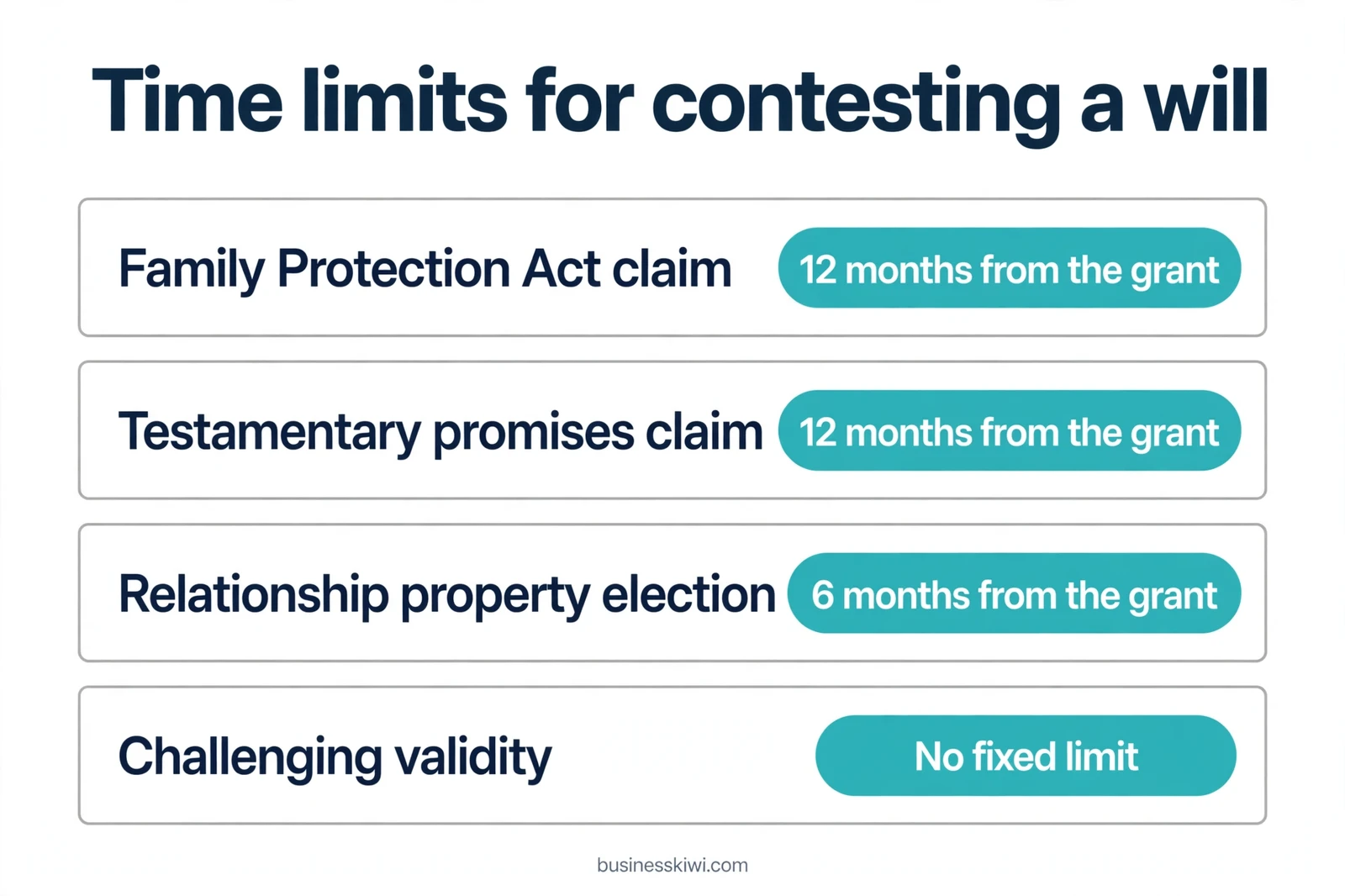
Time limits are the most dangerous part of contesting a will. Most claims must be made within 12 months of the grant of probate or letters of administration, and the estate can start being distributed after 6 months. If you wait, the money may already be gone, even if your claim would have succeeded.
| Claim | Time limit | Source |
|---|---|---|
| Family Protection Act claim | 12 months from the grant of probate or letters of administration | Family Protection Act 1955, s 9 |
| Testamentary promises claim | 12 months from the grant of probate or letters of administration | Law Reform (Testamentary Promises) Act 1949, s 6 |
| Relationship property election | 6 months from the grant, or 6 months from death if no grant is needed; court proceedings within 12 months | Property (Relationships) Act 1976 |
| Challenging the validity of a will | No fixed statutory limit, but act before probate is granted if possible | Community Law guidance |
The 12 month limit for Family Protection Act and testamentary promises claims can be extended by the court, but only if the application for an extension is made before the estate has been finally distributed. Once distribution is complete, an extension is no longer available. This is why the timing of distribution matters as much as the time limit itself.
There is a practical step that protects your position. Under the Administration Act 1969, you can give the administrator written notice that you intend to make an application. The administrator then cannot safely distribute the estate in reliance on the usual protection. That notice lapses after 3 months unless the administrator is served with a copy of the application, or receives written notice that the application has been made. The notice buys you time to prepare, but it is not a substitute for filing the claim itself.
Also note that an administrator who distributes the estate properly, after 6 months from the grant, and without written notice of any application or intention to apply, is protected from action. If you have a claim, do not rely on the administrator waiting for you. Put your intention in writing early.
The process step by step
Contesting a will follows a set course in the High Court. The steps below describe the usual path for a Family Protection Act or testamentary promises claim.
1. Get a copy of the will and check the grant. Once probate has been granted, the will is a public document. You can ask the High Court for a copy. Find out whether probate or letters of administration have been granted, and on what date, because the time limits run from the grant.
2. Work out whether you have a claim. Identify which ground fits your situation and whether you are in one of the groups the law recognises. A lawyer can usually give you a preliminary view from the will, the family circumstances and the size of the estate.
3. Put the administrator on notice in writing. Tell the executor or administrator, in writing, that you intend to make a claim. This stops the estate being distributed while you prepare, and it starts the 3 month period described above. Do this as early as possible.
4. Try to settle before filing. Many families reach an agreement before a hearing, either through direct negotiation between lawyers or with the help of an independent mediator. A mediator does not decide the outcome. The mediator helps both sides talk through the issues and reach an agreement they can both accept. If an agreement is reached, it can be recorded in a court order so that it is binding. Settling early saves time, cost and family relationships, and it is worth attempting even if the relationship is strained.
5. File the application in the High Court. If settlement is not possible, your lawyer files the application, with supporting evidence, in the High Court. The application must be filed within the time limit for your type of claim. The forms are set out in the High Court Rules, and the Ministry of Justice publishes guidance on how to apply to challenge a will.
6. Exchange evidence and attend a hearing if needed. Both sides file evidence, including affidavits. The court may direct a conference to see whether the case can be settled. If it cannot, the matter goes to a hearing, where a judge decides whether the claim succeeds and, if so, what provision should be made.
7. The court makes its order. If your claim succeeds, the court orders provision from the estate. If it fails, the will stands as written. Either side can appeal, but appeals are limited to questions of law or clear errors, and they add time and cost.

What contesting a will costs
There is no fixed price for contesting a will, and no official source publishes a standard fee. What you pay depends on the complexity of the case, how much evidence is involved, whether the matter settles early, and the lawyer’s own charges. A case that settles after a few letters costs far less than a case that goes to a full hearing.
Three cost facts are confirmed by official sources:
- Filing the application is free. The Ministry of Justice states that there is no fee to apply to challenge a will in the High Court.
- Legal aid may be available. The Ministry of Justice notes that legal aid may be available for some people. Whether you qualify depends on your income, your assets and the merits of your case.
- Lawyer fees vary. No government or court source sets a fee for will disputes. Your lawyer should give you a written estimate before work begins, and should explain how costs are charged.
Costs can also fall on the estate. In some cases the court orders the estate to pay some or all of a party’s costs, and in other cases each side pays its own. This is decided case by case, and it is one reason to get a realistic assessment of your prospects before you file. A claim with weak prospects can be expensive in two directions: your own lawyer’s bill, and a costs order against you.
What happens if you succeed
If your claim succeeds, the court orders provision to be made for you from the estate. The will itself is not rewritten. The court makes an order that changes the distribution to the extent needed to repair the breach.
For a Family Protection Act claim, the order is limited to what is necessary for your proper maintenance and support. The court does not divide the estate equally, and it does not give you what you think you deserve. It gives you what the court considers enough to repair the failure of the moral duty. The amount depends on the size of the estate, your needs, and the competing claims of others.
For a testamentary promises claim, the court can order payment of money or the transfer of the property that was promised. The award reflects the value of the services you provided and the value of what was promised, weighed against the size of the estate and other claims.
If a challenge to the validity of the will succeeds, the will is declared invalid. An earlier valid will then takes effect, if there is one. If there is no earlier will, the estate is distributed under the intestacy rules in the Administration Act 1969. This can produce a result nobody expected, which is why a validity challenge should never be started without understanding what replaces the will if you win.
Alternatives to going to court
Court is not the only way to resolve a will dispute, and it is often not the best way. There are two realistic alternatives.
Negotiation between lawyers. Each side’s lawyer sets out their position in writing and the two sides work towards a compromise. This is private, it is usually faster than court, and it costs less. It works best when both sides have a realistic view of their prospects. A lawyer can tell you what a court would probably order, which gives you a sensible range to negotiate within.
Mediation. A mediator is an independent person who helps both sides talk through the dispute and find an agreement. The mediator does not make a decision and cannot impose an outcome. If the mediation succeeds, the agreement is recorded in writing and can be made into a court order. Mediation is voluntary, so both sides must agree to take part. It is worth noting that no official New Zealand source describes mediation as a standard or required step in will disputes. It is simply an option that families use, and it is most useful when both sides want to settle but cannot agree on terms.
Either alternative can be tried at any point, including after an application has been filed. Many cases that start in court still settle before a hearing. The sooner you attempt a settlement, the less the dispute costs and the less damage it does to family relationships.
Before you decide: practical steps
A few practical steps will help you, and your lawyer, work out whether a claim is worth pursuing.
- Get the will and the grant date. These two documents set the timetable. Without the grant date, you cannot work out whether you are inside the time limit.
- Write down the facts while they are fresh. Note what was promised, when, and who heard it. Note the care or services you provided, and for how long. Note any changes to the will and when they happened.
- Gather the documents. Medical records, letters, messages, bank statements showing payments you made for the deceased, and any written statement of the will-maker’s reasons are all useful.
- Do not move estate property. Do not take, sell or give away anything from the estate while a dispute is possible. Doing so can harm your position and may be unlawful.
- Get advice early, even if you are not sure. The time limits run from the grant, not from when you decide to act. An early conversation with a lawyer costs less than a missed deadline.
If you are making your own will, the same lessons apply in reverse. Write down your reasons for an unequal division, keep the will up to date, tell your lawyer about any promises you have made, and make sure the will is signed properly with two witnesses present together. A clear, well prepared will is much harder to challenge than a vague one. Planning for retirement is also a good time to review your will and your other end of life arrangements, including funeral insurance, so that the people you leave behind are not left guessing about your wishes.
If you are planning for later life, the Business and Industry section has more guides on money, work and planning in New Zealand.
Frequently asked questions
Can I contest a will if I was left out completely?
Yes, if you are in one of the groups the law recognises. A child, spouse, civil union partner or de facto partner who was left out can apply under the Family Protection Act 1955, provided the application is made within 12 months of the grant of probate or letters of administration. Being left out does not guarantee success. The court looks at whether the will-maker breached a moral duty to provide for your proper maintenance and support, and it orders only as much as is necessary to repair that breach.
How long do I have to contest a will in New Zealand?
For a Family Protection Act claim or a testamentary promises claim, 12 months from the grant of probate or letters of administration. For a relationship property election, 6 months from the grant, with court proceedings within 12 months. An extension of the 12 month limit is possible only if you apply before the estate has been finally distributed. If you think you have a claim, put the administrator on notice in writing as early as possible, because the estate can be distributed after 6 months from the grant.
What does it cost to contest a will?
There is no fixed cost and no official source publishes a standard fee. Filing the application in the High Court is free, according to the Ministry of Justice. Legal aid may be available depending on your income, assets and the merits of your case. Lawyer fees vary with the complexity of the case and whether it settles early or goes to a hearing. Your lawyer should give you a written estimate before work begins.
Can I contest a will without a lawyer?
You can file an application yourself, and the Ministry of Justice publishes guidance on how to do it. In practice, will disputes are complex, the evidence is technical, and the other side will usually have a lawyer. Most people who succeed in contesting a will have legal representation. A paralegal can support a lawyer’s work, but a paralegal cannot give you legal advice or represent you in court. If cost is a barrier, ask about legal aid, or ask a lawyer for a fixed fee initial consultation to assess your prospects before you commit.
Can a de facto partner contest a will?
Yes. A de facto partner who was living with the deceased at the time of death can apply under the Family Protection Act 1955. A surviving de facto partner can also make a relationship property claim under the Property (Relationships) Act 1976, choosing between what the will gives them and a half share of the relationship property. The relationship property election must be made within 6 months of the grant, with a lawyer’s certificate, and court proceedings must be started within 12 months.
What happens if the will is declared invalid?
If the court declares a will invalid, an earlier valid will takes effect if there is one. If there is no earlier will, the estate is distributed under the intestacy rules in the Administration Act 1969. That can mean the estate goes to people the will-maker did not intend to benefit, which is why a validity challenge should be considered carefully before it is started.
Can I stop the estate being distributed while I decide?
You can give the administrator written notice that you intend to make an application. Under the Administration Act 1969, that notice lapses after 3 months unless the administrator is served with a copy of the application or receives written notice that the application has been made. The notice protects your position while you prepare, but it does not replace filing the claim within the time limit. If you are concerned about distribution, get legal advice immediately, because an administrator who distributes properly after 6 months from the grant, without written notice of a claim, is protected from action.
This article provides general information about New Zealand law. It is not legal advice and it does not create a lawyer-client relationship. The law changes from time to time and every case depends on its own facts. If you are thinking about contesting a will, or if you are an executor facing a claim, speak to a lawyer experienced in estate disputes before you act.