Plywood NZ: Grades, Prices and How to Choose the Right Sheet
Plywood NZ: Grades, Prices and How to Choose the Right Sheet
The short answer
Plywood is one of the most used sheet materials in New Zealand building, and it is also one of the most misunderstood. Two sheets can look almost identical in the shop and still be made for completely different jobs. One might be a structural flooring panel rated to carry loads, while the other is a budget lining sheet that should never be used as a floor. The difference is written on the back of the sheet, in the grade, the treatment and the standard it was made to. This guide explains what those markings mean, what plywood costs in New Zealand, and how to pick the right sheet for floors, walls, roofs, cladding, furniture and boats. It is general information, not building advice. Structural work should always follow the plans and the engineer or designer for the job.
What plywood is and how it is made in New Zealand
Plywood is a panel made from thin layers of wood veneer glued together. Each layer, called a ply, is laid with its grain running at right angles to the layer next to it. That cross-laminated build is what gives plywood its strength and stability. A solid board can split along the grain, but a plywood sheet spreads loads in two directions, and it is far less likely to warp or split when it dries out.
Most plywood sold in New Zealand is made from radiata pine grown in New Zealand plantations. The veneers are peeled from logs, dried, glued and pressed under heat. The glue used in New Zealand made structural plywood is a synthetic phenolic resin, which sets under heat and pressure to form what the standard calls a Type A bond. That bond is the strongest bond class in the standard, and it is the same class of adhesive used in marine plywood.
New Zealand makes its own structural plywood. There are three New Zealand manufacturers of structural plywood, according to BRANZ: Carter Holt Harvey Woodproducts, Juken New Zealand and International Panel and Lumber. The best known brand is Ecoply, made by Carter Holt Harvey Plywood at its Tokoroa mill. Ecoply is made from New Zealand radiata pine veneers, bonded with phenolic resin to form a Type A bond, and manufactured to the joint New Zealand and Australian standard AS/NZS 2269 for structural plywood.
The finished sheets are cut to size, sanded or left unsanded depending on the grade, and stamped on the back with the information a buyer needs: the brand, the standard number, the stress grade, the face grades and the treatment. A sheet is described by several things at once, and no one of them tells the whole story. A 12mm sheet can be a structural bracing panel or a cheap non-structural lining sheet, depending on how it was made and graded. That is why the label on the back of the sheet matters more than the price tag.
The video below shows how IPL, one of the three New Zealand manufacturers, makes plywood from New Zealand grown Pinus radiata. It is a useful way to see the peeling, gluing and pressing steps that turn a log into a sheet.
Structural plywood vs non-structural plywood
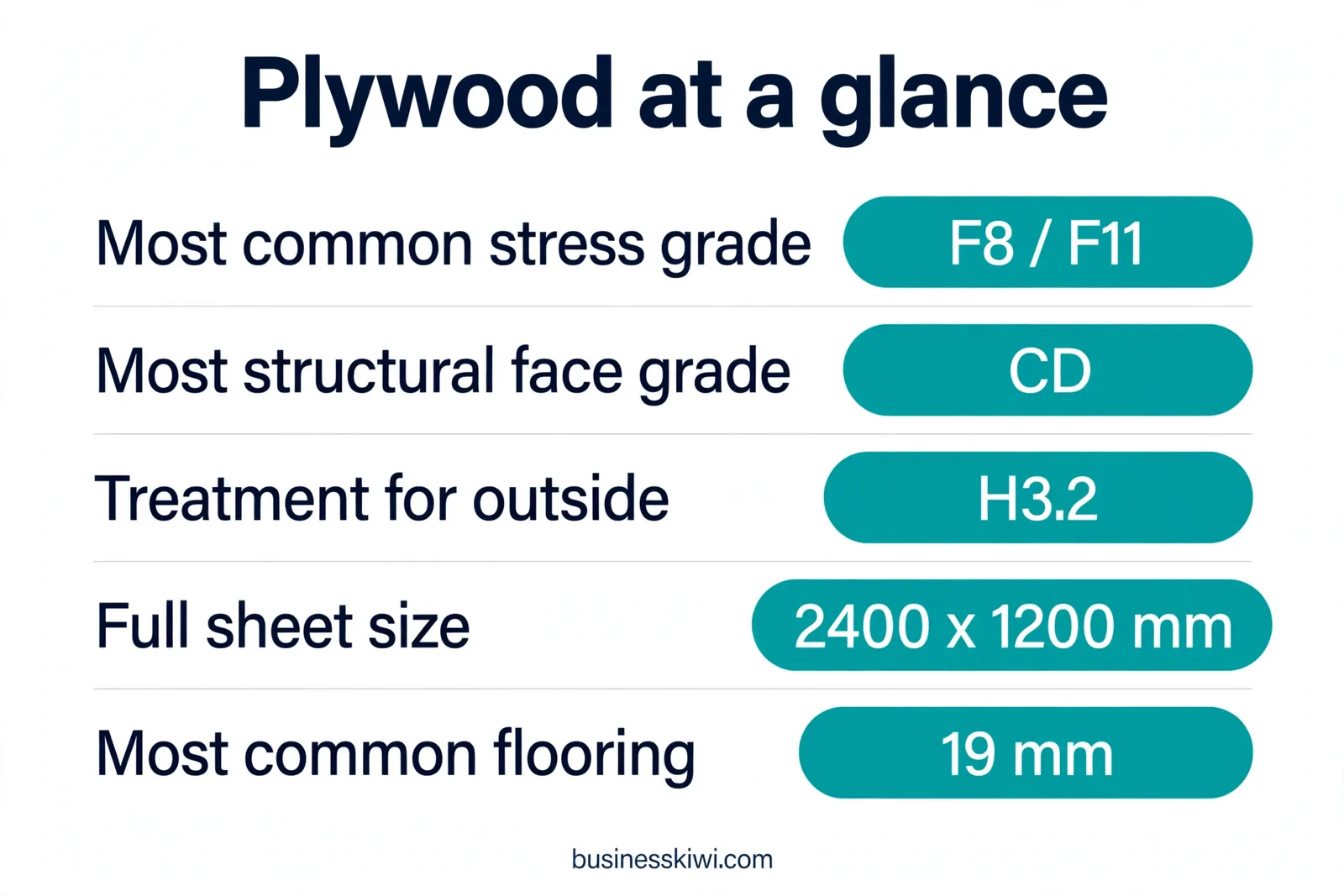
The first decision when buying plywood is whether the job needs structural plywood. Structural plywood has been tested and rated for strength. It carries an F stress grade, such as F8 or F11, and it is made to AS/NZS 2269. Only structurally tested plywood has a strength rating. Any plywood without a strength rating is considered non-structural, as PlaceMakers puts it on its own plywood page.
Structural plywood is the right choice for anything that carries a load or braces a building: floors, roofs, wall bracing, ceiling diaphragms and concrete formwork that must hold its shape under pressure. Its strength is known and can be used in engineering calculations, and it is the plywood that the New Zealand Building Code relies on for structural work. The Building Code clauses that apply are B1 Structure and B2 Durability, and structural plywood used in accordance with the standard helps a building meet those clauses.
Non-structural plywood is a lower grade product made for jobs where strength does not matter. It suits temporary hoardings, packaging, craft projects such as a dolls house, and small DIY jobs where the panel is not load bearing. It is usually cheaper, and it may have open face knots and surface defects that reflect its practical purpose. The important rule is simple: never substitute non-structural plywood where structural plywood is specified. Plywood that has not been tested to AS/NZS 2269 cannot be used in place of structural plywood, and a building consent will not accept it.
How can you tell them apart on site? Check the back of the sheet. Structural plywood is marked with the standard number AS/NZS 2269, the manufacturer’s name or brand, the stress grade, the face grades and the bond type. If those markings are missing, treat the sheet as non-structural and ask the supplier what it is.
Face grades: what A, S, B, C and D mean
The face grade describes how good the veneer looks on each face of the sheet. AS/NZS 2269 sets out five surface grades: A, S, B, C and D. A sheet is sold with two letters, one for the face and one for the back, so a sheet marked CD has a C grade face and a D grade back.
A grade is the highest appearance grade. It is a clean, smooth face suitable for finishing, painting or clear coating where the surface will be seen. S grade is an appearance grade that allows natural wood character, with minor filled splits and small filled holes. B grade is a solid sanded surface that may have some filled knots and repairs visible. C grade is a non-appearance grade with a solid surface, but it can have filled knots and splits, and it is the usual face grade for structural sheets that will be covered up. D grade is a non-appearance grade that permits open defects, and it is used for the back face of sheets where nobody will see it.
Most structural plywood sold in New Zealand is CD grade. That means the face is a C grade, smooth and sanded with filled knots, and the back is a D grade that can have open defects. CD grade is the right choice for flooring, bracing and roofing, where the face will be covered by floor coverings, plasterboard or roofing. If the plywood will be on show, look for a higher face grade. B grade suits painted joinery, while A grade suits clear finished furniture and feature walls.
The face grade says nothing about strength. A CD sheet and an AB sheet of the same thickness and stress grade are equally strong. The difference is only in how the surface looks.
Stress grades: F8, F11 and F14
The stress grade, shown by the letter F followed by a number, tells you the strength and stiffness of the sheet. The number is not a thickness or a quality score. It is a code that links the panel to a full set of strength and stiffness values in the standard, which engineers use to design floors, roofs and bracing.
The most common New Zealand manufactured stress grades are F8 and F11, according to BRANZ. F8 is the standard stress grade for most Ecoply products. Some Ecoply panels are rated F11 in the direction parallel to the face grain and F8 across it, which the manufacturer writes as F11/F8. Flooring plywood is often rated F8/F5, which means F8 in one direction and F5 in the other. Higher numbers mean a stiffer, stronger panel in that direction, and they allow wider spans between joists or trusses.
F14 is a higher stress grade used for flooring. The IBuilt Floorply14 sold by Mitre 10 is a 15mm F14 CD tongue and groove panel, and its veneers are orientated at 90 degrees to give a balanced F14 rating and stiffness in both directions, along and across the grain. That balanced rating is what makes it suitable as a flooring substrate.
For a buyer, the practical point is that the stress grade must match the job and the spans. A designer or engineer specifies the grade and thickness for structural work, and the sheet on site must match the specification. Buying a lower grade because it is cheaper is not a saving if the floor bounces or the bracing does not meet the design.
Treatment: untreated, H3.1 and H3.2
Plywood that will get wet needs preservative treatment. Radiata pine is not naturally durable, so treatment is what stops decay fungi and borer from destroying it. The treatment level is shown by a hazard class, and the classes are set out in NZS 3602 for timber used in buildings.
Untreated plywood is for dry, indoor use only. It must not be used externally or in high moisture areas, and that warning appears on the product descriptions of untreated structural panels. If a sheet will be exposed to weather or moisture, it needs treatment.
H3.1 is the lower of the two exterior treatment classes. It applies to timber used above ground and exposed to the weather, generally in non-structural applications such as cladding and exterior trims. H3.1 relies on a sound paint system to protect it, and it has a 15 year minimum durability requirement. It is usually dyed a light green so it can be told apart from H3.2.
H3.2 is the higher exterior class. It applies to timber used above ground and exposed to weather, or protected from the weather but with a risk of moisture getting trapped. It covers structural uses, decking, exposed joists and fencing. H3.2 has a 50 year minimum durability requirement and does not rely on paint to achieve it. Most structural plywood used outside is H3.2 treated, and it is the most common treatment for plywood flooring.
The treatment chemical matters too. The traditional treatment is CCA, which stands for chromated copper arsenate. A newer option is MCA, or micronised copper azole, which PlaceMakers describes as a safer, lower impact treatment that offers the same protection as CCA with less toxicity. BRANZ notes that exterior plywood left unpainted or used as bracing should be H3 CCA, while exterior plywood that will be painted can be H3 LOSP.
One caution from the manufacturer is worth knowing. CCA treated Ecoply plywood must not be installed in direct contact with steel frames. Check the product information sheet for any treatment before fixing treated plywood to steel.
The main types of plywood you can buy in NZ
Plywood is sold by type as well as by grade, and each type is made for a particular job. The table below summarises the main types available in New Zealand, based on PlaceMakers’ own range descriptions.
| Type | What it is for | Key facts |
|---|---|---|
| Structural plywood | Floors, roofs, wall bracing, ceiling diaphragms | F8/F5 and above, from 7mm, AS/NZS 2269, untreated or H3.1/H3.2 |
| Non-structural plywood | Hoardings, packaging, craft and small DIY jobs | No strength rating, from 4mm, treated or untreated, may have open knots |
| Flooring plywood | Floor substrates under floor coverings | Most common thickness 19mm, most common treatment H3.2, tongue and groove, F8/F5 and above |
| Roofing plywood | Roof decking under membranes and shingles | 15mm to 25mm, F8 and above, DD grade, tongue and groove, laid across trusses |
| Formply | Concrete formwork | Phenolic resin paper overlay for easy release, 12.5mm and above, must have an F rating for subfloors |
| Cladding plywood | Exterior wall cladding | 12mm, H3.1 or H3.2, structural only, radiata pine, 15 year minimum durability |
| Marine plywood | Boat building and wet areas | BS1088, 4mm to 25mm, waterproof resin, non-structural, special order |
| Interior lining plywood | Internal wall and ceiling linings | Non-structural, untreated, tongue and groove or shiplap, some types can brace walls |
Formply deserves a closer look because it is easy to misuse. Form plywood is made for concrete forms, and it is overlaid with heavy duty phenolic resin paper on one or both sides to create a non-stick surface. That stops concrete from sticking to the form, makes the form easy to remove and reuse, and gives a smooth finish to the concrete. When formply is used for concrete subfloors it must have an F stress grade rating.
Marine plywood is the most expensive common type. Its main difference is the waterproof resin between each layer of wood, and it must be built to British Standard BS1088. PlaceMakers notes that marine ply still needs sealing to last, with a rule of thumb of one layer of epoxy sealant per layer of wood in the ply. Marine plywood is sold on special order in New Zealand, and it suits boat building as well as kitchens, laundries and pool changing rooms where moisture is a constant issue.
Cladding plywood is a structural panel made from New Zealand radiata pine, available grooved or rough sawn, and designed to be painted or stained. It has vertical shiplap joints for watertight installation, and it achieves a minimum of 15 years durability under the Building Code. It cannot be used for all buildings, so the manufacturer’s specifications must be checked before it is chosen as a cladding.
Plywood sizes and thicknesses
The standard full sheet of plywood in New Zealand is 2400 x 1200mm. Longer sheets of 2700 x 1200mm are also available, and they suit wall heights and larger floors with fewer joins. Most structural plywood is sold in these two lengths, and Ecoply is available in thicknesses from 7mm to 25mm.
Smaller cut panels are sold for DIY work. Bunnings sells IBS mini panels, which are small cut sheets of plywood for small jobs, and Mitre 10 sells bbi DIY cut ply in 1200 x 596mm pieces. These small panels are handy for repairs, shelves and small projects, but they cost more per square metre than a full sheet, so they are not the economical way to buy plywood for a big job.
Thicknesses run from 4mm to 25mm. Thin sheets of 4mm to 7mm suit lining, backing and craft work. Sheets of 9mm to 12mm suit wall linings, bracing and light duty jobs. Sheets of 15mm to 19mm are the usual range for flooring and roofing. Sheets of 19mm to 25mm suit heavy duty flooring and formwork. The right thickness depends on the span between supports and the load, so structural jobs should follow the specification rather than a guess.
Plywood is also sold with different edge profiles. Square edge sheets butt together with a small gap. Tongue and groove sheets lock together along the long edge, which suits flooring and roofing because the joints are supported and the surface stays flat. Some interior lining panels have a shiplap edge or a V groove profile for a decorative finish.
What plywood costs in NZ
Plywood prices in New Zealand vary widely with grade, thickness and finish. A small cut panel can cost less than $20, while a full sheet of treated structural flooring plywood can cost more than $250. Prices also move with timber markets and differ between stores, so the figures below are a snapshot from the retailers’ own websites on 10 November 2026, not a price list to rely on months later. Always check the current price before budgeting a job.
| Product | Size | Price on 10 Nov 2026 |
|---|---|---|
| IBS mini panels, untreated CD plywood (Bunnings NZ) | 1200 x 600 x 7mm | $15.96 |
| bbi DIY cut ply, non-structural untreated, poplar core (Mitre 10) | 1200 x 596 x 12mm | $28.72 |
| IBuilt Floorply14, F14 CD tongue and groove untreated (Mitre 10) | 2400 x 1200 x 15mm | $146 |
| Ecoply flooring, CD H3.2 treated tongue and groove (Mitre 10) | 2400 x 1200 x 21mm | $264 |
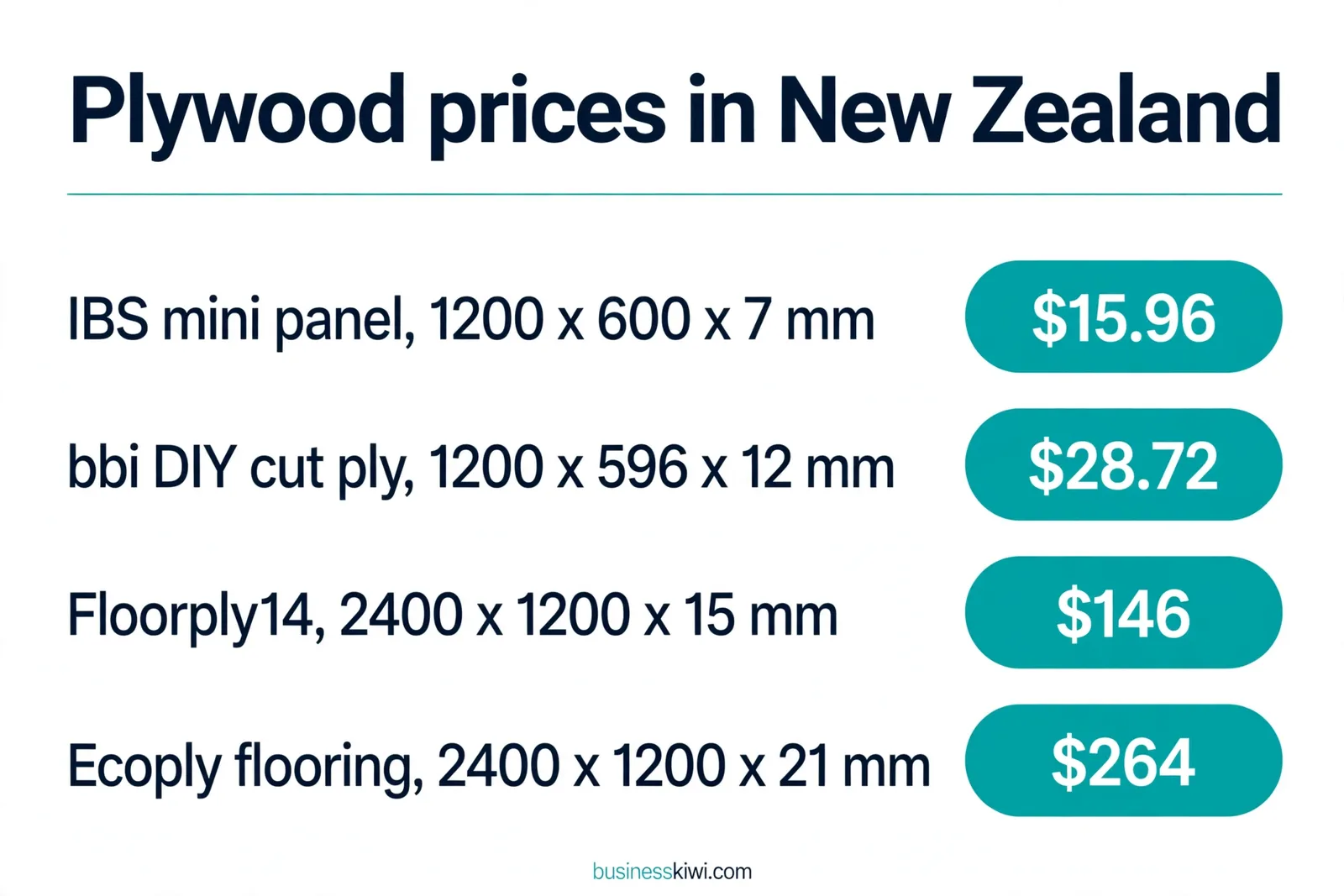
The two cheaper items are small cut panels, not full sheets, so they are not directly comparable with the full sheet prices. The 15mm Floorply14 at $146 is an untreated structural flooring panel, while the 21mm Ecoply at $264 is a thicker, H3.2 treated flooring panel. Thickness and treatment are the main reasons for the price difference.
PlaceMakers does not publish shelf prices for its plywood range. Its website asks trade customers to check their trade price, so a buyer there needs an account or a quote. That is normal for trade merchants, and it means the prices above from Bunnings and Mitre 10 are the best public guide to what a retail buyer will pay.
No current full sheet price for marine plywood could be verified, because marine plywood is sold on special order and no retailer publishes a shelf price for it. The same applies to 18mm full sheets: no 18mm full sheet price from a major retailer could be verified in full on the day of research. Treat any 18mm price quoted without a source as a guess, and ask the supplier for a current quote.
12mm plywood: what it is good for
The sheet keyword for this guide is 12mm plywood, and it is a popular thickness because it sits in the middle of the range. It is thick enough for real work and light enough to handle easily. A full sheet of 12mm plywood is used for wall linings, internal bracing, shelving, cabinet carcasses, subfloors in light duty situations, and as a substrate under other materials.
Whether 12mm is right depends on the grade and the job, not just the thickness. A 12mm structural CD sheet to AS/NZS 2269 can be used as wall bracing and as a lining, and it is the thickness used for 12mm cladding plywood. A 12mm non-structural sheet is a budget panel for jobs where no strength is needed, and it must not be used for bracing or flooring. The same thickness can also be a formply panel for light concrete work, or a marine ply panel for a boat, and each of those is a different product with a different price.
As a rough guide, 12mm plywood is too thin for most flooring jobs, where 15mm to 19mm is the usual range, and it is thicker than needed for a simple wall lining, where 7mm or 9mm is often enough. It is a good all round thickness for shelves, cupboards, workbenches and general DIY, and it is the thickness many people buy first when they are not sure what they need.
Choosing plywood for floors
Plywood flooring is a structural job, so the grade, thickness and treatment all matter. Flooring plywood is structural only, rated F8/F5 and above, and available in thicknesses from 15mm to 25mm. The most common thickness for ply flooring is 19mm, and the most common treatment is H3.2, according to PlaceMakers. Treated flooring plywood should be used for wet areas such as bathrooms and laundries, although some builders use H3.2 treated plywood for the whole building as an extra precaution.
Flooring sheets have a tongue and groove edge so they lock together and form a flat, stable surface. They must be laid perpendicular to the floor joists, with the joints staggered, and fixed according to the manufacturer’s instructions. The Ecoply flooring panel sold by Mitre 10 is a 21mm CD H3.2 treated tongue and groove sheet at $264, and it is described as New Zealand made structural F8/F5 plywood used in certified bracing systems. The IBuilt Floorply14 is a 15mm F14 CD tongue and groove untreated panel at $146, and its balanced F14 rating gives it stiffness in both directions.
Untreated flooring plywood must not be used in wet areas or anywhere it could get damp. If the floor is over an enclosed subfloor or in a bathroom, laundry or kitchen, use treated plywood. The extra cost of treatment is small compared with the cost of replacing a rotten floor.
Choosing plywood for walls, bracing and cladding
Plywood is widely used for wall bracing in New Zealand, because a sheet of structural plywood fixed to the framing gives a wall far more strength against wind and earthquakes than plasterboard alone. Bracing plywood is usually a structural CD sheet, fixed in accordance with the bracing specification for the building, such as the Ecoply EP1 and EPG bracing systems. The sheet must be the grade and thickness the designer specified, and the fixings and spacings must match the specification.
Ecoply Barrier is a related product worth knowing about. It is a 7mm thick structural plywood panel coated on the face and edges, used as a rigid air barrier outside the building frame. It replaces traditional flexible building wrap in the cavity, provides structural bracing, and forms a second line of defence against moisture getting into the building envelope. Because it closes in the building quickly, it can save two to four weeks on a house build.
For exterior cladding, plywood cladding is a structural panel made from New Zealand radiata pine, available in 12mm thickness with H3.1 or H3.2 treatment. It is fixed with vertical shiplap joints, and it can be painted or stained. It achieves a minimum of 15 years durability under the Building Code, but it cannot be used for all buildings, so the manufacturer’s specifications must be checked. For more on cladding choices, see our guide to EIFS cladding in NZ.
Interior lining plywood is a different product. It is non-structural and untreated, and it comes in a range of profiles and wood types for a decorative finish. Some newer interior plywood panels have improved bracing characteristics and can be fixed directly to the framing instead of over plasterboard, which can save money on a project. From garages and tiny homes to high end houses, plywood linings are becoming more popular as a finish in their own right.
Choosing plywood for furniture and interior lining
For furniture and joinery, the face grade matters more than the stress grade. A cabinet carcass hidden inside a kitchen can be made from CD grade plywood, because nobody sees it. A bookshelf, a wardrobe door or a feature wall needs a better face, such as B grade or A grade, so it looks good with paint or clear finish.
Birch plywood is a popular choice for furniture because it has many thin layers, a pale even colour and a smooth face that takes a clear finish well. It is usually sold as an imported product, and it costs more than radiata pine plywood. Poplar core plywood with a radiata pine veneer, such as the bbi DIY cut ply sold by Mitre 10, is a budget option for painted furniture and general DIY. It uses interior glues, so it is not suitable for wet areas or outdoor use.
Interior lining plywood comes in tongue and groove, shiplap and square edge profiles, and in grooved and plain finishes. A V groove profile gives a traditional lined look, while a plain sheet gives a clean modern finish. Because lining plywood is untreated, it is for dry indoor areas only, and it should be sealed or painted to protect it from moisture and marking.
When buying plywood for furniture, check the sheet for flatness before you leave the store. Sight along the face for bowing or twisting, and reject sheets that are visibly warped. A warped sheet will not straighten out once it is cut, and it will make cabinet doors and drawers bind.
Storing, cutting and fixing plywood
Plywood should be stored flat, off the ground and under cover, with support under the whole sheet. Sheets stored on edge or on uneven bearers will bow, and sheets left in the rain will swell and delaminate. Treated plywood should be kept dry until it is fixed, and cut edges on treated sheets should be sealed with preservative, especially on roofing plywood.
Cut plywood with a sharp fine toothed saw blade, and cut with the good face down on a circular saw so any breakout happens on the back face. Support the sheet fully while cutting so it does not pinch the blade or split at the end of the cut. Wear a dust mask and eye protection, and work in a ventilated area, because cutting plywood creates fine dust.
Fix plywood with the fixings the manufacturer specifies for the job. Structural plywood used as bracing or flooring must be fixed with the correct nails or screws at the correct spacings, because the fixings are part of the strength of the system. Do not use adhesives as a substitute for mechanical fixings on structural work. Leave the expansion gaps the manufacturer calls for, usually a few millimetres between sheets, so the panels can move with changes in humidity without buckling.
Five mistakes cause most plywood problems. The first is using non-structural plywood where structural plywood is needed. A budget sheet with no F rating and no AS/NZS 2269 marking is not a substitute for a structural panel, and it will not pass a building inspection. The second is using untreated plywood outside or in a wet area. Untreated plywood will rot, and the damage is often hidden until the floor or wall fails. The third is buying on thickness alone. A 12mm sheet can be structural or non-structural, treated or untreated, and the price difference is large, so read the full label and match the grade and treatment to the job. The fourth is ignoring the face grade for visible work. A CD sheet will show filled knots and patches through a clear finish, so pay for a better face grade when the surface will be seen. The fifth is poor storage. Plywood left leaning against a wall in the rain will warp before it is ever used, and a warped sheet is wasted money.
For more on building and business, browse the Business Guide section.
Frequently asked questions
How much does a sheet of plywood cost in NZ?
It depends on the size, grade and thickness. Small cut panels start at about $16 for a 1200 x 600mm 7mm sheet at Bunnings, and a 12mm cut panel costs about $29 at Mitre 10. Full sheets cost more: a 15mm structural flooring sheet costs about $146, and a 21mm H3.2 treated flooring sheet costs about $264. Those prices were checked on the retailers’ own websites on 10 November 2026. Marine plywood and 18mm full sheets have no published shelf price, so ask the supplier for a current quote.
What is the difference between structural and non-structural plywood?
Structural plywood has been tested and rated for strength. It carries an F stress grade, such as F8 or F11, and it is made to AS/NZS 2269. Non-structural plywood has no strength rating and is made for jobs where strength does not matter, such as hoardings, packaging and craft projects. Non-structural plywood must never be used where structural plywood is specified.
What does CD grade mean?
CD is a face grade. The first letter describes the face veneer and the second letter describes the back veneer. C is a non-appearance grade with a solid sanded surface that may have filled knots and splits, and D is a non-appearance grade that can have open defects. Most structural plywood in New Zealand is CD grade, which suits floors, bracing and roofing where the surface will be covered.
Can plywood be used outside?
Yes, but only if it is treated. Untreated plywood must not be used externally or in high moisture areas. For outdoor use, choose H3.2 treated plywood, which has a 50 year minimum durability requirement. H3.1 treated plywood can be used for cladding and trims, but it relies on a sound paint system and has a 15 year minimum durability requirement.
What thickness of plywood should I use for a floor?
Flooring plywood is usually 15mm to 25mm thick, and the most common thickness is 19mm. The exact thickness depends on the joist spacing and the loads, so structural flooring should follow the designer’s specification. A 12mm sheet is generally too thin for a floor, and a 15mm F14 panel is the thinnest common flooring option.
Is plywood waterproof?
No plywood is fully waterproof, not even marine plywood. Marine plywood uses a waterproof resin between its layers and is built to British Standard BS1088, but it still needs sealing to last. PlaceMakers suggests a rule of thumb of one layer of epoxy sealant per layer of wood in the ply. Structural plywood uses a Type A bond, which is highly durable, but the sheet itself will still swell and decay if it stays wet.
Where can I buy plywood in NZ?
Bunnings and Mitre 10 sell plywood at retail, with published prices for common sheets and cut panels. PlaceMakers and other trade merchants sell a wider range, including marine plywood on special order, but their prices are trade prices and need an account or a quote. Specialist plywood suppliers also stock imported birch, decorative and marine plywood. For a small sleepout or granny flat project, see our guide to 1 bedroom granny flats in NZ.
This guide is general information only. It is not building advice. Plywood grades, treatments and prices change, and structural work must follow the plans, the product specifications and the New Zealand Building Code. Check the current price and the markings on the back of the sheet before you buy, and ask the supplier or a licensed building practitioner if you are unsure which plywood your job needs.