Toolbox Meetings in NZ: How to Run Them and a Template That Works
The short answer
A toolbox meeting is a short, focused safety talk held with workers before or during a shift, usually on site and usually about one topic. It takes 10 to 15 minutes, it covers the hazards of the work ahead, and everyone present signs to say they were there.
This guide explains what the law in New Zealand expects, how to run a meeting that workers actually listen to, and gives you a full template you can copy and use. It is written for small and medium businesses, site supervisors, and anyone who has been asked to run safety meetings without being shown how.
What a toolbox meeting is
A toolbox meeting, also called a toolbox talk or a prestart talk, is a short safety conversation with the people who will do the work. The name comes from the idea of gathering around the toolbox before the day starts. The meeting has one job: to make sure everyone knows what the hazards are today, what the controls are, and what to do if something changes.
A toolbox meeting is not a training course, and it is not a lecture. It is a conversation. The person leading it explains the topic in plain language, asks the workers what they think, and listens to the answers. Workers are the people closest to the hazards, so they often know things the supervisor does not. A meeting where only one person talks is a briefing, not a toolbox meeting, and it misses the point.
Toolbox meetings are common in construction, civil works, manufacturing, warehousing, forestry and farming, but they suit any workplace where the work changes from day to day or where the hazards are real. An office with a stable routine may not need one, but a site with cranes, traffic, dust, heights or chemicals does.
Why the law expects you to talk to your workers
Toolbox meetings are not named in the law, but the duty behind them is. The Health and Safety at Work Act 2015, known as HSWA, requires every business to involve its workers in health and safety. WorkSafe New Zealand, the regulator, calls this worker engagement, participation and representation.
Under section 58 of HSWA, a business (the PCBU) must, so far as is reasonably practicable, engage with workers who carry out work for the business and workers who are, or are likely to be, directly affected by a health and safety matter. A breach of this duty is an offence, and an individual can be fined up to $20,000.
Section 59 sets out what engagement means in practice. Relevant information must be shared with workers in a timely manner. Workers must be given a reasonable opportunity to express their views and raise health or safety issues, and to contribute to decision making. Their views must be taken into account, and workers must be told the outcome in a timely way.
Section 60 lists the situations where engagement is required. They include identifying hazards and assessing risks, making decisions about how to address risks, deciding on the adequacy of welfare facilities, monitoring worker health and exposure levels, providing information and training, setting procedures for resolving health and safety issues, determining work groups, and proposing changes that may affect worker health and safety.
Section 61 adds a second duty. A business must have practices that give workers reasonable opportunities to participate in improving work health and safety on a day to day basis. WorkSafe’s guidance is clear that the focus is on effectiveness, not on having a particular system. A toolbox meeting is one of the simplest participation practices a business can have, because it is regular, it is on site, and it gives every worker a voice.
A toolbox talk also helps show that a business has met its other duties. Site Safe, the construction industry safety body, describes toolbox talks as a key part of an employer’s duty to manage risks, because they show that the employer informs and trains workers to work safely. If WorkSafe ever asks how a business communicates hazards to its workers, a file of dated toolbox meeting records with attendance signatures is a strong answer.
What a good toolbox meeting covers
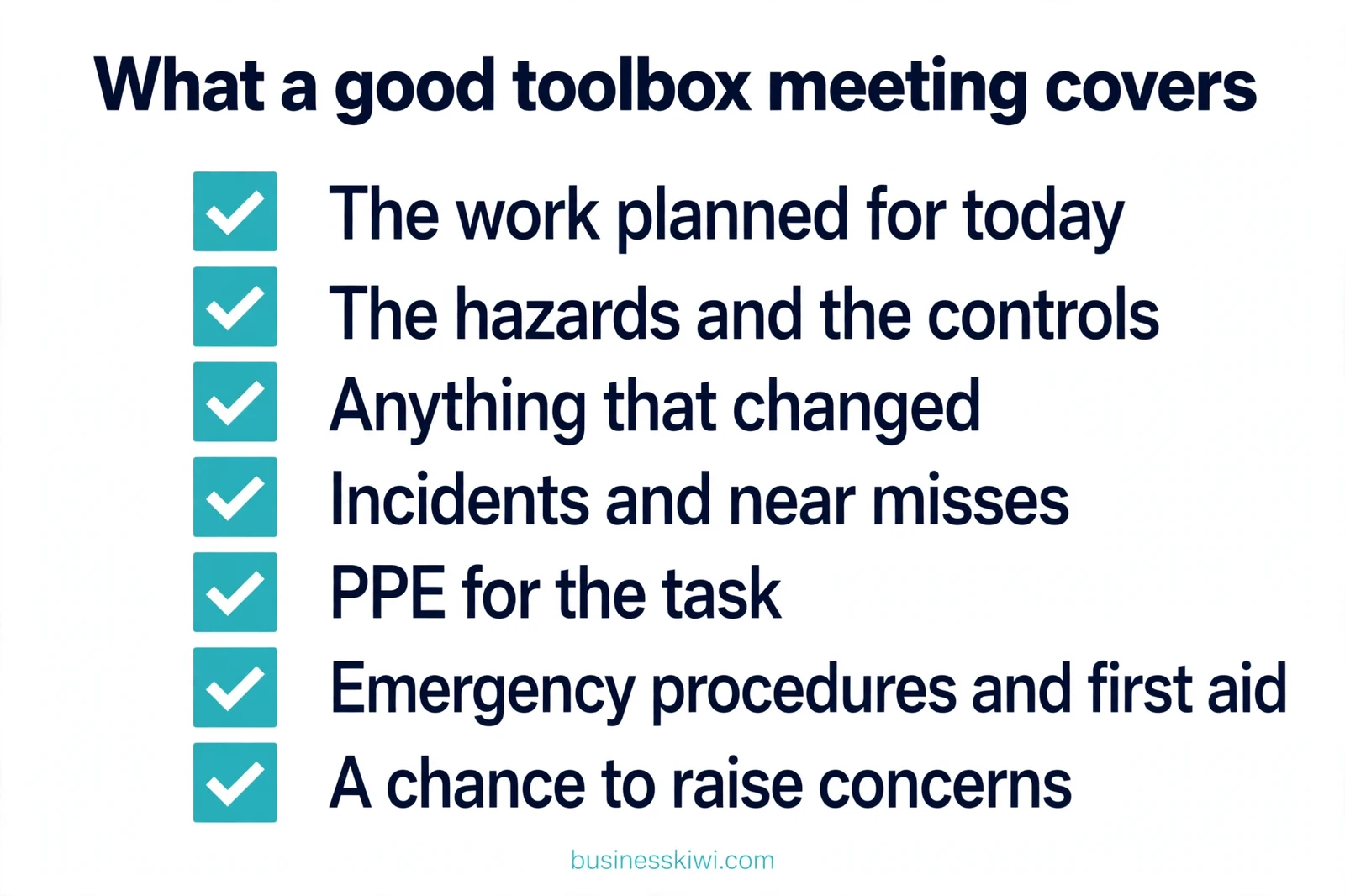
A good meeting covers one topic properly rather than five topics in a rush. The topic should come from the work itself, not from a calendar. The most useful topics are the hazards of today’s work, anything that changed since yesterday, and anything that went wrong recently.
The usual contents are:
- The work planned for the day and where it will happen.
- The hazards in that work, and the controls that manage them.
- Any new hazard, such as a new subcontractor on site, a change in weather, a new chemical, or work near live services.
- Incidents, near misses and injuries since the last meeting, and what was learned from them.
- Personal protective equipment for the task, and whether it is available and in good condition.
- Housekeeping, access, emergency procedures and first aid for the day.
- A chance for every worker to raise a concern or ask a question.
WorkSafe publishes its own toolbox talks, and they show the shape of a good one. Its wood dust talk, for example, starts with what the hazard is and how it harms health, then asks the team which tasks create the dust, then asks what controls are already in place, then covers the control measures, and finishes with why health monitoring matters. Each section has prompts, which are questions for the team, not statements to read out. That structure works for any topic: what is the hazard, how does it hurt people, what do we already do about it, what else do we need to do, and what questions do you have.
How often to hold them
The law does not set a frequency for toolbox meetings. What matters is that engagement is regular and happens when it is needed. A business should set a rhythm that matches its risk and its pace of work, and stick to it.
For most construction and civil sites, a short meeting at the start of each shift works well. Wellington Pipelines, a Wainuiomata water and drainage company featured in a WorkSafe case study, starts every work day with a toolbox meeting. The team stands in a circle and talks through the day’s work plan and risks. The company also holds monthly health and safety meetings. That combination, a daily short talk plus a longer monthly meeting, is a practical pattern for a busy site.
A weekly meeting may be enough for a workshop, a warehouse or a manufacturing plant where the work is steadier. What matters is that the meeting happens before the work it covers, not after. A talk about scaffolding delivered after the scaffold is up is too late.
There are also times when a meeting should be held outside the regular rhythm. Hold one when a new worker starts, when a new subcontractor arrives, when the work changes, when a new hazard appears, after an incident or a near miss, and when new plant, chemicals or procedures are introduced. WorkSafe’s worker engagement guidelines give an example from a manufacturing plant, where toolbox talks were used to make sure every worker understood a new procedure, with a Samoan-speaking health and safety representative translating and then going through the material again in small groups. That is what good engagement looks like in practice.
Who runs them and who attends
A toolbox meeting can be led by a supervisor, a foreman, a manager or a health and safety representative. WorkSafe’s own toolbox talks say they can be led by any of these. The best leader is the person who knows the work and who the workers will actually talk to. That is often the foreman, not the manager.
Everyone who will do the work should attend, including subcontractors, labour hire workers and new starters. A worker who misses the talk misses the hazard information, so the talk should be repeated for anyone who arrives late or starts mid-shift. Visitors who will enter the work area should get a shorter version, usually as part of a site induction.
Language matters. If some workers do not speak English well, the meeting must still reach them. That can mean a translated handout, a bilingual worker explaining the points, or a health and safety representative who speaks the workers’ language going through the material in a small group after the main talk. A signature on an attendance sheet means nothing if the worker did not understand what was said.
The person running the meeting should keep a list of who was there. If an action comes out of the meeting, someone must own it, and the next meeting should check whether it was done.
How to run one in 10 to 15 minutes
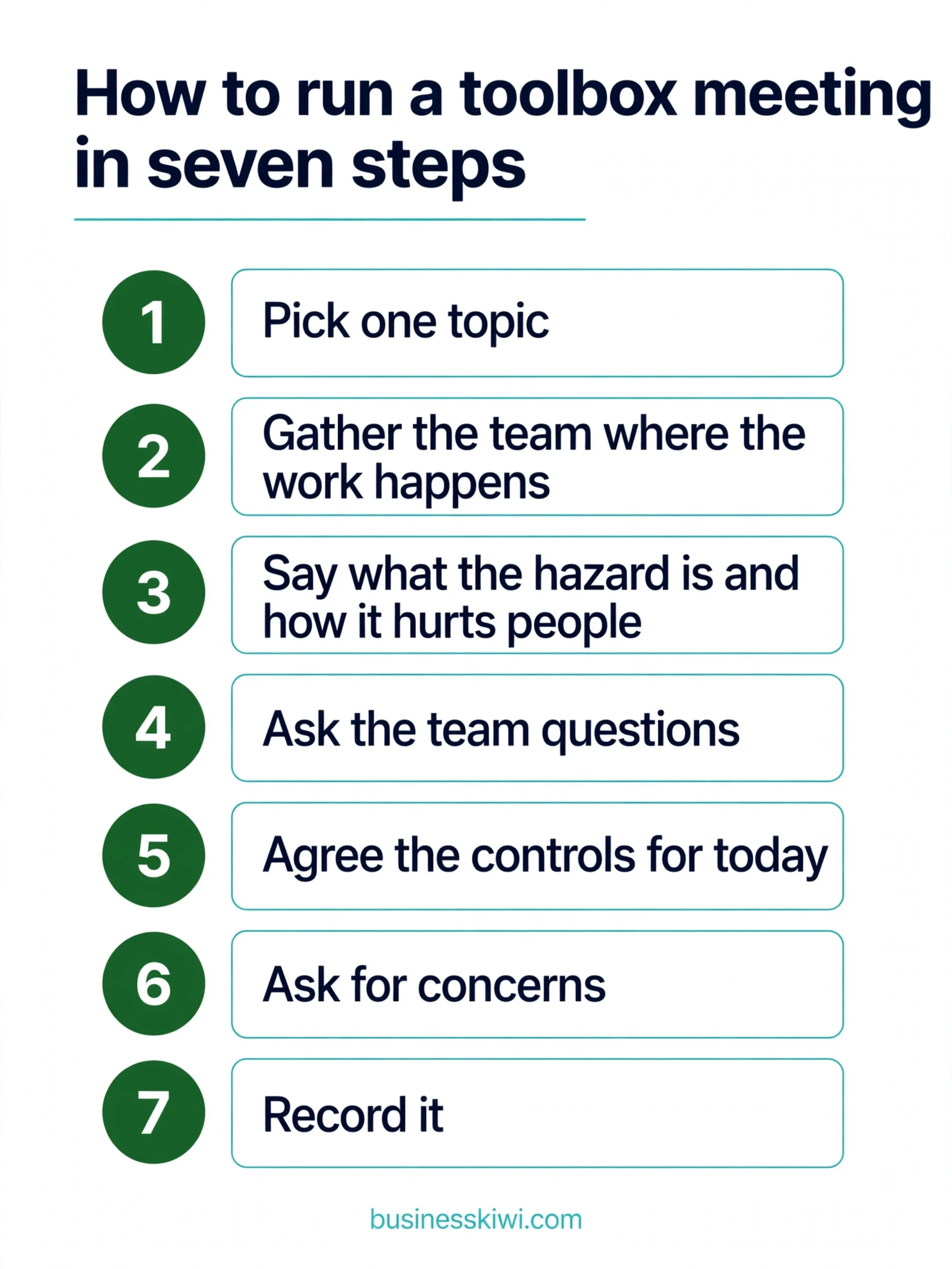
A toolbox meeting that drags on for 40 minutes will lose its audience. Ten to 15 minutes is enough for one topic done well. The steps below keep it short and useful.
1. Pick one topic. Choose the hazard that matters most today. If there are several, pick the one with the highest risk and cover the others another day.
2. Gather the team where the work happens. Stand in a circle at the work area, not in a distant office. People pay more attention when they can see the hazard you are talking about.
3. Say what the hazard is and how it hurts people. Use plain language and real examples. Wood dust scars lungs and can cause asthma and cancer. A fall from a ladder can break bones or kill. Keep it concrete.
4. Ask the team questions. Ask what tasks create the hazard, what controls are already in place, and what could go wrong today. Wait for answers. Silence for a few seconds is better than answering your own question.
5. Agree the controls for today. Name the controls, who is responsible for each one, and what to do if a control fails or a new hazard appears.
6. Ask for concerns. Ask directly whether anyone has seen something unsafe, or whether anyone is unsure about anything. Thank people who speak up.
7. Record it. Fill in the attendance record, note the topic and any actions, and get everyone to sign. File the record where it can be found later.
Keep the tone practical and respectful. Workers who feel talked down to will stop listening. Workers who feel heard will tell you about hazards you did not know existed.
The template
Below is a complete toolbox meeting template. It is original to this guide and free to copy and use. It follows the structure WorkSafe uses in its own toolbox talks: an attendance record at the top, the topic in plain language, questions for the team, the controls, and actions with owners. Print it, or copy it into a document your business already uses.
Toolbox meeting record
| Field | Details |
|---|---|
| Company or business name | |
| Site or work location | |
| Date | |
| Time | |
| Meeting leader | |
| Topic of this meeting | |
| Work planned today |
Attendance
| Name (print) | Company or employer | Signature |
|---|---|---|
1. The hazard and how it hurts people
Write the hazard in one or two plain sentences. Say how it can injure people or damage their health.
Example: “Working at height. A fall from a ladder or a roof can cause broken bones, head injuries or death. Most falls happen from low heights.”
2. Questions for the team
Ask these out loud and write down what the team says. Do not skip this section. The answers are the most useful part of the meeting.
- What tasks today involve this hazard?
- What controls do we already have in place?
- What could go wrong today that is different from yesterday?
- Does anyone have a concern about this work?
3. Controls for today
List the controls that apply to today’s work. Tick each one only when it has been checked.
| Control | Checked |
|---|---|
| The right equipment is on site and in good condition | |
| Personal protective equipment is available and being worn | |
| The work area is set up safely, with access and exclusion zones clear | |
| Everyone knows the emergency procedure and the first aid location | |
| Any permit, isolation or sign-off needed for this work is in place |
4. Actions from this meeting
| Action | Who is responsible | Due by | Done |
|---|---|---|---|
5. Sign-off
Meeting leader signature: ______________________ Date: ______________
Notes: ________________________________________________________________________
Keeping records
A toolbox meeting that is not recorded is hard to prove happened. Keep the signed attendance record, the topic, and any actions in a file, whether paper or digital. WorkSafe’s guidance on contractor prequalification lists prestart and toolbox talk content and attendance as the kind of records a business should be able to show, so treat the records as part of your safety system, not as paperwork for its own sake.
File each record by date and site, and keep them where a supervisor or an inspector can find them. If an action was agreed, the next meeting should check whether it was done, and the record should show that. If a worker was absent, note it and repeat the talk for them before they start work.
There is no set period in the law for keeping toolbox meeting records, but a sensible rule is to keep them for at least the length of the project, and longer if the topic relates to a health risk that can take years to appear, such as dust exposure. Health monitoring records, where they exist, are kept separately and confidentially by a health professional.
Common mistakes
Most toolbox meetings fail in the same few ways. Avoiding these mistakes is worth more than a fancy template.
Reading a script to a silent room. A talk that is read out word for word, with no questions and no discussion, is a lecture. Workers switch off, and nothing is learned. Ask questions and wait for answers.
Covering too much. Five topics in 15 minutes means none of them is covered properly. Pick one topic and do it well.
No record. A meeting with no attendance record and no notes cannot be shown to anyone later. It also means actions are forgotten, because nobody wrote them down.
No follow-up. If a worker raises a hazard and nothing happens, they will stop raising hazards. Every action needs an owner and a due date, and the next meeting should report back on it.
Skipping people. Subcontractors, labour hire workers and new starters are the people most likely to be hurt, because they know the site least. They must be included, not left out because they arrived late or work for another company.
Repeating the same talk. The same generic talk delivered every week becomes background noise. Change the topic to match the work, use recent incidents and near misses, and use real photos from your own site where you can. Wellington Pipelines uses real photos from its sites and asks workers to identify the hazards in them, which keeps the meetings interactive.
Ignoring language. A worker who does not understand the talk has not been engaged, whatever the attendance sheet says. Plan for translation and checking understanding, not just for signatures.
A worked example: a toolbox meeting on working at height
This example shows how the template works in practice. The topic is working at height, one of the most common causes of serious injury in New Zealand construction. WorkSafe reported 645 injuries and 12 deaths in construction from 2022 to 2023, and most falls happen from low heights.
The leader gathers the team at the base of the scaffold and says: “Today we are working on the roof edge. The hazard is a fall. A fall from even two or three metres can break bones or kill. Most falls happen from low heights, not from high ones.”
The leader asks: “What tasks today put us at height? What controls do we already have? What is different today?” The team answers: the scaffold is up, the edge protection is in place, but the wind is picking up, and one ladder is damaged.
The controls agreed are: use the scaffold, not the ladder, until the ladder is replaced; check the edge protection before anyone goes up; wear harnesses where the scaffold does not protect the edge; and stop work at height if the wind gets worse. The action is: the foreman will remove the damaged ladder and order a replacement by the end of the day.
The meeting takes 12 minutes. Everyone signs. The damaged ladder is gone before lunch. That is a toolbox meeting doing its job.
For more on health and safety at work, our guide to health and safety courses in New Zealand covers the training options, and our health and safety policy template gives you a starting point for the document itself.
Frequently asked questions
What is a toolbox meeting?
A toolbox meeting is a short safety talk held with workers before or during a shift, usually on site and about one topic. It covers the hazards of the work ahead, the controls that manage them, and gives every worker a chance to raise concerns. It usually takes 10 to 15 minutes, and everyone present signs an attendance record.
Are toolbox meetings required by law in New Zealand?
Toolbox meetings are not named in the Health and Safety at Work Act 2015, so there is no law that says a business must hold them. But the Act does require a business to engage with its workers on health and safety, and to have practices that let workers participate in improving safety day to day. A toolbox meeting is one of the simplest ways to meet those duties, and WorkSafe and Site Safe both treat toolbox talks as a key part of managing risks.
How long should a toolbox meeting take?
Ten to 15 minutes is enough for one topic done well. A meeting that runs for 40 minutes will lose its audience. If the topic needs more time, it is probably a training session, not a toolbox meeting, and it should be scheduled separately.
How often should toolbox meetings be held?
The law does not set a frequency. Daily meetings suit construction and civil sites where the work and the hazards change every day. A weekly meeting may be enough for a workshop or warehouse with steadier work. Hold an extra meeting whenever a new worker starts, a new hazard appears, the work changes, or after an incident or near miss.
Who should run a toolbox meeting?
A supervisor, foreman, manager or health and safety representative can lead one. The best leader is the person who knows the work and who the workers will talk to honestly. That is often the foreman rather than the manager.
Do subcontractors need to attend toolbox meetings?
Yes. Everyone who will do the work should attend, including subcontractors, labour hire workers and new starters. A worker who misses the talk misses the hazard information. Repeat the talk for anyone who arrives late or starts mid-shift.
What records should I keep from a toolbox meeting?
Keep the signed attendance record, the topic covered, and any actions agreed, filed by date and site. Note who was absent and repeat the talk for them before they start work. If an action was agreed, check at the next meeting whether it was done and record that too.
This guide is general information only, not legal advice. The Health and Safety at Work Act 2015 and the Worker Engagement, Participation and Representation Regulations 2016 set out the duties in full. If you are unsure about your obligations, check WorkSafe New Zealand’s guidance or talk to a health and safety adviser.