Serious Misconduct in NZ: What Counts, the Fair Process and When Dismissal Without Notice Is Lawful

Few workplace moments are tenser than a serious misconduct allegation. For the employee, a job can feel gone in a single meeting. For the employer, one rushed decision can turn a clear-cut case into a personal grievance. New Zealand law draws a firm line: the behaviour has to be serious enough, and the process has to be fair. Both halves matter.
This guide covers what serious misconduct means, how it differs from ordinary misconduct, the fair process, suspension, dismissal without notice, and employee options when the process goes wrong.
The short answer
Serious misconduct is behaviour that undermines or destroys the employer’s trust in the employee, and affects the employee’s ability to do their job. An employer who proves serious misconduct through a fair process can dismiss the employee without notice: summary dismissal. What an employer cannot do is skip the process: even the clearest case needs an investigation, a meeting where the employee can respond, and a decision only after that response is considered.
Misconduct and serious misconduct: where the line sits
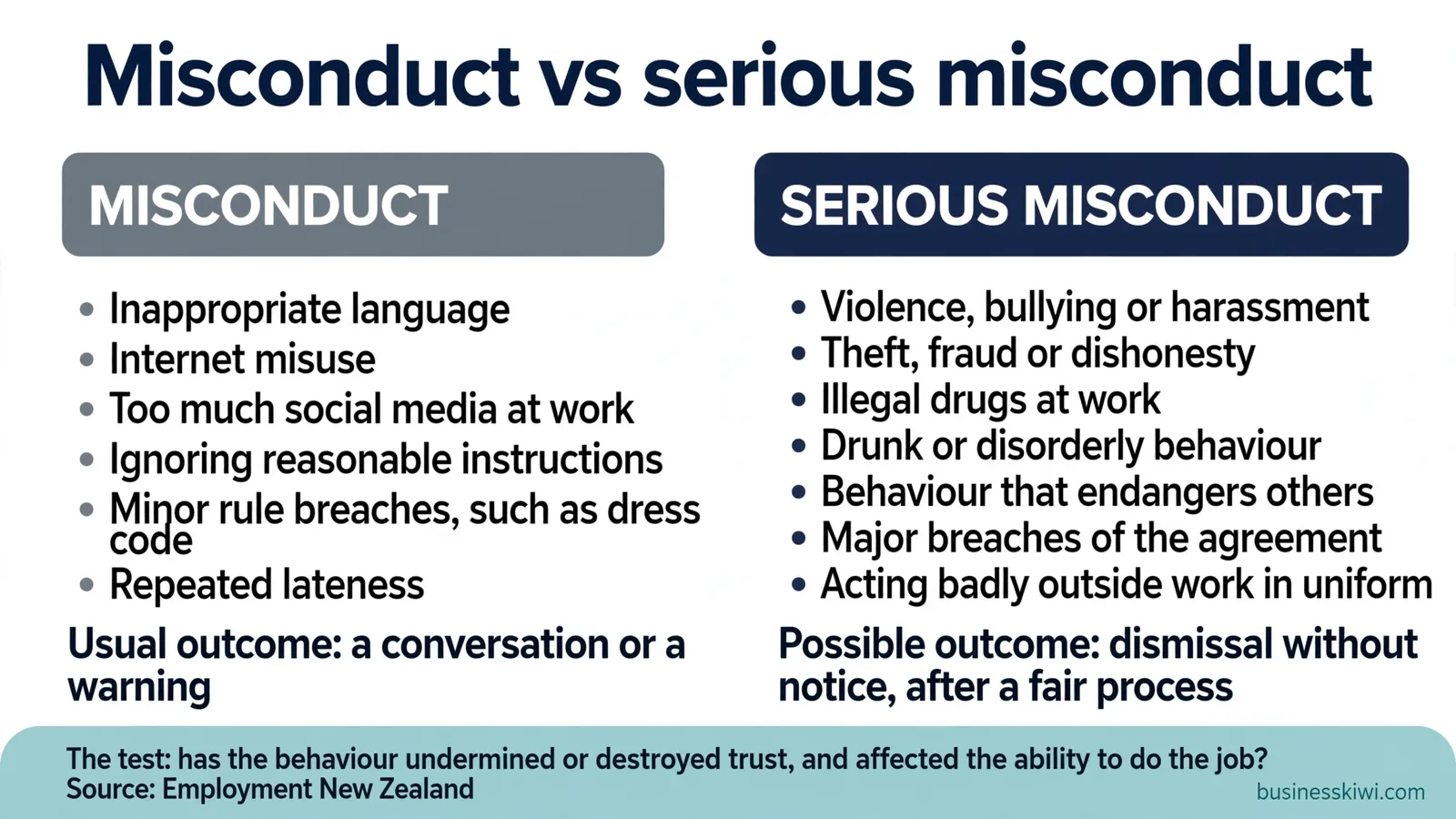
Employment NZ defines misconduct as something an employee does wrong, through what they do, what they fail to do, or how they behave. It comes in two levels, and the level decides how much is at stake.
Ordinary misconduct usually leads to a warning. Serious misconduct is different because of what it does to the relationship. The test Employment NZ gives is practical: behaviour is generally serious when it has undermined or destroyed the employer’s trust in the employee, and affected the employee’s ability to do the job. Its example is a security guard who is physically violent: violence casts real doubt on whether that guard can safely provide security.
Intent matters, but it is not everything. Serious misconduct usually involves something done on purpose, though extreme carelessness can also cross the line. Context matters too: the same act lands differently in different roles. Employment NZ’s example is stolen social club funds. A bank, where the employee handles money daily, may view that theft far more seriously than a large building contractor views the same act by a carpenter. Seniority, access and risk feed into the judgement.
One more point surprises people: behaviour does not become serious misconduct just because it is listed in the employment agreement or a policy, and behaviour on no list can still be serious misconduct. The facts decide, not the label.

Examples of serious misconduct
Employment NZ lists these as potential serious misconduct:
- Violent behaviour
- Bullying or harassing another employee
- Sexual, racial or other harassment
- Theft or fraud
- Dishonesty
- Using illegal drugs at work
- Drunk or disorderly behaviour
- Behaviour that causes danger to the employee or others
- Major breaches of the employment agreement
- Breaches of a workplace or professional code of conduct
- Being charged with a civil or criminal offence
- Acting badly outside work while identifiable as an employee
The word “potential” carries weight: these examples may not be serious misconduct in every situation. A single heated argument is not a pattern of harassment. The employer still has to look at what actually happened, and at the employee’s explanation, before settling on the label.
Behaviour away from work can count. Employment NZ’s own example is an 18-year-old supermarket worker who got into a pub fight after work, still in uniform. The other man identified him as a supermarket employee and complained. After an investigation the supermarket dismissed him without notice for bringing it into disrepute. He raised a personal grievance, arguing his private time was his own business. The Employment Relations Authority found his actions had harmed the supermarket’s reputation and breached trust and confidence, and that the supermarket had acted as a fair and reasonable employer. The grievance was not proven. An employer need only show the business could have been harmed, not that it was.
Behaviour that is usually misconduct, not serious misconduct
Employment NZ’s examples of ordinary misconduct are the everyday end of workplace discipline:
- Using inappropriate language
- Internet misuse
- Spending too much time on social media during work hours
- Not following reasonable and lawful instructions
- Minor breaches of the employment agreement, such as dressing inappropriately at work
- Repeated lateness
These matters are usually handled with a conversation or a warning. Where misconduct is serious or repeated, an employer may issue a final warning, which tells the employee they will be dismissed if the behaviour happens again. There is no set number of warnings an employer must give before dismissal. The response just has to be fair and reasonable.
Repetition changes the picture. A string of smaller acts, none of them serious alone, can build into something an employer is entitled to treat seriously. That is one reason records of earlier warnings matter.
The fair process, step by step
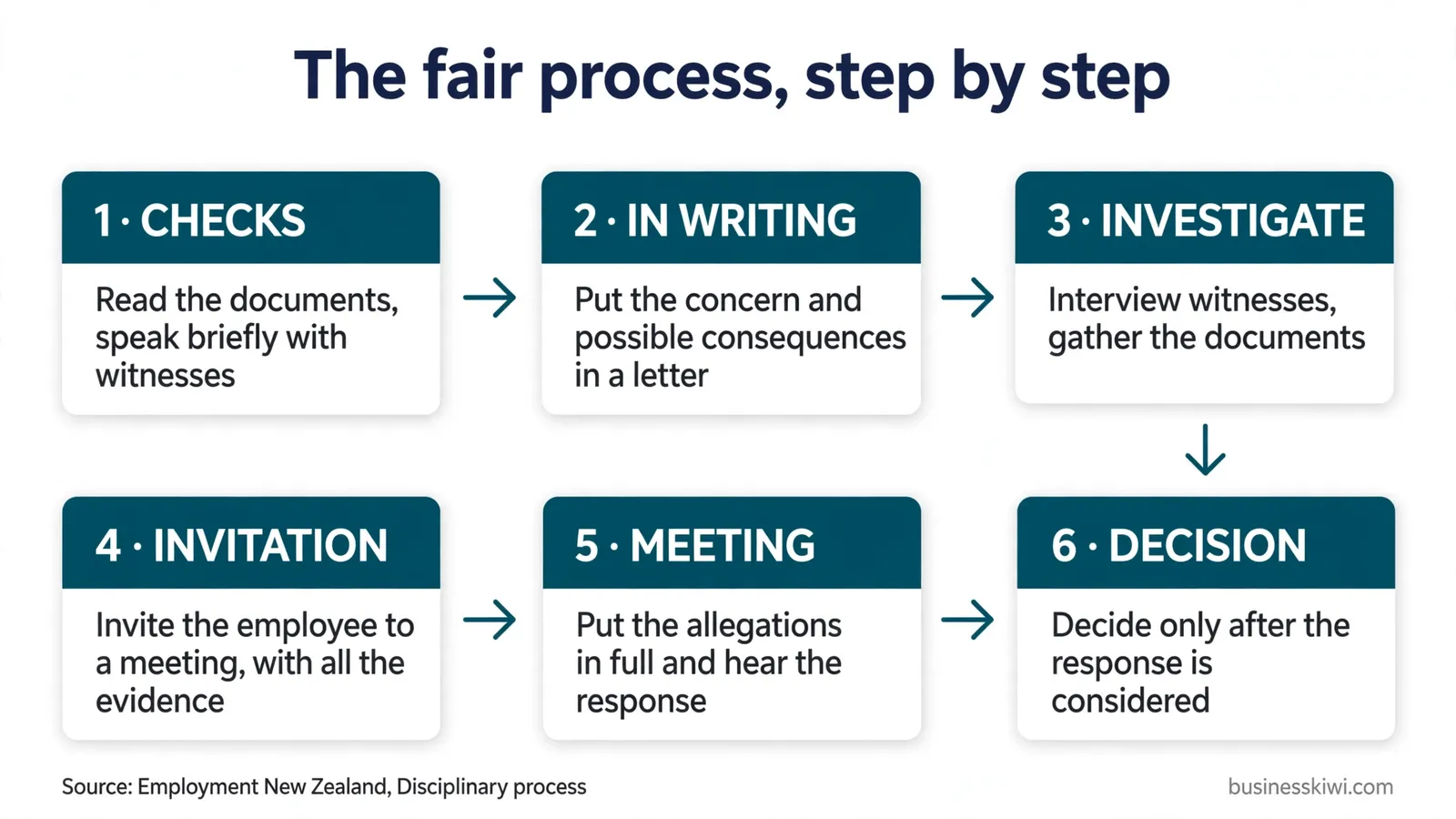
Seriousness never removes the process. Employment NZ sets out a careful sequence, and employers who follow it protect both the employee and the decision. Where the agreement or policies set out a disciplinary procedure, the employer must follow it too.
Make preliminary checks. A short look at the facts comes first: read the relevant emails, speak briefly with witnesses, and take care not to embarrass the employee if the concern turns out to be unfounded. If the issue is minor, an informal conversation may be enough.
Put the concern in writing. The employer writes to the employee explaining what is known, why it may be a problem, and the process that will follow. The letter states the possible consequences. If dismissal is possible, it says whether that dismissal could be without notice. It tells the employee they can bring a representative or support person to meetings, and invites comment on the proposed process.
Investigate properly. The employer investigates the allegation before taking any action, at a depth that matches the seriousness of the issue. Witnesses are interviewed while memories are fresh, and relevant documents gathered. If the employee offers new information, that gets checked too, even if it means a second formal meeting.
Invite the employee to a meeting. If the investigation suggests misconduct or serious misconduct, the employee gets a letter of invitation. It identifies the potential misconduct and includes all the evidence: the investigation report, witness statements and anything else relied on. It gives reasonable notice of the meeting: two to three working days is Employment NZ’s example, with more time where there is a lot of material. It restates the possible outcomes and reminds the employee about bringing a representative or support person.
Hold the meeting fairly. The allegations and findings are put in full, and the employee or their representative gets a genuine chance to respond. The decision-maker should be impartial and have proper authority. Anyone involved in the alleged misconduct cannot be the decision-maker. Notes are taken.
Decide only after hearing the response. The meeting ends before any decision is made. A pre-typed decision letter handed over straight after the discussion is a recognised employer mistake. The decision-maker takes time, weighs the explanation and any mitigating factors, checks how similar cases were handled, and considers alternatives.
Suspension: when it is allowed and what happens to pay
Suspension means the employee is kept away from the workplace while an investigation or disciplinary process runs. Employment NZ calls it a drastic measure, not a punishment, and never a disciplinary tool.
An employer can only suspend in limited circumstances:
- The employee is under disciplinary investigation, and having them at work may compromise it or cause further problems. Employment NZ’s example is suspected fraud.
- The employee poses a risk to health and safety. For example, someone in a safety-sensitive area who is under the influence of drugs or alcohol, or not in a fit state to work safely.
The suspension should last only as long as the investigation takes, or while the safety risk lasts. A clause in the employment agreement or policy makes suspension easier to manage lawfully. Without one it is possible in some situations, but harder.
The employer should normally give the employee a chance to comment on the proposed suspension before deciding. Rare exceptions exist, such as immediate danger to the employee or others. A suspension imposed without a good reason, or through an unfair process, can itself become a personal grievance.
On pay, the position is clear: any suspension should be on full pay, and unpaid suspension can only be considered if the employment agreement specifically provides for it.
Summary dismissal: dismissal without notice
Summary dismissal, also called instant dismissal, is dismissal without notice. It is available where the employer concludes, after a fair process, that the behaviour is serious misconduct.
Three conditions sit behind it: a fair investigation, a disciplinary process, and behaviour that is considered serious misconduct. If those are met, the employee leaves right away and is not paid for any part of the notice period. Money already owed is different: final pay still includes wages earned, accrued annual holidays and any other statutory payments owed.
No special clause is needed in the employment agreement for summary dismissal to be available. Employment NZ still recommends one, because it sets expectations clearly before anything goes wrong.
Ordinary dismissal is different. For misconduct that is not serious, the employer must give the notice in the employment agreement, or a reasonable period if the agreement is silent.
When a dismissal becomes unjustified
An employee who believes their dismissal was unfair can raise a personal grievance for unjustified dismissal. The legal test sits in section 103A of the Employment Relations Act 2000. In plain English, the question is whether the employer’s actions, and the way the employer acted, were what a fair and reasonable employer could have done in all the circumstances at the time. The test is objective.
Lawyers split the test into two halves. The first is substantive justification, sometimes called good reason. Was there a genuine, well-founded reason for the decision? The second is procedural fairness. Was the process fair? A dismissal can fail on either half. Strong evidence of theft does not rescue a process where the employee never heard the allegation.
In applying the test, the Authority or the court must consider whether the employer:
- Sufficiently investigated the allegations, having regard to the resources available to that employer
- Raised the concerns with the employee before acting
- Gave the employee a reasonable opportunity to respond
- Genuinely considered the employee’s response before deciding
- Was obstructed by the employee from doing any of those things
Since February 2026, the Act also states that a dismissal is not unjustifiable solely because of process defects, where the employee was not treated unfairly as a result. Small slips are not automatically fatal. Defects that shut the employee out of the process are another matter.
Both sides also owe each other good faith throughout: share the relevant information, listen before deciding, and do not mislead.
If you are the employee: what you can do
Attend the meeting, take a support person or representative with you, and answer the allegations fully. Your explanation is part of what the employer must weigh, and silence rarely helps.
If you are dismissed and believe the reason was not good enough, or the process was unfair, you can raise a personal grievance. It is raised with the employer within 90 days of the dismissal, or of the issue coming to your attention, whichever is later. Sexual harassment grievances have a 12-month window. Put it in writing, with clear detail.
You can also ask for a written statement of the reasons for your dismissal. Ask within 60 days of finding out about it. The employer must provide it within 14 days of your request.
If the grievance does not resolve things, mediation is available, and a claim can be lodged with the Employment Relations Authority. Possible remedies include reinstatement, reimbursement of lost wages, and compensation for hurt and humiliation. One caution is worth knowing: if your own behaviour contributed to the situation, remedies can be reduced or lost, and where the Authority finds that behaviour amounted to serious misconduct, it cannot award remedies at all. Grievance detail is a large topic in its own right, covered in depth in our personal grievance guide.

What employers should document
Paper wins arguments later. Keep a clear record at every stage:
- The workplace policy or agreement clauses that define misconduct and serious misconduct
- Notes of the initial conversation, shared with the employee for comment
- The letter raising the concerns, and the invitation letter with its evidence pack
- Investigation notes, witness statements and documents relied on
- A written record of every meeting, including who attended and what was said
- Notes showing the employee’s response was considered, including mitigating factors
- The reasons for the final decision, and how similar cases were treated
- Any warning letters, kept on file while they remain current
Record as you go. Notes reconstructed weeks later carry far less weight.
Watch-outs for both sides
For employers, the traps are mostly about haste and assumptions. Do not decide before the investigation finishes. Do not skip telling the employee that dismissal is a possible outcome, or that they may bring a support person. Treat like cases alike, unless there is a genuine reason not to.
For employees, the risks are delay and disengagement. The 90-day grievance clock runs from the dismissal, not from when you feel ready. Ignoring meeting invitations does not stop the process, and an employer who cannot get your side of the story will decide on the evidence it has. Resigning in the heat of the moment can complicate a grievance, so get advice first. A resignation forced by the employer’s behaviour can amount to constructive dismissal.
Both sides should watch the language. Calling something serious misconduct in a reference, a team announcement or a social media post, before any finding is made, creates problems the process was designed to avoid.
More workplace guides: browse the Business & Industry section for the rest of our business and employment guides.
Frequently asked questions
Can an employer fire someone on the spot for serious misconduct?
No. Even where the behaviour looks clear-cut, the employer must investigate, put the allegations to the employee, hear their response and consider it before deciding. Summary dismissal is about the absence of notice once a fair process ends, never about skipping the process.
Does an employer have to give notice when dismissing for serious misconduct?
No. Where serious misconduct is established through a fair process, no notice is required and no pay is owed for the notice period. The employee still receives final pay for wages earned, accrued annual holidays and other amounts owed.
How many warnings must an employer give before dismissal?
There is no set number. A warning is the usual response to ordinary misconduct, and a final warning may follow serious or repeated misconduct. A single act of serious misconduct can justify dismissal on its own, provided the process was fair.
Can I bring a support person to a disciplinary meeting?
Yes. You can bring a representative or a support person to disciplinary meetings. Your employer should tell you this in the letter raising the concerns and again in the invitation. Meetings may need to be rescheduled so your representative can attend, within reason.
Can an employer suspend an employee without pay?
Only if the employment agreement specifically provides for it. Employment NZ’s position is that any suspension should be on full pay. Suspension also needs a good reason and a fair process, and should last no longer than the investigation or the safety risk requires.
Can behaviour outside work count as serious misconduct?
It can, where it connects back to the job. The risk grows where the employee is identifiable as an employee and the behaviour damages the employer’s reputation or breaks trust. The employer only needs to show the business could have been harmed.
How long do I have to challenge a dismissal for serious misconduct?
A personal grievance must be raised with the employer within 90 days of the dismissal, or of it coming to your attention, whichever is later. A late grievance needs the employer’s agreement, or an Employment Relations Authority finding that the delay came from exceptional circumstances.
The bottom line
Serious misconduct is a high bar with a strict procedure attached. The behaviour must genuinely damage trust and the employee’s ability to do the job. The employer must still investigate, listen and decide with an open mind. Get both halves right and summary dismissal is a lawful, defensible outcome. Get the process wrong and even proven misconduct can end in an unjustified dismissal finding.
Sources
- Employment New Zealand, Misconduct
- Employment New Zealand, Disciplinary process
- Employment New Zealand, Dismissal
- Employment New Zealand, Suspension
- Employment New Zealand, Good reason
- Employment New Zealand, Fair process
- Employment New Zealand, Notice periods
- Employment New Zealand, Personal grievances
- Employment Relations Act 2000, section 103A, as amended by the Employment Relations Amendment Act 2026 (New Zealand Legislation)
This article is general information about serious misconduct in New Zealand. It is not legal advice for any particular workplace situation. Employment disputes turn on their own facts, so take advice from an employment lawyer, your union, or Employment New Zealand before acting on it.