How to Read a Balance Sheet in NZ: Assets, Liabilities and What the Numbers Actually Tell You
Ask a room of business owners which financial report they look at most and the profit and loss statement wins easily. It answers the question everyone cares about: did we make money? The balance sheet gets opened at tax time, glanced at, and filed away. That is a shame, because the balance sheet answers a different and arguably more important question. Not “how did we do this year?” but “where do we actually stand right now?”
A balance sheet is a snapshot of a business at one specific moment. It lists what the business owns, what it owes, and what is left over for the owners once the owing is taken care of. Business.govt.nz describes it in almost exactly those terms: a snapshot of how much you own and how much you owe on a certain date. Every figure on it is true for that date only. Run the same report a week later and some of the numbers will already have moved.
This guide walks through how a balance sheet is put together, what each section means in plain language, and how to read one with confidence. It uses New Zealand examples and terminology throughout, including the lines that catch local owners out most often: GST and tax sitting in liabilities, and the shareholder current account that appears in the accounts of almost every small company in the country.
One date, not a period
The single most useful thing to understand about a balance sheet is the date at the top. A profit and loss statement covers a stretch of time, a month, a quarter or a year. A balance sheet covers no stretch of time at all. It shows the position at the close of business on one day, in the same way a photograph freezes one instant rather than telling the story of the whole day.
That has practical consequences. Cash at bank on the balance sheet is the balance on that date, which might be unusually healthy because a large customer paid the day before, or unusually thin because wages went out that morning. Comparing balance sheets from several dates is how you turn single snapshots into a picture of direction. Accounting software such as Xero makes this easy because the report updates as transactions are entered, so the position can be checked at any date rather than only at year end.
The accounting equation
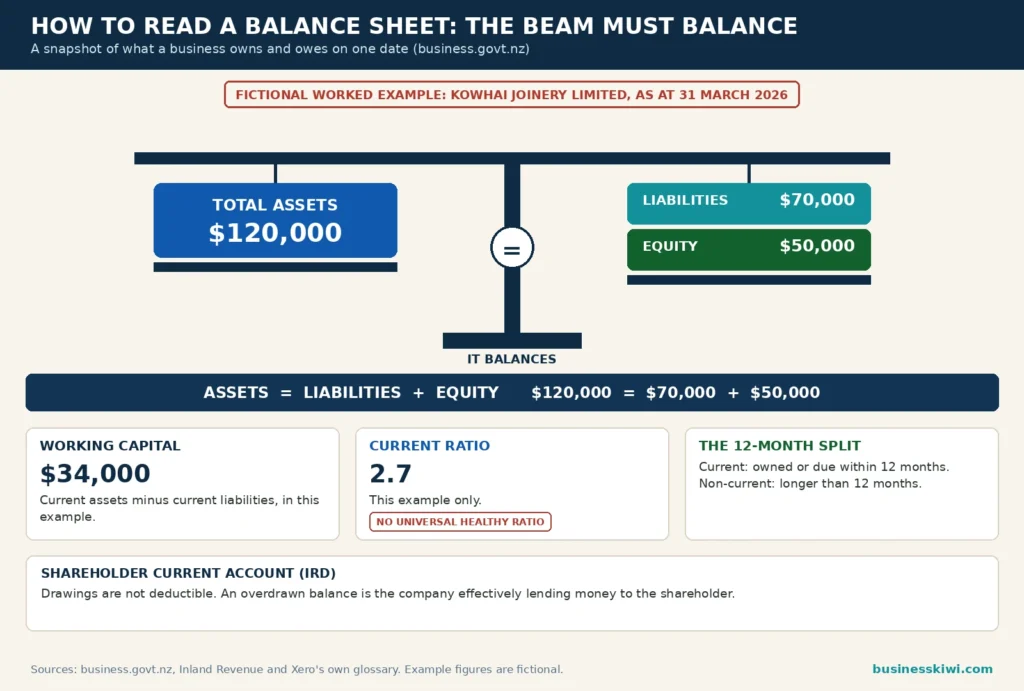
Every balance sheet is built on one formula, called the accounting equation:
Assets = Liabilities + Equity
Assets are what the business owns. Liabilities are what the business owes to others. Equity is the owners’ stake, the value that would remain if everything owned was sold and everything owed was paid off.
The equation has to balance, always. That is where the name “balance sheet” comes from. Everything a business owns was paid for somehow: either with money borrowed from lenders, suppliers and the tax department, or with money the owners put in and profits they left in the business. If the two sides of the equation do not agree, something in the records is missing or has been entered incorrectly, and the figures need a second look before they can be trusted.
Keep the equation in mind as you read the sections below. Each one is simply a detailed list of one part of it.
Assets: what the business owns
Assets are listed first, and they are split into two groups based on how soon they are expected to turn into cash or be used up.
Current assets
Current assets are cash itself, plus items expected to become cash within the next 12 months. On a typical New Zealand small business balance sheet you will see:
- Cash at bank. Money in the business bank accounts, including any funds in term deposits that can be accessed quickly.
- Accounts receivable. Money customers owe the business for work already done or goods already supplied. You may also see this labelled “trade debtors”.
- Inventory. Stock held for sale, or raw materials waiting to be used. A retailer shows finished goods; a manufacturer shows materials and partly finished work as well.
- Prepayments. Amounts paid in advance, such as insurance premiums covering the months ahead. The business has paid the money but has not yet used the benefit.
Non-current assets
Non-current assets are the longer-term items the business uses to operate rather than to sell. Common examples are:
- Plant and equipment. Machinery, tools, computers, fit-out and furniture.
- Vehicles. Cars, utes and trucks owned by the business.
- Land and buildings. Premises the business owns rather than rents.
- Intangible assets. Non-physical items with value, such as a business name, patents or goodwill bought when the business acquired another operation.
Equipment and vehicles lose value as they age and wear, and accounting reflects that through depreciation. The balance sheet often shows the original cost of these assets reduced by accumulated depreciation, leaving the book value. Book value is an accounting figure, not a promise of what the asset would sell for. A delivery van carried at a book value of $20,000 might fetch more or less than that on the open market.
Liabilities: what the business owes
Liabilities are split into the same two time bands as assets.
Current liabilities
Current liabilities are amounts due within the next 12 months. Typical lines for a New Zealand business include:
- Accounts payable. Bills from suppliers that have been received but not yet paid, sometimes labelled “trade creditors”.
- GST payable. When a GST-registered business charges GST on its sales, that GST is collected on behalf of Inland Revenue and held until the GST return is filed and paid. Until then it is money the business owes, so it sits in liabilities. Plenty of owners have come unstuck by treating the GST sitting in their bank account as if it were their own money. It is not, and the balance sheet shows it clearly as an amount owed.
- Income tax payable. Tax assessed on profits but not yet paid, including provisional tax instalments that are due.
- Wages and PAYE payable. Pay earned by staff but not yet paid, and PAYE deducted from wages that is waiting to be passed on to Inland Revenue.
- Short-term loans and credit cards. Borrowings due within a year, including the portion of a longer loan that falls due in the next 12 months.
Non-current liabilities
Non-current liabilities are debts due after 12 months: the remaining balance of a business loan, a mortgage over premises, or finance on equipment that runs for several years. Splitting a loan between its current and non-current portions matters when you read the report, because only the current portion competes with your day-to-day bills.
The shareholder current account
One line deserves special attention in New Zealand company accounts. Many small companies show a shareholder current account, sometimes called a shareholder loan account. Inland Revenue describes it as a record of the net balance of funds a shareholder has loaned to the company and withdrawn or borrowed from it.
The account can sit on either side of the ledger. If the shareholder has put more money in than they have taken out, the company owes the shareholder, and the balance appears as a liability. If the shareholder has drawn out more than they have put in or been credited with as income, the account is described as overdrawn. Inland Revenue points out that an overdrawn balance means, in effect, that the company is lending that amount to the shareholder. Owners often take drawings during the year to cover living costs, before salary or dividends are finalised once the year’s income is calculated. Drawings are not a business expense, and a company cannot claim a tax deduction for them.
An overdrawn shareholder current account can also appear in assets, as an amount the shareholder owes back to the company. Either way, it is one of the first lines an accountant, a lender or Inland Revenue will look at, and it is worth knowing which way yours points before someone else tells you.
Equity: the owners’ stake
Equity is what remains when liabilities are taken away from assets. It is not a bank balance and it is not cash you can spend. It is the accounting measure of the owners’ interest in the business. The way it is presented depends on the business structure.
For a company
A company’s equity section usually includes:
- Share capital. The amount shareholders paid for their shares when the company issued them. In many small New Zealand companies this is a modest figure, sometimes only a few hundred dollars, because owners often fund the business through the shareholder current account instead.
- Retained earnings. Profits the company has earned over its life that have been kept in the business rather than paid out as dividends. This line builds up year by year. A company that has traded profitably for a decade and left the profits in will show healthy retained earnings; a company that has made losses will show the retained earnings shrinking, and possibly going negative.
- Dividends and drawings effects. Dividends paid reduce retained earnings. Money moving through the shareholder current account is usually shown in liabilities or assets rather than in equity, which is why the equity section of a small company can look surprisingly small compared with the size of the business.
For a sole trader
A sole trader is not legally separate from the business, so the equity section is simpler. It generally shows the capital the owner has introduced, plus the profit for the year, less drawings, the money and goods the owner has taken out for personal use. There is no share capital and no retained earnings account in the company sense; profit belongs to the owner directly, and drawings are simply the owner taking their own money out. Partnerships follow the same broad pattern, with a capital account for each partner.
A worked example
Numbers make this far easier to follow. The business below is fictional, and every figure has been invented for illustration. The amounts are round numbers in New Zealand dollars, chosen to show how the sections fit together, and they are not figures from any real company.
Kōwhai Joinery Limited, balance sheet as at 31 March 2026 (illustrative figures only)
Check the equation: assets of $120,000 equal liabilities of $70,000 plus equity of $50,000. The balance sheet balances.
A few things stand out on a first read. The business holds $54,000 of current assets against $20,000 of current liabilities, so there is a cushion of $34,000 of working capital (current assets minus current liabilities) to meet short-term bills. Of the $18,000 in the bank, at least $5,000 is already spoken for by the GST and wages lines alone, before the $6,000 of income tax is considered. And the owner has $10,000 of their own money in the company through the shareholder current account, on top of their $20,000 of share capital and the $30,000 of profits retained over the years.
How to actually read one
Reading a balance sheet is less about individual lines and more about the relationships between them. Work through these checks in order.
First, does it balance? If assets do not equal liabilities plus equity, the records contain an error and nothing else on the page can be relied on until it is found. Accounting software balances automatically, so an imbalance usually signals a manual adjustment gone wrong.
Look at working capital. Subtract current liabilities from current assets. A positive figure means the business holds more in short-term assets than it owes in the short term, which is the normal, comfortable position. Working capital that is shrinking from one balance sheet to the next, or that has turned negative, is an early warning that bills may soon be hard to pay on time, whatever the profit and loss statement says about profit.
Accountants often express the same idea as the current ratio: current assets divided by current liabilities. In the worked example above, that is $54,000 divided by $20,000, a ratio of 2.7, meaning $2.70 of current assets for every $1 of current liabilities. Treat the ratio as a shorthand for the working capital check, not as a score with a pass mark. There is no universal healthy figure that applies to every business, and comparing your ratio with your own past results is far more useful than comparing it with a number quoted for a different industry.
Weigh the debt against the equity. Compare total liabilities with total equity. This shows how much of the business is funded by borrowing compared with how much is funded by the owners. Lenders look at this closely. There is no single correct proportion, and what is normal differs a great deal between industries: a business that owns its premises will usually carry more debt than a consultancy that owns little more than laptops. The trend matters more than any one figure. Debt climbing while equity stands still is a different story from debt funding growth that is also lifting equity.
Check whether equity is growing. Compare the equity total with the same business a year earlier. Equity that grows steadily usually means profits are being made and left in the business. Equity that falls year after year means losses, or owners drawing out more than the business earns. If liabilities ever exceed assets, equity turns negative and the business is, on paper, insolvent: it could not pay everything it owes even if all its assets were sold. That is a serious position that needs professional advice promptly.
Read the specific lines for red flags. Accounts receivable that keeps growing faster than sales can mean customers are paying slowly, tying up cash. Inventory swelling without a matching lift in sales suggests stock that may not sell. An overdrawn shareholder current account is a common one in New Zealand: Inland Revenue treats the overdrawn amount as the company lending to the shareholder, and leaving it unmanaged can create tax complications. GST and tax payable lines that grow from period to period can indicate the business is using money collected for Inland Revenue as working capital, which has a habit of ending badly.
Finally, compare across dates. A single balance sheet is a photograph. Two or three, side by side, are a film. Software reports usually let you add comparative columns, and the direction of travel for cash, receivables, debt and equity tells you more than any single snapshot.
Balance sheet, profit and loss, cash flow: what is the difference?
These three reports are often spoken of as a set, and business.govt.nz lists the profit and loss statement and the balance sheet among the four key tools and reports for keeping track of business money, alongside the cash flow report and a budget. Each answers a different question.
The profit and loss statement summarises income earned and expenses incurred over a period, usually a financial year, and shows whether the business made a profit or a loss across that period. The balance sheet shows the position at one date: what is owned, what is owed, and the owners’ stake at that moment. The cash flow statement tracks the actual movement of cash in and out over a period, which explains why the bank balance changed.
The three connect. Profit from the profit and loss statement flows into equity on the balance sheet, which is how retained earnings grow. Cash on the balance sheet is the figure the cash flow statement explains. A business can be profitable on paper and still run out of cash, because profit counts sales made on credit that customers have not yet paid for. That gap between profit and cash is one of the main reasons the balance sheet deserves as much attention as the profit figure. For a closer look at the performance side of the pair, our guide to the profit and loss statement works through that report line by line.
Common mistakes
Treating the bank balance as the whole story. Cash is one line. A healthy balance can hide large tax bills and supplier payments falling due, all visible in the liabilities section.
Ignoring the date. A balance sheet prepared before year-end adjustments, depreciation or tax calculations are posted is a draft, not the final position. Check which date the report was run at, and whether it is the completed version.
Confusing book value with market value. Assets are carried at cost less depreciation, not at what they would fetch today. Do not assume the balance sheet tells you what the business could be sold for.
Misclassifying items. Putting a long-term loan entirely in current liabilities makes working capital look far worse than it is. Recording personal spending as a business asset does the opposite. Xero’s guidance makes the point that a single misclassification throws off the whole report.
Letting the shareholder current account drift. Drawings taken without checking the balance can push the account overdrawn without anyone noticing until the annual accounts are done, months after the fact.
Never looking between year ends. Business.govt.nz includes the balance sheet among the core reports for understanding how a business is doing, not just for satisfying the accountant once a year. A quarterly or monthly look catches problems while they are still small.
Frequently asked questions
What is a balance sheet in simple terms?
It is a list of everything a business owns and everything it owes, set out on one particular date, with the difference between the two shown as equity, the owners’ stake. If the business sold all its assets and paid all its debts, equity is what would be left.
What is the accounting equation?
Assets = Liabilities + Equity. Everything the business owns is funded either by what it owes or by the owners’ stake, so the two sides of a balance sheet must always be equal. If they are not, there is an error in the records.
How often should I look at my balance sheet?
Many small businesses prepare one monthly or quarterly, and at least once a year for tax and reporting purposes. More frequent checks give a clearer picture before big decisions, such as taking on a loan or a large purchase. Accounting software can produce an up-to-date balance sheet at any time.
Why does my balance sheet show GST and tax as liabilities?
Because that money is owed to Inland Revenue. GST you charge on sales is collected on behalf of Inland Revenue and held by the business until the return is filed and paid, and income tax assessed on profits is a debt until it is settled. Neither amount belongs to the business, so both appear under liabilities.
What does an overdrawn shareholder current account mean?
It means the shareholder has taken more money out of the company than they have put in or been credited with as income. Inland Revenue describes the overdrawn balance as the company effectively lending that amount to the shareholder, and it can have tax consequences, so it is a balance to discuss with your accountant rather than ignore.
Can a business be profitable but have a weak balance sheet?
Yes. Profit is measured over a period and includes sales that customers have not yet paid for. A business can report a good profit while its balance sheet shows thin cash, growing receivables, GST and tax owing, and rising debt. The two reports need to be read together.
What is the difference between retained earnings and share capital?
Share capital is the money shareholders paid for their shares. Retained earnings are the profits the company has earned and kept in the business over its life, rather than distributing them as dividends. Together with any other reserves, they make up the company’s equity.
Do sole traders have a balance sheet?
Yes. The same equation applies. The equity section is simpler than a company’s: it shows the capital the owner has put in, plus profits, less drawings the owner has taken out for personal use. There is no share capital, because the owner and the business are not legally separate.
Sources
- Business.govt.nz (Ministry of Business, Innovation and Employment), “Business finance basics”: https://www.business.govt.nz/tax-and-money/business-finance-basics
- Inland Revenue, “Shareholder current account”: https://www.ird.govt.nz/income-tax/income-tax-for-businesses-and-organisations/income-tax-for-companies/shareholder-current-account
- Xero, “What is a balance sheet?” (glossary): https://www.xero.com/hk/glossary/balance-sheet/
- Xero, “Balance sheet basics for small business owners”: https://www.xero.com/us/guides/balance-sheet-basics-for-small-business-owners/
This article is general information about how to read a balance sheet in New Zealand. It is educational only and is not accounting, tax or financial advice for your specific situation. The worked example uses invented figures for a fictional business and does not describe any real company. Balance sheet formats vary between businesses and accounting systems, and tax treatment depends on individual circumstances. For advice on your own accounts, talk to a chartered accountant or other qualified adviser.