How Much Does an Accountant Cost in NZ? Fees for Tax Returns, GST and Business Accounting

Ask a room of small business owners what they pay their accountant and you will get wildly different answers. One pays a modest monthly amount and never thinks about tax. Another gets a single large bill each year and is never quite sure what it covered. A third swears their accountant is expensive but worth every cent.
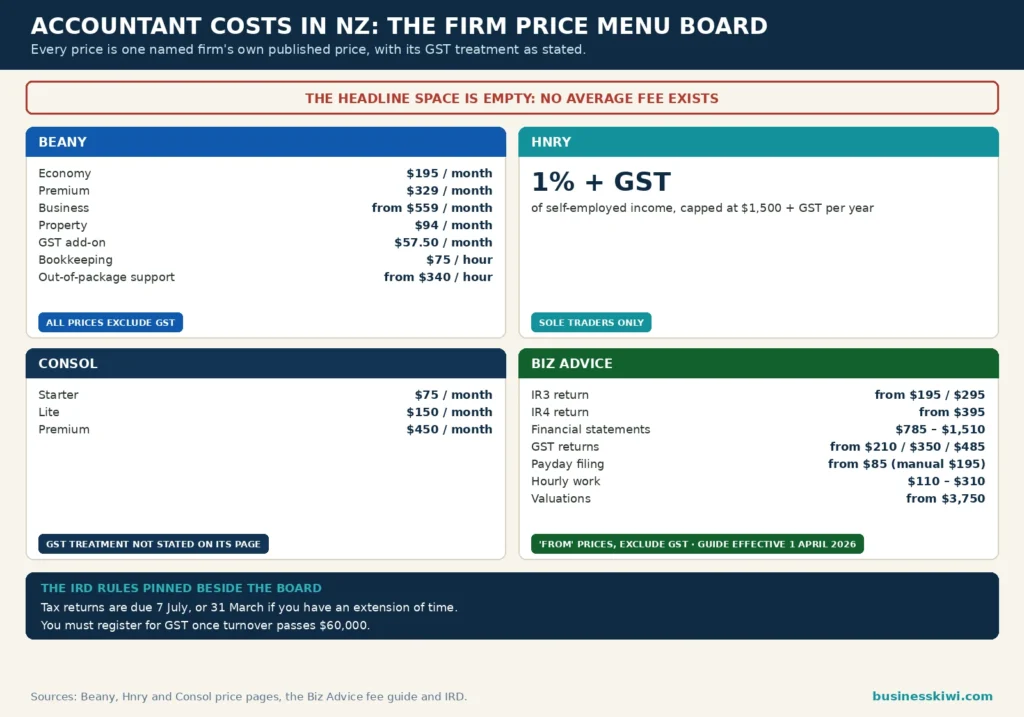
Part of the confusion is that there is no standard price. Accounting fees in New Zealand are not regulated or set by any official schedule, and the large majority of firms do not publish their prices at all. They will talk to you first, look at what your business involves, and then quote. That makes shopping around harder than it should be.
This guide works around that problem by using the firms that do put prices in writing. A handful of New Zealand accounting firms publish package prices or full fee schedules on their own websites, and their figures give real, checkable reference points for the common jobs: tax returns, annual accounts, GST returns, payroll, bookkeeping and advice. Those published prices are examples from named firms, not market averages, and the guide says so wherever they appear. It also explains how the different pricing models work, what pushes a quote up or down, and how to get a firm price in writing before any work starts.
One clarification before the numbers. This article is about what clients pay an accountant. It is not about what accountants themselves earn, and it is not about buying or selling an accounting practice. Those are separate topics.
Why there is no single price for an accountant
Three things explain most of the variation.
First, the work itself differs. Preparing a tax return for a wage earner with one rental property is a different job from preparing annual accounts for a company with staff, stock, vehicles and a trust alongside it. Firms price the job in front of them.
Second, firms sell the work differently. Some charge by the hour, some charge a fixed fee per job, and a growing number bundle everything into a monthly package. The same underlying work can look cheap or expensive depending on how it is packaged.
Third, most firms keep their prices off the internet. Of the firms referenced in this guide, Beany, Consol and Hnry publish package pricing on their websites, and one traditional firm, Business Advisory Accounting and Tax Services (Biz Advice), publishes a detailed fee guide. Plenty of other firms, including large and well-regarded ones, publish nothing and quote case by case. So treat every figure below as one firm’s price for a defined piece of work, not as the going rate.
The main ways accountants charge
Monthly packages. The annual cost of your accounting is divided into twelve equal payments. Beany, an online firm, describes its packages exactly that way: the monthly fee is the yearly fee split into twelve instalments, with a twelve-month commitment. Consol works on a similar monthly or annual plan structure, with a small discount for paying annually. Packages suit owners who want predictable cash flow and no large year-end bill.
Fixed fees per job. You agree a price for a defined task, such as a tax return or a set of annual accounts, before the work begins. Biz Advice’s published fee guide is built on this model, with a “fees from” price for each service.
Hourly rates. Traditional firms often charge for time, and the rate depends on who does the work. Biz Advice publishes its consulting rates by seniority: a director at $310 per hour, a manager at $250, a senior accountant at $205, an intermediate accountant at $150, and a junior accountant or bookkeeper at $110, all excluding GST. Beany, by contrast, publishes a rate of $340 per hour as its starting point for additional accounting support and consultancy outside its packages.
A percentage of income. Hnry, a service built specifically for sole traders, charges 1 percent plus GST of your self-employed income, capped at $1,500 plus GST per year. You only pay when income comes in, and the fee covers tax calculations and payments, filing of income tax and GST returns, expense management, ACC levies and student loan deductions, plus its invoicing software.
Software on top. Check whether your accounting software subscription is inside the price. Consol includes a Xero subscription in its plans. Biz Advice states in its fee guide that Xero and tax management software subscriptions are charged separately. Beany sells Xero setup and training as a one-off service at $350 plus GST. Two quotes that look similar can differ by the cost of the software once you add it up over a year.
What common jobs cost at firms that publish prices
Personal tax returns
If your affairs are simple, this is the cheapest professional job on the list. On Biz Advice’s fee guide, an IR3 personal income tax return for someone with salary or wage income only starts from $195, excluding GST. Add other income, such as a rental property, and the same firm’s starting price rises to $295. A personal return for a shareholder of a trading company starts from $345. Business packages often bundle personal returns instead: Beany’s packages include personal returns for up to two shareholders or directors, and it charges $15 per month for each extra shareholder return.
It is worth checking whether you need to pay anyone at all. If your only income is salary or wages, Inland Revenue may assess you automatically, so confirm whether an IR3 is actually required before paying for one.
Rental properties
Rental income has to be summarised in annual statements and flowed into a tax return, and the price depends heavily on the ownership structure. Biz Advice charges from $520 a year for annual rental property statements for a personally owned property, from $865 where a company or look-through company owns the property, and from $1,075 where a trading trust owns it. Each additional property adds from $375. Beany takes a package approach: its Property package costs $94 plus GST per month and covers up to two rental properties, with each extra property at $20 per month.
Sole traders
Sole traders sit at the simple end of business accounting, and the published prices reflect that. Biz Advice charges from $785 for annual financial statements for a non-GST-registered sole trader or partnership, rising to $1,025 if you are GST registered. The tax return is on top of that, priced on the IR3 scale above. Its entry-level Onyx package, which bundles end-of-year financial accounts, one income tax return and limited email support, starts from $100 per month.
Hnry’s percentage model is the other reference point: 1 percent plus GST of what you earn, capped at $1,500 plus GST a year, with tax and GST returns, payments and expense handling included. Consol’s Starter plan, at $75 per month, is aimed at non-GST-registered businesses with revenue under $60,000 and includes annual financial statements, annual tax returns, the Companies Office annual return where relevant, tax planning and unlimited support. Consol’s page does not state whether its plan prices include GST, so confirm that when you enquire.
Companies: annual accounts and tax returns
A company needs annual financial statements, meaning a balance sheet and a profit and loss statement, and an IR4 company tax return, plus a Companies Office annual return. Biz Advice’s fee guide separates the pieces: financial statements for companies and trading trusts start from $1,510, and the IR4 return itself starts from $395, with a further $150 where company turnover exceeds $500,000. A look-through company return (IR7) starts from $345 and a trust return (IR6) from $345 to $400 depending on whether the trust trades.
Package pricing bundles these items together. Beany’s Economy package is $195 plus GST per month, which is $2,340 plus GST across the year, and covers financial statements, the company tax return, personal returns for up to two shareholders, the Companies Office annual return, tax planning and unlimited support for day-to-day queries. Its Premium package, at $329 plus GST per month, adds GST returns, quarterly management reports and meetings, and dividend preparation. Consol’s Lite plan, for GST-registered businesses with revenue under $500,000, is $150 per month and includes GST returns alongside the annual work.
GST returns
If you file GST returns yourself, they cost you time rather than fees, but many owners hand them over. Biz Advice publishes per-return prices: a monthly GST return starts from $210, a two-monthly return from $350, a six-monthly return from $485, and even filing a nil return starts from $110. If you prepare your own return and want the firm to check it, its review service starts from $210. Alternatively, GST returns fold into packages: Beany charges $57.50 plus GST per month for GST return preparation and filing where it is not already included in a package, and Biz Advice’s Core Essentials bookkeeping package, from $215 per month, includes two-monthly or six-monthly GST returns along with coding up to 100 transactions a month.
A note on the basics, because it affects whether you need this service at all: Inland Revenue requires GST registration once turnover passes $60,000 in a twelve-month period, and it sets the filing frequency. If you are well under the threshold and not registered, there is no GST return to pay anyone to prepare.
Payroll
Payroll is usually priced per pay run or bundled into a bookkeeping package. Biz Advice charges from $85 per pay run for payday filing using payroll software, and from $195 per pay run where payroll is handled manually, a gap that shows how much of the cost is the manual handling rather than the filing itself. Beany offers bookkeeping and payroll help on a pay-per-hour basis, with bookkeeping from $75 per hour.
Bookkeeping
Bookkeeping is the day-to-day coding and reconciling that sits underneath the annual accounts, and it is priced either by the hour or as a monthly bundle. Beany’s bookkeeping rate is $75 plus GST per hour, quoted as an agreed block of hours each month. Biz Advice’s Baseline bookkeeping package, from $80 per month, covers coding of up to fifty bank and credit card transactions a month but excludes GST returns and payroll. Its hourly rate for a junior accountant or bookkeeper is $110, and its transaction management and administration support starts at $100 per hour.
One-off advice and project work
Advice is where hourly rates bite. Using Biz Advice’s published bands, core business and tax advice starts at $210 per hour, broader business advisory work at $260 per hour, and high-level tax advisory work, such as structuring, disputes and transaction advice, at $330 per hour. Beany’s starting rate for additional accounting support is $340 per hour. Set-piece work can be fixed instead: Biz Advice charges from $350 for a one-hour consultation (which includes a $100 credit towards future compliance work within six months), from $795 for a twenty-point review of a business you are considering buying, and from $3,750 for a business valuation. Expect business sales, restructures, IRD disputes and anything involving a trust or multiple entities to be quoted individually almost everywhere.
The Biz Advice figures above come from one firm’s published fee schedule, effective 1 April 2026, and every price in it is a “from” price quoted exclusive of GST. They are the clearest published example of per-job pricing this guide found, not a benchmark for the whole market.

What pushes the price up or down
Complexity. More entities, more bank accounts, stock, foreign income, crypto assets or a rental portfolio all add work. Beany’s extras list reads like a map of complexity charges: $20 per month for each additional rental property, $30 per month for managed crypto, $15 per month for FIF income and $40 per month for livestock schedules.
The state of your records. This is the factor most within your control. Biz Advice states plainly in its fee guide that if records arrive incomplete, unreconciled or in raw form, such as a box of bank statements and paper invoices with no summaries, the extra work is charged at $110 per hour on top of the quoted fee. The same firm offers a 10 percent early submission discount to clients who deliver complete records and checklists by 30 June and help finish the work within four weeks, and a further discount of up to $120 on annual fees where it prepares your GST returns all year. Tidy, complete records are quite literally worth money.
Who does the work. On an hourly model, a question answered by a director costs roughly three times one handled by a junior at the same firm, going by Biz Advice’s published rates. Good firms triage work so routine queries land with junior staff, and it is fair to ask how a firm handles that.
Location and firm type. Online firms such as Beany and Consol run without a network of local offices and publish entry packages below what many traditional firms charge, while traditional firms argue the value sits in face-to-face advice and local knowledge. Neither claim can be settled by price alone.
Timing. Work dumped on a firm at the last minute costs more, in money or in goodwill. Some firms say so explicitly through early submission discounts, and accountants’ busiest months are not the time to negotiate.
What is usually included, and what often costs extra
In a typical annual package or fixed-fee arrangement, expect the following to be inside the price: annual financial statements, the entity tax return, personal returns for the owners (often capped at two), the Companies Office annual return for companies, and routine correspondence with Inland Revenue. Beany and Consol both list those items as core inclusions, and both advertise unlimited support for day-to-day queries, which means quick questions do not start a meter running.
Common extras include GST returns at firms where they are not bundled, bookkeeping, payroll, dividend preparation (Beany charges $237.50 plus GST as a one-off), company formation and changes, software subscriptions, and anything project-shaped: valuations, due diligence, cash flow forecasts for the bank, and IRD dispute work. Provisional tax sits in this grey area too. Biz Advice, for example, charges from $55 per provisional tax reminder and from $240 for a provisional tax review and payment plan, rather than treating them as part of the base fee. Biz Advice also warns of a service charge of 5 percent, capped at $40 per invoice, on some services to cover administration and processing costs. None of this is unreasonable, but it is why two headline prices are rarely the whole story. The fix is to get the inclusions and exclusions listed in writing against your quote.
Accountant, tax agent, bookkeeper: who does what
The titles overlap, and the differences matter for what you are paying for.
A bookkeeper keeps the records straight: coding transactions, reconciling accounts, running payroll. An accountant prepares financial statements and tax returns, interprets the numbers and advises. In practice one firm often supplies both, priced separately, as the Beany and Biz Advice figures above show.
A tax agent is a specific status with Inland Revenue. Tax agents prepare and file returns for clients and deal with Inland Revenue on their behalf. The practical prize is time: clients of a tax agent get an extension of time to file income tax returns, up to 31 March of the following year, where returns without an extension are due by 7 July. Inland Revenue can withdraw that extension if an agent’s filing performance slips, which is one reason well-run firms guard their filing record carefully.
Using an agent does not transfer your obligations. The legal duty to keep proper records stays with you: businesses must keep sufficient records for Inland Revenue to work out the tax payable, and those records must generally be kept for seven years. An accountant can prepare everything perfectly and it will still unravel if the underlying receipts and invoices were never kept.
On qualifications, “accountant” is a title anyone can use, so check what sits behind it. A Chartered Accountant is a member of Chartered Accountants Australia and New Zealand (CA ANZ). Members who offer services to the public hold a Certificate of Public Practice, and CA ANZ’s Find a Chartered Accountant tool on its website lets you search for members holding that certificate and verify membership. Business.govt.nz, the government’s small business site, lists accountants among the advisers who can help you understand your finances, manage cash flow and minimise tax, which is a fair description of the job when it is done well.
Whatever the firm, expect a written engagement letter or terms of engagement setting out the scope of the work, who is responsible for what, and how fees are charged. CA ANZ provides an engagement letter tool for its members for exactly this purpose. If a firm will not put the scope and fee basis in writing, that is useful information in itself.
How to get a firm quote
- Write down the job first. List your entities (just you, a company, a trust, rentals), whether you are GST registered, whether you have staff, and exactly what you want handed over: returns only, or bookkeeping and payroll as well. Vague briefs produce vague quotes.
- Ask two or three firms, including at least one that publishes prices. Published prices, like the ones in this guide, give you a reference point even if you end up choosing a firm that quotes individually.
- Ask what is excluded, not just what is included. Software subscriptions, GST returns, extra personal returns, dividend paperwork and Companies Office fees are the usual gaps.
- Ask how out-of-scope work is charged. Get the hourly rates by staff level, and ask whether the firm warns you before extra charges are incurred. Beany, for example, states it will tell you the extra cost of custom work before starting it. Hold any firm to that standard.
- Ask about the records discount, in reverse. Find out what state your records need to be in for the quoted price to hold, and what happens to the fee if they are not. Then decide whether tidying them yourself, or paying for bookkeeping, is the cheaper route.
- Get it in writing. The quote, the scope, the fee basis and the payment terms should all be in the engagement letter. Note the term as well: Beany’s packages carry a twelve-month commitment because the fee is an annual amount paid monthly, while Consol advertises that its plans can be cancelled at any time.
- Review it yearly. A package sized for a start-up will not fit a business that has taken on staff, a second entity or a rental property. Fees should be renegotiated as the work changes, not left on autopilot.
Frequently asked questions
How much does an accountant cost for a small business in NZ?
There is no standard figure, because most firms quote individually and do not publish prices. Among firms that do publish, monthly packages for core annual accounting start from $75 per month at Consol (Starter plan, for non-GST-registered businesses under $60,000 revenue), $100 per month at Biz Advice (Onyx package, excluding GST), and $195 plus GST per month at Beany (Economy package, which bundles financial statements, the company tax return, two personal returns and unlimited support). What is included differs a lot, so compare the contents, not just the headline number.
How much does it cost to get a personal tax return done?
On the one detailed fee schedule published by a traditional firm that this guide found, Biz Advice charges from $195 plus GST for an IR3 return for a salary or wage earner, rising to $295 where there is other income such as rent. Personal returns are also bundled into business packages at online firms. If your only income is salary or wages, check first whether Inland Revenue assesses you automatically, because you may not need to file or pay for an IR3 at all.
Do accountants charge for the first meeting?
It varies by firm. Consol offers a free consultation before sending a proposal. Beany starts with a free phone call and then sends a quote for the work discussed. Biz Advice charges from $350 for a one-hour consultation, which includes a $100 credit towards future compliance services used within six months. Ask before you book, so the meter is never a surprise.
What is the difference between an accountant and a tax agent?
An accountant prepares accounts and tax returns and advises on them. A tax agent is listed with Inland Revenue to act for clients, and the practical benefit is an extension of time: agent clients can have until 31 March the following year to file income tax returns, compared with 7 July without an extension. Many accountants are also tax agents, and many firms supply bookkeeping as a separate service underneath both roles. Whoever you use, the legal responsibility for your tax and your records remains yours.
Why do quotes vary so much between firms?
Because the jobs are rarely identical. Quotes move with the number of entities, transaction volumes, whether GST and payroll are included, the seniority of the staff doing the work, and the state of your records. One firm may include your accounting software subscription and unlimited phone support while another charges both separately. Comparing the written scope, line by line, is the only reliable way to compare two prices.
How can I keep my accounting bill down?
Keep records complete and reconciled through the year, use accounting software properly, and deliver everything early and in one go. The effect is visible in published pricing: Biz Advice charges extra at $110 per hour where records arrive incomplete or unreconciled, and offers a 10 percent discount for early submission of complete records. The other lever is scope. Do the simple parts yourself, such as coding transactions, and pay the firm for the parts that need judgement.
Is an online accountant cheaper than a local firm?
The firms that publish the lowest entry prices in this guide, Consol and Beany, are both online services, and their streamlined model is a big part of why. But cheaper at the entry point does not always mean cheaper overall: check whether software, GST returns, bookkeeping and advice are included, and what the hourly rate is for anything outside the package. Some owners also value being able to sit down with a local accountant. Price the whole service you will actually use, not the advertisement.
Sources
- Beany, Pricing: https://www.beany.com/pricing
- Beany, Beany Accounting Services and Pricing (Beany Support): https://supportnz.beany.com/hc/en-nz/articles/10748871784975-Beany-Accounting-Services-and-Pricing
- Hnry, Pricing: https://hnry.co.nz/pricing
- Consol, Accounting: https://www.consolgroup.co.nz/?p=1542
- Business Advisory Accounting & Tax Services Limited (Biz Advice), Professional Services Fee Guide, effective 1 April 2026: https://www.bizadvice.co.nz/wp-content/uploads/2026/05/20260401_BAS_Standard-Fee-Guide_FY27.pdf
- Inland Revenue, Extension of time arrangements: https://www.ird.govt.nz/topics/intermediaries/extension-of-time-arrangements
- Inland Revenue (Tax Technical), SPS 13/01: Retention of business records in electronic format: https://www.taxtechnical.ird.govt.nz/standard-practice-statements/general/sps-1301-retention-of-business-records-in-electronic-format-application-to-store-records-offshore-an
- Chartered Accountants Australia and New Zealand (CA ANZ), Find a Chartered Accountant: https://www.charteredaccountantsanz.com/find-a-ca
- Business.govt.nz, Types of advice you’ll need: https://www.business.govt.nz/strategy-and-performance/business-and-financial-advice/types-of-advice-youll-need
This article is general information about the fees New Zealand accountants charge clients, based on prices and guidance published by the firms and organisations listed above at the time of writing. It is not tax, accounting or legal advice for your situation. Published prices change, most firms quote individually, and the right choice depends on your circumstances, so confirm the full scope and fee in writing with any firm before engaging them. If your tax affairs are complex, consider advice from a qualified accountant or tax adviser about your specific position.