Accountant Fees NZ: NZ Guide, Examples & Practical Information

The short answer: NZ accountants charge in four main ways: a fixed fee for a defined package, an hourly rate for time spent, a price agreed up front for a specific piece of work, or a monthly amount that spreads the year’s compliance across the year. The model matters less than the scope underneath it. Two quotes that look far apart usually cover different work, so compare the same list of services before you compare prices.
Ask ten business owners what their accountant charges and you will get ten different answers, and a shared complaint: nobody can quite say what is included. That confusion is rarely about the amount. It is about structure. An accountant’s fee is a contract for a list of jobs, and the price only makes sense once you can see the list.
This guide explains how the fees are structured: the charging models, the work inside a typical engagement, the factors that push a fee up or down, and the questions worth asking before you sign. If you want the price tags themselves, our guide to how much an accountant costs in NZ sets out what named firms publish for defined services. This page stays on the machinery underneath the numbers.
The four ways accountants charge
Most NZ practices use one of four models, or a blend of them. Chartered Accountants Australia and New Zealand (CA ANZ) notes in its professional standard on terms of engagement that a fee may be based on the time a job takes, on the value of the service to the client, or on normal commercial practice.
| Model | How it works | Suits | Watch for |
|---|---|---|---|
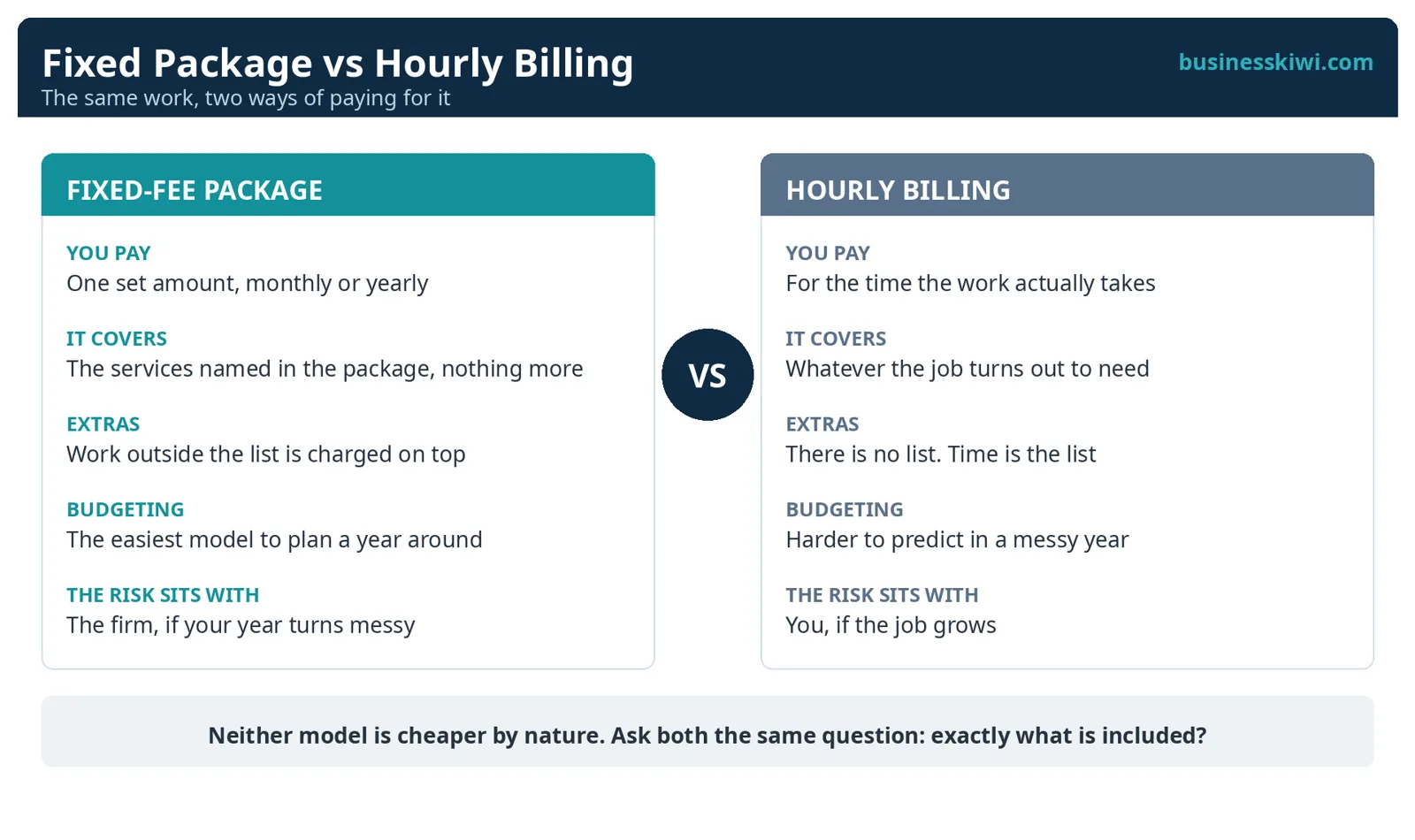
| Fixed-fee package | One set price, usually monthly or annual, for a named bundle: year-end accounts, tax returns, GST returns, software and a set amount of contact. | Businesses with steady, predictable compliance. | What sits outside the bundle. Advice, catch-up work and extra entities are commonly charged on top. |
| Hourly billing | You pay for the time spent, at rates that vary with the seniority of the person doing the work. | One-off jobs, unusual years, and work nobody can scope in advance. | The meter runs on phone calls and emails too. Ask how time is recorded and rounded. |
| Agreed price for a defined job | A price fixed before work starts on a specific outcome, such as a restructure, a system migration or a business valuation. | Projects with a clear finish line. | The price holds only while the scope holds. New facts usually mean a new price, agreed before the extra work. |
| Monthly subscription | The year’s expected compliance fee is totalled and split into equal monthly payments, often bundled with accounting software. | Cash flow. The bill lands evenly instead of in one year-end lump. | It is the fixed-fee package wearing a payment plan. Check what happens if you leave part-way through the year. |
None of these is cheapest by nature. A fixed package prices in the risk of a messy year; hourly billing charges only for the year you actually have.
What the fee actually buys
Most of the fee pays for a compliance calendar that runs whether you think about it or not: the jobs Inland Revenue creates.
The year-end job. Annual financial statements and the income tax return are the core of most engagements. One practical benefit hides here: taxpayers who file their own return generally file by 7 July, while clients of a tax agent with an extension of time arrangement file by the following 31 March. That breathing room is part of what the relationship buys.
GST returns. If your turnover passes $60,000 a year you must register, and our guide to GST registration covers that step. Once registered, you file monthly, two-monthly or six-monthly, which means twelve, six or two returns a year. Filing frequency is a direct fee driver: a monthly filer hands their accountant six times as many returns as a six-monthly filer.
Provisional tax. Provisional tax is income tax paid in instalments through the year. On Inland Revenue’s standard option you pay three instalments based on last year’s tax bill plus 5%. An accountant’s job is to check those figures against how the current year is tracking, then adjust using the estimation or ratio options when trading has changed. Getting this wrong costs interest, so the checking is real work, not a courtesy.
Payroll. If you employ staff, payday filing and PAYE sit inside or beside the engagement. Headcount and pay frequency decide how much work that is.
Bookkeeping. The daily recording sits at the seam between you and your accountant. Some packages include it, some assume you or a bookkeeper do it, and many fee disputes start right here, with each side picturing the other doing it.
Software. Cloud accounting software usually appears in the quote somewhere: included in the package, charged as a pass-through, or billed to you directly. Your choice of accounting software also decides how much manual fixing happens at year end.
Advice. Structure changes, buying or selling, hiring, and “can I afford this” questions are the part owners value most and the part most often outside the package. Expect advice to be quoted separately or billed by time.
What pushes your fee up or down
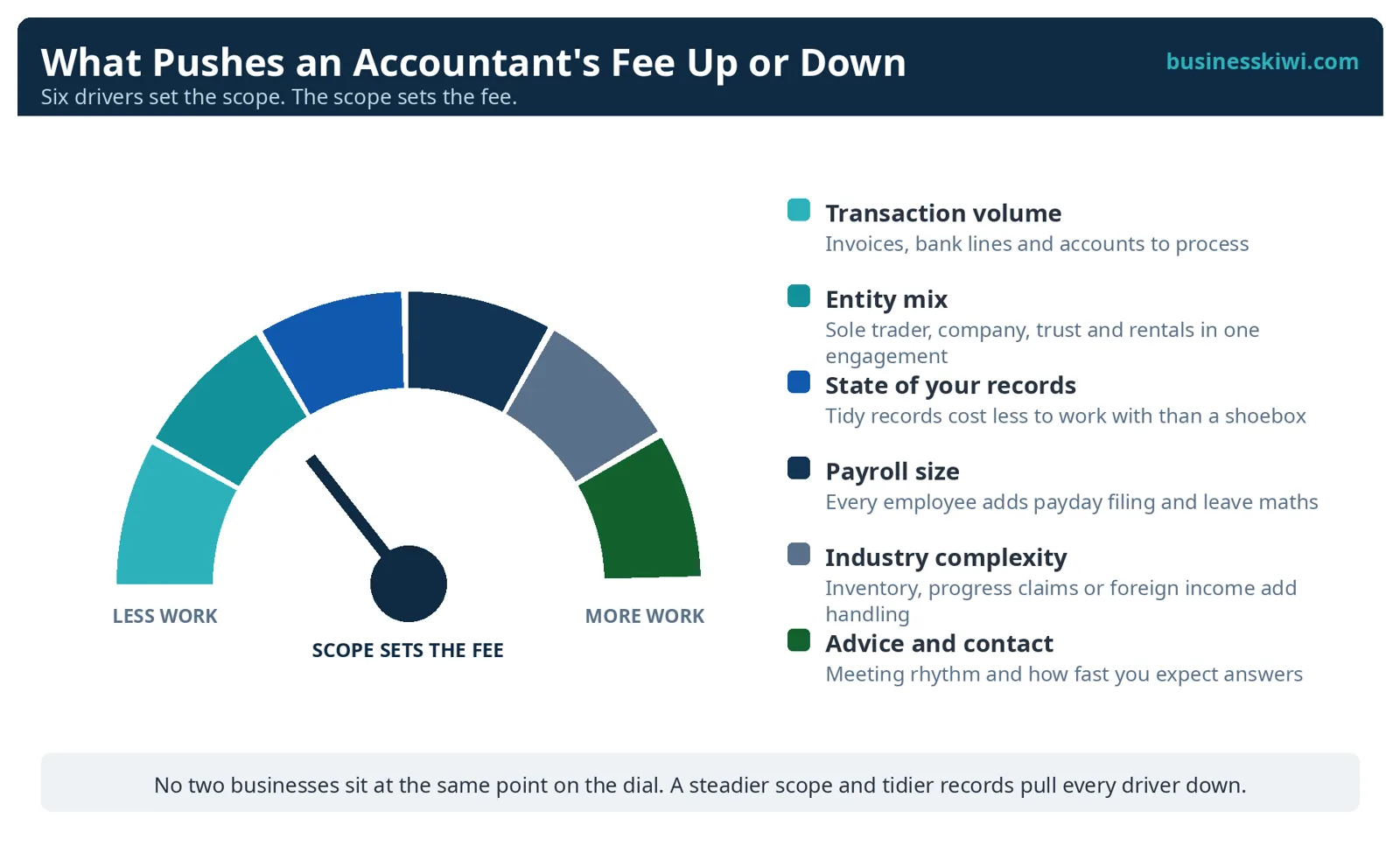
Fees move for reasons that are mostly visible in advance. Six drivers explain most of the difference between two similar businesses.
Transaction volume. More invoices, more bank lines and more accounts mean more processing. Volume is the single biggest driver of compliance cost.
Entity mix. A sole trader is one tax return. Add a company, a trust and two rental properties and the engagement holds several returns that must agree with each other.
The state of your records. Inland Revenue requires business records to be kept for at least seven tax years, and tidy records are cheaper records. A year delivered as a shoebox of receipts becomes catch-up work, billed like any other work. The end of financial year rush punishes the disorganised twice: once in stress, once in fees.
Payroll size. Every employee adds payday filing, leave calculations and KiwiSaver administration to the calendar.
Industry complexity. Inventory, progress claims, foreign income, schedular payments and multi-currency trading all add specialist handling that a simple service business never triggers.
How you use the firm. Monthly meetings and same-day answers cost more than an annual meeting and a reply within the week. Neither is wrong. Just know which service level your fee assumes.
The engagement letter is the fee contract

For a chartered accountant, the paperwork is not optional. CA ANZ’s professional standard PS 3, which applies to services from 1 January 2024, requires members to document the terms of engagement, communicate them to the client and agree them in writing before the work starts. That letter is where your fee lives.
Read it for these points:
- The fee basis. The terms must state how fees will be calculated and set out the billing arrangements, including what happens if you do not pay. If the letter quotes an hourly rate, it should say whose rate applies to what work.
- The scope, service by service. A clear scope protects you twice. It proves what is included, and CA ANZ notes that a defined scope is also what allows a firm to charge extra when work grows beyond it. Vague scope is where surprise bills breed.
- Your responsibilities. Expect a list: the information you supply, when you supply it, and signing an authority for the firm to act with Inland Revenue on your behalf.
- Ownership of documents. The terms should say which documents are yours and which working papers stay with the firm, which matters the day you change accountants.
- Confidentiality and systems. The terms cover how your information is held and who it is shared with, including cloud software and any outside providers the firm uses.
- The complaints process. The terms must describe how the firm handles complaints, the first route to use if a bill looks wrong.
Before you sign, check
- Every service you expect is named, and anything you assumed is either named or confirmed as extra.
- The fee basis is written down: fixed, hourly or agreed price, and whether figures include GST.
- Billing timing is clear: monthly, on completion, or on invoice terms, plus what happens with late payment.
- Out-of-scope work has a stated charging method, so extras are priced before they surprise you.
- Your jobs are listed too: records, deadlines, and the authority to act.
- You know the term: how the engagement ends, and what you owe if you leave mid-year.
Comparing quotes like-for-like
Start by knowing which document you hold. Consumer Protection draws a line that applies well here: a quote is an offer to do a job for a stated price, and once accepted the provider cannot charge more unless you agree extra work or the scope changes. An estimate is a best guess, and the final price should generally land within about 10–15% of it. Accountants often give estimates for year-end work because the true scope is unknown until your records arrive. Ask which one you have been given, in those words.
Then compare the same scope, not the same headline. Write one list of services, send it to each firm, and get each to mark what is included and what is extra. The gaps are the quote.
The like-for-like checklist: put the same questions to every firm
- Annual accounts and income tax return: included or extra?
- GST returns at your filing frequency: included? How many?
- Provisional tax management: included, or charged per review?
- Payroll and payday filing: included? Up to how many staff?
- Bookkeeping: included, assumed done by you, or quoted separately?
- Accounting software: included in the price, passed through, or yours to buy?
- Meetings and phone advice: how much is included before the meter starts?
- Price basis: does the figure include GST?
- Out-of-scope work: charged at what rate, and agreed how?
A cheaper quote that excludes GST returns, software and all advice can cost more across a year than a higher package that contains them. The checklist turns three sales pitches into three versions of the same list. Only then are you comparing fees.

Questions to ask before you sign
Eight questions worth asking
- Exactly which services does this fee cover, and which will I be charged for on top?
- Is this a fixed quote or an estimate, and what could move it?
- Who does my work day to day, and whose hourly rate applies if I need extra help?
- What do you need from me, and by when, to hold this fee?
- How do you charge for questions between jobs: included, per call, or by the hour?
- When do you review fees, and how much warning do I get before an increase?
- What happens if I leave mid-year: what do I owe, and what records come with me?
- If I think a bill is wrong, what is your process for sorting it out?
How fees change over time
Two things move an accountant’s fee: the firm’s prices and your scope. Both are supposed to move in the open.
On the firm’s side, PS 3 requires that any change to the fee structure or billing arrangements be advised promptly and agreed with you in writing before further action is taken. The same standard expects a firm to warn you when a job looks likely to pass its quote or estimate, and to agree the next step rather than simply bill the overrun. For ongoing engagements, CA ANZ describes an annual review of terms as best practice. A fee letter arriving once a year is therefore normal. Silence followed by a bigger invoice is not.
On your side, scope changes are the usual culprit: a new company, a first employee, a rental property, GST registration, or a year of rapid growth. Tell your accountant before you make the change and the fee conversation happens while you can still choose the service level.
If a bill does surprise you, work the process in order. Ask for the breakdown against the engagement letter, point to the scope if the work sits outside it, then use the firm’s complaints process. Most fee disputes are scope misunderstandings, and the letter you checked at the start is what settles them.
Keeping your own fee down
You cannot negotiate the compliance calendar away, but you can decide how expensive your business is to process.
- Keep records tidy all year, reconciled in the software as you go. Accountants charge for reconstruction, not arithmetic.
- Deliver complete records, on time, in one go. Three partial deliveries create three lots of handling.
- Batch your questions. A monthly list takes less billable time than nine scattered calls.
- Flag changes early. A new entity, employee or property is cheaper to set up properly than to untangle at year end.
- Review the package annually, and drop services you have outgrown rather than paying for them by default.

The bottom line
An accountant’s fee is a scope with a price attached, and the scope is the part you control. Choose the model that matches how predictable your year is, get the services listed in the engagement letter, compare quotes against one shared list, and treat the annual fee review as a conversation rather than a surprise.
For more guides for NZ business owners, browse our Business & Industry section.
Frequently asked questions
Should my accountant put the fees in writing?
Yes. A chartered accountant must document the terms of engagement and agree them with you in writing before the work starts, and those terms must include the basis on which fees are calculated and the billing arrangements. If a firm will not put the fee basis in writing, that is useful information in itself.
Is a monthly package or hourly billing cheaper?
Neither, by default. A package suits a predictable year because the firm prices the expected work, plus a margin for the unexpected. Hourly billing suits irregular work because you pay only for what happens. Compare the package contents with your last year of actual work, then decide.
Does my fee include GST returns?
Only if the scope says so. GST returns are a separate, recurring job from the year-end accounts and return, and firms bundle them differently. Check the engagement letter for your filing frequency: twelve returns a year is a very different bundle from two.
Why did my accountant’s bill go up this year?
Usually one of three reasons: your scope grew (more transactions, staff, entities or returns), the firm reviewed its fees, which should have been advised and agreed in writing, or work fell outside the agreed scope. Ask the firm to map the increase to one of the three.
Can an accountant charge for work I did not agree to?
The engagement terms define the agreed scope, and changes to fees or billing are meant to be agreed in writing before further action. If you are billed for work outside the letter, ask for the breakdown and where the work was agreed. The firm’s complaints process, described in its terms, is the next step.
Is the accounting software included in the fee?
Both arrangements are common. Some packages bundle the subscription, some pass the cost through, and some leave the subscription in your name entirely. Ask who owns the subscription, because that decides what happens to your data access if you change accountants.
What happens to my fee if I switch accountants mid-year?
Your engagement letter holds the answer: it sets the billing arrangements and what is owed. Monthly packages may run to an agreed point, with final compliance work settled on exit. Check the ending terms before you sign anywhere new.