Business Acquisitions in NZ: How Buying a Business Works, From Offer to Settlement

The quick answer
An acquisition is the purchase of ownership or control of an existing business. In New Zealand, a small or mid-sized business usually changes hands in one of two ways: the buyer purchases the business’s assets (plant, stock, the business name and goodwill), or purchases the shares in the company that owns the business. Either way, the deal is normally recorded in a written sale and purchase agreement, usually a conditional one: the buyer gets time to investigate the business through due diligence, arrange finance and satisfy other conditions before the sale settles and the handover begins.
Buying a business versus starting one
Buying an existing business means stepping into something already trading. As business.govt.nz points out, a buyer typically gains customers, premises, existing contracts and staff from day one. The trade-off is that you inherit whatever problems come with the business, and you pay for goodwill, the value built up in its name, reputation and customer base. Buying suits people who want income and infrastructure straight away; starting from scratch suits people who want full control and no legacy issues. If you are still weighing the two routes, our business ideas guide can help you think through what you might start yourself.
The two structures: buying assets or buying shares
The structure changes what you actually own, what risks you take on and what paperwork follows. Most differences flow from one fact: in an asset sale the business changes owner, while in a share sale only the company’s owners change.
Neither structure is automatically better. Asset sales are common for smaller businesses because the buyer can draw a cleaner line around what they take on. Share sales offer smoother continuity, but the buyer inherits the company’s full history, so careful investigation is essential.

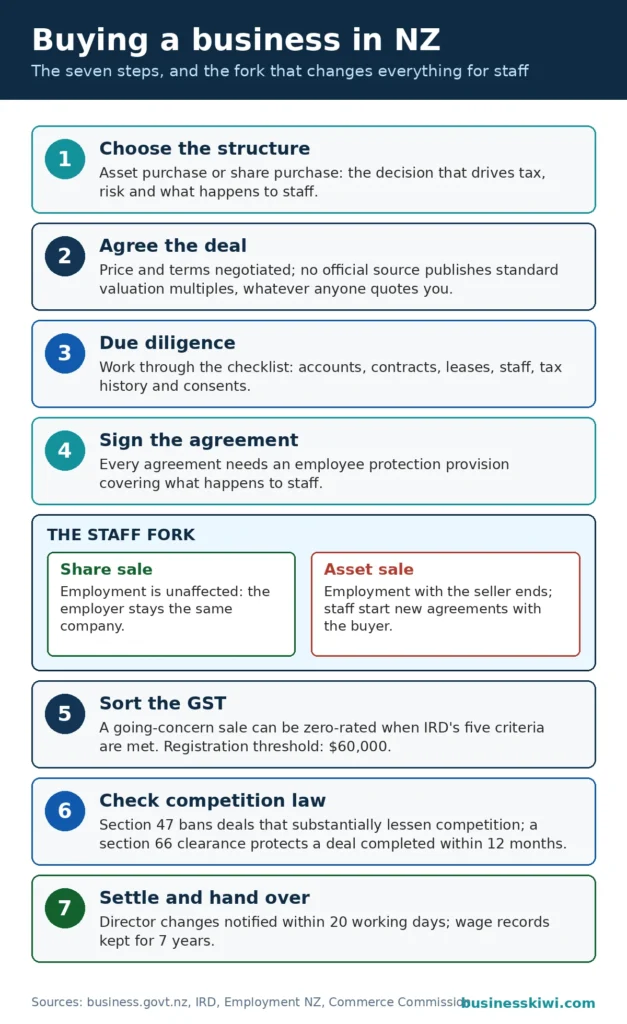
The process, step by step
Step 1: Do your homework and value the business
Before any offer, get a feel for what the business is worth. Valuations are generally approached from a few directions: what the business owns (its assets less what it owes), what it earns (its profit and cash flow, and how reliable that record looks), and what similar businesses have changed hands for, where that information is available. A robust valuation usually considers more than one angle, and an accountant can help you work through the seller’s figures. Treat the asking price as a starting point, not an answer: business.govt.nz suggests comparing why the owner says they are selling with what the documents show, and understanding any mismatch before you go further.
One caution: you will come across rules of thumb about what businesses sell for, often expressed as multiples of profit. No New Zealand government source publishes standard multiples, and any such figure depends heavily on the industry, the business’s size and how dependent it is on the owner, so this guide does not quote them. Value the business in front of you, on its own records.
Step 2: Register interest and protect confidentiality
Sales are often managed by the owner or a business broker. Register your interest with whoever is running the sale, and expect to sign a confidentiality agreement before receiving detailed financial information.
Step 3: Heads of agreement or letter of intent
For larger purchases, the parties sometimes record the main terms in a letter of intent or heads of agreement before drafting the full contract, covering the price, the structure (assets or shares), a target settlement date and an investigation period. These documents are generally intended to be non-binding, except for matters like confidentiality, but that depends on the wording. Get your lawyer to check anything you sign at this stage: a document described as non-binding can still create obligations if drafted poorly.
Step 4: Sign a conditional sale and purchase agreement
The sale and purchase agreement is the contract that binds both sides. Expect it to record:
- the parties and exactly what is being sold (the assets, or the shares)
- the purchase price and how it is allocated between assets, where relevant
- a deposit and how the balance is paid
- the conditions, and the dates for satisfying them
- warranties from the seller about the business
- restraint of trade terms limiting the seller’s ability to compete afterwards
- what help the seller will give after settlement, and for how long
- the settlement date and what must be delivered on it.
Most agreements are signed subject to conditions: due diligence completed to the buyer’s satisfaction, finance arranged, the landlord’s consent to assign the lease, any franchisor’s consent where the business is a franchise, and key contracts confirmed. Until conditions are met and declared satisfied, either side may be able to walk away under the agreement’s terms, so this drafting is where your lawyer earns their fee.
Step 5: Due diligence
The investigation period built into the agreement, covered in detail below.
Step 6: Go unconditional and prepare for settlement
Once conditions are satisfied, the agreement becomes unconditional and both parties are committed. Between then and settlement, the practical work happens: lease assignments and contract consents are finalised, finance is documented, transfer documents are prepared, and stocktake arrangements are agreed. If you are buying shares, the transfer is recorded in the company’s share register and its Companies Office records. Director changes must be notified to the Companies Office within 20 working days.
Step 7: Settlement and handover
On settlement day the balance of the price is paid and ownership passes. Keys, records, passwords and customer lists change hands. Most agreements include a handover period in which the seller introduces the buyer to key customers and suppliers and explains systems while the new owner finds their feet. Agree the length and scope of that help in the agreement itself, because goodwill walks out the door quickly if the transition is mishandled.

Due diligence: what to check
Due diligence is where you verify the business is what the seller says it is. Depth should match the size and risk of the purchase, but a thorough review usually covers the following.
Financial records. Review several years of financial statements and tax returns, plus recent management accounts. Look at whether sales and profit are growing, flat or falling, how much revenue depends on a few customers, and whether the reported profit relies on the owner working long hours for little pay. Check the accounts match the tax returns filed.
Tax position. Confirm the business is up to date with GST returns and payments, PAYE and income tax. Ask how the price will be allocated between assets, because that affects both parties. If shares are being bought, the company’s tax history comes with it, including tax losses (which have their own continuity rules) and any amounts owing.
Leases and premises. Read the lease in full: remaining term and rights of renewal, rent and review dates, who pays for what, and whether the landlord will consent to an assignment. A great business on a lease with six months to run and no renewal right is a different proposition entirely.
Contracts. Review key customer and supplier contracts, equipment leases and finance agreements. Look for end dates, change-of-control clauses and anything that lets the other party walk away when ownership changes. Check whether plant or vehicles are subject to finance or security interests.
Consents and licences. Some businesses cannot operate without licences or regulatory approvals, from food and liquor licensing to industry-specific registrations. Confirm what the business holds, and whether each approval transfers or must be applied for fresh.
Intellectual property and online presence. Confirm who owns the trade marks, business name, domain names, social media accounts and customer databases. Domains registered in a founder’s personal name, and trade marks never registered at all, are common findings. Make sure the agreement actually transfers these assets to you.
Stock and plant. Understand what stock is included, how it will be valued at settlement (often by a stocktake), and what state it is in. Inspect significant plant and equipment, and check maintenance records. Obsolete stock is worth much less than its book value.
Employees and leave liabilities. Get a full list of staff, roles, pay rates and employment agreements. Accrued leave is a real cost: if staff transfer to you, the value of untaken annual holidays usually follows them, and the agreement should say how that is adjusted in the price. Inland Revenue notes a seller can claim the cost of leave provisions, such as paying out holiday pay, as an expense in the year of sale, another reason to settle the treatment in the agreement.
Disputes and compliance. Ask about current or threatened claims, personal grievances, health and safety incidents or regulator investigations, and check the business meets its obligations on health and safety, privacy and consumer law. Problems found here are not always deal-breakers, but they should be priced in or fixed before settlement.
Tax points to get right
Going concern sales and GST. Inland Revenue explains that when a business is sold as a going concern, the sale can be zero-rated for GST, meaning GST is charged at 0 percent rather than the standard rate, if the conditions are met. Under Inland Revenue’s published criteria, the main conditions are:
- the sale supplies the whole business, or a part of it that can operate on its own as a separate activity
- everything necessary for the business to keep operating is included in the sale
- both the seller and the buyer are registered for GST
- both parties agree it is a sale of a going concern and record that agreement in a document
- both parties intend the business to be capable of being carried on by the buyer as a going concern
- the business is still operating as a going concern at the time of the transfer.
Inland Revenue warns that getting this wrong can leave either side with a large tax bill. Confirm the treatment and record it in the agreement before settlement, not afterwards.
GST where going concern treatment does not apply. If the conditions are not met, GST generally applies to the taxable assets being sold. A share sale is the purchase of shares rather than the business’s assets, so it is handled differently again. Either way, the buyer will usually need their own GST registration: business.govt.nz notes you must register if turnover exceeds $60,000 in a 12-month period, and many buyers register voluntarily from the start.
Allocating the price. For an asset sale, the price is split between the items bought, such as trading stock, plant and goodwill. Inland Revenue’s guidance makes clear the allocation matters: the part relating to trading stock is taxable to the seller, and both parties need consistent figures. Payments for restrictive covenants (where the buyer pays the seller not to compete) are generally taxable to the seller and claimable by the buyer. Goodwill is more nuanced: business goodwill, such as reputation and customer relationships, is generally a non-taxable capital receipt, while site goodwill tied to premises or a lease is usually taxable. Depreciation needs care too: if assets sell above their tax book value, the seller may have depreciation recovery income to return. Work through these points with an accountant before signing.
Earn-outs and vendor finance. Sometimes part of the price is paid over time, or depends on post-sale performance. Inland Revenue notes the tax treatment of these earn-out payments depends on the agreement’s terms, so get advice before agreeing to the structure. Interest and other financing costs can usually be claimed as an expense.
Becoming an employer. If you take on staff, Inland Revenue requires you to register as an employer as soon as you start employing staff. You must then deduct PAYE, use payday filing each pay day, and keep full and accurate wage records for 7 years. Build these steps into your settlement week, not the first pay run.
What happens to employees
Employment is one area where the structure changes everything.
Share sales. If you buy the shares, the employer does not change: the company employs the staff before the sale and after it. Employment New Zealand states that a sale or transfer of shares does not affect a person’s employment, so staff simply carry on, and the employee protection rules below do not apply.
Asset sales. If you buy the assets, the seller is the old employer and you are a new one. Employment with the seller ends, a situation Employment New Zealand calls technical redundancy, and staff who come across start under new agreements. The seller must give employees notice of termination, and the buyer must give them a copy of the proposed new agreement to consider and sign before they start. Every employment agreement must contain an employee protection provision setting out the process to follow if the business is sold, transferred or contracted out, so check what those clauses promise before assuming staff will simply move over.
Extra protection for specified employees. Part 6A of the Employment Relations Act 2000 gives additional rights to specified categories of employees whose work is commonly contracted out. Employment New Zealand lists these as cleaning and food catering services in any workplace, laundry services for the education, health or age-related residential care sectors, orderly services for health and age-related residential care, caretaking services for education, and certain security services such as guarding property, monitoring premises, crowd control and cash collection. The full list is in Schedule 1A of the Act.
For these employees, restructuring includes the sale or transfer of a business. If their work will be done by the new employer and they will no longer be required by the old one, they can choose to transfer on their existing terms and conditions; if they transfer, they are treated as if nothing had changed. The process has set timeframes: the current employer must notify affected employees at least 20 working days before the restructure takes effect and give them the relevant information at least 15 working days beforehand. Employees then have 10 working days to send a signed written election notice, which the old employer passes to the new employer within 5 working days. Employees who decline may end up redundant if the old employer has no role for them. As a buyer, find out early whether any staff fall into these categories: their right to transfer on existing terms is not yours to negotiate away.
Continuity and records. For non-specified staff in an asset sale, continuity of service counts only if the new agreement says so. Whatever the structure, track leave balances accurately from day one: errors here commonly become costs and grievances after settlement.
Competition law: a short note for larger deals
Most small business purchases raise no competition issues. The regime becomes relevant where a buyer is acquiring a competitor or a significant player in a concentrated market. Section 47 of the Commerce Act 1986 prohibits acquiring the assets of a business or shares if the acquisition would have, or would be likely to have, the effect of substantially lessening competition in a market.
The Commerce Commission runs a voluntary clearance regime: there is no obligation to notify it, but under section 66 parties can apply for clearance before proceeding. The Commission grants clearance only if satisfied the acquisition is not likely to substantially lessen competition. A clearance protects the transaction from action under the Act, provided it completes within 12 months and in line with the clearance given. Authorisation is a separate route where an acquisition would lessen competition but the Commission is satisfied the public benefits are likely to outweigh the harm. Parties proceeding without clearance take the risk of a later challenge. If you are buying a competitor of any size, ask your lawyer early whether clearance should be considered.
Common mistakes to avoid
- Skipping or rushing due diligence. The investigation period is your one real chance to find problems while you can still renegotiate or walk away. Once you own the business, its problems are yours.
- Ignoring leave and lease liabilities. Accrued holiday pay, a short lease tail or a rent review falling due just after settlement can each turn a good price into a poor one.
- Underestimating working capital. The purchase price is not the whole cost: stock, debtors, the gap before your first receipts arrive and one-off setup costs all need cash. Many new owners are profitable on paper and short of money in practice.
- Weak restraint and handover terms. If the seller can open a competing business next door next month, or disappears the day after settlement, the goodwill you paid for can evaporate. A clear restraint of trade and a defined assistance period protect what you bought.
- Leaving tax treatment to chance. Agree the GST treatment, the price allocation and who bears which costs before settlement, and record it in the agreement. Inland Revenue’s warnings about going concern mistakes exist because these errors are expensive.
- Assuming staff automatically come with the business. Outside the Part 6A categories, transferring staff in an asset sale depends on offers being made and accepted. Talk to your lawyer about timing and process, and treat people well through the change.
FAQs
Do I need a lawyer and an accountant to buy a business?
Business.govt.nz recommends getting a lawyer or accountant to check the details and represent you, and in practice both are valuable: the accountant tests the numbers and tax treatment, the lawyer drafts or reviews the agreement and transfer documents. The cost of advice is small next to the cost of buying the wrong business on the wrong terms.
What is the difference between buying a business and buying a company?
Buying a business usually means buying its assets: equipment, stock, name and goodwill, which your own entity then operates. Buying a company means buying the shares, so you own the company itself, with its history, contracts and liabilities intact. The structures differ on risk, tax and staff, so choose with advice before the agreement is drafted.
Do I pay GST on the purchase price?
Often not, if the sale qualifies as the sale of a going concern and both parties are GST-registered and record their agreement to that treatment. Inland Revenue sets out the criteria, and if they are not met, GST can apply to the assets sold. The agreement should state the treatment clearly.
Can the seller just hand me their employees?
Not exactly. In a share sale, staff stay employed by the same company and nothing changes. In an asset sale, employment with the seller ends and staff sign new agreements with you. Specified employees in categories such as cleaning and food catering have a legal right to choose to transfer on their existing terms under Part 6A of the Employment Relations Act 2000.
What happens if due diligence uncovers a serious problem?
That depends on your agreement. A properly drafted due diligence condition lets you decline to proceed, or renegotiate, if the investigation is unsatisfactory. Some buyers instead seek price adjustments, warranties or indemnities for known issues. Conditions should be drafted to suit the deal, not copied from a template.
Sources
- Business.govt.nz, Starting a business, business.govt.nz
- Business.govt.nz, Selling, closing, or stepping away, business.govt.nz
- Employment New Zealand, Restructuring when a business is sold or transferred, employment.govt.nz
- Inland Revenue, Tax on business asset sales, ird.govt.nz
- Inland Revenue, Zero-rated supplies, ird.govt.nz
- Inland Revenue, Employing staff, ird.govt.nz
- Commerce Commission, Mergers and acquisitions guidelines, May 2022, comcom.govt.nz
- Commerce Commission, Mergers and acquisitions: applying for a clearance, fact sheet, August 2019, comcom.govt.nz
- Companies Office, Companies Register help centre, companiesoffice.govt.nz
Disclaimer
This article is general information about how business acquisitions work in New Zealand. It is not legal, tax or accounting advice and does not take your circumstances into account. The rules described are summaries of official guidance and can change. Before signing anything, get advice from a lawyer and an accountant experienced in business sales.
More guides for buyers and owners are in our Business & Industry hub.