Richie McCaw Net Worth: What We Know, What We Do Not, and Where His Money Comes From
Richie McCaw Net Worth: What We Know, What We Do Not, and Where His Money Comes From
The short answer
Richie McCaw’s net worth is not publicly known, and any website that states a figure is estimating. He has never published his finances, New Zealand Rugby does not publish what it pays individual players, and his private company does not publish accounts. What can be verified is the shape of his wealth rather than its size: fifteen years of professional rugby earnings, endorsement income, a bestselling autobiography and a documentary film, a directorship and shareholding in Christchurch Helicopters, his own company Richie McCaw Limited, and a board seat on the commercial company that holds New Zealand Rugby’s revenue generating assets. He is one of New Zealand’s most successful sportspeople, and one of its most private about money.
Is there a published net worth figure for Richie McCaw?
No. There is no published net worth figure for Richie McCaw that comes from a source you can check. He has never stated his net worth in an interview, a book or a public filing. Companies Office records show the companies he is involved with, but New Zealand private companies do not publish their accounts, so those records show structure, not value. New Zealand Rugby does not publish individual player salaries, so his playing earnings are not on the public record either.
That leaves the celebrity net worth websites. They publish figures for McCaw, and those figures disagree with each other by millions of dollars. None of them shows its working, none of them cites a source, and none of them has access to his bank accounts, his tax returns or his private company. A number that cannot be checked is not a fact, it is a guess, and this guide does not repeat guesses as if they were facts. If you see a precise figure for McCaw’s net worth anywhere, treat it as an estimate from a website that estimates celebrity wealth for a living.
This matters because the question behind the search is usually a fair one. People want to know whether a long and decorated sporting career made McCaw rich, what he did with the money, and what he does now. Those questions can be answered honestly from the public record, without inventing a number. The rest of this guide does that.
Who Richie McCaw is
Richard Hugh McCaw was born in Oamaru on 31 December 1980 and grew up on his family’s farm in the Hakataramea Valley in South Canterbury. He boarded at Otago Boys’ High School in Dunedin, played for Canterbury, and made his debut for the Crusaders in 2001. Later that year, aged twenty, he made his All Blacks debut against Ireland in Dublin on 17 November 2001, and was named man of the match in a 40-29 win.
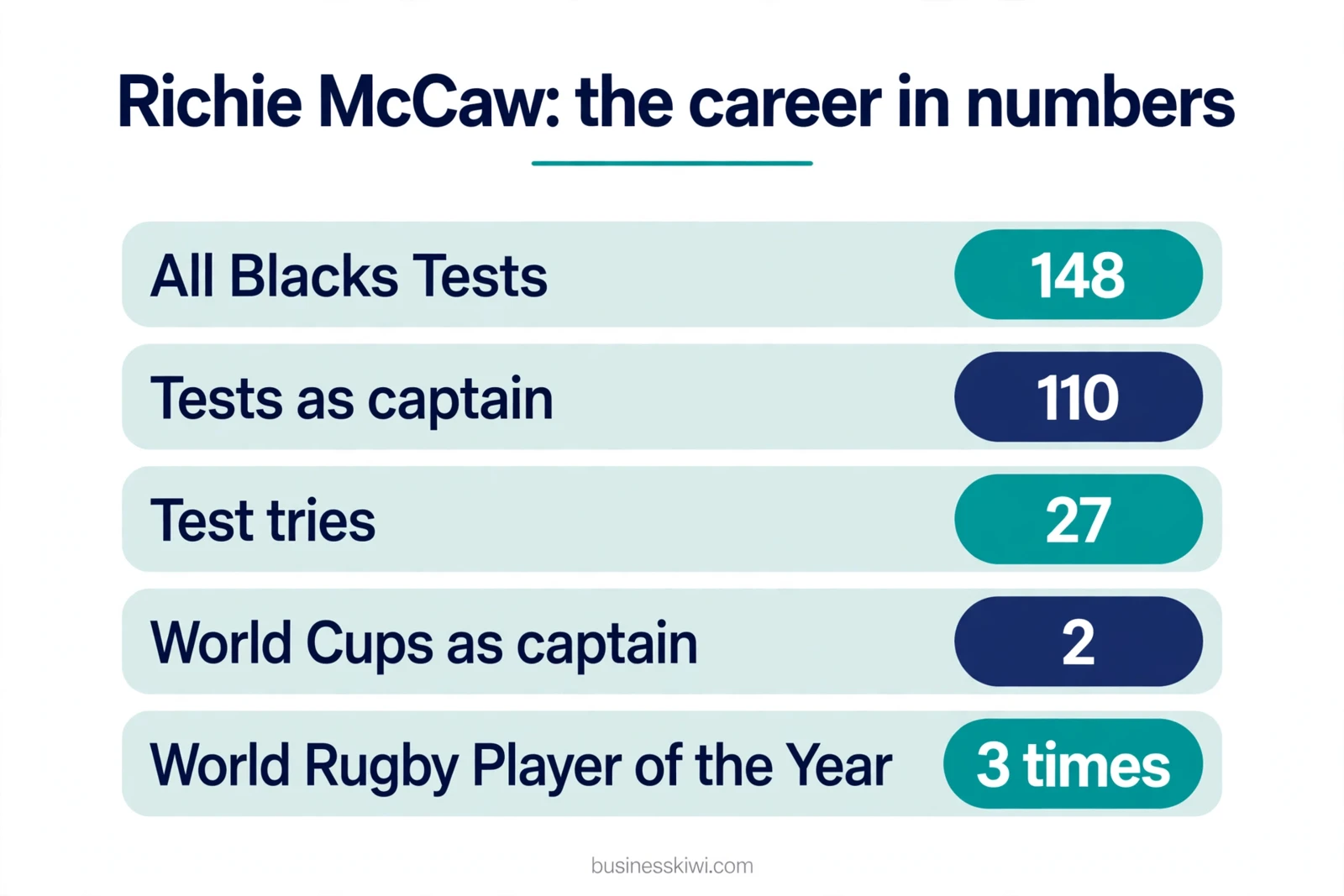
He went on to become the most capped All Black of all time and the most successful captain in the history of international rugby. He captained the All Blacks in 110 of his 148 Tests, won two Rugby World Cups as captain, and was named World Rugby Player of the Year three times. He retired from professional rugby in November 2015, a few weeks after lifting the Webb Ellis Cup for the second time, and walked straight into a second career as a commercial helicopter pilot.
Off the field he has been recognised at the highest level New Zealand offers. He was appointed a Member of the Order of New Zealand, the country’s highest honour, in the 2016 New Year Honours, and was named New Zealander of the Year in 2016. He was inducted into the World Rugby Hall of Fame in 2019.
The rugby career in numbers
McCaw’s playing record is one of the reasons people assume he must be wealthy, and it is worth setting out exactly, because the numbers are all on the public record through World Rugby’s Hall of Fame.
| Record | Figure |
|---|---|
| All Blacks Test appearances | 148 |
| Tests as captain | 110 |
| Test tries | 27 |
| Rugby World Cup wins as captain | 2 (2011 and 2015) |
| World Rugby Player of the Year | 3 (2006, 2009 and 2010) |
| Tri Nations and Rugby Championship titles | 7 |
| Super Rugby titles with the Crusaders | 4 (3 as captain) |
| First All Black to reach 100 Tests | Yes, against France at the 2011 World Cup |
The 148 Tests made him New Zealand’s most capped player. The 110 Tests as captain are a world record. The 27 tries are the most by any All Black forward. He is the only person to have captained a side to two Rugby World Cup wins. He was the first All Black to play 100 Tests, reaching the mark against France in pool play at the 2011 World Cup.
Those numbers also explain why his earning years were long. He played international rugby for fourteen seasons, from 2001 to 2015, and he was the All Blacks captain for most of that time. In professional sport, longevity at the top is what turns a good salary into serious career earnings, and McCaw had more of it than any All Black before him.
How a professional All Black gets paid
To understand McCaw’s rugby income, it helps to understand how All Blacks are paid, and what is and is not public about it. New Zealand Rugby contracts its leading players centrally. A contracted All Black is paid by New Zealand Rugby, plays Super Rugby for a franchise and provincial rugby as required, and is available for Test selection. The contracts are negotiated collectively with the New Zealand Rugby Players Association, and the terms are not published player by player.
That means there is no public record of what McCaw earned in any given year. No annual report names him, no contract value has been published, and no reliable figure exists for his total career earnings from rugby. What can be said is that he was at the top of the pay scale for his entire career, because he was the captain of the national team for a decade, and that he earned that pay for fourteen seasons, which is a long time at the top of any sport.
Players also earn match payments and win bonuses on top of their base contracts, and senior All Blacks have historically been able to earn additional income from personal endorsements and appearances. None of those amounts are published either. So the honest position is this: McCaw was one of the best paid rugby players in New Zealand for a decade and a half, and nobody outside his accountant and his bank knows the total.
It is also worth noting what he did not do. Unlike many leading players of his era, McCaw never took a big overseas contract. He did not play club rugby in England, France or Japan, where the largest salaries in the game were on offer. He stayed in New Zealand for his whole career, playing for Canterbury, the Crusaders and the All Blacks. That choice almost certainly cost him money in the short term, and it is part of why he is so highly regarded in New Zealand.
Endorsements and sponsorships
Endorsement income was a real part of McCaw’s earnings, and it is the part that is hardest to put a number on. During his playing career he was one of the most recognisable faces in New Zealand sport, and brands wanted him. He was an ambassador for ISPS Handa, the international golf and sporting organisation, and his profile with them describes him as one of New Zealand’s most respected sportsmen.
The details of individual endorsement deals are private commercial agreements, and they are not published. No list of McCaw’s sponsors, and no value for any deal, appears in a public source that can be checked. So this guide does not name deals it cannot verify, and it does not put a dollar figure on his endorsement income. What can be said is that a player of his profile, over a career of that length, would have earned meaningful income from endorsements on top of his playing contract, and that the income would have continued after retirement through ambassadorial roles.
After retirement he has kept a low profile commercially. He does not front advertising campaigns, he does not do regular television punditry, and he has not turned his name into a consumer brand. That is a choice, and it is consistent with everything else about how he has handled his public life since 2015.
The book and the film
Two projects turned McCaw’s story into income in their own right. The first was his autobiography, The Real McCaw, published in 2012 and written with Greg McGee. It was also published under the title Richie McCaw: The Open Side. The book covers his life up to the 2011 World Cup win, including the four years leading into it, and it was a bestseller in New Zealand. No reliable public figure exists for what he was paid for it, or for how many copies it sold, so this guide does not state one.
The second was Chasing Great, the documentary film that followed McCaw through his final season as an All Black as he tried to guide New Zealand to back to back World Cup wins. The film was directed by Michelle Walshe and Justin Pemberton, produced by Augusto, and opened in New Zealand cinemas on 1 September 2016, a few days after its world premiere at the Civic Theatre in Auckland. It tells the story of his life through family video archives and footage from his last season. No box office figure from a verifiable source is published for the film, so none is stated here.
Both projects matter for a different reason too. They are the two places where McCaw has told his own story in his own words, and they are the reason so much of what is known about his attitudes to money, work and leadership comes from him directly rather than from people writing about him.
His own company: Richie McCaw Limited
The clearest public window into McCaw’s business affairs is the Companies Register, and it shows a simple structure. Richie McCaw Limited was incorporated on 6 October 2004, early in his All Blacks career. It is a New Zealand limited company, company number 1556304, and it remains registered. Its registered office is at PwC, Level 4, 60 Cashel Street, Christchurch.
McCaw is the company’s sole director, and its 1,000 shares are held by the RH McCaw Trust, with McCaw as trustee. That is a common structure for a New Zealand professional whose income comes from a mix of salary, endorsements and business interests: a personal company to hold and manage income, with a family trust as shareholder. It is not evidence of any particular level of wealth. It is evidence that he set up his business affairs early and kept them in order.
If you are thinking about your own business structure, the choices McCaw made are the same ones any self employed New Zealander faces, and our guide to how to start your own business in NZ explains the options. The difference between a company and a sole trader, and when each one makes sense, is covered in our guide to how to register as a sole trader.
Christchurch Helicopters: the second career
McCaw’s main business after rugby is aviation. He learned to fly helicopters in 2012, while he was still playing, and when he announced his retirement in November 2015 he said he would be joining Christchurch Helicopters, a business in Christchurch, and working towards his commercial helicopter licence. He has been a director and shareholder in the company since then, and he became one of its chief pilots, taking on management responsibility as well as flying.
He worked full time for Christchurch Helicopters between 2016 and 2019, flying commercial work, scenic flights, pilot training and conservation work. He flew rescue and reconnaissance missions after the Kaikoura earthquake in November 2016, helping to reach isolated communities and deliver supplies, and he was part of the helicopter response to the Canterbury Christmas Day fire in 2017.
The company is a real operating business, not a vanity project. It does commercial helicopter work, tourism flights, training and conservation flying, including moving native birds into predator free areas. McCaw’s role in it is hands on: he flies, he manages, and he owns part of it. That is a second career, not a hobby, and it is the main thing he has done with his working life since rugby.
How much the business is worth, and how much McCaw’s share of it is worth, is not public. Christchurch Helicopters is a private company and does not publish accounts. What can be said is that he went from being an employee of the business to being an owner and a senior pilot, which is the path of someone building a long term position in a company rather than cashing in a name.
The New Zealand Rugby commercial board
In June 2022 McCaw was appointed a director of New Zealand Rugby Commercial GP Limited, the company set up to hold New Zealand Rugby’s commercial assets under its partnership with the American investment firm Silver Lake. He was one of six initial directors, and he sits on the board as the representative of the New Zealand Rugby Players Association.
The company itself is on the public record. New Zealand Rugby Commercial GP Limited, company number 8333408, was incorporated on 25 March 2022 as New Zealand Rugby Commercial Ventures GP Limited and changed its name on 3 June 2022. It remains registered.
The Silver Lake deal gives a sense of the scale of the business McCaw now helps to govern. Silver Lake invested 200 million dollars in the new commercial entity at a valuation of 3.5 billion dollars, for a stake of between 5.71 and 8.58 percent. Of the investment, 7.5 million dollars went to rugby clubs, 2 million dollars to Maori Rugby and 20 million dollars to Provincial Unions. The partnership was approved by New Zealand Rugby’s Provincial Unions at a special general meeting on 2 June 2022, and the commercial and technology teams moved under the new entity from 1 July 2022.
McCaw’s board seat is not a salaried executive job, and there is no public record of what directors of the company are paid. Its significance is different. It puts a former player, and a former players association representative, at the table where the commercial value of New Zealand rugby is decided, including the value of the All Blacks brand he helped to build. For a man who spent his career as an employee of New Zealand Rugby, it is a move to the other side of the table.
To understand how a business like that is valued, it helps to know what the numbers mean. Our guide to net profit explains how profit is worked out and how to read it, which is the starting point for valuing any company.
Adventure racing and the Pure Adventure Charitable Trust
McCaw’s other post rugby project is adventure racing. He has competed in four chapters of GODZONE, the expedition adventure race that sends teams of four across the New Zealand backcountry for eight days on foot, by bike, by kayak and by packraft. It is one of the hardest races in the world, and it suited him: he has always been drawn to endurance events, and he has run ultramarathons since retiring.
In 2025 he helped form the Pure Adventure Charitable Trust to bring GODZONE back to the calendar after a two year break. He is a lead trustee of the trust alongside Rob Nichol, the chief executive of the New Zealand Rugby Players Association. The trust now owns and operates the race, and its thirteenth chapter is set for 25 February to 5 March 2027 in the Aoraki Mount Cook and Mackenzie region.
The trust is a charitable entity, not a business, and McCaw’s role in it is unpaid trusteeship rather than an investment. It is included here because it shows where his time and energy go now, and because it is the kind of project that tells you more about a person’s priorities than their bank balance does. He has spent his retirement building things he cares about: a helicopter company, a race, and a trust to keep that race alive.
Honours and awards
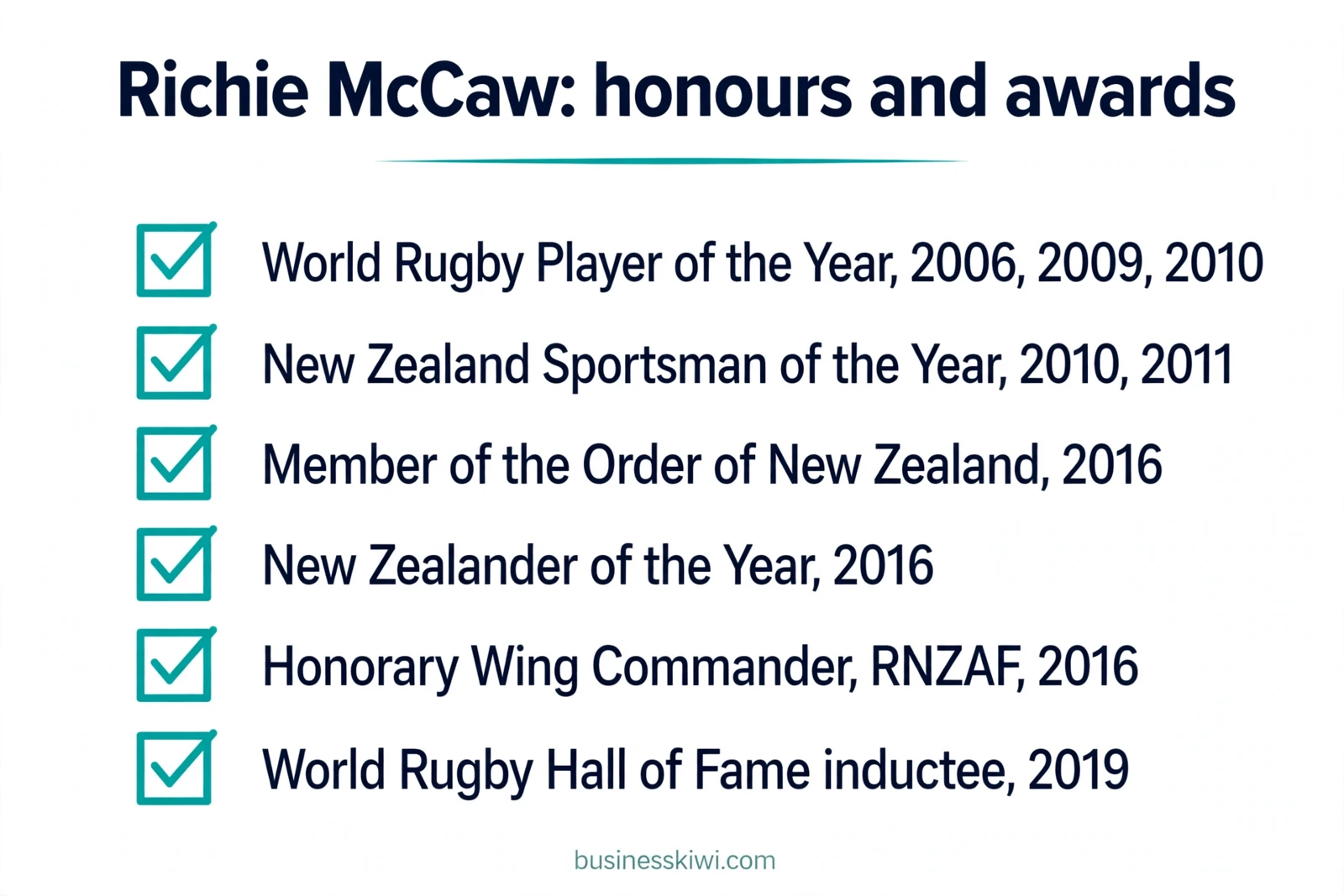
McCaw’s honours are a matter of public record, and they are worth listing because they show how New Zealand has recognised him, and because they are the closest thing to an official measure of his standing.
| Honour or award | Year |
|---|---|
| World Rugby Player of the Year | 2006, 2009, 2010 |
| New Zealand Sportsman of the Year | 2010, 2011 |
| Member of the Order of New Zealand | 2016 |
| New Zealander of the Year | 2016 |
| Honorary Wing Commander, Royal New Zealand Air Force | 2016 |
| World Rugby Hall of Fame inductee | 2019 |
The Order of New Zealand is the country’s highest honour, and membership is limited to twenty living New Zealanders at any one time. McCaw was appointed in the 2016 New Year Honours, announced on 31 December 2015, and invested at Government House in Wellington in April 2016. At thirty five he was the youngest person ever appointed to the Order. He had turned down a knighthood after the 2011 World Cup, and the Order of New Zealand, which carries no title, sat more comfortably with him.
He was named Kiwibank New Zealander of the Year in February 2016, a few weeks after the Order of New Zealand announcement, in recognition of his contributions to rugby and to charity. He had been made an honorary Squadron Leader in the Royal New Zealand Air Force in 2009, and was promoted to honorary Wing Commander in September 2016.
What his wealth is likely made of, and how to read net worth figures
Pulling the verified pieces together, McCaw’s wealth comes from five sources, and none of them can be totalled from public information.
First, fourteen seasons of professional rugby pay, at the top of the New Zealand scale, as captain for most of that time. Second, endorsement and ambassadorial income, including his role with ISPS Handa, earned over a long career at the top of world rugby. Third, his book and film, both of which sold well in New Zealand without any public figure for what he earned from them. Fourth, his business interests, principally his shareholding and directorship in Christchurch Helicopters and his own company, Richie McCaw Limited. Fifth, his board role with New Zealand Rugby’s commercial arm, which is a governance position rather than a source of wealth in itself.
That is a broad base, and it is the base of someone who earned well for a long time, spent carefully, and invested in a real business rather than in a lifestyle. It is also the base of someone who has never shown any interest in displaying wealth. He does not talk about money, he does not show off houses or cars, and he has not built a personal brand around being rich. If you are looking for a number, you will not find a reliable one. If you are looking for the shape of a career that produced real wealth, it is all here.
The reason this guide refuses to state a number is worth explaining, because the same problem applies to every famous person you search for. Celebrity net worth websites do not have access to anyone’s finances. They estimate, using public clues like salaries in the same sport, property records, and how famous a person is, and then they present the estimate as a fact. Different sites produce different numbers for the same person, sometimes years apart, and none of them corrects the others.
There are a few checks you can run on any net worth figure you see. First, does the site name a source for the number? If it does not, it is an estimate. Second, does the number change when you check another site? If two sites disagree by millions, at least one of them is wrong, and probably both are. Third, is the person from a country where private wealth is not public? In New Zealand, private companies do not publish accounts, salaries are not published, and there is no public register of personal wealth. That means a precise net worth figure for a New Zealand private individual is almost always invented.
The useful question is not how much someone is worth, but how they made their money and what they did with it. For McCaw, the answer is public, verifiable and more interesting than a number: a long career at the top of his sport, a real second career in aviation, a seat on the board of the game he played, and a charitable trust keeping a race he loves alive.
For more on money and finance in New Zealand, browse the Finance section.
Frequently asked questions
What is Richie McCaw’s net worth?
There is no reliable published figure. McCaw has never stated his net worth, New Zealand Rugby does not publish player salaries, and his private company does not publish accounts. Figures on celebrity net worth websites are estimates with no named source, and they disagree with each other. This guide does not repeat them.
How much did Richie McCaw earn as an All Black?
That is not public either. New Zealand Rugby contracts its leading players centrally and does not publish what it pays individual players. McCaw was at the top of the pay scale for fourteen seasons, from 2001 to 2015, and captained the side for most of that time, so his rugby earnings were substantial, but no total exists on the public record.
What does Richie McCaw do now?
He is a commercial helicopter pilot, a director and shareholder in Christchurch Helicopters, a director of New Zealand Rugby Commercial GP Limited, and a lead trustee of the Pure Adventure Charitable Trust, which runs the GODZONE adventure race. He also competes in adventure racing and ultramarathons.
Does Richie McCaw own Christchurch Helicopters?
He is a director and shareholder in the company, not the sole owner. He joined the company when he retired from rugby in 2015, became one of its chief pilots, and has taken on management responsibility as well as flying.
Did Richie McCaw turn down a knighthood?
Yes. After the 2011 World Cup win, then Prime Minister John Key raised the idea of a knighthood, and McCaw declined. After the 2015 World Cup he was appointed a Member of the Order of New Zealand instead, in the 2016 New Year Honours. The Order is New Zealand’s highest honour, limited to twenty living members, and it carries no title.
How many World Cups did Richie McCaw win?
Two, as captain, in 2011 and 2015. He is the only person to have captained a side to two Rugby World Cup wins. He played 148 Tests for the All Blacks, captaining the side in 110 of them, and scored 27 tries.
Where does Richie McCaw’s money come from?
From five verified sources: fourteen seasons of professional rugby pay, endorsement and ambassadorial income, his autobiography and the Chasing Great documentary, his business interests led by Christchurch Helicopters and his own company Richie McCaw Limited, and his governance role with New Zealand Rugby’s commercial arm. No total can be calculated from public information.