Cheapest Car Finance NZ: How Low Interest Car Loans Really Work

Every car finance advertisement in New Zealand leads with the same promise: a low rate. The number is big, the conditions are small, and the borrower who actually receives that number is usually not the average borrower at all. If you are hunting for a low interest car loan, the honest starting point is that the cheapest loan is rarely the one with the lowest advertised rate. It is the one with the lowest total cost once the rate you qualify for, the fees, the term and extras are added up.
Two people can borrow the same amount for the same car on the same day and pay thousands of dollars different in total, purely because one was offered a rate near the bottom of a lender’s range and the other near the top. This article sits alongside our broader guide to comparing car finance and focuses only on the low-rate end of the market: how pricing works, what lenders publish as their rates and fees (checked on their own pages on 8 October 2026), how to work out the true cost of any offer, and your rights under the Credit Contracts and Consumer Finance Act 2003 (CCCFA).
Cheap means total cost, not the headline rate
A car loan turns a car’s price into a series of repayments. Its cost is everything you pay above the amount borrowed, in three parts.
The first is interest, charged on the outstanding balance. It is heaviest at the start of the loan when you owe the most, and it grows with both the rate and the time you take to repay. The second is fees: an establishment fee at set-up, a fee to register the lender’s interest in the vehicle on the Personal Property Securities Register (PPSR), sometimes a monthly administration fee, and charges that only appear if something goes wrong, such as late payment or early repayment charges. The third is the extras sometimes folded into the amount borrowed at the dealership: repayment insurance, extended warranties and similar add-ons. Sorted, run by Te Ara Ahunga Ora Retirement Commission, makes the point plainly: if an insurance premium is added to the loan, you pay interest on the premium as well as on the car.
Because the three parts interact, a lower rate can cost more than a higher one. A modest rate with a large establishment fee and a monthly admin fee, stretched over a long term, can overtake a slightly higher rate with no fees at all. The only figure that captures everything is the total amount payable, and by law it must be disclosed before you commit.
How lenders decide what rate you get
Most specialist vehicle lenders in New Zealand use risk-based pricing. Instead of one rate for everyone, they publish a range and place each applicant somewhere inside it. MTF Finance, one of the country’s larger vehicle finance companies, states on its interest rates and fees page that its rates vary by individual circumstances, and that the factors include information from credit bureaus and other third parties, plus your credit history with MTF itself. The lender scores your application for risk. A borrower who looks very likely to repay in full and on time is cheaper to serve, and gets a rate nearer the bottom of the range. A borrower with a patchier record pays nearer the top.
Several things feed into it:
- Your credit report and score. Lenders look at your history of paying debts and bills, covered in full further down.
- Whether the loan is secured. With a secured loan, the vehicle itself stands behind the debt. MTF states that secured rates are generally lower than unsecured rates because, if repayments stop, the asset may be repossessed and sold to help recover the balance. The trade-off: a cheaper rate, with the car itself at risk.
- The vehicle. For a secured lender, the car is the fallback, so its age, condition and resale value form part of the assessment. A vehicle that is old or worth little may not be accepted as security, pushing the borrower towards an unsecured loan at higher rates.
- The amount and the term. Borrowing more, or spreading repayments over more years, changes the lender’s exposure and, as the worked example shows, dramatically changes the interest bill at the same rate.
- Your relationship with the lender. Some of the lowest published rates are reserved for existing customers, not the general public, as the published rates covered next show.
The big banks mostly work differently. Several publish a single standard rate for an unsecured personal loan and apply it to everyone approved, rather than a wide risk-based range. Approval is not automatic, and the rate is variable in some cases, but the advertised bank rate is much closer to the rate an approved borrower receives. The catch is that bank loans are unsecured, so their standard rates sit well above the bottom of the secured ranges offered by vehicle specialists.

What lenders publish: rates and fees checked on 8 October 2026
These figures come only from each lender’s own official pages, read in full on 8 October 2026. Rates change, so treat this as a snapshot of how the market is structured, not a price list.
Heartland Bank publishes the lowest starting rate of the lenders checked: fixed term rates from 8.95% to 13.95% p.a., fixed for the term, with an establishment fee of $249 and a PPSR fee of $7.39. The page does not say which borrowers receive 8.95%; the bottom of the range is the price for applications assessed as lowest risk.
MTF Finance publishes the widest ranges, making it the clearest illustration of risk-based pricing. Secured loans range from 10.55% to 22.55% p.a. and unsecured loans from 14.00% to 24.00% p.a., both fixed for the term. The fees matter as much as the range: an establishment fee of up to $380, a PPSR fee of $10.35, a monthly maintenance fee of $7.54 on secured loans, an early repayment fee of $17, and a variable loss on full prepayment charge. MTF’s own examples show borrowers at different credit ratings paying totals over $1,000 apart on the same loan.
BNZ publishes a single interest rate of 12.90% per annum for its Advanced Personal Loan, with a loan facility fee of $50, no monthly fees and no early repayment charges. Two conditions deserve attention. The rate is variable, not fixed: BNZ states it can change at any time, including after you enter the contract. And you must be a BNZ customer to apply, with online applicants needing an income of $35,000 or more. Loans run from $1,000 to $60,000 over three months to five years.
ASB publishes a single fixed rate of 13.90% p.a. for its car loan, an unsecured personal loan used to buy the vehicle. There is no loan processing fee and no early repayment charges, and approved borrowers receive the same fixed rate, so there is no gap between the advertised rate and the rate offered. Loans start over $2,000, with terms of six months to seven years, and ASB no longer offers secured personal loans to new customers.
Westpac publishes a standard personal loan rate of 13.90% p.a., with no establishment fee and no fees for lump sum payments or paying the loan off early. The rate is built from a base rate of 14% p.a. less a margin of 0.10% p.a., and either component can change, so it is not fixed for the term. Westpac also publishes an EV personal loan at 9.99% p.a. for electric and hybrid cars, e-mopeds and e-bikes, subject to approval. Standard terms run from six months to five years, up to $50,000 or possibly more.
Latitude Financial Services, providing car loans for Kiwibank, shows why conditions matter. Its car loan page publishes two fixed rates: 13.95% p.a. for customers who hold a Kiwibank home loan, and 18.95% p.a. as the standard rate for everyone else. The lower number is real, but only if your home loan is already with Kiwibank. The establishment fee is $199, added to the loan amount, the late fee is $35, there are no early repayment fees, and terms run one to seven years from $2,000.
ANZ is the gap in this snapshot, and the gap is worth reporting. ANZ’s own ways to borrow page, read in full on the same day, describes its personal loan: amounts from $3,000 to $50,000, terms from six months to seven years, a fixed rate for the life of the loan, no application fee and no early repayment costs. But the page did not display the actual rate, showing a placeholder where the figure should be. A rate that cannot be read on the lender’s own page cannot be verified, so none is quoted.
The anatomy of total cost
Interest is normally the largest single cost, and it responds to three levers: the rate, the balance and the time. A deposit is the simplest lever, because money you do not borrow never attracts interest or fees.
Establishment and registration fees are charged once, at the start, and are usually added to the loan balance rather than paid in cash. A $380 fee added to the balance is not just $380: you pay interest on it for the entire term. The PPSR fee is small by comparison ($10.35 at MTF, $7.39 at Heartland above) but is still repaid.
Monthly administration fees look trivial and are not. A fee of $7.54 a month, MTF’s published figure, adds up to $452.40 over five years before interest. A lender charging no monthly fee starts with an advantage a small rate difference may not overcome.
Early repayment charges decide how much freedom you have to escape a loan cheaply. Several lenders above charge nothing for extra repayments or early settlement, so every extra dollar reduces the balance and the future interest bill. Others charge: MTF charges a $17 fee plus a loss on full prepayment amount that varies with market interest rates. The CCCFA position is that you have the right to repay in full early, but what it costs depends on the contract’s disclosed terms.
Dealer finance deserves a cool head. Sorted’s car loans guide notes that dealer loans are often actually provided by a finance company, with the dealer signing you up during the purchase. Convenience is the product: one signature, drive away today. The risks are that the rate is set by where you sit in that finance company’s range, the term gets stretched to make the weekly repayment look painless, and extras such as repayment insurance and warranties are folded into the amount borrowed, where they attract interest for years. Consumer Protection adds a check: make sure the cash price on the vehicle’s Consumer Information Notice matches the contract price, and question any supposedly free extra.
Balloon payments are the other structure to understand. Some contracts set regular repayments to cover only part of the amount borrowed, leaving a single large lump sum, the balloon, due at the end. The repayments look low because a chunk of the debt has been postponed, while interest keeps running on the full balance. When the balloon falls due it must be paid in cash, covered by selling or trading the car (which may be worth less), or refinanced. Judge the deal on the total payable including the balloon.

A worked example on assumed figures
Real quotes depend on your application, so this example uses assumed figures, clearly labelled, to show how the moving parts interact. The arithmetic is standard loan amortisation with monthly repayments, and you can rerun it with any lender’s disclosed figures. Assume you borrow $25,000 over four years (48 payments), with no deposit.
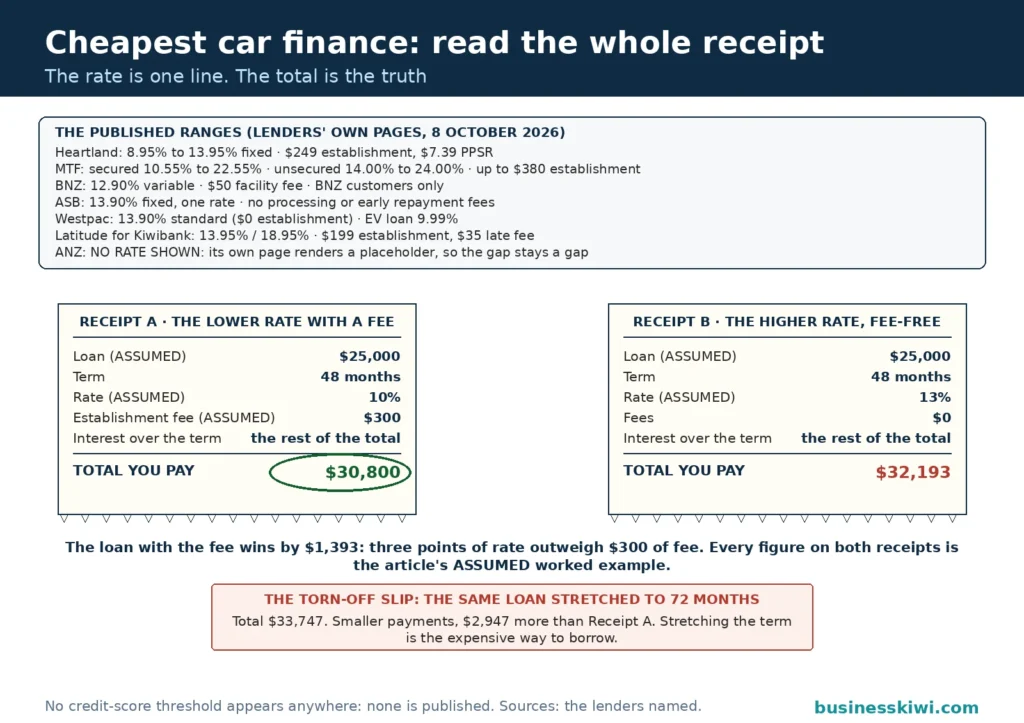
Offer A (assumed): interest rate 10.00% p.a. fixed, establishment fee of $300 added to the loan balance, no monthly fee. The amount owed at the start is therefore $25,300. The monthly repayment is about $641.67. Over 48 payments you repay about $30,800 in total, of which about $5,500 is interest, making the total cost of credit about $5,800.
Offer B (assumed): interest rate 13.00% p.a. fixed, no fees. The monthly repayment is about $670.69 and the total repaid is about $32,193, the extra over $25,000 being interest of about $7,193.
Offer B’s rate is “only” three percentage points higher, yet it costs about $1,393 more overall, even though Offer A carried a $300 fee. Run Offer A over six years instead of four and the picture changes: the monthly repayment falls to about $468.70, which looks kinder, but the total repaid climbs to about $33,747. Two extra years cost roughly $2,946 in added interest at the identical rate and fee. Term length is the most expensive comfort in car finance.
Two habits follow. Always compare offers on the same amount over the same term, using the total amount payable from the disclosure statement rather than the repayment or the rate alone. And multiply any monthly fee by the number of months before calling it small: at an assumed $8 a month, you would pay $384 over four years.
Credit reports and scores: how you get placed in the range
Because risk-based lenders place you in a range, your credit file is effectively part of the price. New Zealand has three credit reporting agencies: Centrix, Equifax and Experian. Sorted’s credit reports guide explains that each holds slightly different information, because not all lenders report to all three, so it is worth getting your free report from each. You have a legal right to a free copy from every agency. Free reports typically take up to 10 working days, and Sorted suggests checking a few months before you apply for credit, so there is time to fix errors.
A credit score is a number calculated from the information in a report. Sorted describes it as typically falling between 1 and 1000, and stresses the point borrowers most often get wrong: the agencies use different algorithms and different scales, so the same score means different things at different agencies. There is no single national score and no universal pass mark that unlocks the cheapest rates. What lenders respond to is the underlying pattern: consistent on-time payments push you towards the attractive end of their ranges, defaults the other way. A default stays on your report for five years, even after the debt is paid.
A few practical points from Sorted’s guidance:
- Checking your own report does not affect your score. It is a soft enquiry, invisible to lenders. Enquiries by lenders and other third parties are hard enquiries, they show on your report, and a cluster of them in a short period can count against you.
- You do not need to carry debt, or pay interest, to build a score. Paying bills such as power and phone on time helps, because utility payments can be reported under comprehensive credit reporting. Paying a credit card in full counts for more than carrying a balance.
- Errors can be corrected. If information on your report is wrong, the agency must investigate and fix mistakes. If the error came from a lender, contact that lender first.
- If your history is currently rough, time and tidy payments rebuild it, but there is no quick fix and no legitimate way to wipe accurate information. For readers whose credit is already damaged, borrowing with bad credit is a different problem with its own costs and traps, covered in our separate guide.
Your rights before and after you sign
Car loans sit under the CCCFA, which gives borrowers more protection than many realise. Consumer Protection’s car loan guide sets out the core duties. Before you sign, the lender must explain the contract so you understand it, check the loan is suitable for you, and check you can afford the repayments without substantial hardship. Any insurance sold with the loan must also be checked as affordable and suitable. The Act backs this with lender responsibility principles that apply to all dealings with borrowers, and credit and default fees must be reasonable, relating to actual costs and losses rather than acting as penalties. Regulation of the Act moved from the Commerce Commission to the Financial Markets Authority on 1 July 2026.
The central document is the disclosure statement. It must list, in plain language:
- the amount owing and the total cost of the loan
- the interest rate and how interest is calculated
- all fees and charges, and the payment terms
- any security interests, meaning what the lender can take if you default
- penalties for late or missed payments
- what happens if you cannot make repayments, including repossession
- your rights to change the terms or cancel the contract
If disclosure is not made properly, the consequences fall on the lender: Consumer Protection notes that a lender who fails on disclosure cannot recover interest and fees for the period of non-compliance, cannot enforce the contract, and may face penalties. You may also cancel at any time if you never received a disclosure statement, or yours was incorrect or incomplete.
Cancellation rights are short but real. You can cancel the credit contract by notifying the lender within five working days of disclosure. If you cancel the finance but still want the car, you have 15 working days to pay the cash price. If you have not taken the vehicle yet, the sale itself can be cancelled too. If you have already driven it home, you can still cancel the finance within that window, but you remain committed to buying the vehicle.
If something unforeseen, such as illness, injury or job loss, makes repayments impossible, tell the lender early and ask about a hardship application. Consumer Protection lists options including spreading payments over a longer period, a payment holiday, or interest-only payments for a time. On repossession, the rules are specific: the lender can only repossess if the right is in your contract, you have missed payments or broken another term, and they sent a warning notice at least 15 days beforehand. After a sale, the lender must account for the price achieved and any shortfall, and must take reasonable steps to get the best market price. If a lender has breached its obligations, complain to its dispute resolution scheme.
Hunting the lowest total cost: a practical sequence
The search for a genuinely cheap loan looks like this. First, fix the amount and term before you shop: decide what you can pay each month, then choose the shortest term that fits, because the worked example shows how dearly extra years charge you. Second, check your credit reports a few months out and fix any errors. Third, collect quotes on identical terms and insist on the total payable from each disclosure statement. Fourth, look past the rate to the fees. Fifth, get approval arranged before you settle on a specific car, as Sorted recommends, so dealer finance has to beat a real alternative. Finally, treat every optional extra as more borrowing at the loan’s rate.
Frequently asked questions
What is the lowest car loan rate in NZ?
There is no single lowest rate, because the cheapest published figures are conditional. On 8 October 2026, the lowest starting rate on a lender’s own page was Heartland Bank’s 8.95% p.a., the bottom of a fixed range running to 13.95% p.a. Westpac published 9.99% p.a. on its EV personal loan, and MTF Finance’s secured range starts at 10.55% p.a.
Why was I offered a higher rate than the one advertised?
With risk-based pricing, the advertised figure is usually the bottom of a range, not a promise. Lenders place applicants inside it using credit bureau information, repayment history, whether the loan is secured, and their own assessment.
Is a secured car loan always cheaper than an unsecured one?
Usually the rate is lower, because the lender can repossess and sell the vehicle if repayments stop. But a cheaper rate is not the same as a cheaper loan: secured lending can carry establishment, monthly admin and early repayment fees that an unsecured bank loan avoids. Compare the total amount payable, and remember the car itself is on the line.
How much do fees really add to a car loan?
More than they appear to. An establishment fee added to the balance attracts interest for the whole term, and a monthly fee of $7.54, MTF Finance’s published figure, totals $452.40 over five years before interest. ASB and Westpac charge no establishment fee on the loans above, and BNZ charges a $50 facility fee with no monthly fees.
What credit score do I need to get the lowest rate?
There is no universal score that unlocks a particular rate in New Zealand. Centrix, Equifax and Experian each calculate scores differently, and lenders set their own criteria on top. Sorted’s guidance is to watch the trend of your score and the accuracy of your report rather than chase a magic number.
Can I pay my car loan off early to save interest?
Yes. Under the CCCFA you have the right to repay a consumer credit contract in full early. Whether it costs anything depends on the contract: ASB, BNZ, Westpac and Latitude for Kiwibank publish no early repayment charges on the products above, while MTF Finance charges a $17 fee plus a variable loss on full prepayment amount. Paying extra where it is free is a guaranteed way to cut total cost.
What should I check in the disclosure statement before signing?
Check the total amount payable, the interest rate and how it is calculated, every fee and charge, the payment schedule, what security you are giving, the penalties for late payments, and your cancellation and early repayment rights. Consumer Protection also advises checking that the cash price matches the vehicle’s Consumer Information Notice, and asking what add-ons cost.
Disclaimer: This article is general information about car finance in New Zealand, based on sources listed below as at 8 October 2026. It is not financial advice and does not take your personal circumstances into account. Rates, fees and criteria change, and any offer depends on the lender’s assessment of your application. Check the lender’s current disclosure statement before signing, and consider a financial adviser or a free financial mentor if unsure.
Sources
- ASB, Car loans, asb.co.nz
- ANZ, Ways to borrow, anz.co.nz
- BNZ, Personal loans, bnz.co.nz
- Commerce Commission, Transfer of responsibility for regulation of consumer credit, comcom.govt.nz
- Consumer Protection, Getting a loan for your car, consumerprotection.govt.nz
- Heartland Bank, Car Loans and Finance, heartland.co.nz
- Latitude Financial Services, Car Loans NZ: Latitude for Kiwibank, latitudefinancial.com.au
- MTF Finance, Interest rates and fees, mtf.co.nz
- Sorted, Car loans, sorted.org.nz
- Sorted, Credit reports, sorted.org.nz
- Westpac NZ, Personal Loans, westpac.co.nz