
What does “idea generation” mean in business?
Every successful business starts with one idea that solves a problem, fills a need, or makes something completely new. But where do these thoughts come from? And more importantly, how can people who want to start their own businesses keep coming up with them?
Coming up with new ideas is the most important part of being an entrepreneur. It’s the process of coming up with ideas, developing them, and making them better so they can become real business opportunities. Without strong ideas, there’s no foundation for innovation, growth, or competitive advantage.
This guide talks about what idea generation means in business, why it’s important, and how you can learn the skills that help you turn your ideas into successful businesses.
How to Understand Idea Generation in Business
In entrepreneurship, idea generation is the methodical process of finding opportunities and coming up with creative ways to meet market needs. It’s more than just brainstorming random thoughts—it involves recognizing patterns, understanding customer pain points and evaluating potential business models.
Think of it as the bridge between observation and action. You see a problem, think of ways to fix it, and then turn those ideas into plans that are worth following through on.
Why Idea Generation Matters
Successful entrepreneurs are different from those who have trouble getting started because they can come up with good ideas. This is why this process is so important:
This is where new ideas come from. Businesses stop growing when they don’t get new ideas. Companies that always come up with new ideas stay ahead of their competitors.
Solving problems becomes a routine. Instead of waiting for inspiration to strike at random, entrepreneurs who have structured ways to come up with ideas can actively look for opportunities.
Less risk. By using the right generation techniques to validate ideas early, you lower the risk of spending time and money on ideas that won’t work.
The ability to adapt gets better. Markets are always changing. Companies that have strong idea generation processes can quickly change direction when they need to.
Different ways to come up with ideas in business
Not every business idea comes about in the same way. Knowing about different types helps you see chances when they come up.
Ideas Based on Problems
These happen when you find a specific problem that needs to be solved. For instance, the fact that busy professionals have a hard time finding healthy meals led to the creation of many meal prep services.
Ideas for making things better
Sometimes the best ideas don’t come up with something new; they just make it work better. This method involves improving current goods or services by adding better features, lowering prices, or making the customer experience better.
Ideas for Market Gaps
These come up when you find a market that isn’t being served or a segment that hasn’t been tapped yet. This kind of idea generation is shown by the growth of specialised dietary products for vegan athletes.
Ideas Based on Technology
Advances in technology often create new possibilities. All of these things—mobile apps, AI tools, and blockchain solutions—are ideas that came from new technologies.
Sources of Idea Generation
There are many places where ideas can come from. Successful business owners learn to see chances in everyday life.
My Own Experience
Your own problems and needs are often the best place to start. What annoys you? What do you want to exist? A lot of companies start because someone thought, “There has to be a better way to do this.”
What Customers Say
Pay close attention to what people say about products and services that are already out there. Complaints show where the problems are. Questions show that someone is confused. Both create opportunities for new solutions.
Industry Trends
Keep up with what’s new in your field. Changes in consumer preferences, new technologies, and new rules all point to possible business opportunities.
Inspiration from Other Industries
One of the best ways to come up with new ideas is to use solutions from one field to solve problems in another. Magazines were the first to use subscription models, but now they are used for everything from software to razors.
Working together and making connections
Talking to other professionals gives you new ideas and challenges that you might not have thought of on your own. People often come up with new ideas during these talks.
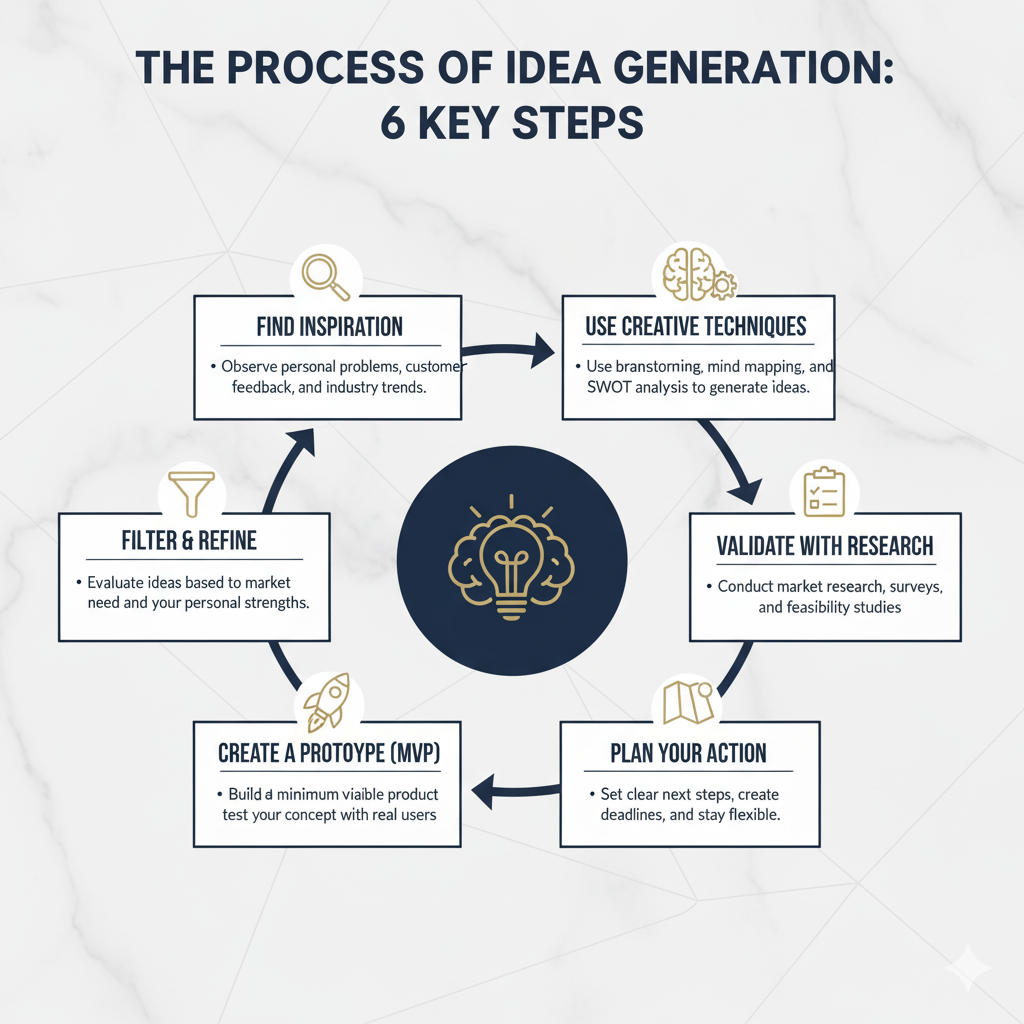
Techniques for Coming Up with Ideas That Work
Moving from theory to practice requires specific methods. These are the best ways for entrepreneurs to come up with business ideas.
Brainstorming
The classic approach works when done correctly. Set a time limit, let people share crazy ideas without judging them, and at first, focus on quantity over quality. The goal is to come up with a lot of ideas that you can narrow down later.
Think about having theme-based brainstorming sessions to make them work better. Instead of “generate business ideas,” try “ways to reduce packaging waste” or “services for remote workers.”
Mind Mapping
This visual method helps you think about ideas and how they are related. Begin with a main idea and then add related ideas, sub-topics, and possible uses. Mind maps show how ideas are connected in ways that linear lists might not.
SWOT Analysis
Looking at strengths, weaknesses, opportunities, and threats gives you a structured way to find good ideas. This method is especially useful for looking at current markets or thinking about how to market a new business.
The Five Whys
When you encounter a problem, ask “why” five times to dig deeper into root causes. Originally made for manufacturing, this method helps business owners figure out what the real problems are that need to be fixed instead of just the symptoms.
Reverse Thinking
Instead of asking, “How can I fix this?Ask yourself, “What could I do to make this worse? This approach, which goes against common sense, often shows new angles and solutions.
Trend Watching
Take the time to read industry publications, follow thought leaders, and keep an eye on what customers are doing. When you keep an eye on what’s changing in the market, you start to see patterns.
Making a Place Where Ideas Can Flow Freely
The best techniques won’t help if your mindset blocks creativity. Building the right environment—both mental and physical—significantly impacts your ability to generate quality ideas.
Promote creative thought
Set aside dedicated time for idea generation when you’re not distracted by daily operations. Some business owners set aside time each week to “think” about new ideas. During these times, they put off important tasks and focus only on being creative.
Embrace Collaboration
Two heads truly are better than one. Get together a group of people who think differently, come from different backgrounds, and have different skills and points of view. This variety makes you question what you think you know and gives you new ways of looking at things that you might not have thought of on your own.
Welcome Failure and Risk
Nothing kills creativity faster than fear. Make it okay for people to suggest new ideas without being immediately criticised. Keep in mind that a lot of new ideas that changed the game seemed silly at first.
Write Down Everything
You can keep a journal of your ideas, use apps to take notes, or make a separate file for ideas that might work. Ideas often come to you at bad times. They go away if you don’t catch them right away.
Change the things around you
The physical environment has an effect on the mind. If you’re feeling stuck, move to a new place. You can work from a coffee shop, go for a walk, or just move to a different room. Being in a new place can make you think differently.
The Process of Coming Up with Ideas: From Idea to Reality
Coming up with ideas is only the first step. Successful business owners follow a process that helps them turn ideas into reality.
Step 1: Look and Learn
Be aware of what’s going on around you. What issues do people have? What are they upset about? What new trends are coming up? Get information without deciding if the ideas are “good” yet.
Step 2: Come up with ideas
Use the methods we talked about before to come up with a lot of ideas. At this point, focus on quantity. There may be things worth looking into in ideas that seem impossible.
Step 3: The first filter
Look over your ideas with these basic rules: Does this fix a real problem? Is there a market that could work? Is it in line with what you know how to do and like to do? Get rid of ideas that obviously won’t work.
Step 4: Growth
Take good ideas and make them more complete. Who would use this? How would it work? What would set it apart from other options? Make rough drawings or write down your ideas.
Step 5: Checking for accuracy
Test your ideas before putting a lot of time and money into them. This brings us to the next very important step.
Checking Your Ideas
Great ideas mean nothing if nobody wants them. Validation distinguishes between wishful thinking and authentic opportunities.
Do some market research
Study your target audience. How big is it? What do they use right now to fix this? How much do they pay? Would they change your answer?
Use surveys, interviews, and online research to gather data. The goal is to find out if there is real demand for your idea.
Conduct Feasibility Studies
Is it possible for you to carry out this idea? Think about your own skills, as well as the technical, financial, and legal needs. An idea that can’t be put into action isn’t really amazing.
Make prototypes or MVPs
Minimum Viable Products let you test concepts with minimal investment. Make the simplest version of your idea that still shows how valuable it is. Then get it in front of potential customers.
You can learn more from their reactions than from any amount of planning. Do they get it? Does it fix their issue? Would they pay for it?
Get feedback and make changes
Pay close attention to what early users say. Their ideas help you improve the idea before it goes live. Be prepared to pivot if feedback reveals issues with your original approach.
Examples of generating ideas in the real world
It’s helpful to understand theory, but examples make ideas real.
Example based on a problem: A teacher saw that students had trouble getting to educational materials outside of school. This observation prompted the development of an economical tablet tailored for educational purposes, preloaded with offline learning resources.
Example based on improvement: A small business owner who was tired of complicated project management tools made a simpler version that only had the basic features that small teams really need.
An example of a market gap: Recognizing that most fitness programs ignored people with limited mobility, an entrepreneur created specialized workout plans for individuals recovering from injuries or managing chronic conditions.
In each case, the process began with careful observation, then structured idea generation, and finally, real-world testing to confirm the idea.
Common Problems with Coming Up with Ideas
Even with good techniques, entrepreneurs run into problems that make it hard to think creatively.
Overthinking: Looking at every idea too closely kills creativity. Don’t mix up generation and evaluation. Let ideas come to you first, and then decide what to do with them.
Fear of criticism: When you’re worried about what other people think, you can’t look into new ideas. Remember that most revolutionary ideas seemed strange initially.
Not enough time: Busy schedules make it hard to think creatively. You need to make time for coming up with ideas a priority, not an option.
Limited perspective: If you work alone or with a group of people who are all the same, you’ll come up with fewer ideas. On purpose, look for different points of view.
Analysis paralysis: If you wait for the “perfect” idea, you’ll never get out of it. Accept that all ideas need refinement. Begin with “good enough” and work your way up.
Putting Ideas into Action
Coming up with ideas is fun, but putting them into action is what makes them work. Once you’ve identified and validated a promising concept, create an action plan.
Set clear next steps. What should happen first? What do you need? Who can help you? Instead of seeing the whole project as one big task, break it up into smaller, more manageable steps.
Make sure you have deadlines. Ideas without timelines remain dreams. Set specific dates for finishing your first research, building prototypes, and starting tests.
Stay flexible throughout implementation. As you learn more, your idea will change. It’s normal for the idea you launch to look very different from what you first had in mind.
Are you ready to come up with your next big idea?
In business, coming up with ideas isn’t about waiting for something to happen. You can get better at it by practicing, using tried-and-true methods, and keeping the right attitude.
Begin to notice issues in your surroundings. Practice the techniques outlined here. Make places that help people be creative. Before you go all-in, make sure your ideas are good.




![How to Start an Ecommerce Business in NZ [2025 Guide]](https://businesskiwi.com/wp-content/uploads/2025/11/How-to-Start-an-Ecommerce-Business-in-NZ-644-300x200.png)