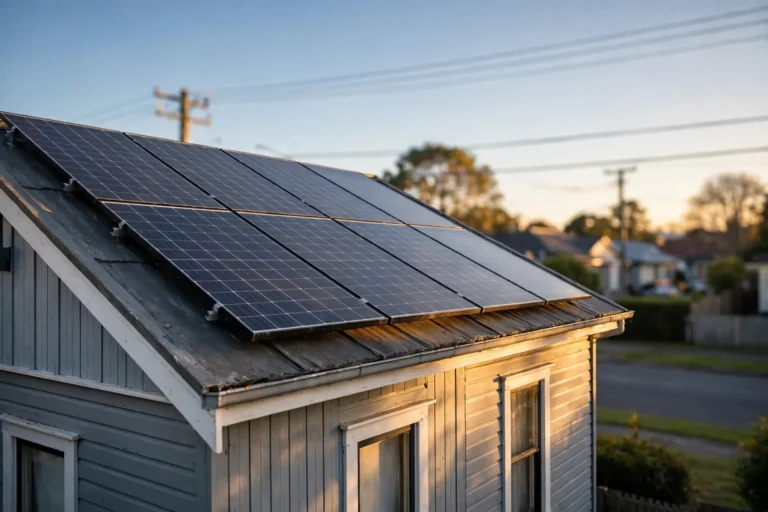
Government Subsidy for Solar Power NZ: Grants, Loans and What’s Actually Available

Search for a government subsidy for solar power in NZ and you will find plenty of pages that make it sound as if help is sitting there waiting to be claimed. Most of them are selling something.
Here is the honest answer up front. There is no government grant, rebate or cash subsidy that pays part of the cost of rooftop solar panels for a New Zealand home. Not a small one, not a means-tested one, not one you have somehow missed. EECA, the government agency that runs home energy funding, does not put a single dollar towards solar panels for households. Its grant money goes into insulation and efficient heating instead.
That puts New Zealand in a different position from Australia, where a long-running federal scheme cuts a meaningful amount off the upfront price of a home system. Nothing equivalent exists here, and nothing is open for applications.
So is there any help at all? Some, just not in the form people expect. The banks offer unusually cheap loans for solar through ordinary home loan top-ups. The government is spending real money putting panels on schools. And from April 2026, electricity rules changed so households get paid more fairly for power they export at busy times. This guide works through each one, what it is worth, and who can actually get it.
The short answer
No government subsidy exists for residential solar panels in New Zealand. If a website, ad or salesperson tells you the government will cover part of your installation, they are almost certainly talking about one of three things:
- A bank green loan, which is a commercial loan product, not government money
- Warmer Kiwi Homes, a genuine government grant programme that covers insulation and heating but not solar
- An idea a political party has floated, which is a proposal, not a programme you can apply for
Everything else in this article is detail on those three things, plus the one place government solar money genuinely is being spent: schools.
Why so many people think there is a subsidy
The confusion is understandable. Australian content fills New Zealand search results, and Australian households really do get federal assistance with solar, so articles written for that market read as if a subsidy is just how things work. Local installers then borrow the language. Words like “rebate” and “government deal” show up in ads for what turns out to be a bank loan or the installer’s own discount.
Election cycles add another layer. Parties propose solar schemes from time to time, the announcements get reported, and the headlines linger long after. A proposal is not a programme. Until a scheme is funded, legislated and open for applications through an agency like EECA, there is nothing to claim.

What EECA actually does for solar
EECA (the Energy Efficiency and Conservation Authority) is the government body for home energy. Its solar role is information, not funding. On its site you will find sizing guides, a calculator, and plain costings you can hold up against any quote:
- A small 3 kW system costs about $8,500 installed, including GST
- A medium 5 kW system costs about $11,500
- A large 10 kW system costs about $20,000
- Adding a battery adds roughly $5,000 to $15,000 depending on capacity
EECA estimates solar can save the average home $1,000 or more a year on power bills, with a typical payback of 7 to 10 years where the household uses most of the electricity it generates. Those numbers matter because they are the real economics of solar in NZ. There is no grant shortening that payback from the government’s side. When EECA talks about financing a system, it points you to the banks, noting that most major banks offer loans between 0% and 1% for home energy upgrades. We cover those loans below.
Warmer Kiwi Homes: real grants, but not for solar
Warmer Kiwi Homes is the government’s flagship home energy grant programme, run by EECA, and it is the scheme people most often mistake for a solar subsidy. It does not fund solar panels at all. It funds insulation and heating, and on those it is genuinely generous for households that qualify:
- Insulation grants cover 50% to 90% of the cost of ceiling and underfloor insulation, depending on your card status and where you live
- Heater grants cover up to 90% of the cost of an approved heat pump, capped at $3,450 including GST
To qualify, you need to own and live in a home built before 2008, and hold a Community Services Card or SuperGold Combo Card, or live in an area identified as low-to-middle-income. A heater grant also requires your home to be insulated to EECA standards already, with no working fixed heater in any living area. Rentals and business-owned homes are not eligible.
Worth knowing if you are planning a whole-home upgrade: a Warmer Kiwi Homes grant can take care of the insulation and heating side of the bill, which frees up your own money for the solar side. But the panels themselves come out of your pocket, one way or another.
The one real government solar spend: Solar on Schools
Central government money is flowing into solar, just not into houses. In June 2026 the government announced Solar on Schools, a $30 million programme made up of $20 million from the Community Renewable Energy Fund and $10 million from the Ministry of Education. EECA and the Ministry of Education are delivering it together.
The programme installs solar panels and batteries at up to 500 schools, with energy management systems for up to 150 of them. EECA’s modelling puts the savings for a standard 30 kW school system at up to $8,000 a year, with a payback of 5 to 7 years, and the full rollout is phased through to 2028. The 500 selected schools were announced in August 2026.
Useful context if your kids’ school is on the list. Of no use at all for your roof, and households cannot apply.
Bank green loans: the help that actually exists
The closest thing to a solar subsidy in New Zealand is cheap finance. All five major banks offer a home loan top-up or dedicated product for energy upgrades, solar included, at interest rates well below standard lending. These are commercial products. The government does not fund them, guarantee them or set their terms, and every dollar has to be repaid. But a loan at 0% or 1% does change the maths of a solar install in a way that feels a bit like a subsidy over time.
Westpac Greater Choices
Westpac’s Greater Choices offer gives eligible home loan customers 0% interest on up to $50,000 for five years for a list of sustainable upgrades that includes solar power systems and batteries. It is available to new and existing Westpac Choices home loan customers, carries no establishment fee, and you can take more than one loan as long as the total stays within the $50,000 cap. A professional quote is required.
ANZ Good Energy Home Loan
ANZ’s Good Energy Home Loan is a top-up to an existing ANZ home loan of between $3,000 and $80,000 per customer, fixed at 1.00% p.a. for three years, after which ANZ’s floating rate applies. Solar power systems qualify, along with the related project costs and solar batteries. For solar, ANZ requires a quote and a confirmed installation date from an installer who is a member of SEANZ (the Sustainable Energy Association of New Zealand). The loan cannot be used for business purposes.
ASB Better Homes Top Up
ASB’s Better Homes Top Up lets existing ASB home loan customers borrow up to $80,000 at 1.00% p.a. fixed for three years for eligible home improvements, solar panel installation among them. You need at least 20% equity in your home. When the fixed period ends, ASB’s Housing Variable Rate applies.
BNZ Better Future home loan top-up
BNZ offers a top-up of up to $80,000 at 1% p.a. fixed for three years for eligible energy upgrades, solar included. Fees are modest but real: an establishment fee of up to $150 for new customers, or a top-up fee of up to $100 for existing customers. Like ANZ’s offer, it is not available for business purposes.
Kiwibank Sustainable Energy Loan
Kiwibank takes a different approach. Its Sustainable Energy Loan is a home loan top-up charged at the standard variable rate, with no discounted interest period. Instead, if you borrow more than $5,000, Kiwibank contributes up to $2,000 towards your costs over four years: $800 at the end of the first year, then $400 at the end of each of the following three years. That contribution is the nearest thing to a cash grant anywhere in this article, and it comes from a bank, not the government.
The conditions are tighter than the others. The system must be on sale to the general public, carry at least a 10-year manufacturer warranty, and be supplied and installed by a SEANZ member. The loan is for owner-occupied homes only, the term runs between 7 and 10 years, and it is not available alongside offset or revolving home loans.
One warning applies to all five offers. Banks change these products, pause them and relaunch them. Rates, caps and eligibility in this article were checked against each bank’s own website in October 2026. Read the bank’s current page before you count on any of the figures, and remember that a cheap loan is still a loan: it only helps if the system’s savings comfortably cover the repayments.
Council schemes: mostly history now
A decade ago, several councils ran rates-based schemes where the council funded insulation or solar gear upfront and recovered the cost through a targeted rate on the property. Very little of that survives.
Auckland Council’s Retrofit Your Home scheme once lent up to $5,000, repayable over nine years through rates, and was widened in 2019 to cover solar PV, battery storage and EV chargers. The council’s own repayments page confirms the scheme closed to new applicants in 2020. More than 23,700 homes used it while it ran. Hawke’s Bay Regional Council’s solar schemes date back to 2009 to 2013 and are long finished.
We checked council sources in October 2026 and could not verify any council rates-based scheme, anywhere in the country, that is currently open and will fund solar for households. If your council launches one, it will be on the council’s own website. Installer claims about council funding should be checked against that, every time.
Getting paid for the power you export
No subsidy, then, but the rules on exported power have quietly improved. When your panels generate more than your home is using, the surplus goes to the grid and your retailer pays you a buy-back rate for it. Retailers set their own rates, not the government, and EECA research puts them between 8c and 20c per kWh depending on the retailer. The rates vary a lot, so it pays to compare them properly: our guide to solar buy-back rates in NZ tracks what each retailer pays.
On top of that, the Electricity Authority amended the Electricity Industry Participation Code so that from 1 April 2026, distributors must pay a rebate, effectively a negative charge, when small-scale generators export electricity at peak times. It covers households and other small generators exporting up to 45 kW. The rebate is paid to your retailer, which can pass the value through as a better buy-back rate or a credit on your bill. It is a market rule, not a subsidy, and what reaches you depends on your retailer’s plan. Still, it tilts the numbers a little further in solar’s favour.
And the tax position on export payments
Payments and credits for exported electricity may be taxable. IRD’s published analysis of the issue concludes that amounts households receive, or have credited against their power bills, for excess electricity are likely to be income in many cases, which would mean filing a return and claiming related deductions (such as a share of loan interest or depreciation) against it. An exemption for household export income has been proposed as part of a tax simplification bill, but as at October 2026 that was a proposal being legislated, not settled law. Do not assume the income is tax-free until the law actually changes.
So how do households actually pay for solar?
In practice, three ways. Savings, a cheap bank top-up on the home loan, or a mix of the two. Run the numbers on your own usage before signing anything: solar rewards homes that use power during the day, and the payback stretches out if most of your generation is exported at 8c to 20c instead of offsetting power you would otherwise buy at retail prices. Our full guide to solar panels in NZ covers system sizes, installers and what to ask for in a quote.
If you are weighing solar as part of a bigger business or property decision, you will find more guides like this one in our business and industry section, from energy costs to setting up and running a company.
Common questions
Is there a government rebate for solar panels in NZ?
No. There is no rebate, grant or subsidy from central government for household solar panels, and there is no application form to fill in because there is no scheme. Anyone who tells you otherwise is describing a bank loan or a programme that covers something else.
Does Warmer Kiwi Homes pay for solar panels?
No. Warmer Kiwi Homes grants cover ceiling and underfloor insulation and, for eligible households, a heat pump or other approved heater. Solar panels are not on the list.
Are the bank green loans backed by the government?
No. The 0% and 1% offers from Westpac, ANZ, ASB, BNZ and Kiwibank are the banks’ own commercial products, attached to their home loans. EECA mentions them as a financing option, but no government money sits behind them.
Can I get a grant for solar on a business or farm?
We could not verify any open government grant for commercial rooftop solar from official sources in October 2026. The funded programme that exists is Solar on Schools, which is limited to schools. Check EECA’s site for any business co-funding rounds before relying on older announcements, because business programmes open and close.
Sources
- EECA, Warmer Kiwi Homes programme: https://www.eeca.govt.nz/co-funding-and-support/products/warmer-kiwi-homes-programme/
- EECA, Breaking down home solar costs and savings: https://www.eeca.govt.nz/for-homes/solar-for-homes/solar-costs-and-savings/
- MBIE, Government announces new Solar on Schools programme: https://www.mbie.govt.nz/about/news/government-announces-new-solar-on-schools-programme
- Westpac, Greater Choices home loan: https://www.westpac.co.nz/home-loans-mortgages/options/greater-choices-home-loan/
- ANZ, Good Energy Home Loan: https://www.anz.co.nz/personal/home-loans-mortgages/loan-types/good-energy/
- ASB, Better Homes Top Up: https://www.asb.co.nz/home-loans-mortgages/better-homes-top-up.html
- BNZ, Home loan top-ups: https://www.bnz.co.nz/personal-banking/home-loans/manage-your-loan/top-ups
- Kiwibank, Sustainable Energy Loan: https://www.kiwibank.co.nz/personal-banking/home-loans/getting-a-home-loan/sustainable-energy-loan/
- Electricity Authority, Task Force 2A decision paper on peak export rebates: https://www.ea.govt.nz/documents/9191/Task_Force_2A_definition_of_small_businesses_-_Decision_paper.pdf
- EECA research paper, Appendix Eight: Retail and buyback prices: https://www.eeca.govt.nz/assets/EECA-Resources/Research-papers-guides/Appendix-Eight-Retail-and-buyback-prices.pdf
- IRD Tax Policy, Regulatory impact statement on income derived from residential sale of excess electricity: https://www.taxpolicy.ird.govt.nz/-/media/project/ir/tp/publications/2025/ria-pack-compliance-simplification-tax-bill/ris—income-derived-from-residential-sale-of-excess-electricity.pdf
- Auckland Council, Retrofit Your Home repayments: https://www.aucklandcouncil.govt.nz/en/property-rates-valuations/retrofit-your-home-repayments.html