Grandparents Day in New Zealand: When It Is, Where It Came From and How to Mark It
Most families have a grandparent story. It might be a grandmother who collected a child from school every day, a grandfather who taught half the street to fix a bike, or an older person who is not a relative at all but has been part of the family for years. New Zealand has a day set aside for exactly those people, and it is younger than many people expect.
Grandparents Day is not a public holiday. Its value is simpler: a prompt, once a year, to thank the grandparents in a child’s life while they are there to hear it, and to make time for a visit, a call or a shared activity that busy weeks push aside.
This guide covers when the day falls, who promotes it here, how it began, and the organiser’s own ideas for marking it. It also looks at grandparents raising their grandchildren full time, and the support that exists for them.
When is Grandparents Day in New Zealand?
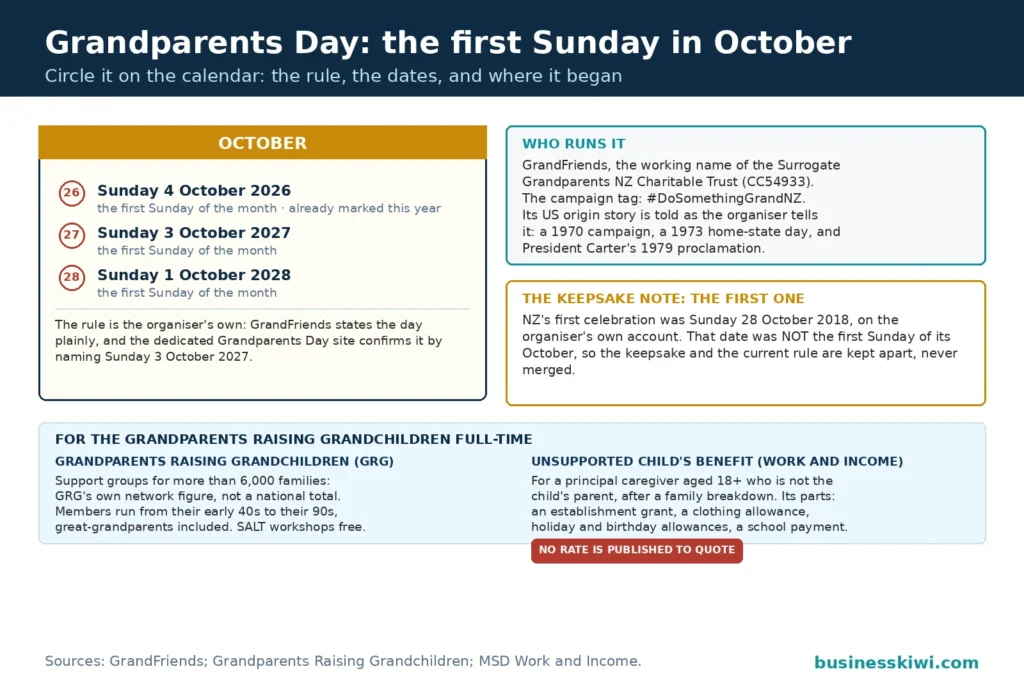
In New Zealand, Grandparents Day is marked on the first Sunday in October each year. That is the date rule stated by GrandFriends, the organiser behind the day here, on its own website.
Because the rule follows a weekday rather than a fixed calendar date, the actual date moves a little from year to year:
- 2026: Sunday 4 October 2026
- 2027: Sunday 3 October 2027
- 2028: Sunday 1 October 2028
Those dates are worked out from the rule, not copied from a calendar of observances. The organiser’s homepage supports the pattern: at the time of writing it names Sunday 3 October 2027 as the next date, which is the first Sunday of October that year. Anyone reading this in October 2026 should note the day has already passed for this year, on 4 October. The next opportunity is 3 October 2027.
Two points of confusion are worth clearing up. Other countries use different dates, so an overseas date does not apply here. And the first New Zealand celebration, in 2018, was held on Sunday 28 October. That inaugural date is not the rule that applies now.
Who is behind the day, and what is it for?
The day is promoted in New Zealand by GrandFriends, the working name of the Surrogate Grandparents New Zealand Charitable Trust, registered charity CC54933. The trust runs the dedicated New Zealand Grandparents Day website as one of its initiatives, under the campaign line #DoSomethingGrandNZ.
The purpose, as the organiser frames it, is to celebrate what grandparents bring to the lives of New Zealand children, whether they are grandparents by family connection or grandparents by love. That second phrase matters to its wider work. GrandFriends connects families who do not have older people nearby with older New Zealanders who would like that kind of connection, so both sides can share time, support and memories. On its homepage the trust puts it in terms of a village: some families do not have one ready made, and it helps them build one.
For most families the day is about their own grandparents. For the organiser, it is also about older people with no grandchildren close by, and children with no grandparents close by, and the good that can come from bringing them together.
Where the day came from
The organiser’s own account traces the idea to the United States in the 1970s. In that account, a West Virginia woman, Marian Lucille Herndon McQuade, began campaigning in 1970 for a day honouring grandparents, launched one in her home state in 1973, and wanted a family occasion built around small gatherings, reunions and community events rather than anything commercial. The organiser records that in 1979 President Jimmy Carter proclaimed a national day in the United States, set there for the first Sunday after Labor Day. That is the organiser’s telling of the American origin, presented here as the organiser states it.
New Zealand’s starting point is clearer and more recent. Following the Australian example, as the organiser puts it, New Zealand held its first Grandparents Day on Sunday 28 October 2018. There was no long local tradition before that date. It arrived here as a modern, community led observance, promoted by a small charitable trust, and it has been marked each October since. That short history explains its shape today: still growing, organised by community groups rather than government, and marked very differently from town to town.
How schools, early childhood services and communities mark it
The organiser’s Get Involved page sets out what it asks each type of group to do, and that is the best guide to how the day is actually marked.
Schools and early childhood education centres are invited to bring grandparents in to join ordinary activities, and to use the organiser’s classroom resources around the theme of the day. One suggestion is a mufti day with a twist, where children dress as a grandparent and bring a gold coin donation. The organiser also recognises a timing problem: the first Sunday in October often falls in the school holidays. Its answer, on its homepage, is for schools to mark the day once the new term has started.
Community groups such as libraries, playgroups and community centres are encouraged to put on a display or run activities across the week, and to team up with a local early childhood service or retirement home if their own group has no grandparents, or no grandchildren, to include. Retirement villages are asked to invite grandchildren in, perhaps for afternoon tea, or to arrange for residents to visit a local kindergarten instead. Workplaces are included too: the organiser suggests a workplace version of the dress as your grandparent idea, with a gold coin donation and a prize for the best effort, and it offers a poster that schools, services, workplaces and community centres can print and display.
The organiser’s early events listings include an intergenerational morning in Hamilton, run with Age Concern Hamilton, and an intergenerational coffee and playgroup in Auckland where retirement home residents joined families. Those listings are from the early years, not a current programme, but they show the model: a local group hosts, and generations mix.

Ways to mark the day at home
The ideas below come from the organiser’s own published lists for families, with two suggestions of our own clearly marked as such.
- Get the board games out. The organiser favours the traditional end of the cupboard, games such as Ludo and Draughts, or a jigsaw puzzle everyone can work on together.
- Bake something together, or bake a cake for a grandparent and deliver it. Cooking appears in a second form too: learn to cook a meal alongside a grandparent, then cook it for them another weekend.
- Go for a walk together. Try a new track, or let a child lead the way and show a grandparent their favourite local places.
- Read together. A trip to the library, a pile of picture books, or a child choosing books from their own shelf to share.
- Make a time capsule. Gather small items from a grandparent’s generation, a parent’s generation and today, and put them away together for a future generation to open.
- Start a family tree. A grandparent is often the person who knows which names belong where, and what the stories behind them are.
Two further ideas are suggestions from us, not organiser traditions. A card or letter written by a child is often kept for years in a way a bought gift is not. And a short family history session, asking a grandparent about their childhood or first job, then writing the answers down or recording them with permission, turns a visit into something the family still has decades later.
Grandparents in New Zealand family life
For many children, a grandparent is a regular caregiver in the practical sense: school pickups, cover for a shift change, grandchildren after school or help in the holidays. For others the role is less frequent but just as important, as keeper of family stories, recipes, reo and connections to relatives a child may never meet.
The organiser’s work points to the gaps as well. Some families have moved away from where they grew up, and some older people have no grandchildren nearby at all. GrandFriends was set up for that situation, connecting families and older people locally in person or online across the country. The day is therefore not only for families who already have grandparents on hand. It is also a reminder that the relationship is worth having, and can be built.
When grandparents are raising the grandchildren
There is a second, harder reality behind the celebrations, and a complete guide should not skip it. Some grandparents are not helping out. They are parenting again, full time, usually because something has gone seriously wrong in the middle generation.
Grandparents Raising Grandchildren Trust NZ, known as GRG, is the national charitable trust supporting those caregivers. On its Our Mahi page, GRG describes how, for most grandparents in this position, taking on the children follows an unexpected and traumatic event, and means a significant readjustment to their lives and to the children’s lives. Its membership spans all socio-economic levels and many ethnic communities, members range in age from their early 40s to their 90s, and they include great-grandparents raising great-grandchildren.
The scale GRG itself publishes is about its own network, not a national total. It describes a nationwide network of local support groups providing grassroots support and fellowship to more than 6,000 grandparent and whānau member families. This article does not put a national figure on how many New Zealand children are raised by grandparents, because no permitted source read in full for it published a current figure we could stand behind. Any precise total quoted elsewhere should be checked back to who published it and when.
What GRG offers, on its own account, falls into four areas:
- Financial and legal advocacy, one to one, which GRG calls vital for its member families.
- Local support groups around the country, through its regional and local network.
- Research and publications, aimed at keeping law, policy and child welfare practice up to date with how family life is changing.
- Education and training, including its free SALT workshop programme, designed for caring for children affected by trauma, alongside training from other providers.
GRG also provides community outreach and advocates with specialist knowledge to help caregivers at each step. Its services are for grandparents and whānau caregivers raising children full time. Anyone in that position who has not heard of GRG is the person this section is really for.
Support with the cost: Unsupported Child’s Benefit
Money is one of the pressures those caregivers face, and the main state support designed for this situation is the Unsupported Child’s Benefit. This is general information only, taken from the Ministry of Social Development’s official policy guide, and entitlement always depends on individual circumstances.
In outline, the benefit is paid to the main caregiver of a child whose parents cannot care for or fully provide for them because of a breakdown in the child’s family. The caregiver must not be the child’s natural parent, adoptive parent or step-parent, must be aged 18 or older, must be the principal caregiver or principal temporary caregiver, and must be a New Zealand citizen or a residence class visa holder. Caregiver and child generally need to be ordinarily resident in New Zealand. MSD’s material bases the rate on the child’s age, but rates change, so this article does not quote a dollar figure. Anyone who thinks they may qualify should check current rates and criteria with Work and Income directly, or ask GRG’s advocacy service to help them work through it.
The same official guide records related extra help that comes with the benefit: an Establishment Grant to be considered when the benefit is granted, a Clothing Allowance granted automatically, and Holiday and Birthday Allowances paid each year to help with celebration costs. A School and Year Start-up Payment may also apply early in the year. These details are easy to miss at a stressful time, which is one reason GRG puts financial advocacy at the centre of its work.
A short note for schools and workplaces planning ahead
Plan around two facts. First, the date moves: check the first Sunday in October for the year you are planning. Second, that Sunday will often land in the school holidays, or when your building is shut. Schools can mark it in the first week back of term, using the organiser’s poster and downloadable certificate. Workplaces can use the poster, or the fundraiser idea above, on the nearest working day. A display, an invitation and an hour of shared activity is the scale the organiser describes.
Frequently asked questions
When is Grandparents Day in New Zealand in 2026, 2027 and 2028?
It fell on Sunday 4 October 2026. It will fall on Sunday 3 October 2027 and Sunday 1 October 2028. All three are the first Sunday in October for their year, which is the rule the organiser, GrandFriends, states for New Zealand.
Is Grandparents Day a public holiday in New Zealand?
No. It is a community observance, not a public holiday. Shops, workplaces and services keep their usual Sunday arrangements, and there is no holiday pay attached to it.
Who organises Grandparents Day in New Zealand?
GrandFriends, the working name of the Surrogate Grandparents New Zealand Charitable Trust (CC54933). The trust runs the New Zealand Grandparents Day website and the #DoSomethingGrandNZ campaign, and publishes the resources, poster and certificate that schools and groups use.
When did Grandparents Day start in New Zealand?
The organiser records that New Zealand’s first Grandparents Day was held on Sunday 28 October 2018, following the Australian example. The date has since settled on the first Sunday in October, so the 2018 date should not be used to calculate future years.
What if we do not have grandparents nearby?
That is the situation GrandFriends was created for. It connects families with older people who would like a grandparent style relationship, locally in person or online across New Zealand. Community events have also invited local retirement home residents to join, so a child without grandparents nearby can still take part.
How can a school mark the day if it falls in the holidays?
The organiser suggests marking it once term has restarted. Inviting grandparents into classrooms, using its themed resources, holding a dress as your grandparent mufti day with a gold coin donation, or putting up its poster are the options it publishes.
Where can grandparents who are raising grandchildren get help?
Grandparents Raising Grandchildren Trust NZ supports full time grandparent and whānau caregivers with local support groups, financial and legal advocacy, information and training, including its free SALT workshops for caring for children affected by trauma. Its Our Mahi page describes support for more than 6,000 member families through its support group network. For income support, Work and Income is the place to check Unsupported Child’s Benefit eligibility and current rates.
Do other countries celebrate on the same date?
No. The organiser notes the day is now marked around the world at different times of year, and gives the United States date as the first Sunday after Labor Day. Use the New Zealand rule, the first Sunday in October, for anything planned here.
Sources
- GrandFriends (Surrogate Grandparents New Zealand Charitable Trust), grandfriends.nz: Seven ways to celebrate Grandparents’ Day (New Zealand date rule, United States origin as the organiser states it, family activity ideas)
- New Zealand Grandparents Day (GrandFriends / Surrogate Grandparents New Zealand Charitable Trust), newzealandgrandparentsday.org: Homepage (purpose of the day, grandparents by blood or by love, Sunday 3 October 2027 as the next date, advice for schools on marking the day after the holidays)
- New Zealand Grandparents Day, newzealandgrandparentsday.org: About, The Story of New Zealand Grandparent’s Day (United States origin as the organiser states it, inaugural New Zealand celebration on Sunday 28 October 2018)
- New Zealand Grandparents Day, newzealandgrandparentsday.org: Get Involved / Join (schools and early childhood centres, communities, workplaces, retirement homes and families; charity number CC54933)
- New Zealand Grandparents Day, newzealandgrandparentsday.org: Resources (poster for schools, ECE, workplaces and community centres, grandparent certificate, #DoSomethingGrandNZ)
- New Zealand Grandparents Day, newzealandgrandparentsday.org: Events (early intergenerational events in Hamilton with Age Concern Hamilton and in Auckland)
- GrandFriends, grandfriends.nz: Homepage (connecting families and older people, creating a village where a family does not have one)
- Grandparents Raising Grandchildren Trust NZ, grg.org.nz: Our Mahi, Support Services for Grandparents Raising Grandchildren (full time kinship care, member ages and diversity, support groups for more than 6,000 families, advocacy, research and SALT training)
- Ministry of Social Development, Work and Income MAP (Guide to Social Development Policy), workandincome.govt.nz: Orphan’s Benefit and Unsupported Child’s Benefit, Qualifications (caregiver age, citizenship and residence criteria, not a natural, adoptive or step-parent, family breakdown test, Establishment Grant, Clothing Allowance, Holiday and Birthday Allowances)
This article is general information about an annual observance and about support services for grandparent caregivers in New Zealand. It is not legal, financial or welfare advice. Benefit eligibility and payment rates depend on individual circumstances and change over time, so check the current position with Work and Income or the Ministry of Social Development before acting. Details of Grandparents Day events and resources can also change, so confirm them on the organiser’s website, newzealandgrandparentsday.org, or grandfriends.nz.