Home Loan Rates NZ: NZ Costs, Requirements & Practical Guide
Home loan rates in NZ right now
Quick answer (rates as at 1 October 2026): The Reserve Bank’s Official Cash Rate (OCR) is 2.75%, set on 2 September 2026, with the next review scheduled for 28 October 2026. Advertised fixed home loan rates at the five main banks, ANZ, ASB, BNZ, Kiwibank and Westpac, ranged from 4.79% to 6.49% depending on the fixed term, and floating (variable) rates sat around 6.25% to 6.49%. Most of the lowest advertised fixed rates are “special” rates that generally require at least 20% equity in the property. Rates change frequently, sometimes weekly, so treat every figure on this page as a dated snapshot, not a quote.
| Loan type | Advertised range at main banks | As at |
|---|---|---|
| 6 months fixed | 4.79% – 4.89% p.a. | 1 Oct 2026 |
| 1 year fixed | 4.99% – 5.19% p.a. | 1 Oct 2026 |
| 18 months fixed | 5.29% – 5.45% p.a. | 1 Oct 2026 |
| 2 years fixed | 5.29% – 5.45% p.a. | 1 Oct 2026 |
| 3 years fixed | 5.45% – 5.59% p.a. | 1 Oct 2026 |
| 4 years fixed | 5.49% – 6.39% p.a. | 1 Oct 2026 |
| 5 years fixed | 5.59% – 6.49% p.a. | 1 Oct 2026 |
| Floating (variable) | approx. 6.25% – 6.49% p.a. | late Sep – early Oct 2026 |
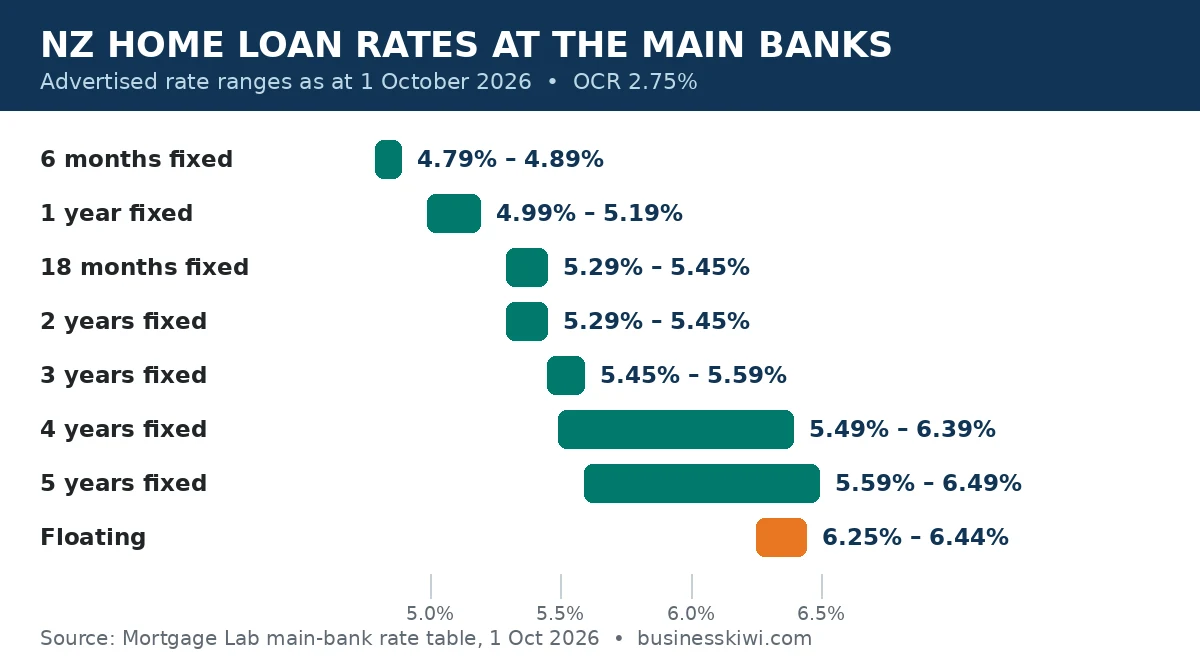
Source: advertised rates read from each bank’s own website (ANZ, ASB, BNZ, Kiwibank and Westpac), checked on 5 October 2026; the advertised card was unchanged from 1 October 2026. The floating range is the main banks’ published variable rates (for example, BNZ’s standard floating rate is 6.34%). The wider gap at four and five years partly reflects the fact that not every bank publishes a discounted “special” rate for every term: ANZ offers no special rate at four or five years, so its standard rates set the top of those ranges.
Fixed vs floating at a glance
| Fixed rate | Floating rate | |
|---|---|---|
| How the rate behaves | Locked in for the chosen term (6 months to 5 years); your rate and repayments stay the same for that term | Moves up or down when the lender reprices, usually following OCR changes |
| Typical level (Oct 2026) | Lower than floating across all terms as at 1 Oct 2026 | Higher, around 6.25%–6.49% at main banks |
| Repayment flexibility | Limited. Extra repayments may be capped, and breaking the term early can trigger an early repayment adjustment (break fee) | High. You can usually repay extra, or repay the loan in full, at any time without penalty |
| Main trade-off | Certainty of repayments, but less flexibility and break-cost risk if you sell or refinance mid-term | Full flexibility, but your repayments can rise at any time |
Many NZ home loans are split between fixed and floating, so the borrower gets some repayment certainty and some flexibility. How any individual loan is structured is a personal decision that depends on the borrower’s circumstances.
Fixed terms explained: 6 months to 5 years
When you fix, you are choosing how long you want the rate locked in for. The rate for each term is set on the day the fixed period starts (or the day you accept a rate lock, if your lender offers one), and it does not move again until the term ends, even if market rates rise or fall in the meantime.
- 6 months: the shortest common term. As at 1 October 2026 it carried the lowest advertised rates at the main banks (4.79%–4.89%). A short term reprices again soon, so your rate tracks the market more closely in both directions.
- 1 year: historically the most popular term in NZ. Advertised at 4.99%–5.19% at the main banks as at 1 October 2026. It balances a competitive rate against repricing reasonably often.
- 18 months: sits between the 1- and 2-year terms (5.29%–5.45% as at 1 October 2026). Some banks price it sharply to compete; BNZ held its 18-month rate at 5.29% in its 22 September 2026 repricing while lifting most other terms.
- 2 years: advertised at 5.29%–5.45% as at 1 October 2026. Offers two full years of repayment certainty.
- 3 years: 5.45%–5.59% as at 1 October 2026. Longer certainty, and less sensitivity to near-term rate movements.
- 4 and 5 years: the longest common terms. Advertised rates as at 1 October 2026 ranged widely (5.49%–6.39% for 4 years; 5.59%–6.49% for 5 years) because fewer lenders publish discounted specials at these terms. Long fixes maximise certainty but carry the largest potential break costs if you exit early, and you stay on the agreed rate even if market rates fall.
When a fixed term expires, the loan usually rolls onto the lender’s floating rate unless you re-fix or restructure it. Lenders typically let you arrange a new fixed rate shortly before the current term ends.
Floating, offset and revolving credit in plain English
A floating rate (also called a variable rate) can change at any time. In practice, lenders usually reprice floating rates soon after an OCR move. Floating loans allow unlimited extra repayments and full repayment at any time without penalty, which is why borrowers expecting a lump sum, for example from a property sale, bonus or inheritance, sometimes keep part of a loan floating.
An offset account links your everyday and savings accounts to your floating home loan. You pay interest only on the difference between the loan balance and the combined balance of the linked accounts. For example, a $500,000 floating loan with $50,000 held in linked accounts charges interest on $450,000. The linked money stays accessible, but it earns no interest itself. The benefit is the interest saved. Offset facilities are floating-rate products, so the higher floating rate (around 6.25%–6.49% in early October 2026) is part of the equation.
A revolving credit facility works like a large overdraft secured against your home, usually at a floating rate. You can draw down, repay and redraw up to an agreed limit, and interest is calculated on the daily balance. It suits borrowers with variable income who are disciplined about keeping the balance trending down, because there is no set repayment schedule forcing the balance to reduce.

How the OCR influences home loan rates
The OCR is the interest rate the Reserve Bank sets for overnight transactions with registered banks, and it anchors the whole structure of NZ interest rates. The Monetary Policy Committee reviews it eight times a year, aiming to keep inflation between 1% and 3%.
The OCR affects home loan rates through two channels:
- Floating rates follow it closely. When the OCR rises or falls, floating mortgage rates usually move by a similar amount within days or weeks.
- Fixed rates follow expectations. Banks fund fixed-term lending in wholesale markets, where prices (swap rates) reflect where traders expect the OCR to go over the coming years. That is why fixed rates often move before an OCR decision, and why longer fixed terms do not simply equal today’s OCR plus a margin.
The 2026 rate path shows both channels at work. The Reserve Bank cut the OCR to 2.25% on 26 November 2025, at the end of an easing cycle that began from a peak of 5.50% in August 2024. As inflation pressures re-emerged, annual inflation was 4.1% in the year data published in July 2026, above the 1–3% target band, the Reserve Bank raised the OCR to 2.50% on 8 July 2026 and again to 2.75% on 2 September 2026, stating it was increasing the OCR so inflation returns to 2%. Banks repriced fixed rates upward through August and September 2026 in response to rising wholesale rates, ahead of and alongside the OCR moves. The next OCR review is on 28 October 2026, and bank economists’ published forecasts for where the OCR ends 2026 differ. It is a reminder that the future path is uncertain in both directions.
The Reserve Bank also publishes the official record of the rates borrowers actually paid: its B30 statistics report the weighted average interest rates on new residential mortgage lending each month, across floating and fixed terms up to two years. Because B30 is published around 25 working days after each month ends, it always lags the rates being advertised today, but it is the most reliable check on what new borrowers paid in practice. Its companion tables, B20 and B21, record banks’ advertised standard and special rates at month end.
What affects the rate a borrower is offered
The advertised rate is a starting point. The rate in a specific loan offer depends on:
- Equity and LVR. LVR (loan-to-value ratio) compares the loan size to the property’s value. Lenders reserve their “special” advertised rates for lower-risk lending. ASB, for example, publishes its headline fixed rates for borrowers with a minimum of 20% equity. Borrowing with a small deposit can mean a standard (higher) rate, and sometimes a low equity premium or margin added on top, which is removed once equity builds to the lender’s threshold.
- Owner-occupied vs investment property. Investment lending is usually priced higher than owner-occupied lending and typically requires a larger deposit.
- Loan size and overall relationship. Larger loans and broader banking relationships sometimes attract sharper pricing or negotiated discounts off the carded rate. Advertised rates are not always the final price.
- Property and loan type. Construction loans, apartments, and non-standard properties can be priced or assessed differently.
- Credit history and servicing. A lender must be satisfied the loan is affordable. Even where a rate is advertised, approval depends on income, expenses, existing debts and credit history.
Reserve Bank lending rules also sit behind the scenes: banks must keep most of their new lending within loan-to-value ratio limits, which is one reason high-LVR lending is rationed and priced at a premium.
Costs beyond the interest rate
The interest rate is the biggest cost of a home loan, but it is not the only one. Depending on the lender and the loan, borrowers may also face:
- Establishment or application fees when the loan is set up, and fees for rate locks, top-ups or restructuring.
- Valuation costs if the lender requires a registered valuation of the property.
- Legal fees for conveyancing, payable to your own lawyer, plus the lender’s documentation requirements.
- Low equity premiums or margins for high-LVR lending (see above).
- Account and facility fees, such as monthly fees on revolving credit or offset facilities.
- Cashback clawbacks. Some lenders offer cash contributions toward costs. These commonly come with conditions: if you repay or move the loan within a set period (often around three years), some or all of the cashback must be repaid.
- Break fees if you end a fixed term early (explained next).
- Discharge and administration fees when the loan is fully repaid and the mortgage is removed from the title.
Fees vary between lenders and change over time, so the only reliable figures are those in the loan offer documents for the specific loan. Comparing loans on rate alone can be misleading: a slightly higher rate with no cashback conditions and lower fees can cost less over the fixed term than the headline-grabbing rate.
Worked example: what a rate difference actually costs
This is an example only, using round figures to show how repayments are calculated. It is not a quote or a prediction. It assumes the stated rate stayed the same for the full 30-year term, which does not happen in practice. Fixed rates are re-set at the end of each fixed term.
Example: a $600,000 home loan repaid over 30 years.
| Assumed rate | Monthly repayment | Total repaid over 30 years | Total interest |
|---|---|---|---|
| 5.35% p.a. | $3,350.48 | $1,206,174 | $606,174 |
| 4.99% p.a. | $3,217.26 | $1,158,215 | $558,215 |
The 0.36 percentage point difference between the two rates changes the repayment by $133.22 a month. Both example rates sit inside the advertised main-bank ranges as at 1 October 2026 (the 2-year fixed range was 5.29%–5.45%, and the 1-year range was 4.99%–5.19%). Most NZ borrowers repay fortnightly rather than monthly; the fortnightly equivalent of the 5.35% example is about $1,546.38. You can model different balances and rates with our compound interest calculator. A dedicated mortgage repayment calculator is in development and will be linked here when it launches.
Break fees: the cost of ending a fixed term early
If you repay a fixed-rate loan before the term ends, because you sell the property, refinance to another lender, or repay a lump sum above any allowed limit, the lender may charge an early repayment adjustment, commonly called a break fee.
The break fee is not a flat penalty. It is calculated from the movement in wholesale interest rates between when you fixed and when you break, applied to your loan balance and the time left on the term. In plain terms:
- If wholesale rates have fallen since you fixed, the lender is losing the higher rate it locked in, and the break fee can be substantial, sometimes thousands of dollars on a typical loan with years left to run.
- If wholesale rates have risen since you fixed, the break cost may be small or zero, because the lender can re-lend the money at a similar or better rate.
The calculation is lender-specific and changes daily with wholesale rates, so the only way to know the figure is to ask the lender for a break cost quote on the day. Anyone thinking of selling or refinancing mid-term should get that quote before making commitments, because it is a real cost of moving.
How to compare home loan rates properly
- Compare on the same day. Rates moved repeatedly through August and September 2026. A rate quoted from last month’s news article is not a current rate. Use the rate pages on the lenders’ own websites, checked the same day, and re-check before you commit.
- Check whether you qualify for the “special”. Headline rates usually require at least 20% equity, an owner-occupied property and sometimes your everyday banking with the lender. If you don’t qualify, the standard rate applies. Compare the rate you would actually be offered.
- Add up the total cost over the fixed term. Rate × term, plus establishment fees, minus any cashback (after reading its clawback conditions). This is the fairest like-for-like comparison between lenders.
- Weigh flexibility, not just price. Offset and revolving credit facilities, extra-repayment allowances on fixed loans, and splitting the loan across terms all have value a rate table can’t show. Our Real Estate hub groups our property guides, and the investment calculator can help model deposit growth while you save.
- Think about the refix, not just the fix. Note when each fixed term expires. A loan split across terms reprices gradually; a single term reprices all at once.
What lenders require: the practical checklist
Whatever the rate, a lender will generally require:
- A deposit or equity: the gap between the purchase price (or property value) and the loan. Twenty percent is the threshold at which most “special” rates become available; smaller deposits are possible for some borrowers, including some first-home buyers, but usually at standard rates and possibly with a low equity premium.
- Proof of income and expenses: payslips or business financials for the self-employed, plus a detailed budget of living costs, debts and commitments. Lenders apply their own servicing calculations and buffers rather than simply lending a multiple of income.
- Identification and credit checks, as required under NZ lending and anti-money-laundering law.
- Property information: a sale and purchase agreement for a purchase, and sometimes a registered valuation.
- Insurance arrangements: lenders require the property to be insured, with the lender’s interest noted.
Approval, the amount offered and the final rate all follow from this assessment, which is why two borrowers can be offered different rates by the same bank on the same day.
Frequently asked questions
What is the current OCR in New Zealand?
The Official Cash Rate is 2.75%, set by the Reserve Bank on 2 September 2026. The next scheduled review is 28 October 2026.
What is a typical home loan rate in NZ right now?
As at 1 October 2026, advertised fixed rates at the five main banks ranged from 4.79% (6 months) to 6.49% (5 years, standard rate at one bank), with 1-year fixed rates at 4.99%–5.19% and 2-year rates at 5.29%–5.45%. Floating rates were around 6.25%–6.49%. These are advertised rates. The rate you are offered depends on your equity, the property and your circumstances, and rates change often.
Why are fixed rates lower than floating rates at the moment?
Fixed rates are priced from wholesale market rates, which reflect where markets expect the OCR to average over the fixed term. Floating rates are priced off today’s OCR plus a margin. When wholesale markets judge that current OCR settings are high relative to the expected average, or when competition for fixed-term lending is strong, fixed rates can sit below floating rates, as they did in October 2026.
Do advertised rates apply to everyone?
No. The lowest advertised rates are usually “specials” for owner-occupiers with at least 20% equity who meet the lender’s criteria. Borrowers with smaller deposits, or buying investment property, are generally offered standard rates, which are higher.
How often do home loan rates change?
As often as lenders choose to reprice. During August and September 2026, major banks changed fixed rates several times within a few weeks as wholesale rates moved. There is no set schedule, which is why any rate you read should carry a date.
Can I break a fixed term if rates fall?
Yes, but the lender may charge an early repayment adjustment (break fee) if wholesale rates have fallen since you fixed, because that difference is the lender’s loss on the contract. Ask for a break cost quote before deciding. It changes daily and can be large.
Where can I check what rates borrowers actually paid, rather than advertised rates?
The Reserve Bank’s B30 statistics publish the weighted average interest rates on new residential mortgage lending each month, based on lending that actually occurred. They appear about 25 working days after each month ends, so they lag advertised rates but reflect real transactions.
Sources
- Reserve Bank of New Zealand, The official cash rate (OCR 2.75%, updated 2:00pm, 2 September 2026; next update 28 October 2026): https://rbnz.govt.nz/monetary-policy/about-monetary-policy/the-official-cash-rate
- Reserve Bank of New Zealand, homepage key statistics (OCR 2.75%; inflation 4.1% y/y, updated 21 July 2026): http://www.rbnz.govt.nz/
- Reserve Bank of New Zealand, New residential mortgage weighted average interest rates (B30), methodology and coverage: https://www.rbnz.govt.nz/statistics/series/exchange-and-interest-rates/new-residential-mortgage-weighted-average-interest-rates
- ANZ, Home loan rates (special and standard fixed rates; floating rate): https://www.anz.co.nz/personal/home-loans-mortgages/loan-types/rates/
- ASB, Home loan interest rates and fees (special fixed rates published for borrowers with minimum 20% equity): https://www.asb.co.nz/personal/banking-with-asb/interest-rates-and-fees/home-loan
- BNZ, Compare BNZ home loan rates (advertised fixed rates and floating rates, including TotalMoney): https://www.bnz.co.nz/personal-banking/home-loans/compare-bnz-home-loan-rates
- Kiwibank, Home loan rates and fees (special and standard fixed rates; variable rate): https://www.kiwibank.co.nz/personal-banking/home-loans/rates-and-fees/
- Westpac, Home loan interest rates (Choices Fixed special and standard rates; Choices Floating): https://www.westpac.co.nz/home-loans-mortgages/interest-rates/
Rates and the OCR change over time. Figures on this page are stated as at the dates shown and were correct to the cited sources at the time of writing. This page is general information only and is not financial advice.