Professional Indemnity Insurance NZ: Cover, Claims-Made and Who Needs It

Sell your judgement for a living and you carry a particular kind of risk. A surveyor misreads a boundary. An accountant’s tax advice turns out to be wrong. A design flaw surfaces two years after the building opened, and the client’s lawyer starts using words like negligence. The work was done in good faith, but good faith does not pay legal bills.
Professional indemnity insurance, usually shortened to PI, exists for exactly this. It responds when a client (or another third party) claims your professional advice or services caused them a financial loss, and it pays the legal costs of defending you as well as any damages or settlement you become liable for.
This guide covers what PI does and does not do, the claims-made mechanics that trip people up, who actually has to have it in New Zealand, and how to compare policies that look alike on the quote page and behave very differently when a claim lands.

What professional indemnity insurance covers
The heart of a PI policy is a civil liability insuring clause. DUAL New Zealand’s professional indemnity wording, written for Lloyd’s underwriters and used here as a worked example, promises to pay loss from a claim for civil liability first made against the insured and reported to the insurer during the insurance period, arising out of the conduct of the professional business.
In plain terms, a typical PI policy responds to:
- Negligence claims. A client alleges you failed to exercise the care and skill expected of your profession and they lost money as a result.
- Errors and omissions. The missed deadline, the wrong figure in the report, the clause left out of the contract.
- Breach of professional duty. Claims framed as a breach of the duty you owe your client, including some breach of contract claims tied to your services.
- Defence costs. Legal fees, expert evidence and investigation costs of defending a covered claim. In DUAL’s wording these are paid in addition to the indemnity limit, up to a matching amount, and advanced as bills come in rather than reimbursed at the end.
- Claims connected with your team. Cover usually extends to principals, partners, directors and employees acting in the business, to claims arising from consultants and subcontractors you are liable for, and commonly to former principals and employees.
On top of the core clause, wordings typically add automatic extensions: unintentional defamation, unintentional infringement of intellectual property rights, breach of confidentiality, compensation claims under sections 9 to 14 of the Fair Trading Act 1986, employee dishonesty (protecting innocent parties), lost documents, and the costs of attending an official investigation or disciplinary hearing. That last one matters more than people expect. The DUAL real estate wording, for example, can cover compensation ordered by the Real Estate Agents Disciplinary Tribunal.
What PI does not cover
PI is not a general safety net, and the gaps are where disputes start.
- Fines and penalties. The DUAL wording’s definition of loss leaves out taxes, fines and penalties, along with punitive and exemplary damages. Regulatory cover, where it exists, usually sits in a separate statutory liability policy.
- Deliberate and dishonest conduct. Your own fraud or intentional wrongdoing is excluded. Cover for other people’s dishonesty usually protects innocent insureds only.
- Things you already knew about. Claims, and circumstances you knew might produce one, from before the policy started are the classic exclusion. This prior knowledge trap is why the notification rules below matter so much.
- Injury and property damage. A visitor who trips in your office, or a contractor who floods a client’s premises, is public liability territory. PI is about financial loss from your professional work.
- Your own income. PI pays claimants and lawyers, not you. If illness or injury stops you working, that is what income protection is for.
Claims-made cover: the part everyone gets wrong
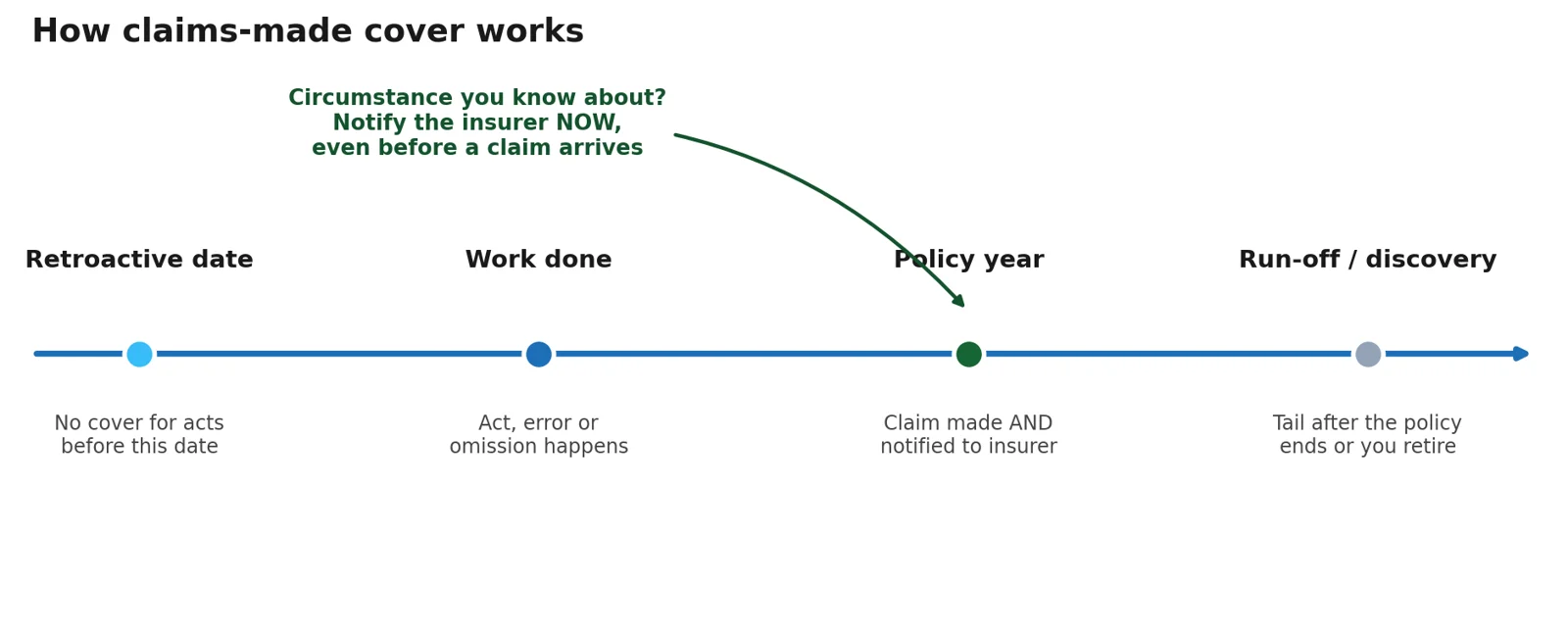
House and car insurance generally respond to events that happen while the policy is current. PI works the other way around. It is claims-made cover: the trigger is a claim being made against you, and notified to your insurer, during the current policy period, regardless of when the work was done. Insurers call this claims made and notified, and the DUAL insuring clause quoted above is written in exactly those terms.
Three consequences follow.
First, you can do the work in 2026, let the policy lapse in 2028, and be completely exposed if the claim arrives in 2029. The policy you held while doing the work is irrelevant if no claim was made and notified under it.
Second, gaps are dangerous. Let cover lapse, or switch insurers carelessly, and claims from earlier work can fall between two policies, each insurer legitimately saying the claim belongs in the other’s period.
Third, the wording defines a claim more widely than most people assume. In the DUAL wording it covers a civil proceeding, a written or verbal demand for money, and also any circumstance you become aware of that a reasonable person would think may give rise to a claim. That third limb pulls your notification duty forward in time, well before anyone threatens court.
The retroactive date
Because claims-made policies reach backwards, insurers control that reach with a retroactive date in the policy schedule. The DUAL wording is blunt: cover applies only to an act, error or omission committed after the retroactive date.
If your retroactive date is the day you first bought PI, earlier work is uninsured even if the claim arrives tomorrow. Some wordings instead offer unlimited retroactive cover, where no date applies. Woodina Underwriting’s accountants PI wording spells out both settings: unlimited where no date is specified, limited where one is, with claims then restricted to acts after that date.
Practical points worth checking:
- When you switch insurers, make sure the new retroactive date is no later than the old one, or that you get unlimited retroactive cover. A cheaper premium bought with a reset date quietly deletes your work history.
- When you buy or merge a practice, check whose past work is covered and whose is not.
Notifying circumstances: do not wait for the claim
The most expensive mistake PI policyholders make is sitting on bad news. You discover the error, hope the client has not noticed, renew in the meantime, and a year later the claim arrives. By then you may be with a different insurer: the new one can point to the prior knowledge exclusion, the old one to the fact the claim was never notified in its period.
The fix is built into the product. Notify your insurer of circumstances that might give rise to a claim as soon as you become aware of them, in the policy period in which you become aware. That notification anchors the future claim to the current policy. The DUAL wording even includes an hour of free advice from a panel solicitor for an accepted notification of circumstances, which tells you how strongly insurers prefer early warning over surprises.
One safety valve exists if you stay put: continuous cover clauses. Under DUAL’s version, if you became aware of circumstances in an earlier period and failed to notify, the insurer will still respond when the claim arrives, provided it insured you when you first became aware, has insured you continuously since, and there was no fraudulent non-disclosure. Switch insurers midstream and the safety valve disappears. Continuity is a genuine reason to think twice before chasing a small premium saving.
Run-off cover: the tail after you stop
Claims-made cover has a tail problem. Professional work can be challenged years after it is finished, so the day you retire, sell your practice or close the business is the day your exposure is longest, not shortest. Run-off cover is PI that stays in force after you stop practising, responding to claims about work done before you stopped.
CA ANZ makes the point in its guidance on selling a practice: PI claims can arise up to seven years after the act or omission occurred, and it advises New Zealand members to obtain run-off cover so their personal assets are not exposed. Estates can be claimed against too; some wordings extend cover to heirs and legal representatives.
Wordings build the tail in different ways. The DUAL wording’s discovery period clause gives a free 30-day window after the policy ends to notify claims first made before expiry, a 12-month extension for an additional premium of 100 percent of the annual premium, and periods of up to 84 months where the business has been sold, merged or wound up insolvent. Dedicated run-off policies bought at retirement work the same way. Ask how long the tail is, whether the premium is one-off or annual, and whether the tail limit matches your practising limit.
Who has to have PI in New Zealand?
There is no single law saying professionals must hold PI. The obligation arrives by several routes, and it pays to know which one applies to you.
Required by law: conveyancers. Registered conveyancing practitioners and incorporated conveyancing firms must hold PI to a minimum cover amount of $1.2 million. The requirement sits in Part 6 of the Lawyers and Conveyancers Act (Conveyancers: Registration and Practice) Regulations 2008, and the New Zealand Society of Conveyancers runs a master policy members can use.
Required by the professional body: chartered accountants in public practice. CA ANZ’s requirements for a Certificate of Public Practice in New Zealand include having current and appropriate PI in place. Lose the cover and you put the certificate, and the right to offer accounting services to the public as a CA, at risk.
Not compulsory, but disclosure is: lawyers. New Zealand is unusual here. The New Zealand Law Society confirms lawyers are currently not required to hold PI insurance, which puts this country out of step with comparable jurisdictions. What lawyers must do, under rules 3.4(b) and 3.4A(b) of the Rules of Conduct and Client Care, is tell clients whether they hold cover meeting the Law Society’s minimum standards (currently the greater of $1.2 million per practice or $900,000 per partner or director), hold less than that, or hold none. The Law Society consulted the profession in 2025 on making PI compulsory, so this setting may change.
Not a licence condition: financial advisers. When the current advice regime was designed, the Financial Markets Authority considered making PI a standard condition of a Financial Advice Provider licence and decided against it, citing feedback on cost, availability and likely benefit to consumers. The FMA still asks whether a provider holds PI, calling it good business practice, and its Regulatory Impact Statement notes many product providers require PI under their agency agreements anyway. For most advisers, the market imposes what the regulator did not.
Coming for building design professionals: architects and engineers. Neither profession currently faces a general statutory PI mandate. The Registered Architects Board’s rules require agreed terms of appointment, which may include provision for PI, and Engineering New Zealand tells recognised dam safety engineers they should hold PI and public liability. That is set to shift: in November 2025 the Ministry of Business, Innovation and Employment announced that the move to proportionate liability in the building sector will be paired with requiring design professionals, such as architects and engineers, to hold PI. Check the current state of that reform before relying on either position.
Required by contract, whatever the law says. Government and large clients routinely make PI a condition of engagement. NZ Transport Agency Waka Kotahi, for example, requires consultants doing design work under its professional services contracts to hold PI cover. For many consultancies, the real answer to “is PI compulsory?” is that their biggest client has already decided.
PI vs public liability vs statutory liability
These three liability covers are constantly confused, and the confusion is expensive when a claim lands in the wrong policy. They answer different questions, and sit together in the wider liability package described in our guide to business insurance.
| Cover | What triggers it | Typical claim |
|---|---|---|
| Professional indemnity | A client claims your advice, design or professional service caused them financial loss | Negligent report, wrong advice, missed deadline, defective design |
| Public liability | You are liable at common law for injury to a third party or damage to their property in the course of your business | Customer injured at your premises, your team damages a client’s property |
| Statutory liability | You face prosecution or an official investigation for an unintentional breach of a New Zealand statute | Defence costs for a prosecution under building, fair trading, privacy or resource management law |
The ACC system shapes the public liability row. Because ACC covers personal injury in New Zealand, public liability here leans towards property damage and the injury costs ACC does not reach. NZTA puts the test simply: cover where you are judged liable under common law for injury or damage to a third party because you breached your duty of care.
Statutory liability has one hard limit. It can cover defence costs and, where the law allows, penalties and reparation for inadvertent breaches of most statutes. It cannot cover fines under the Health and Safety at Work Act 2015: section 29 makes insurance against those fines unlawful and of no effect.
A consultant engineer might need all three policies: PI for design work, public liability for site visits, statutory liability for the regulatory exposure after an incident. A desk-based adviser might need PI and little else. The mix follows the work, not a template.
What affects the cost?
No regulator or insurer publishes average PI premiums, and any article quoting a typical price is guessing, so this guide will not. What can be explained is what underwriters price on.
- Your profession and the work mix within it. Insurers rate the activity, not the job title. An accountant doing audit and insolvency work is a different risk to one doing bookkeeping, and underwriters ask for the split.
- The limit of indemnity. Higher limits cost more. Set the limit by your largest plausible claim, your professional body’s minimums and your client contracts, not by a round number.
- Fees, headcount and claims history. Premium usually scales with revenue and the number of professionals covered, and a recent claim, or a clutch of notifications, will be priced in for years. A clean record is worth money.
- Retroactive scope. Unlimited retroactive cover costs more than a policy with a recent retroactive date, because the insurer is taking on more history.
- The excess. A higher excess lowers the premium and raises what you pay towards each claim. Check whether defence costs fall inside the excess or outside it.
- The run-off tail. Stopping practice safely costs money, as a discovery period extension or a standalone run-off policy, and it should be budgeted into closing or selling a practice.
How to compare policies
Quotes are easy to compare on premium and limit, and nearly meaningless on those two numbers alone. Work through this checklist in the wording and schedule instead.
- Retroactive date. Is past work fully covered, or only work after a stated date? Does moving to this insurer preserve your existing date?
- Defence costs and limit structure. Are defence costs paid in addition to the limit or deducted from it? A $1 million limit with costs inside it is a smaller promise than it looks. Is the limit any one claim or a yearly aggregate, and how many reinstatements are there?
- Extensions that match your risks. Disciplinary and investigation costs if your profession has a regulator. Fair Trading Act cover if clients are consumers. Fidelity cover for employee dishonesty if staff handle money.
- Exclusions and sub-limits. Prior knowledge, contractual liability you have voluntarily taken on, work for related parties, and profession-specific exclusions such as particular building materials or project types.
- Notification conditions. How quickly must you notify claims and circumstances, and in what form? Treat these as obligations, not admin.
- Continuity and switching terms. Is there a continuous cover clause, and what do you give up by moving? If you switch, notify every known circumstance to the outgoing insurer first.
- Run-off availability. Can you buy a discovery period or run-off term at the end, and for how long?
- Who is insured. Does the wording pick up former principals and employees, new subsidiaries, and contractors you are liable for?
Two closing habits are worth more than any single clause. Keep every old schedule and wording when you renew or switch, because which policy responds can be argued about years later. And if a claim decision goes against you, remember the policyholder’s backstop: the Insurance and Financial Services Ombudsman Scheme is a free, independent dispute service for complaints about insurers, who must belong to an approved scheme. Its complaint limit was lifted to $500,000 by regulation in 2024, putting most claim disputes within reach of a free process rather than a courtroom.
The bottom line
PI looks like paperwork until the first serious claim, when it becomes the only thing between a professional mistake and your personal balance sheet. Get the mechanics right: continuous cover, a retroactive date that reaches your earliest work, circumstances notified early, and a funded plan for the run-off tail. Then the premium argument becomes what it should be, a comparison of promises, not prices.
This article is general information about how professional indemnity insurance works in New Zealand, not financial advice. Wordings differ between insurers and professions, so check your own policy and schedule, and talk to your professional body or an insurance broker about the cover your situation needs. More guides for Kiwi businesses are in our Finance, Tax and Money hub.
Sources
- DUAL New Zealand, Professional Indemnity Real Estate Policy Wording (Mind The Gap, 02.18), underwritten at Lloyd’s: https://nz.dualinsurance.com/hubfs/DUAL%20ANZ/DUAL%20New%20Zealand/NZ%20policy%20wording/DUAL-NZ-PI-Real-Estate-Wording.pdf
- Woodina Underwriting Agency, Accountants Professional Indemnity Policy Wording (06_21): https://underwriting.woodina.com.au/documents/wordings/Accountants_PI_Wording_06_21.pdf
- New Zealand Society of Conveyancers, Professional Indemnity Insurance: https://nzsconveyancing.co.nz/professional-indemnity-insurance
- Chartered Accountants Australia and New Zealand, Certificate of Public Practice requirements: https://www.charteredaccountantsanz.com/member-services/member-obligations/certificate-of-public-practice-reviews-and-compliance/certificate-of-public-practice
- Chartered Accountants Australia and New Zealand, How to maximise value when you sell your practice (run-off guidance): https://www.charteredaccountantsanz.com/member-services/mentoring-and-support/professional-and-ethical-support/practical-ethics-advice-series/how-to-maximise-value-when-you-sell-your-practice
- New Zealand Law Society, Questions and Answers: Professional indemnity insurance consultation: https://www.lawsociety.org.nz/about-us/consultations/consultation-on-professional-indemnity-insurance-requirements/questions-and-answers-professional-indemnity-insurance-consultation/
- Financial Markets Authority, FMA releases standard conditions for licensing of financial advice (6 November 2020): https://www.fma.govt.nz/news/all-releases/media-releases/fma-releases-standard-conditions-for-licensing-of-financial-advice/
- Financial Markets Authority, Regulatory Impact Statement: Standard conditions for financial advice provider licences: https://www.fma.govt.nz/assets/RIS/FAP-standard-conditions-full-licence-RIS.pdf
- Ministry of Business, Innovation and Employment, New liability rules for the construction sector to improve consumer protection (November 2025): https://www.mbie.govt.nz/about/news/new-liability-rules-for-the-construction-sector-to-improve-consumer-protection
- NZ Transport Agency Waka Kotahi, Professional services insurance requirements: https://www.nzta.govt.nz/roads-and-rail/highways-information-portal/technical-disciplines/insurance/professional-services
- Health and Safety at Work Act 2015, section 29 (Legislation New Zealand): https://www.legislation.govt.nz/act/public/2015/70/en/2017-12-21.pdf
- Insurance and Financial Services Ombudsman Scheme, About the IFSO Scheme: https://www.ifso.nz/about-us
- Insurance and Financial Services Ombudsman Scheme, IFSO Scheme marks 30 years (complaint limit $500,000): https://www.ifso.nz/media-releases/ifso-scheme-marks-30-years-of-independent-fair-and-free-dispute-resolution