The Complete Guide to New Zealand Work Visa Sponsorship
New Zealand is always one of the best places to live and work. It’s easy to see why people from all over the world want to move to New Zealand. The South Island has beautiful scenery, and Auckland and Wellington have lively city cultures. But there is one important thing that connects dreaming of a “Kiwi” life and actually getting off the plane at Auckland International Airport: the visa.
It can be hard to understand immigration systems, like learning a new language. For most foreign workers, the only way to get a permanent or temporary job is to get a job with a company that is willing and able to sponsor them. The first step in making your plans to move to New Zealand a reality is to learn about the requirements for sponsoring a work visa.
This guide has more than just the basic checklists. We will explain in detail how the sponsorship system works, what the “Accredited Employer Work Visa” means for you, and give you useful tips on how to find those hard-to-find sponsoring employers.
What do you need to get a work visa for New Zealand?
Most of the time, to get a work visa in New Zealand, you need a job offer from a recognized employer, proof of your qualifications, and a clean health and character record.
There are many ways to get a visa, but most people will go through the Accredited Employer Work Visa (AEWV) scheme. Immigration New Zealand (INZ) has a set of basic requirements that all visa applicants must meet, no matter what type of visa they are applying for.
Health and Character
Before looking at your job skills, New Zealand wants to make sure you are healthy and have good morals.
- Health: A panel physician who is approved will probably need to do a chest X-ray and a general medical exam on you. This is to make sure you don’t have any health problems that would cost New Zealand’s health system a lot of money.
- Character: You need to show police certificates from any country where you have lived for at least five years since you turned 17. If you have a serious criminal record, you may not be able to enter right away.
The Job Offer
You can’t just apply for a sponsorship visa and then start looking for work. You need to have a written offer of a full-time job. In order to comply with New Zealand labor laws, the employment contract must contain certain clauses regarding hours, pay, and holidays.
Age Limit for New Zealand Work Visa
Is there a maximum age for New Zealand work visas?
As long as you can do the job and pass the medical checks, there is usually no strict age limit for temporary work visas like the AEWV.
But age is very important if you want to live in the country permanently. For example, the Skilled Migrant Category usually only lets people up to 55 years old in. You can still work on temporary visas if you are over 55, but your options for staying permanently may be more limited unless you are in a very specific niche role or investing money.
Learning about employer sponsorship
In the past, a lot of New Zealand employers could help with a visa application. The Accredited Employer system changed that. Now, the company has to prove that they can hire migrants.
Is it possible to become an accredited employer?
A letter from a boss saying, “I want to hire this person” is not enough for sponsorship. Immigration New Zealand must give the company its stamp of approval. This means the company has shown that they are a real, viable business.
- Have a history of complying with immigration and employment laws.
- Are dedicated to helping migrants settle in by giving them information about housing, the community, and other things.
“Is this company an Accredited Employer?” should always be your first question when you see a job ad. If they aren’t, they generally cannot support your work visa application.
The “Job Check” Requirement
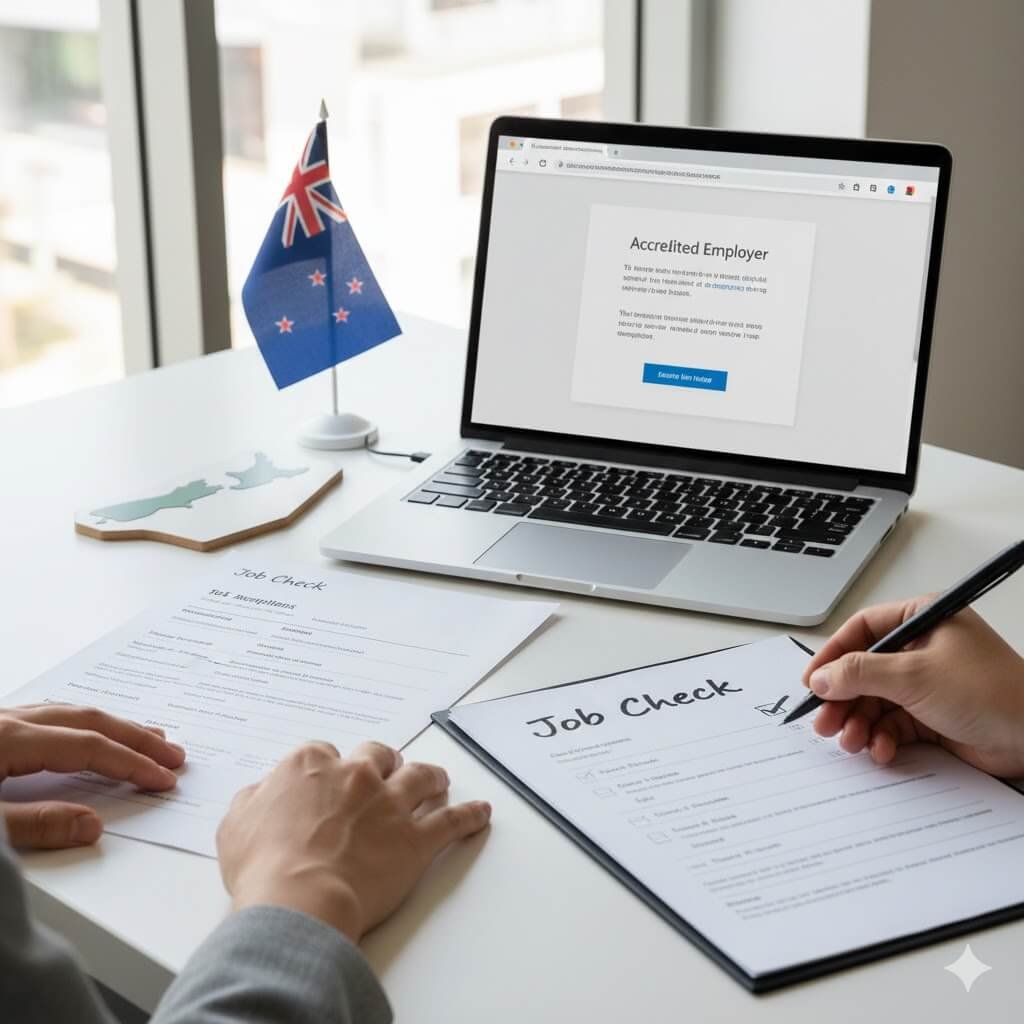
A company can’t just hire you right away, even if they are accredited. They need to pass a “Job Check” for the exact job they offered you. To do this, they have to show the government that they couldn’t find a New Zealand citizen or resident to do the job. They usually do this by putting up ads for the job in the area for a set amount of time.

The AEWV, or Accredited Employer Work Visa, is one type of visa
The AEWV is the most important temporary work visa. It is meant to make sure that New Zealanders are the first to get jobs and that employers can hire immigrants when there are real skill gaps.
Length of the Visa
You might come across searches for “New Zealand 2 year work visa” or “New Zealand 3 year work visa requirements.” Your pay rate and the type of job you have will determine how long your visa is good for.
- Maximum Length of Stay: The longest visa length is currently up to 5 years for most jobs that pay at least the median wage.
- Sector Agreements: Some jobs in certain fields, like care work, construction, or meat processing, may have different rules about how long they last or how much they pay. Sometimes, these are only good for a short time (like two or three years), and there are rules about how long you have to leave the country before you can apply again.
The “Green List”
If your job is on the “Green List,” which is a list of highly skilled jobs that are hard to fill (like doctors, engineers, and ICT professionals), you may have a big advantage. If you have a Green List job, you may be able to get a Straight to Residence or Work to Residence path, which means you won’t have to worry about renewing your temporary visa.
Apply for a New Zealand Work Visa Online: The Steps
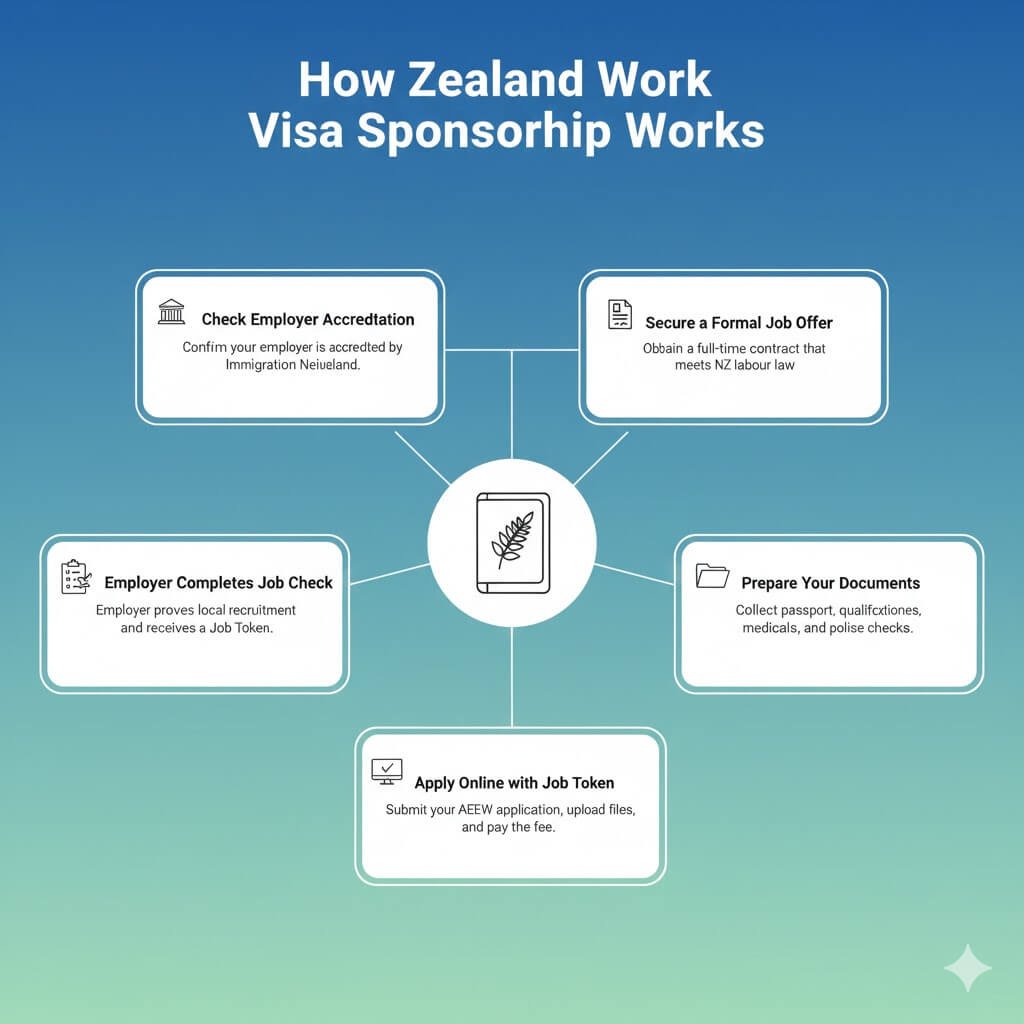
The first step in getting a visa is to apply online. This is how sponsorship really works in order.
Step 1: Get the Job Offer
You have an interview with a company that is accredited. They give you the job and a signed employment contract.
Step 2: The employer asks for the job check
You can’t apply for your visa right now. Your boss needs to send a Job Check to Immigration New Zealand. They will get a “Job Token,” which is a unique link or code, once this is approved.
Step 3: You Get the Invite
The employer gives you the Job Token. This is what you are “sponsoring.” It connects your application to their job check that has already been approved.
Step 4: Send in your application
You fill out the online form for a New Zealand work visa with the token. You can upload your here:
- Information about your passport.
- Police and medical records.
- References and a CV that show proof of qualifications and work experience.
- Picture.
Step 5: Pay the Fees
The cost of a New Zealand work visa depends on your citizenship and where you are applying from. There is usually an application cost and sometimes an immigration levy. Keep in mind that your employer usually pays for the costs of hiring you, but you are usually responsible for the visa application fee unless your employer agrees to pay it.
Step 6: Processing
The wait times are different. The process may take a few weeks to a few months. During this time, INZ may ask for more information.
Getting a job with a sponsoring company
This is usually the hardest part of the trip. A lot of people looking for work in New Zealand ask for a list of companies that can sponsor visas.
How to Find Employers Who Are Accredited
Immigration New Zealand has a public tool that lets you see if an employer is accredited. They don’t have a single PDF list of all the companies, but you can use the “Check an Accredited Employer” tool on the immigration website to see if the company you want to work for can hire you.
Job Seekers’ Tips
- Use Job Boards That Are Specific to Kiwi: Seek.co.nz and Trade Me Jobs are the two biggest platforms. Make your searches more specific. You can’t search by “sponsorship,” but you can look for words like “accredited” or “relocation support” to help.
- LinkedIn Networking: Connect with Talent Acquisition Managers in New Zealand. Don’t just ask for a job; also ask if the company is allowed to hire people from other countries.
- Make Your CV Fit: New Zealand CVs are very specific. They are usually only two or three pages long, focus on accomplishments, and don’t have any photos or personal information like age or marital status.
- Agencies that hire people: There are companies that specialize in moving people to New Zealand, especially in the fields of construction, health, and IT. They often have a roster of accredited clients.
Problems and Answers
Getting a sponsor visa for New Zealand isn’t easy. This is what is really going on and how to deal with it.
The “Local Experience” is the first challenge. Bias
Employers often like candidates who have “local experience.” They are worried that migrants won’t get how things work in New Zealand.
- Solution: In your cover letter, talk about how flexible you are. Talk about your soft skills and any research you’ve done on the standards in New Zealand’s business world. If you work in tech or engineering, make sure to stress that the math or code is universal.
Challenge 2: The Catch-22 of Accreditation
You find a great job, but the employer isn’t certified and doesn’t want to deal with the paperwork.
- Solution: This is hard. But if you are a top candidate, you may be able to negotiate. You could talk about how much value you bring to the table and politely point out that accreditation will help them with staffing problems in the future, not just for you.
Challenge 3: Verification of Documents
INZ is very strict. Your application will be put on hold if your old boss doesn’t answer the phone to check your work history.
- Solution: Give your referees a heads up. Ensure the contact details you provide are current. If it’s hard to get references, you can show your experience by getting tax records or pay stubs from past jobs.
Case Studies of Real People
To help you understand how this works in the real world, here are two made-up situations that are based on what most applicants go through.
Case Study A: The IT Professional (Green List) Profile: Priya, an Indian Senior Software Engineer.
- Priya figured out what her job was on the Tier 1 Green List. She applied for roles on Seek.co.nz specifically targeting large tech firms in Wellington.
- The Sponsorship: She got an interview with a tech consulting firm that was certified. The employer didn’t have to show that they advertised locally (no labor market test) because her job is on the Green List.
- Result: She got a “Straight to Residence” pathway. Because her skills are in high demand, the process was sped up.
- Case Study B: The Carpenter (Trades) Carlos is a carpenter from the Philippines who has been working for six years.
The Path: Carlos worked with a construction recruitment agency.
- The Sponsorship: A construction company in Christchurch offered him a job. His visa was subject to a “Sector Agreement” because the pay was a little below the median wage (which is common in some trades at the entry level).
- Outcome: He received a 2-year work visa. He knows that to stay longer or get a permanent residency, he needs to learn new skills and ask for a raise so that he can eventually meet the median wage threshold.
Things you need for your trip
Always trust official sources. Forums and social media are full of false information.
- Immigration New Zealand (INZ) is the only official place to find out about visa rules, costs, and processing times.
- Now in New Zealand: A government website that talks about living and working in New Zealand, including taxes, housing, and lifestyle.
- Seek and Trade Me are the main job search engines.
Begin Your Adventure in New Zealand
It can be hard to understand the requirements for sponsoring a New Zealand work visa, but with the right planning, it is possible. It’s mostly over now that you can fly over and get a job by walking into a store. These days, you need to be strategic: focus on accredited employers, make sure your health and character documents are in order, and write a CV that will appeal to the Kiwi market.
It may seem like a lot of red tape, but the reward of a job in one of the most beautiful and balanced countries in the world is well worth the trouble. Check your qualifications, the Green List, and your CV to get started. Your New Zealand future starts with that first application.