Solar Panels NZ: Costs, Savings, Payback and How Solar Works
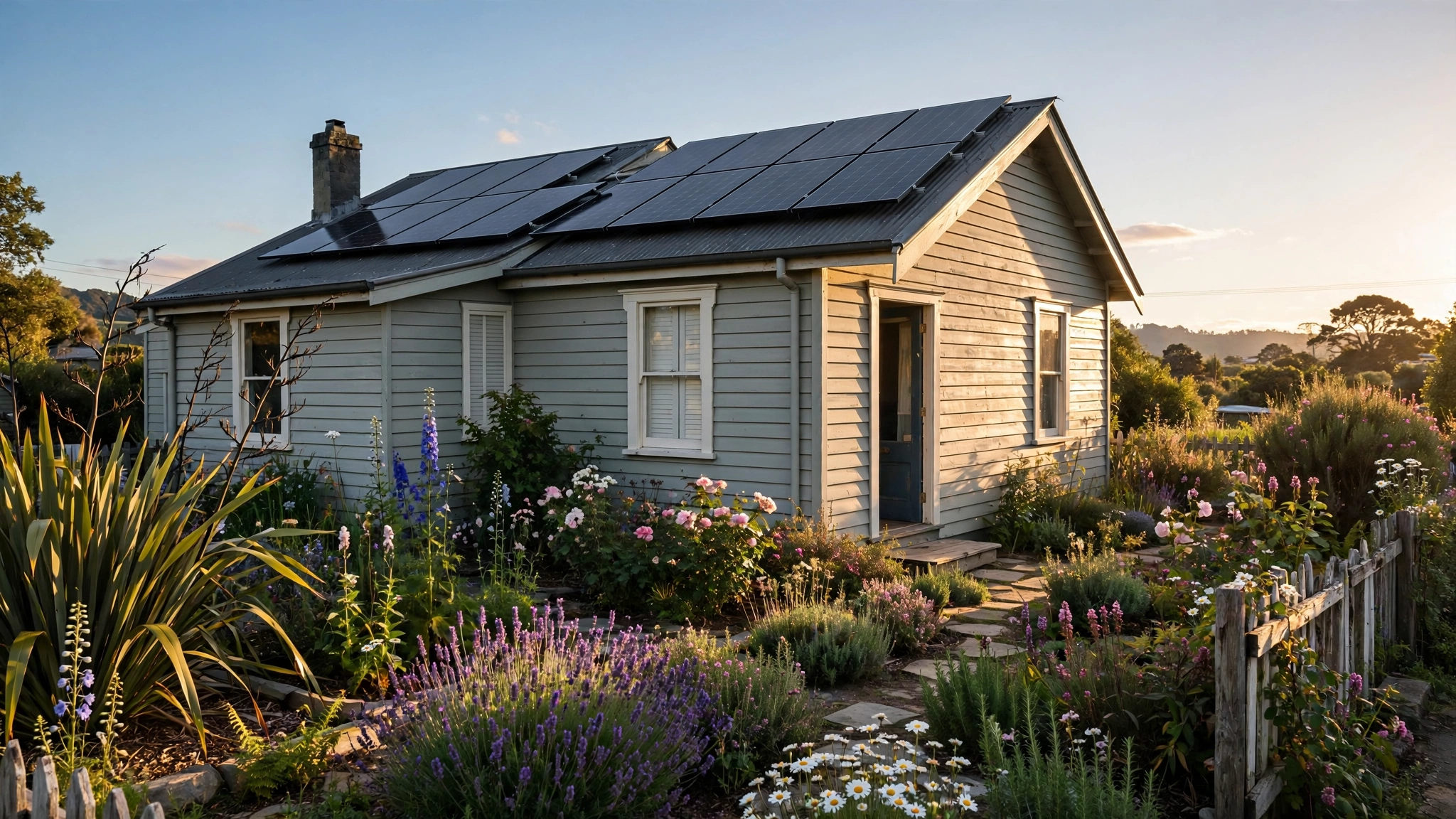
Rooftop solar has become a mainstream home upgrade in New Zealand, and the sums are getting easier to justify as power prices rise and install prices fall. It is still a serious purchase: a typical system costs about as much as a decent used car, sits on your roof for decades, and pays back at a speed that depends on how your household uses power during the day. This guide sticks to figures published by official sources such as EECA, the Electricity Authority and MBIE, and says so where the numbers are uncertain.
Solar in New Zealand at a glance
- EECA puts typical installed costs at $8,500 for a 3 kW system, $11,500 for a 5 kW system and $20,000 for a 10 kW system, including standard installation and GST.
- A battery adds roughly $5,000 to $15,000, depending on capacity.
- EECA estimates solar can save the average home $1,000 or more a year.
- Typical payback is 7 to 10 years for households that use most of their generation, stretching to 10 to 12 years in less suitable situations.
- Surplus power is sold to your retailer at a buy-back rate the retailer sets. EECA research found 8 to 20 cents per kWh.
- Since 23 October 2025, most rooftop installations have not needed a building consent, although the work must still meet the Building Code.
- There is no one-for-one net metering in New Zealand. Power you use yourself is worth more than power you export.
How rooftop solar works in New Zealand
Panels convert sunlight into direct current (DC) electricity, and an inverter converts that into the alternating current (AC) your home runs on. The power then follows a simple pecking order:
- Your home uses the solar electricity first, as it is generated.
- If you have a battery, surplus power charges the battery.
- Any remaining surplus flows out to the local network. This is called export, and your retailer pays you for it at your buy-back rate.
- When the panels are not generating enough, at night or on a dull winter morning, you draw from the grid as usual. Your connection stays the same; you simply buy less.
Systems are sized in kilowatts (kW), the panels’ peak output in strong sun. Output across the year is another matter. MBIE’s energy statistics work on an assumed average capacity factor of about 14 percent for solar in New Zealand, scaled monthly using NIWA sunshine data: far more power on a long December day than a short June one, and your savings follow that pattern.
EECA says a system of 3 to 5 kW produces around 50 to 80 percent of the electricity used by an average three-person household with all-electric appliances and no EV. As a rough illustration only, applying MBIE’s 14 percent assumption to a 5 kW system gives about 6,100 kWh a year. Your own figure will move with your region, roof angle, orientation and shading.
What a solar system includes
- Panels, mounted on rails fixed to the roof. EECA’s typical examples use about 7 panels for 3 kW, 12 for 5 kW and 24 for 10 kW.
- Inverter, usually in the garage or on an exterior wall, converting DC to AC and managing the grid connection. A hybrid inverter can also work with a battery.
- Mounting and cabling. The fixings matter: they hold the array down in high winds and must not compromise the roof’s weathertightness.
- Monitoring. Most systems report generation and use through an app, so you can check performance against the quote.
A battery is optional, covered below. Some households add a hot water timer or diverter, so surplus solar heats water instead of being exported cheaply.
What solar costs in New Zealand
EECA publishes typical installed costs to benchmark quotes against, including standard installation and GST.
| System (EECA typical examples) | Size | Typical cost | Cost with battery |
|---|---|---|---|
| Small (7 panels) | 3 kW | $8,500 | $13,500 with a 5 kWh battery |
| Medium (12 panels) | 5 kW | $11,500 | $21,500 with a 10 kWh battery |
| Large (24 panels) | 10 kW | $20,000 | $40,000 with a 20 kWh battery |
Quotes move away from those benchmarks with system size, roof type and access (which EECA notes affect the final cost), battery inclusion, panel and inverter selection, and any switchboard work an older home needs. A hybrid inverter also makes a later battery cheaper to add.
Get more than one itemised quote, and ask each installer to show their savings assumptions. A quote assuming you use nearly all your generation is not comparable with one assuming you export half.
On finance, EECA notes that most major banks offer home energy loans at 0 to 1 percent interest for upgrades such as solar, usually as a top-up on an existing mortgage. If you are comparing a top-up with other borrowing, our guide to home loan rates in NZ explains how those rates and fees work.
Savings and payback, explained honestly
Solar saves money in two ways, and they are not worth the same.
Self-consumption is where the value is. Every unit of solar power your home uses directly is a unit you do not buy at the full retail price. EECA estimates the average home can save $1,000 or more a year this way, and more in a heavily electrified household with electric hot water, heating and cooking, or an EV charged during the day.
Export earns less. Surplus power is bought at the buy-back rate, 8 to 20 cents per kWh on EECA’s research. That is well below the per-unit price of grid electricity, so an exported unit is worth much less than one used at home.
Payback therefore hinges on timing. A household with someone home during the day, a hot water cylinder on a timer and a heat pump running through winter afternoons uses most of what a right-sized system makes. One empty from 8am to 6pm exports much of its summer generation cheaply and buys power back in the evening. Same roof, same panels, very different returns.
Illustrative example, not a prediction. Take EECA’s medium system at $11,500. Saving $1,200 a year, inside EECA’s published range, gives a simple payback of about 9.6 years. Saving $1,500 a year by shifting usage into the day cuts that to about 7.7 years. This ignores power price rises, maintenance and any inverter replacement. EECA’s own typical range is 7 to 10 years, stretching to 10 to 12 in less suitable situations.
Panels are long-lived, too: EECA works on a lifespan of about 25 years, so a system paying back in year nine has many years of low-cost power after that. EECA also points to research suggesting solar adds a premium to a home’s sale price, put at an average of 1.34 percent. Treat that as a possible bonus, not a reason to buy.
Buy-back rates and selling power back
When your system exports, your retailer buys that power and credits your bill. There is no national buy-back rate and no government-set price: each retailer sets its own, and some offer time-varying rates that pay more when the network is busy. EECA’s residential solar research found rates between 8 and 20 cents per kWh, sometimes higher or lower at certain times of day or year.
Mechanics worth knowing:
- Metering. Export is measured separately, with import and export metering arranged as part of the install. EECA notes you may also build up credit over summer to lower winter bills, paid at the buy-back rate, not the retail rate.
- Network approval. Connecting generation is covered by Part 6 of the Electricity Industry Participation Code, administered by the Electricity Authority. Systems of 10 kW or less use a streamlined application process with your distributor, and since May 2026 the Code has prevented distributors from setting an export limit below 10 kW unless a network study shows a lower limit is needed.
- Peak rebate. From 1 April 2026, distributors must pay a rebate when households and small businesses supply power at peak demand times, for connections exporting up to 45 kW. The Electricity Authority requires it to go to your retailer, which passes it on through your buy-back arrangement. It may not appear as a separate line on your bill.
Because rates differ so much, your choice of retailer is part of the solar decision. Note, too, that overseas talk of net metering, where exports cancel imports one for one, does not apply here: exports are sold separately at the lower buy-back rate. Anyone whose quote assumes one-for-one crediting is using the wrong country’s maths.
Batteries: when they make sense
A battery stores surplus daytime generation for use in the evening and overnight, instead of exporting it cheaply. It lifts self-consumption, the valuable part of solar economics, and can also charge from the grid on cheaper off-peak rates if you are on a time-of-use plan.
A battery tends to make sense when your household uses most of its power in the morning and evening and shifting usage is impractical; when time-of-use pricing has a wide peak to off-peak gap; when backup power matters; or when you want to export at peak times, when rebates and time-varying buy-back rates pay best. It tends not to make sense on payback alone: storage adds $5,000 to $15,000, and EECA’s guidance is that panels without a battery generally return their cost fastest. Buy one for resilience, independence or tariff reasons, and treat payback as a bonus.
Two technical points catch people out. First, a standard grid-connected system shuts down during a power cut, even on a sunny day, as a safety requirement so lines staff are not working around live wires fed from your roof. Panels alone give no backup. Second, not every battery setup provides backup automatically: it needs a backup-capable inverter and wiring for the circuits you want protected, so ask the installer to spell out in writing what will run when the grid goes down. EECA and Standards New Zealand’s best practice guide for residential systems makes a related point: size the system to your household’s actual energy use, and choose products that work with timers and smart controls.
Consents and rules
The consenting picture changed recently, and older advice is out of date.
Building consent. Amendments to Schedule 1 of the Building Act took effect on 23 October 2025. Under exemption 28D, roof-mounted arrays of less than 40 square metres in a wind zone no greater than high need no building consent, and typical home systems are far smaller than that limit. Under exemption 48A, larger arrays, or areas where design wind speeds exceed 44 metres per second, are also exempt, but only if a Chartered Professional Engineer designs or reviews the fixings, or a pre-engineered kitset with an engineer’s sign-off is used.
Exempt is not unregulated. MBIE’s Building Performance guidance stresses that work must still comply with the Building Code, including structure and weathertightness, and meet the exemption conditions. Your installer should confirm which exemption applies.
District plan rules still apply. Building Performance advises checking with your council for planning implications such as site coverage or recession planes. A resource consent is unlikely for ordinary rooftop panels, but heritage overlays and special character areas can change the answer.
Electrical rules always apply. MBIE’s Energy Safety service classifies mains-parallel solar systems as high-risk prescribed electrical work. It must be done by a licensed electrician, certified with a Certificate of Compliance, and inspected, with a Record of Inspection issued, and must comply with standards including AS/NZS 3000 (the wiring rules) and AS/NZS 4777 for grid connection. The Electrical Workers Registration Board has also been phasing in a licence endorsement for parallel generation work, covering solar and batteries, since September 2024.
Tell the right people. Your distributor needs the connection application, your retailer needs to know so the buy-back plan and metering are set up, and your insurer should be told.
Choosing an installer
The installer matters more than the panel brand. A well-designed system on a modest roof beats a poorly designed premium system every time.
- Get two or three itemised quotes. Each should list panel and inverter models, expected annual generation, the savings assumptions behind any payback figure, and warranty terms.
- Check the industry body. The Sustainable Energy Association of New Zealand (SEANZ) is the industry association. Installing members work to a SEANZ Code of Conduct, supply products complying with NZ and international standards, and design and install to AS/NZS 5033. SEANZ publishes a directory of authorised installers.
- Confirm electrical credentials. Ask for the licence details of the electrician certifying the work, and whether they hold the parallel generation endorsement.
- Ask about paperwork. You should receive the Certificate of Compliance, Record of Inspection, distributor’s approval, manuals and warranties. Keep them with your house records.
- Interrogate savings claims. Ask what share of generation the quote assumes you will use yourself, and what buy-back rate it assumes.
Consumer law still applies to solar purchases, so keep the contract and quotes, and raise problems promptly if the system does not match what was promised.
Solar for rentals and new builds
Rentals. Panels are a capital upgrade only a property owner can make, so tenants need the landlord’s agreement. For landlords, the pitch is a more attractive, cheaper-to-run home, balanced against the tenant usually holding the power account and capturing most of the savings. Some landlords negotiate rent that shares the benefit; no rule splits solar savings, so it must be agreed and written into the tenancy arrangements.
New builds. Building solar in is usually cheaper than retrofitting, because scaffolding, roof work and electrical runs are already happening. MBIE’s fast-track consenting for new homes with solar, 10 working days instead of the standard 20, is a further nudge. Choices that pay off later include a north-facing roof pitch kept free of vents and flues, switchboard space for a future battery, and wiring that makes a later install simple. More planning material is in our property and housing guides.
Common mistakes
- Oversizing for export income. Buy-back rates are low, so a system sized well beyond your daytime use earns a poor return on the extra panels.
- Installing on a tired roof. EECA advises doing roof replacement or major maintenance first if it falls due within 10 years. Removing and refitting panels later is an avoidable cost.
- Assuming panels work in a blackout. Without a battery and backup-capable equipment, they do not.
- Ignoring shading. Shading from a chimney, tree or neighbouring building cuts generation more than most people expect. A good installer models it.
- Signing before connection approval. The distributor’s approval and any export limit should be confirmed before you commit.
- Comparing quotes on price alone. Quotes assume different generation, self-consumption and buy-back rates. Compare the assumptions, not just the totals.
FAQs
Does solar work in the South Island, or in cloudy places?
Yes, although generation is lower than in the sunniest regions and payback takes longer. EECA puts the average saving at $1,000 or more a year anywhere in New Zealand. Expect much more power in summer than winter, because output tracks sunshine hours and day length.
Do I need a building consent for rooftop solar?
For most homes, no. Since 23 October 2025, arrays under 40 square metres in wind zones up to high are exempt under the Building Act, and larger arrays or higher wind areas are also exempt if a Chartered Professional Engineer designs or reviews the fixings. The work must still meet the Building Code, and district plan rules can still apply.
Will my panels keep the power on during an outage?
Not by themselves. Grid-connected systems shut down in an outage for safety. You need a battery with a backup-capable inverter and the circuits you care about wired for backup.
Is there a government subsidy for solar panels?
EECA’s solar guidance lists no grant for panels, and there is no equivalent of the Warmer Kiwi Homes insulation and heating grants. The help it points to is low-interest lending: most major banks offer home energy loans at 0 to 1 percent, usually as a mortgage top-up.
How much will I be paid for power I export?
Your retailer sets the rate. EECA research found 8 to 20 cents per kWh across retailers, sometimes varying by time of day, which is less than the retail price you pay. From April 2026, distributors must also pay a rebate for export at peak times, passed on through your retailer.
Can I add a battery later?
Usually, yes. It is cheaper if the original install uses a hybrid inverter or is otherwise battery-ready. Get the installer’s answer on cost and process in writing.
Sources
All figures in this guide come from official New Zealand sources, accessed 5 October 2026.
- EECA, Breaking down home solar costs and savings (typical system costs, savings, payback, bank loans): https://www.eeca.govt.nz/for-homes/solar-for-homes/solar-costs-and-savings/
- EECA, Is solar right for your home? (payback range of 7 to 12 years, roof condition checks, resale premium research): https://www.eeca.govt.nz/for-homes/solar-for-homes/is-solar-right-for-your-home/
- EECA, Residential Solar and Energy Storage research, Appendix Eight: Retail and Buyback Prices (buy-back rates of 8 to 20 c/kWh, how export and self-consumption are billed): https://www.eeca.govt.nz/assets/EECA-Resources/Research-papers-guides/Appendix-Eight-Retail-and-buyback-prices.pdf
- EECA and Standards New Zealand, Best practice guidance for residential solar PV and battery storage systems: https://www.eeca.govt.nz/insights/best-practice-guidance/best-practice-guidance-for-residential-solar-pv-and-battery-storage-systems/
- Electricity Authority, Electricity Industry Participation Code, Part 6: Connection of Distributed Generation (connection process for systems of 10 kW or less, export limit rules), version dated 11 May 2026: https://www.ea.govt.nz/documents/9773/Part-6-connection-of-distributed-generation-11-May-2026_wRz9X4J.pdf
- Electricity Authority, factsheet on network pricing changes (peak export rebate from 1 April 2026, export up to 45 kW): https://www.ea.govt.nz/documents/9803/260506_-_factsheet_-_updated.pdf
- Electricity Authority, decision paper: Requiring distributors to pay a rebate when consumers supply electricity at peak times: https://www.ea.govt.nz/documents/7774/2A_Requiring_distributors_to_pay_a_rebate_when_consumers_supply_electricity_at_hYzYEsJ.pdf
- MBIE, Supercharging residential solar power (consent clarification, 10 working day consent processing for new homes with solar), 13 June 2025: https://www.mbie.govt.nz/about/news/supercharging-residential-solar-power
- MBIE Building Performance, Solar panel and boundary setback building consent exemption changes (exemptions in force from 23 October 2025): https://www.building.govt.nz/about-building-performance/all-news-and-updates/solar-panel-and-boundary-setback-building-consent-exemption-changes
- MBIE Building Performance, Exempt building work guidance 14.4: Roof-mounted solar panel arrays of more than 40 square metres (exemption 48A conditions): https://www.building.govt.nz/projects-and-consents/planning-a-successful-build/scope-and-design/check-if-you-need-consents/building-work-that-doesnt-need-a-building-consent/technical-requirements-for-exempt-building-work/14-other-structures/14-4-roof-mounted-solar-panel-arrays-of-more-than-40-square-metres-in-size
- MBIE, Energy Statistics: Sources and Methods (solar PV capacity factor assumption of 14 percent, monthly scaling using NIWA data): https://www.mbie.govt.nz/assets/Energy-statistics-sources-and-methods.pdf
- MBIE Energy Safety, Certification requirements for solar photovoltaic (PV) systems (high-risk prescribed electrical work, Certificate of Compliance and Record of Inspection, AS/NZS 3000 and AS/NZS 4777): https://d3n8a8pro7vhmx.cloudfront.net/seanz/pages/245/attachments/original/1504694522/ES_Certification_Requirements_for_Solar_Photovoltaic.pdf?1504694522
- SEANZ, Professionals Directory and Code of Conduct (member installers, AS/NZS 5033): https://www.seanz.org.nz/Directory
- SEANZ, Electrical licence endorsements for parallel generation, including solar and battery storage (EWRB endorsement from September 2024): https://www.seanz.org.nz/electrical_license_endorsements_news
This article is general information about rooftop solar in New Zealand. It is not financial, legal or building advice for your property. Costs, savings and payback depend on your home, your usage and your retailer. Get itemised quotes, confirm consent and connection requirements for your situation, and consider independent advice before committing.