KiwiSaver Funds Explained: Types, Fees, Providers and How to Choose

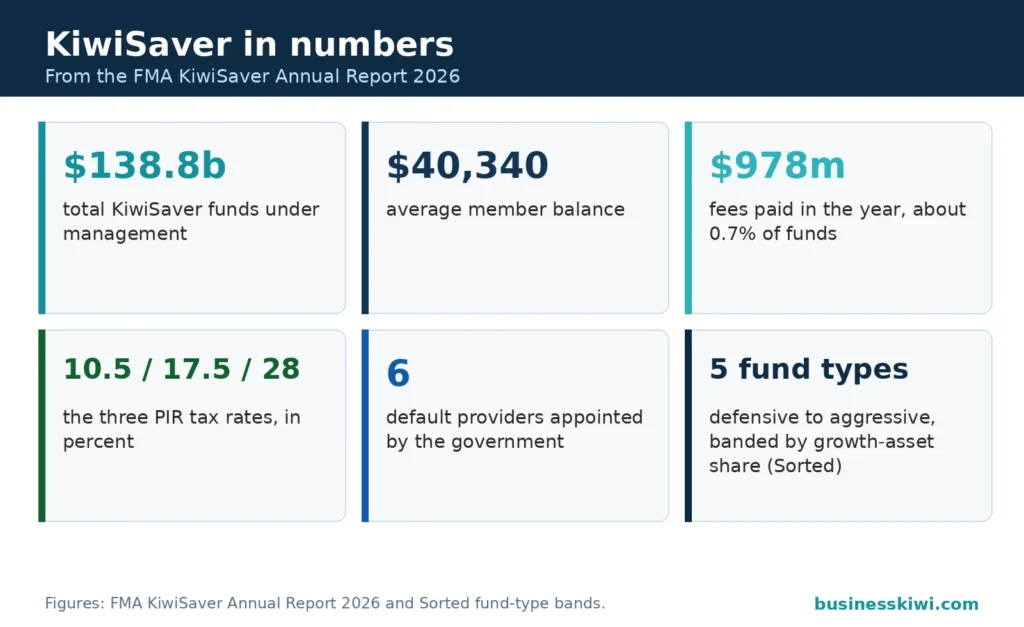
Ask a room of New Zealanders for their KiwiSaver balance and most can answer. Ask which fund it sits in and the room goes quiet. That gap matters, because over a working life the fund your money sits in, the fees it charges, and whether those settings still suit you will influence your final balance more than almost anything else. The Financial Markets Authority’s KiwiSaver Annual Report 2026, covering the year to 31 March 2026, put total funds under management at $138.8 billion, with the average member balance passing $40,000 for the first time to reach $40,340. This guide explains how the funds work and how to check yours is doing its job. It is general information only, not personalised advice.
Quick answer
- Your money is invested by your scheme provider in the fund you choose. Each fund holds a mix of growth assets, shares and property, and income assets, cash and bonds.
- Defensive and conservative funds hold few growth assets and move gently. Balanced funds hold roughly a third to two thirds in growth assets. Growth and aggressive funds hold mostly growth assets and swing more.
- If you never chose a provider, Inland Revenue allocated you to one of six government-appointed default providers, in a balanced default fund since December 2021.
- Fees are charged as a percentage of your balance plus, in some schemes, a flat member fee. Small percentage differences compound into large dollar differences over decades.
- Most schemes are portfolio investment entities, so earnings are taxed at your prescribed investor rate (PIR) of 10.5 percent, 17.5 percent or 28 percent.
- You can change funds or providers at any time, but you cannot belong to two schemes at once.

How KiwiSaver funds work
The plumbing is simpler than the marketing suggests. If you are employed, your contributions come out of your pay and travel via Inland Revenue to your scheme provider, plus employer contributions and the annual government contribution (25 cents per dollar you contribute, up to $260.72). Your provider pools your money with other members’ money in your chosen fund, and a fund manager invests that pool across hundreds, sometimes thousands, of underlying investments.
What the fund buys falls into two families. Growth assets are bought mainly for capital gain: shares in New Zealand and overseas companies, listed property and similar holdings. They rise strongly over long stretches and fall hard from time to time. Income assets are bought mainly for a steadier return: cash, term deposits, and bonds issued by governments and companies. They move less and return less over the long run. Nearly every fund holds a blend of the two, and the blend is the fund’s personality.
Two protections are worth knowing. KiwiSaver schemes are licensed and supervised under the Financial Markets Conduct Act, and each scheme has an independent supervisor whose role includes holding the scheme’s assets. Your money is not sitting in the provider’s own bank account, so if a provider got into financial trouble, the fund’s assets are held apart from its business. What nobody protects you from is the market itself: your balance can and will fall at times, sometimes sharply. As with investing in New Zealand generally, diversification, costs and timeframes are the levers you control. Your money is locked in, generally until you qualify for NZ Super at 65, with exceptions including first home withdrawals: the FMA’s 2026 report recorded more than 50,000 members withdrawing a combined $2.2 billion toward first homes in the year to March 2026.
Fund types explained
Providers give their funds friendly names, but underneath the names almost everything sorts into five bands based on the share held in growth assets. The Sorted KiwiSaver fund finder, run by the Retirement Commission, groups them this way: defensive funds hold 0 to 9.9 percent in growth assets, conservative funds 10 to 34.9 percent, balanced funds 35 to 62.9 percent, growth funds 63 to 89.9 percent, and aggressive funds 90 to 100 percent.
Defensive and cash funds
Defensive funds hold next to nothing in growth assets. Many are cash funds in all but name, investing in bank deposits and very short term securities, so returns run a little above what cash earns and the balance barely moves. They suit money needed within a year or two. The trap is time: leave retirement money in cash for thirty years and inflation eats it.
Conservative funds
Conservative funds hold a modest slice of growth assets, between about a tenth and a third, with the rest in cash and bonds, aiming to edge ahead of inflation while keeping falls small and rare. The FMA suggests they fit people planning to access their money, for retirement or a first home, within the next few years, and people with a low tolerance for ups and downs. Reasonable near 65; usually a mistake at 30.
Balanced funds
Balanced funds are the middle of the road: roughly a third to two thirds growth assets, the rest income assets. You get meaningful exposure to sharemarket growth, cushioned by bonds and cash when markets wobble, with shallower falls than growth funds. Balanced funds, including the six default funds, held $37.4 billion at March 2026.
Growth funds
Growth funds put most of the money to work in shares and property, typically 63 to just under 90 percent growth assets. Expect a bumpier ride: double digit falls in a bad year are entirely possible. Expect also, over a decade or more, the strongest returns of the mainstream fund types. Growth funds now hold $68 billion, roughly 49 percent of all KiwiSaver money. They suit people with ten years or more before they need the money.
Aggressive funds
Aggressive funds sit at the top of the ladder, with 90 to 100 percent in growth assets. They are essentially share funds in a KiwiSaver wrapper. The long run return potential is the highest of all, and so is the chance of a gut wrenching fall at exactly the wrong moment. They make sense for younger members with decades to ride out the swings, and little sense for a house deposit needed next year.
Lifecycle funds
A lifecycle fund, offered by some providers, changes the blend for you: heavily growth while you are young, shifting automatically toward income assets as you age, ending up conservative around retirement. It is the set and forget version of the ladder. The cost of that convenience is control: the glide path is fixed by the provider and may not match your plans.
Default KiwiSaver schemes and funds
Defaults exist because millions of people never make an active choice. If you were automatically enrolled, did not pick a provider, and your employer had no chosen scheme, Inland Revenue allocated you to a default provider. There are six, appointed by the government after a selection process run by MBIE: BNZ, Booster, BT Funds (Westpac), KiwiWealth, Simplicity and Smartshares (NZX). Their current appointments run for seven years from December 2021.
Before December 2021, default money sat in conservative funds. The settings changed deliberately: default funds are now balanced, because a lifetime parked in a conservative fund was leaving members with much smaller balances at 65. Default funds also carry obligations the rest of the market does not: they must exclude investments in fossil fuel production and illegal weapons, they were selected partly on value for money, their providers must engage with members at key moments to prompt active choices, and they cannot charge a flat member fee.
A default fund is a reasonable safety net, not a tailored fit. If you are saving for a first home within a couple of years, the FMA points out that a balanced default fund may be the wrong place for your deposit, because a market fall could land just before settlement. If retirement is decades away, you may be taking less risk than you need.
Fees: what you pay and why it matters
Nobody sends you an invoice for KiwiSaver fees. They are deducted from your balance inside the fund, which makes them dangerously easy to ignore. Across the scheme, members paid $978 million in fees in the year to March 2026, and total fees have sat at roughly 0.7 percent of funds under management for three years running.
The fee types you will meet, as the FMA describes them, are these:
- Management fee. The main charge, paid to the fund manager and calculated as a percentage of the fund’s net assets. Actively managed and higher risk funds generally cost more to run.
- Member fee. A flat dollar amount in some schemes, deducted monthly. It bites hardest on small balances. Default funds do not charge one.
- Administration and supervisor fees. Contributions to the cost of running the scheme, and to the independent supervisor who oversees it and holds its assets.
- Performance fee. A bonus some managers charge for beating a target return. Only a few KiwiSaver managers charge one directly, although more invest through underlying managers who do.
- Other possible charges. Depending on the scheme: fees for underlying managers, for changing investment options, for transferring from another scheme, for withdrawals, and adviser fees you have agreed to pay through your account.
Fund updates roll most of this into one figure called total fund charges, expressed as a percentage of the fund’s value over the year. That is the number to compare between funds of the same type. Sorted’s fund finder and Smart Investor also display it in dollars, showing what fees come to on a $30,000 balance.
Why the fuss? Because fees compound just like returns do, except against you. Here is a purely illustrative example using round numbers, not any real fund’s data. Imagine a $50,000 balance, no further contributions, earning 6 percent a year before fees over 30 years. With no fees it would grow to roughly $287,000. Charge 1 percent a year, cutting the net return to 5 percent, and it reaches roughly $216,000. One percentage point of fees has cost about $71,000, even though the first year’s fee was only around $500. The cheapest fund does not always win, but you should know what you pay and what you get for it.
Performance and disclosure: fund updates, quarterly reports and statements
KiwiSaver disclosure is good by international standards. Managers must publish a fund update for every fund every quarter, generally within 20 working days of the quarter’s end, and lodge it on the Disclose register. Fund updates sit on your provider’s website and on Smart Investor, the Retirement Commission’s comparison platform.
A fund update tells you, in a standard format, what the fund returned over one, three, five and ten years after fees and tax, its ten largest holdings, its total fund charges, and its risk indicator, a scale from 1 to 7 based on how much the fund’s value has moved around. Two habits serve you well. Compare returns only against funds in the same band over the same period; a growth fund beating a conservative fund in a rising market tells you nothing about skill. And treat past performance as background, not prophecy.
Each scheme also publishes an annual report on how it was run. Your own annual member statement is the most useful document in the pile: your balance, every dollar in and out, the tax paid, the fees paid in dollars, and a projection of what your savings might be worth at 65. Reviewing it once a year, as the FMA advises, is the natural KiwiSaver health check.
Tax on your fund: PIR in brief
You pay tax on what your KiwiSaver investments earn, not on contributions going in and not on money you withdraw. How it is calculated depends on the scheme type. Most KiwiSaver schemes, including all six default schemes, are portfolio investment entities, or PIEs. In a PIE, your share of the fund’s taxable income is taxed at your prescribed investor rate, your PIR. There are three rates for individuals: 10.5 percent, 17.5 percent and 28 percent. Which applies depends on your total taxable income across the previous two income years. A smaller number are widely-held superannuation schemes; their earnings are taxed at a flat 28 percent.
Getting your PIR right is your job, not your provider’s. If you never tell your provider a PIR, 28 percent is applied by default. Set the rate too low and you can face a tax bill at year end; too high, and the extra tax is generally gone for good. Inland Revenue can suggest the rate it believes applies, you can work yours out with its online calculator or in myIR, and your provider will prompt you to recheck it each year. It also helps to understand how PIE tax differs from resident withholding tax, which applies to bank interest and similar income outside managed funds.
Choosing a fund
The FMA frames the decision around three questions: are you in the right fund, could you be saving more, and are you paying too much in fees? For the first, two things do most of the work.
The first is your timeframe. Money needed soon cannot afford a deep fall, so the closer you are to spending it, the lower down the ladder you should be. Sorted’s fund finder profiles risk the same way: it will not steer anyone with a horizon under three years to anything riskier than a conservative fund, and nothing riskier than balanced for horizons under ten years unless their other answers support it.
The second is your tolerance for watching your balance fall. A growth fund that drops 15 percent in a bad year only delivers its long run returns to members who stay in it. If a fall like that would send you switching to cash at the bottom, you would lock in the loss and miss the recovery. Falling balances are a normal part of investing, the FMA stresses, and reacting at the low point usually makes things worse. Choose the highest rung you can genuinely live with.
Beyond that, compare like with like: total fund charges within the same fund type, five year returns after fees and tax on Smart Investor or the fund finder, and the services each provider offers, which Sorted also rates. Revisit the choice at life’s obvious checkpoints: a first home bought, a career break, a decade passing, retirement coming into view. You can also split your money across more than one fund with the same provider, running a conservative pool for a near term goal alongside a growth pool for retirement.
Switching funds or providers
Switching funds inside your current provider is the easy half of the system. You can change funds at any time through your provider’s app, website or phone line. The FMA highlights a subtler option: if you are nervous about moving a large balance in one jump, leave the existing balance where it is and direct new contributions into the new fund.
Changing providers takes a little more paperwork but not much. You apply directly to the provider you want to join, and they arrange the transfer of your savings from your old scheme. Inland Revenue says the process takes about two weeks. You can only belong to one scheme at a time, so joining a new one ends the old membership, and your old provider may charge a transfer fee, so check before you sign. Your employer and government contributions simply follow you. The FMA recorded about 460,000 fund switch transactions worth $11.9 billion, and a record $7.4 billion in transfers between providers, in the year to March 2026. But switching because another fund had a better last year is chasing your tail. Switching because your timeframe, fees or risk setting no longer fit is maintenance, and maintenance is healthy.
Responsible and ethical funds
Interest in where KiwiSaver money actually goes has reshaped the market. Almost every provider now offers a fund badged as responsible, ethical, sustainable or similar. Some funds exclude certain industries: tobacco, controversial weapons, fossil fuel extraction. Others screen companies on environmental and social criteria or tilt toward lower carbon businesses. Default funds sit at the regulated end of this spectrum: by law they must exclude fossil fuel production and illegal weapons, and their providers must maintain a published responsible investment policy.
A word of caution: these labels are not standardised, and two funds with near identical names can hold quite different things. The honest way to judge one is to read its product disclosure statement and responsible investment policy, then check the fund update’s top holdings to see what it actually owns. The FMA has tightened its expectations here, issuing updated guidance on sustainability related disclosures in May 2026. If ethical settings matter to you, treat them like fees: verify, do not assume.

Checking your fund today
You do not need an adviser, a spreadsheet or a spare weekend to give your KiwiSaver a health check.
- Find your fund’s name and type. Log in to your provider’s app or site, or check myIR, which shows who your provider is. If the name says default, you are in a balanced fund chosen for you.
- Check your PIR. Compare the rate your provider holds against your income over the last two years, using Inland Revenue’s calculator or myIR.
- Find your fees in dollars. Your last annual statement states them plainly. Then look up your fund’s total fund charges on Smart Investor and compare them with funds of the same type.
- Test the fit. Ask when you actually need this money and how a 10 or 15 percent fall would feel. If either answer has changed since you joined, your fund probably should too.
- Run the fund finder. Sorted’s KiwiSaver fund finder will profile your risk, estimate your fund’s lifetime fees, and show alternatives in the same band.
- Read one fund update. Pick the latest quarterly update for your fund and read it end to end: returns, charges, holdings, risk indicator. It takes five minutes, and it is the document providers are legally required to write for you.
For more guides on saving, tax and making your money work harder, browse the Finance hub.
FAQs
I never chose a KiwiSaver fund. Where is my money?
Almost certainly in a default fund with one of the six default providers: BNZ, Booster, BT Funds (Westpac), KiwiWealth, Simplicity or Smartshares (NZX). Since December 2021 all default funds are balanced funds. Check your provider in myIR; you can move funds at any time.
Can I invest in more than one fund at once?
Yes, within a single provider. Most providers let you split your balance and contributions across several of their funds. What you cannot do is belong to two different providers’ schemes at once.
Do higher fees mean a better fund?
Not reliably. Fees are the most predictable number in the whole arrangement, while outperformance comes and goes. Compare total fund charges and long term returns after fees and tax, within the same fund type, before deciding.
How is my KiwiSaver taxed?
On its earnings, inside the fund. If your scheme is a PIE, which most are, tax is charged at your PIR of 10.5, 17.5 or 28 percent, based on your income over the previous two years. Widely-held superannuation schemes pay a flat 28 percent. You pay no tax when you withdraw your money.
What happens if my PIR is wrong?
If it is too low, Inland Revenue can assess you for the shortfall at year end. If it is too high, the overpaid tax is generally not refunded, which is why checking it annually matters.
When can I get my money out?
Generally at 65, when you qualify for NZ Super. Earlier withdrawals are possible in defined situations, including buying your first home after at least three years of membership, significant financial hardship, serious illness and permanent emigration.
My balance has dropped sharply. Should I switch to a conservative fund?
Usually that is the worst moment to switch. You would be selling growth assets after they have fallen and giving up the recovery that long run returns are built on. The FMA warns against being spooked by falling balances. If the fall taught you your risk setting is too hot, change once things settle. Do not panic.
What is a lifecycle fund and should I use one?
A lifecycle fund automatically lowers your risk as you age, shifting from growth assets toward income assets on a preset path. It suits people who want the age adjustment handled for them. Its weakness is that the path is generic: it does not know your first home plans or a retirement date that is not 65. If you are happy to review your fund every few years, you can replicate the effect yourself and keep the control.
Sources
- Financial Markets Authority, KiwiSaver consumer guidance, fma.govt.nz: fund types and growth asset ranges, fee types, default provider allocation, annual statements and fund updates, switching guidance.
- Financial Markets Authority, KiwiSaver Annual Report 2026 (year to 31 March 2026), fma.govt.nz: total funds under management, average balances, fee totals, fund type holdings, switching and transfer volumes, first home withdrawal figures.
- Financial Markets Authority, media release on the appointment of KiwiSaver default providers, fma.govt.nz, 2021: the six appointed providers, the move of default funds from conservative to balanced, lower fee settings, and the exclusion of fossil fuel production and illegal weapons.
- Te Ara Ahunga Ora Retirement Commission, Sorted KiwiSaver fund finder methodology, sorted.org.nz: the five fund type bands by growth asset share, risk profiling by timeframe, fee calculation and comparison approach, and the Smart Investor platform.
- Inland Revenue, How your KiwiSaver income is taxed, ird.govt.nz: PIE and widely-held scheme tax treatment, prescribed investor rates of 10.5 percent, 17.5 percent and 28 percent, and how PIR is determined.
- Inland Revenue, Changing to another provider, ird.govt.nz: the transfer process, the approximate two week timeframe, and the possibility of a transfer fee charged by the outgoing provider.
Disclaimer
This article is general information about how KiwiSaver funds work in New Zealand. It is not financial advice, and it does not take into account your personal circumstances, goals or risk tolerance. KiwiSaver fund values rise and fall, past performance is not a reliable indicator of future performance, and no return is guaranteed. Figures drawn from the FMA’s KiwiSaver Annual Report 2026 relate to the year ended 31 March 2026 and will change over time. Before choosing or changing a fund or provider, read the relevant product disclosure statement, and consider talking to a licensed financial adviser who can give advice tailored to your situation.