First Home Loans in NZ: How First Home Buyers Get Approved, and What Happened to the Grant

Buying your first home usually comes down to two separate problems. The first is the deposit: how much cash you need before a lender will talk to you. The second is approval: whether a lender believes you can carry the loan once you have it. First home buyers get genuine help with the first problem, mainly through KiwiSaver and the Kāinga Ora First Home Loan, but the second is judged the same way for everyone. This guide walks through how approval works, the deposit routes in summary, and one piece of help that no longer exists.
The short answer
First home buyers borrow under the same lending rules as every other buyer. A lender will check your income, your spending, your debts, your credit record and the source of your deposit, and it will test whether you could still afford the repayments if interest rates were higher than they are now. Against that standard background, first home buyers have two real advantages. After at least three years in KiwiSaver, most members can withdraw almost all of their balance towards a first home. And if your income is under the caps, a Kāinga Ora First Home Loan can cut the deposit you need to 5%, because Kāinga Ora underwrites the loan for the lender. What you cannot do any more is apply for the First Home Grant, which closed in May 2024.
First, the grant: what happened to the First Home Grant
Plenty of older articles still talk about the First Home Grant as if it were current. A deposit plan built around money that no longer exists has a hole in it, so it is worth being clear about what the grant was.
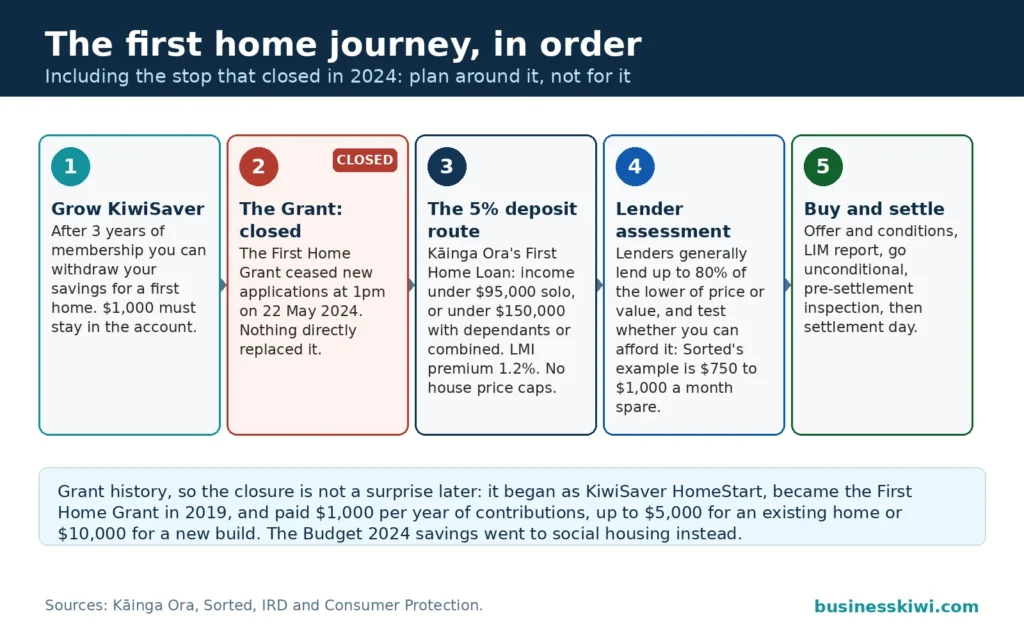
The grant began life as the KiwiSaver HomeStart Grant and became the First Home Grant on 1 October 2019. It was delivered by Kāinga Ora and tied to KiwiSaver: each eligible buyer received $1,000 for every year they had contributed, up to $5,000 towards an existing home and up to $10,000 towards a newly built one. For a couple who both qualified, that could add up to a meaningful chunk of a deposit.
On 22 May 2024 the Government closed the scheme with immediate effect as part of Budget 2024. Kāinga Ora stopped accepting new applications at 1pm that day. The savings were redirected to social housing: Budget 2024 put $140 million towards 1,500 new social housing places to be provided by community housing providers. Applications already in before the cut-off were processed, and a narrow exemption briefly covered a small number of buyers caught mid-purchase. That exemption has long since expired.
So the position today is simple. There is no grant to apply for, and nothing has directly replaced it for first home buyers. The help that remains works differently: it gets your own KiwiSaver money out, or it lowers the deposit a lender will accept. Both are covered below.
How much deposit do you actually need
The standard number is 20% of the purchase price. Sorted, the personal finance service run by Te Ara Ahunga Ora Retirement Commission, notes that lenders will generally lend up to 80% of the lower of a property’s price or its value, and that 20% is the ideal deposit to aim for. With 20% down, you sit outside the Reserve Bank’s loan-to-value ratio (LVR) restrictions and avoid the extra costs of high-LVR borrowing.
Smaller deposits are possible, but the supply of them is rationed. The Reserve Bank limits how much of a bank’s new lending can go to borrowers with small deposits. Since 1 December 2025, up to 25% of new owner-occupier lending can have an LVR above 80%, meaning a deposit under 20%. Those settings were reviewed and left in place in August 2026. Banks can say yes to low-deposit buyers, but not to everyone, and they reserve those approvals for strong applications.
A second set of guardrails works in the background: the Reserve Bank’s debt-to-income (DTI) restrictions limit the share of new lending going to borrowers whose total debt is large relative to their income. That is another reason lenders look hard at what you already owe.
Borrowing with 10% or less changes the economics as well as the odds of approval. Sorted points out that borrowing over 80% usually brings a low-equity premium or a margin added to your interest rate, and that lenders will often require a registered valuation and lend against whichever of the price or the valuation is lower. A 5% deposit is achievable through the First Home Loan described below, and sometimes directly through a bank, but it is the most expensive and most scrutinised way in.
This article keeps the deposit rules at summary level on purpose. Our home loan deposits guide works through the deposit options, the LVR settings and the costs in full.
Route one: your KiwiSaver balance
For most first home buyers, KiwiSaver is the single biggest contributor to the deposit. Inland Revenue sets out the rules for the first home withdrawal, and they are straightforward.
You must have been a KiwiSaver member for at least 3 years before you can withdraw for a first home. If you qualify, you can take out your own contributions, your employer’s contributions, the government contributions paid into your account and the investment returns earned on all of it. Two limits apply. You must leave $1,000 behind in your account, and any money transferred in from an Australian complying superannuation scheme cannot be withdrawn. Apply through your KiwiSaver provider, and start early: Inland Revenue suggests talking to your provider and to Kāinga Ora well ahead, because the withdrawal has to line up with your purchase timeline and is normally paid through your lawyer at settlement.
Two practical points follow. The withdrawal is a one-off opportunity tied to buying your first home (previous homeowners can sometimes qualify if Kāinga Ora assesses them as being in a similar position, but that is the exception). And emptying KiwiSaver takes a real bite out of your retirement savings, so keep contributions going once you are in the house.

Route two: the Kāinga Ora First Home Loan
The First Home Loan exists for people who can afford the repayments but cannot save a large deposit. It cuts the deposit you need from the standard 20% to 5% of the purchase price. The loan comes from a participating bank or other lender, and Kāinga Ora underwrites it, which allows the lender to approve a loan that would otherwise sit outside its normal lending standards.
Kāinga Ora’s eligibility criteria, in summary, are these:
- You are over 18, and a New Zealand citizen, permanent resident or resident visa holder.
- You are a first home buyer, or a previous homeowner whose financial position is similar to a typical first home buyer’s.
- Your before-tax income over the last 12 months is under the caps: $95,000 for an individual buyer, $150,000 for an individual buyer with dependants, or $150,000 combined where there are two or more buyers.
- You have a deposit of at least 5% of the purchase price. Your KiwiSaver withdrawal can form part of it.
- The home will be your primary place of residence, and you meet the participating lender’s own lending requirements, because the lender makes the final decision.
There is no minimum income for the scheme itself, but your income still has to be enough for the lender to approve the loan. Regional house price caps used to apply, but Kāinga Ora removed them in 2022, so the caps that matter now are the income caps above. Criteria can change, so check the current version on the Kāinga Ora website before you rely on it.
The trade-off for the smaller deposit is a fee. Kāinga Ora charges a Lender’s Mortgage Insurance premium of 1.2% of the loan amount to insure the loan, and borrowers may have to reimburse the lender for it, on top of any application fee the lender charges. Kāinga Ora sets the minimum criteria while each lender can add its own requirements, so a decline from one participating lender does not automatically mean the next one will decline you too.
How a lender decides whether you can afford it
Approval is not a single test. It is a bundle of checks, and first home buyers go through exactly the same ones as everyone else.
Income. The lender wants evidence of what you earn and how secure it is, starting with salary or wages and how long you have been in the job. Kāinga Ora’s list of what lenders ask for gives the flavour: proof of identity and of your current address, evidence of your deposit (savings, investments, first home withdrawals and gifts), evidence of household income or employment, and a breakdown of household expenses.
Spending and surplus. Lenders look at what is left after your commitments are paid. Sorted describes two common approaches. Some work to a rule of thumb that fixed payments, meaning mortgage repayments plus any other loan or hire purchase payments, should be no more than 30 to 40% of gross income. Others calculate a minimum monthly surplus, sometimes called uncommitted monthly income, that must remain after fixed payments and a living allowance. Either way, the surplus expected of you grows as your deposit shrinks: Sorted’s example is that a borrower putting down just 5% might need to show $750 to $1,000 a month left over. Existing debts and credit card limits eat into that surplus, because lenders assess the limit on a card, not just the balance.
Stress testing. No lender approves you at today’s interest rate and hopes for the best. Applications are assessed at a rate above the one you will actually pay, so there is a buffer if rates rise, and Sorted suggests running the same test on yourself by checking what your repayments would look like at a rate 1% or 2% higher. Each bank sets its own buffer and no single test rate is published across lenders, but the practical effect is that you will usually be offered less than a quick online calculator suggests.
Your credit record. Anything on your credit report, such as missed hire purchase payments or an unpaid power bill that went to collection, can reduce how much a lender will offer or stop an approval altogether. Check your own record before you apply, while surprises can still be fixed.
The deposit itself. Where the money came from matters. Saved money and a genuine gift from family are both generally acceptable, while a deposit raised through another loan usually is not, because it adds a repayment you have to service. The closer you get to a 95% loan, the more a lender will want to see the deposit was saved rather than gifted.
Our how much can I borrow guide goes deeper on affordability, including how lenders treat different income types. Whatever number you arrive at, treat it as a ceiling, not a target.
Pre-approval: what it is, and what it is not
A pre-approval is a lender’s written indication of how much it is prepared to lend you, based on the income, spending and deposit information you have provided, before you have a specific property. You can get one from a bank or through a mortgage adviser, and Kāinga Ora’s First Home Loan process includes a pre-approval stage while you are house hunting.
Used well, pre-approval tells you your price range before you fall for a house you cannot buy, makes your offer stronger because the seller can see your finance is largely sorted, and surfaces problems early, while a credit record blemish or a debt can still be fixed.
Used badly, it misleads. A pre-approval is conditional: the lender still has to approve the actual property, which usually means a valuation and a check that the place fits its lending policy. It is also time-limited. Kāinga Ora notes that a First Home Loan pre-approval typically expires after a fixed period and has to be resubmitted or updated before it lapses, and mainstream lenders work the same way, so note the expiry date. Finally, if your circumstances change after pre-approval, a new job, a new debt, a drop in income, the lender can reassess. The figure is a ceiling, not a promise and not a spending target.
Choosing the shape of the loan
Once you are approved, you choose how the loan is structured. Most first home buyers, according to Sorted, start with a table loan: set repayments over a term of up to 30 years, where early repayments are mostly interest and later ones mostly principal. The real choices are about the interest rate.
- Fixed. The rate is locked in for a term of between six months and five years, so your repayments stay exactly the same. The cost of that certainty is flexibility: extra repayments are usually limited, and ending the loan early can trigger a break fee.
- Floating. The rate moves with the wider market, up and down. You can repay extra or pay the loan off at any time without penalty, but your repayments change when rates change, and floating rates have historically sat above fixed ones.
- Split. Many buyers divide the loan, fixing most of it for certainty and leaving a smaller portion floating so they can repay extra without fees. Splitting across different fixed terms is also common, so the whole loan never reprices on one day.
- Offset. Your savings and everyday account balances are linked to the mortgage and interest is charged only on the difference. The linked accounts earn no interest themselves, which is the trade you are making.
- Revolving credit. This works like a large overdraft: your pay goes in, bills go out, and interest is charged daily on the balance. It suits organised borrowers and people with irregular incomes, and punishes anyone who treats the limit as spending money.
Interest-only loans exist but are mostly used by investors, under strict criteria. For a first home you will almost always be on principal-and-interest repayments from day one. The structure is not permanent either: fixed terms roll off every few years, and you can reshape the loan as your income grows.

From offer to keys: the buying steps in brief
The loan is only half the machinery. Consumer Protection describes the stages of buying, and they run like this.
Making an offer. You sign a sale and purchase agreement, usually with conditions and a date by which they must be satisfied. Typical conditions cover your finance being confirmed, a building report, and a LIM: the land information memorandum your council holds on the property, covering things like flood and erosion risk, rates, and whether the deck or bathroom extension ever got a consent. Your lawyer should review the agreement and the LIM with you.
Going unconditional. Once every condition is met, the agreement becomes unconditional and you are committed; pulling out after this point is very difficult. The deposit is payable as the agreement sets out, commonly at this stage, usually into a trust account until settlement.
Before settlement. A pre-settlement inspection confirms the property is in the same state as when you signed. Behind the scenes, your lawyer and the lender prepare the loan documents and the transfer.
Settlement day. Your lawyer works with the lender to draw down the loan and pay the balance to the seller. Title transfers to you, the mortgage is registered against it, and you get the keys.
Mistakes that catch first home buyers out
Borrowing to the ceiling. Approval is a maximum, not a recommendation. A loan that leaves no surplus turns every rate rise, car repair or cut in overtime into a crisis. The stress test a lender applies is a minimum standard, not a comfortable one.
Assuming the grant still exists. It does not; it closed on 22 May 2024. Budget your deposit from savings and KiwiSaver only, and treat any older guide that mentions the grant as a warning to check the date on everything else it says.
Skipping the LIM or the building report to save money. The reports are cheap relative to the house. An unconsented extension, a flood-prone section or unpermitted work can affect your insurance, your lender’s willingness to proceed and the resale value. That is what the conditions in the agreement are for.
Forgetting the ongoing costs of the property type. A unit title property comes with body corporate levies that run to thousands of dollars a year and are not optional. A cross-lease property shares the land with neighbours and can need their consent for alterations. Both belong in your budget and your lender conversation from the start, not as a settlement-week surprise.
Counting every dollar of the deposit. Between the low-equity premium or margin, a valuation, legal fees and moving costs, buying eats money beyond the deposit itself. Arriving at settlement with nothing left over is a fragile way to start.
FAQs
Is the First Home Grant still available?
No. Kāinga Ora stopped accepting new applications at 1pm on 22 May 2024, when the Government closed the scheme as part of Budget 2024 and redirected the money to social housing. Applications lodged before the cut-off were processed, but there is no way to apply now, and nothing has directly replaced the grant for first home buyers.
How much deposit do I need as a first home buyer?
The standard is 20% of the purchase price, which keeps you clear of the Reserve Bank’s LVR restrictions and avoids low-equity costs. Smaller deposits are possible: banks can lend above 80% LVR for a limited share of their new lending, and a Kāinga Ora First Home Loan allows 5% if you meet its caps and criteria. The smaller the deposit, the more extra cost and scrutiny to expect.
Can I use my KiwiSaver for the deposit?
Yes, in most cases. After at least 3 years of membership you can withdraw your contributions, your employer’s contributions, the government contributions and the returns earned, as long as you leave $1,000 in your account and the money did not come from an Australian superannuation transfer. Apply through your provider, and start early, because the withdrawal has to be coordinated with your settlement.
Who can get a Kāinga Ora First Home Loan?
You need to be over 18, a New Zealand citizen, permanent resident or resident visa holder, and a first home buyer (or a previous homeowner in a similar financial position). Your income must be under the caps: $95,000 for an individual, or $150,000 for an individual with dependants or for multiple buyers combined. You need at least a 5% deposit, the home must be your main residence, and the participating lender still has to approve you under its own criteria.
Does pre-approval guarantee I will get the loan?
No. A pre-approval is a conditional indication based on your finances at the time. The lender still has to approve the specific property, which can involve a valuation, and the pre-approval expires after a set period. If your income, debts or employment change in the meantime, expect to be reassessed.
Sources
- Kāinga Ora, First Home Loan page, First Home Loan brochure and Home Ownership Products quarterly reports, kaingaora.govt.nz
- Beehive, Government invests in 1,500 more social homes, beehive.govt.nz
- Reserve Bank of New Zealand, LVR restrictions releases (November 2025 and August 2026), rbnz.govt.nz
- Inland Revenue, Getting my KiwiSaver savings for my first home, ird.govt.nz
- Sorted, Find out how much of a mortgage you could get; Types of mortgages in New Zealand; How to save for a deposit and other costs when buying a home, sorted.org.nz
- Consumer Protection, Prepare to make an offer; Solving issues with the owner or real estate agent, consumerprotection.govt.nz
Disclaimer
This article is general information about home loans and first home buyer support in New Zealand. It is not financial advice and does not take your personal circumstances into account. Lending criteria, Kāinga Ora scheme settings and Reserve Bank restrictions change over time, so confirm the current details with the relevant agency or lender before you act. For advice on your own situation, talk to a licensed financial adviser or your lender.
You will find more property and home buying guides in our Real Estate hub.