Cross Lease in NZ: How It Works, the Risks and Converting to Freehold
The quick answer
A cross lease is a hybrid form of property ownership. Everyone on the title owns an undivided share of the whole piece of land together, and on top of that each household holds a registered lease over its own flat or unit. Those leases usually run for 999 years, so the term itself is never the issue. What matters is the paperwork: a plan of the buildings (the flats plan) sits on the title, and the lease document sets the rules everyone lives under.
Cross leases are a legacy feature of the New Zealand housing stock. They turn up in every main centre, often where two to four homes share a section that was never formally subdivided. Most of them work perfectly well for decades. The traps are consistent though: buildings that no longer match the flats plan, alterations done without the other owners’ consent, and shared areas like driveways that nobody clearly owns the job of maintaining. If you are buying, the golden rule is simple. What is drawn on the flats plan must match what is actually standing on the land, and your lawyer needs to confirm that before you commit.
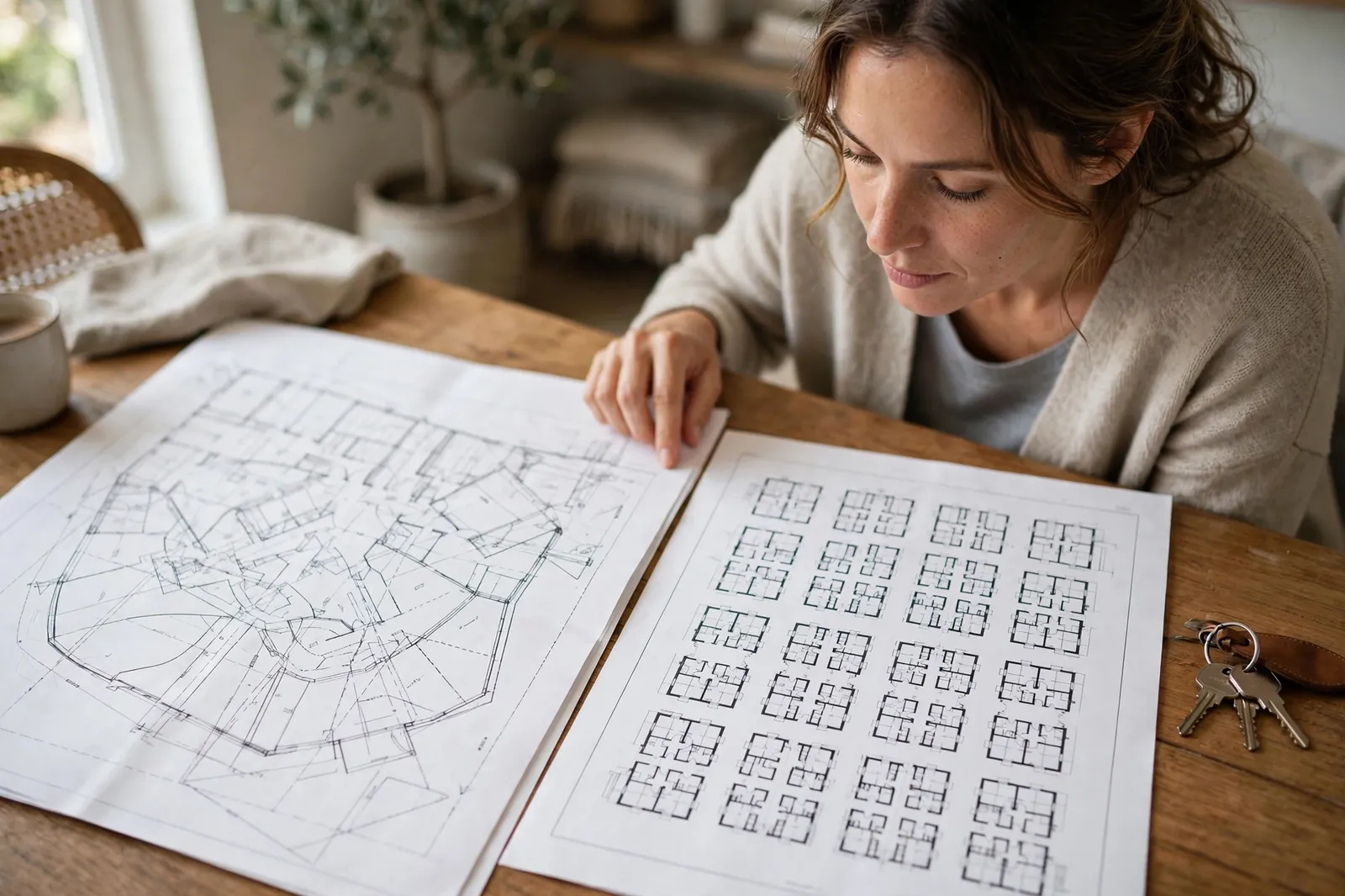
How a cross lease title actually works
Two interests in one property
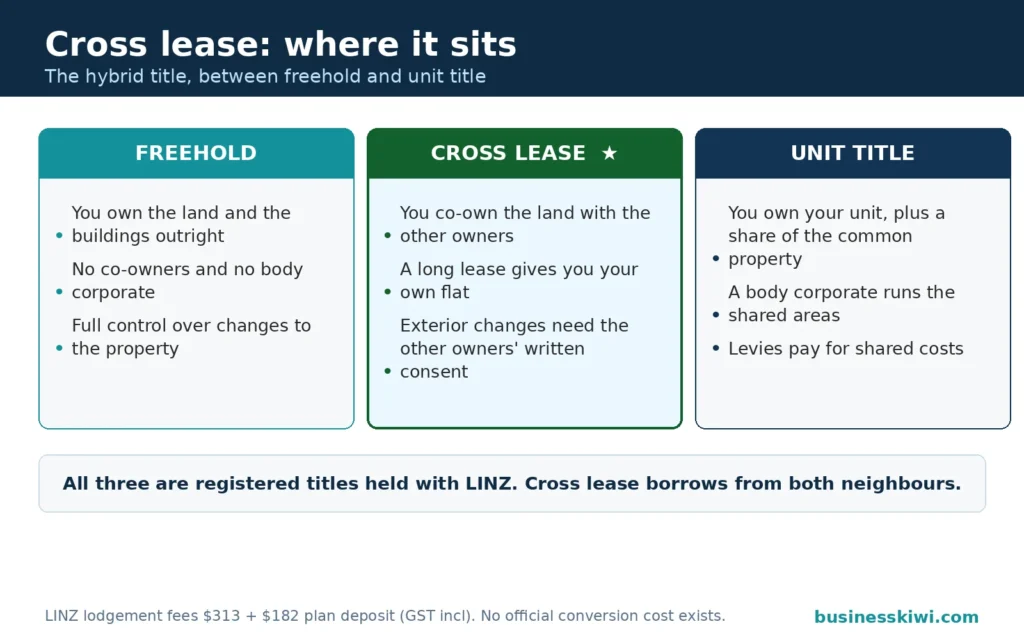
Buy a cross lease home and you are buying two things at once. The first is a share of the underlying freehold title, held in common with the other owners. If there are two homes on the section, you typically own a one-half share of the land; if there are three, a one-third share, and so on. The second interest is leasehold: each owner grants a lease of their own building to themselves and the others, and that lease is registered against the title.
Settled.govt.nz, the Real Estate Authority’s consumer site, puts it plainly: when you buy into a cross lease you become a part owner of every building on the plot, not just the one you live in. Your lease carves out the part you occupy. This is why the arrangement is called a cross lease, because the leases cross over the shared freehold ownership.
LINZ, which runs the land title register, supports cross lease titles under the Land Transfer Act 2017. Its survey guidance describes how a cross lease plan must define the boundaries of the building lease areas and the covenant areas, following the footprint of the permanent structures on the site.
The flats plan
Every cross lease title includes a flats plan, sometimes called a flat plan. It shows the footprint of each building, the areas each household can use exclusively (often labelled as exclusive use or covenant areas) and the parts held in common, such as a shared driveway or a common garden.
That plan is not a rough sketch. It is the legal record of what each owner is entitled to occupy. A deck, garage, conservatory or extension that exists on the ground but not on the plan is a problem in waiting, which is why comparing the plan with the real buildings is the single most important check when buying.
Exclusive use areas and common areas
Your lease gives you the exclusive right to occupy your flat and any exclusive use areas attached to it, such as your courtyard or back garden. Common areas belong to everyone together. Nobody owns the shared driveway outright, so decisions about it, and costs of repairing it, have to be sorted out between the owners under the terms of the lease.
The lease document and its covenants
The lease itself is a long document, and it is where the day-to-day rules live. Standard cross lease documents usually deal with things like:
- getting the other owners’ written consent before making structural alterations or additions
- restrictions on building anything new on the land
- how common areas are used and maintained, and how shared costs are split
- obligations to keep your building insured and in repair
- rules about use of the property, which in some leases extend to things like animals or business use
The exact wording varies from lease to lease, often depending on when it was drafted. There is no standard modern template imposed by law, so two cross leases on the same street can have noticeably different rules. Reading the actual lease, not a summary, is essential.
No body corporate
One feature surprises people moving from an apartment or unit title: a cross lease has no body corporate. There is no separate entity collecting levies, holding meetings or arranging insurance for the whole site. The owners deal with each other directly. Rates, insurance and maintenance of shared areas are arranged between the households, guided by whatever the lease says. That keeps costs low when neighbours get on, and makes everything harder when they do not.
The problems that catch people out
Defective title
The best known cross lease problem is a defective title. This is what conveyancers call it when the flats plan no longer matches the buildings on site. It usually happens because a past owner added a room, enclosed a carport, built a conservatory or extended a deck without updating the flats plan and lease afterwards. The buildings grew; the title did not.
Settled.govt.nz advises buyers to check the plan on the title against the property in front of them and to ask their lawyer about any unexpected additions, such as decks, or changes to access. If the footprint differs, the lease may not actually cover the building as it stands, and fixing it later means a surveyor, a new plan, the other owners’ cooperation and cost.
Unconsented and unapproved alterations
Two consent systems apply to any building work on a cross lease, and they are easy to confuse. Council consent (building consent, and sometimes resource consent) is one. The other owners’ written consent under the lease is the other. Having one does not give you the other. Work done with a council consent but without the neighbours’ agreement can still breach the lease, and work the neighbours agreed to still needed the title updated if it changed the building footprint.
Shared areas and neighbour disputes
Common areas generate the everyday friction: a driveway that needs resurfacing, a shared drain that blocks, a fence on a boundary nobody can quite locate in the documents. Because decision making sits with the owners personally, a disagreement has no body corporate process to absorb it. Many leases contain dispute or arbitration clauses, but those are slow and unpleasant to use. The practical reality is that a cross lease works best when the owners talk to each other early and keep shared costs boring and documented.
Insurance wrinkles
Because every owner part-owns every building, insurance needs thought. Many cross leases are insured under a single joint policy covering all the buildings on the title, and some leases require that arrangement. Others leave each household to insure its own flat. Either way, a mismatch, such as one owner letting cover lapse, or additions that were never disclosed to the insurer, can affect everyone when a claim lands. Check what the lease requires and what is actually in place.
Selling and lending friction
None of this makes a cross lease unsellable, and plenty change hands every week. But a title defect can narrow your buyer pool. Buyers’ lawyers flag mismatches, some purchasers walk away rather than inherit a fix-up job, and lenders and insurers tend to look harder at a property where the documents and the buildings disagree. A clean cross lease, plan matching buildings, sells much like anything else. A defective one often sells at a discount or only after the defect is remedied.
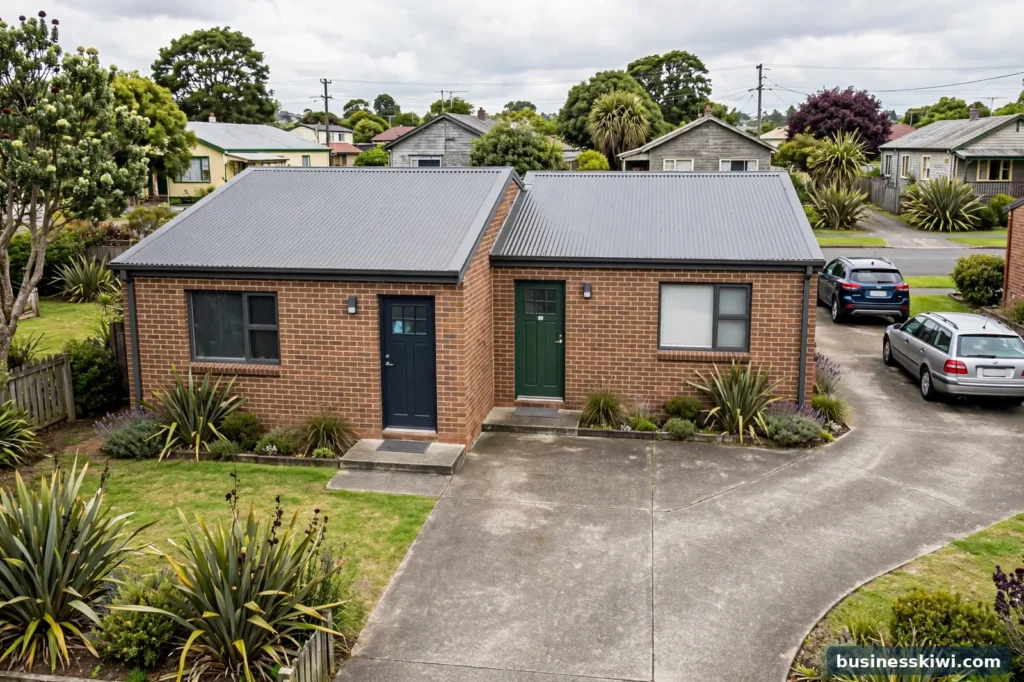
Buying a cross lease: the checks that matter
Work through these before you sign, or make your offer conditional on them.
Get the title and the flats plan. A title search through LINZ records shows the ownership, the plan and the interests registered against the property. Lay the flats plan beside what you saw at the open home. Does every building, garage and extension on site appear on the plan, in the right place and shape?
Read the lease. Your lawyer should go through the lease document itself, not just the title. Look for the consent rules for alterations, how shared costs are split, insurance obligations and any unusual use restrictions that could bite later, such as limits on pets, parking or renting the property out.
Order the LIM. Settled.govt.nz points out that a Land Information Memorandum from the local council shows information the council holds about the property and land. Match the council’s building consent records against the buildings. An extension with no consent record is a double warning sign: a possible Building Act problem and a probable flats plan problem.
Ask about the shared arrangements. How is the driveway maintained, and who paid last time? Is insurance held jointly or separately, and is it current? Are there any informal agreements, ongoing disagreements or planned works? The seller and agent should be able to answer; vagueness is information too.
Use your lawyer early. Settled recommends engaging a lawyer before the house hunting gets serious, and cross lease is exactly why. Your lawyer verifies that the lease covers the buildings as they stand, checks the consent history, and can make the agreement conditional on a defect being fixed by the seller, often by updating the flats plan before settlement at the seller’s cost.
Inspect properly. A building inspection checks condition, and a pre settlement inspection in the final days before settlement confirms the property is in the state you agreed to buy, with nothing removed or newly damaged. On a cross lease, walk the boundaries of your exclusive use areas and the common areas too, not just the inside of the house.
Owning a cross lease home
Renovations and extensions
Plan on two approvals for anything structural. First, the written consent of the other owners under your lease. Second, whatever council consents the work needs. Auckland Council, for example, lists amending a cross lease by making alterations or additions among the activities that need a subdivision resource consent, on top of the usual building consent for the work itself. Minor non-structural work may not trigger either, but the lease wording decides, so check before assuming a new deck or fence is yours to build.
If the work changes the external footprint of your building, the flats plan has to be updated to match. That means a licensed cadastral surveyor prepares a new cross lease plan, the owners sign off, and the new plan and amended lease are registered with LINZ. Skipping this step is precisely how defective titles are created, and it stores up cost and conflict for whoever sells next.
Insurance and shared costs
Keep the insurance arrangement the lease requires, and tell your insurer about any building changes. For shared costs, treat the driveway, shared drains and common fencing like a tiny, informal body corporate: agree contributions in writing, keep receipts, and revisit the arrangement when owners change. New owners inherit the lease, not your handshake deals, so anything important should be documented in a way that survives a sale.
Selling
Before listing, do the check you would want done as a buyer: compare the flats plan with the buildings. If a past owner (or you) changed the footprint without updating the plan, getting it fixed before going to market is usually faster and cheaper than negotiating around it mid-sale, when the other owners have less reason to cooperate quickly.
Converting to freehold or unit title
Why owners convert
Conversion replaces the cross lease with separate freehold (fee simple) titles, one per home. Owners do it for control: no neighbour consent needed for alterations, a title a wider pool of buyers understands, and cleaner insurance and lending. It is a one-off project with a lasting effect, so owners often tackle it when relationships are good, or before a sale.
The process
Converting is legally a subdivision, even though the buildings and households do not change. Auckland Council’s subdivision guidance sets out the shape of it, and other councils run a similar process:
- Get every owner on board. A conversion cannot be done unilaterally. All owners on the title, and their mortgage lenders, need to agree, because the existing title and leases are surrendered and replaced.
- Engage a licensed cadastral surveyor. The surveyor is the key professional. They check feasibility, survey the site and prepare the new plan defining each lot, along with any easements needed for shared driveways and services that cross lot boundaries.
- Apply for subdivision resource consent. The council assesses the application under the Resource Management Act 1991 and the local plan, and grants consent with conditions. Those conditions can require services, access or drainage work to be brought up to standard.
- Meet the conditions and certify the plan. Once consent is granted, the survey plan goes back to council for a section 223 certificate confirming the plan matches the consent. Any physical works required are done, and council then issues a section 224(c) certificate confirming the conditions have been met.
- Deposit the plan with LINZ and get new titles. The plan and certificates are lodged with LINZ, the cross lease titles are cancelled, and LINZ issues new individual Records of Title, one for each home. Your lawyer handles the legal side, including new easements and everyone’s mortgages.
The unit title alternative
Some conversions head to unit title instead of freehold. Under the Unit Titles Act 2010, each owner holds a unit title over their own unit and a share of the common property, and a body corporate comes into existence to manage shared areas, insurance and rules. MBIE’s Unit Titles Services explains that every unit title property has a body corporate, that all unit owners are members, and that the body corporate looks after maintenance of shared areas, insurance and the operational rules. For a small group of homes this swaps neighbour negotiation for formal structure: levies, meetings and Act-backed processes. It suits some sites, particularly where buildings share structure or services closely, but it is not a shortcut around survey and consent work.
What conversion costs
There is no single official price, because the total is mostly professional fees and council charges rather than a fixed fee. The components are surveyor’s fees, legal fees, council consent and certification charges, any physical works the consent conditions require, and LINZ’s own lodgement fees. LINZ publishes its fee schedule: as an example of scale, its cadastral survey fees list a cross lease dataset base fee of $313 and a plan deposit fee of $182, both GST inclusive, and those government charges are usually the smallest part of the bill. Surveyors and lawyers set their own prices, so get quotes once the surveyor has seen the site. Owners usually share the cost in the proportions they agree, often equally or in line with their title shares.
What can block it
The common blockers are people and pipes. One owner refusing to agree or to contribute stops the project outright, since unanimity is required. Councils can impose conditions that make conversion expensive, for example upgrading a shared driveway, drainage or fire separation between attached homes. Old unconsented work on the site can surface during the process and need resolving first. And where owners disagree about where new boundaries should fall, especially around gardens and parking people have treated as theirs for years, the negotiation itself becomes the project.
Cross lease, freehold and unit title compared
FAQs
Is a cross lease a bad title?
No. It is a legitimate, long-standing form of ownership, and most cross lease homes are bought, sold and lived in without drama. The problems come from paperwork that has not been kept up to date, especially buildings that no longer match the flats plan, and from the need to get neighbour consent for changes. Buy with your eyes open and the structure itself is manageable.
How long does a cross lease last?
The leases are usually written for 999 years, so expiry is not a practical concern. The arrangement ends when the owners agree to cancel it, normally by converting to freehold or unit titles through a subdivision process.
Can I extend or renovate a cross lease home?
Usually yes, but expect two layers of approval: written consent from the other owners under the lease, and any building or resource consents the council requires. If the work changes the outside footprint of your building, the flats plan and lease must be updated and registered afterwards. Doing the work without those steps is how defective titles happen.
Can one owner block a conversion to freehold?
Yes. Conversion replaces the shared title everyone owns, so it needs all owners (and their lenders) to agree. If one owner refuses, the conversion cannot proceed, which is why these projects tend to happen when all parties see a benefit, such as before a sale.
What is a defective cross lease title?
It is the term used when the flats plan on the title does not match the buildings actually on the land, usually because an addition or alteration changed a building’s footprint without the plan being updated. The fix is a new survey plan and amended lease registered with LINZ, agreed by all owners. Your lawyer can spot a defect by comparing the plan with the property and the council’s records.
Sources
- Land Information New Zealand (LINZ), Cross lease CSDs, cadastral survey guidelines, linz.govt.nz
- Land Information New Zealand (LINZ), Survey and title fees, linz.govt.nz
- Settled.govt.nz (Real Estate Authority), What you need to know about cross lease ownership, settled.govt.nz
- Auckland Council, Apply for a subdivision resource consent, aucklandcouncil.govt.nz
- Unit Titles Services (MBIE), About unit titles and body corporate, and Body corporate: how it works, unittitles.govt.nz
Disclaimer
This article is general information about cross lease ownership in New Zealand, based on official sources. It is not legal advice. Cross lease documents differ from property to property, and title or conversion work should always be handled with a lawyer and, where survey work is involved, a licensed cadastral surveyor.
More guides like this one are in our Real Estate hub.