Taupō Rentals: Median Rents, Areas and How to Secure a Rental

Renting in Taupō looks simple from a distance. It is a compact lakeside town and the stock is mostly ordinary family houses. The catch is that Taupō is also a holiday town. A meaningful share of its houses are second homes or short-stay properties, and that shapes what is left for people who need a long-term home, especially heading into summer.
For rents, this guide uses one source only: the bond data published by Tenancy Services, part of the Ministry of Business, Innovation and Employment. Those figures come from bonds lodged for real tenancies, not advertised asking prices, so they show what tenants actually agreed to pay. The legal sections follow Tenancy Services guidance, and the application section follows the Privacy Commissioner.
The quick answer: what rent looks like in Taupō
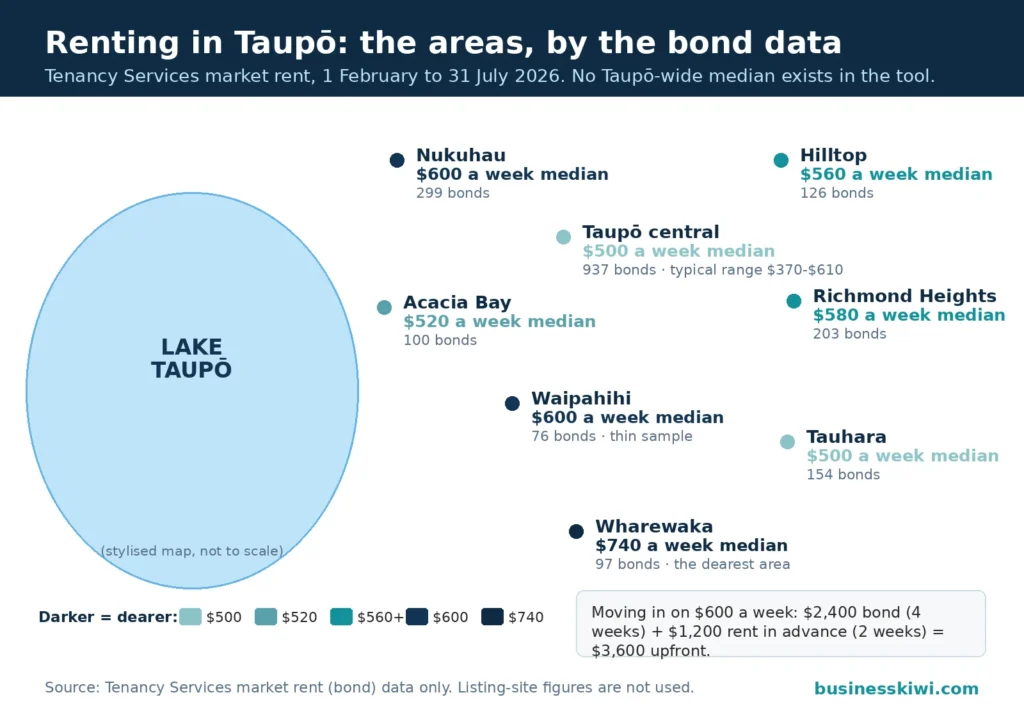
Tenancy Services does not publish a single median for the whole of Taupō. Its market rent tool reports by area, with no town-wide roll-up. The best starting point is the area the tool simply calls Taupo, covering the central town. For 1 February 2026 to 31 July 2026, that area recorded 937 bonds, with a median weekly rent of $500. The middle half of rents sat between $370 and $610.
Around that central figure, the areas vary a lot:
- Wharewaka, on the southern lake edge, is the dearest area in the data: median $740 a week across 97 bonds.
- Nukuhau and Waipahihi both sit at a $600 median, Nukuhau across a solid 299 bonds and Waipahihi across a much thinner 76.
- Richmond Heights records a $580 median across 203 bonds, and Hilltop $560 across 126.
- Acacia Bay records a $520 median across 100 bonds, and Tauhara matches the central area at $500, across 154 bonds.
Bedroom count matters more than suburb in most cases. A three-bedroom house, the workhorse of the Taupō market, medians at $573 a week in the central Taupo area (306 bonds), $600 in Nukuhau (146 bonds), $590 in Tauhara (39 bonds), $560 in Richmond Heights (134 bonds) and $550 in Hilltop (61 bonds). Two-bedroom houses are cheaper, but not by much: $480 in the central area, $500 in Nukuhau and $490 in Hilltop. One-bedroom houses often median as high as larger houses in the same area. That looks odd until you remember what they usually are in Taupō: compact newer builds or standalone units, and the bond data reflects that mix.
Two cautions. First, small samples wobble. Where a combination rests on fewer than about 20 bonds, treat the median as a rough pointer, not a price. Second, the tool guides you to the middle of the market only. Tenancy Services itself says the figures should not be used on their own to set the rent for a specific property, and condition, heating and exact location move individual homes well above or below the median.
The method here is the same one used in our Auckland rentals guide, where suburb medians from the same bond data do the work that listing sites cannot do reliably. Compare bond medians with bond medians, for the same period, and keep the sample sizes in view.
How the market rent figures work
The tool draws on bonds received over the previous six months, excluding the most recent month, and updates monthly. The period used throughout is 1 February 2026 to 31 July 2026. Each area shows a total bond count with lower quartile, median and upper quartile for all properties combined, then a breakdown by dwelling type and bedroom count. The breakdown counts active bonds with complete information, so the rows do not always add up to the headline total. If too few bonds exist for a combination, the tool publishes nothing. Wharewaka, for example, has no two-bedroom house row at all. The window takes in late summer through winter, so it is an all-round picture, not a peak-season snapshot.

Area by area
Taupo (central)
The area labelled Taupo covers the town centre and its immediate surrounds, and with 937 bonds it is by far the deepest sample in the district. The overall median is $500 a week, between a lower quartile of $370 and an upper quartile of $610. Houses dominate: three bedrooms median at $573 (306 bonds), two bedrooms at $480 (193 bonds), four bedrooms at $600 (61 bonds) and one bedroom at $585 (142 bonds). Flats are the cheaper end, at $290 for one bedroom (63 bonds) and $430 for two (99 bonds). Apartments sit in between, at $350 for one bedroom and $440 for two, on small samples of 11 and 23 bonds. If you want the widest choice at the widest range of prices, this is where most of it is.
Tauhara
Tauhara, east of the centre and home to a large share of Taupō’s everyday rental stock, records the joint-lowest overall median: $500 across 154 bonds, with the middle half between $400 and $603. Three-bedroom houses median at $590 (39 bonds), one-bedroom houses at $595 (43 bonds), two-bedroom houses at $420 (30 bonds) and four-bedroom houses at $550 on a small sample of 12. A two-bedroom flat medians at $400 (17 bonds). The bond data backs up Tauhara’s reputation as the more affordable side of town, although the one-bedroom house figure shows that newer small homes there are not cheap.
Hilltop
Hilltop sits above the town, south of the centre, and records an overall median of $560 across 126 bonds, with quartiles of $480 and $660. The breakdown is houses only: three bedrooms at $550 (61 bonds), two bedrooms at $490 (13 bonds), four bedrooms at $733 (13 bonds) and one bedroom at $650 (29 bonds). The two-bedroom and four-bedroom figures rest on small samples, so read them as indicative. Rents here sit a step above Tauhara and the central area for family-sized homes.
Nukuhau
Nukuhau, on the north-western side along the lake and the river outlet, records an overall median of $600 across 299 bonds, the second-deepest sample in the district, with quartiles of $444 and $690. Three-bedroom houses median at $600 (146 bonds), four-bedroom houses at $695 (33 bonds), two-bedroom houses at $500 (19 bonds) and one-bedroom houses at $680 (62 bonds). That one-bedroom figure is the highest in this guide and again points to modern, compact houses rather than older small homes. A couple of flat rows here rest on 11 bonds and 7 bonds and sit oddly against the house figures. They are best ignored, and they show why the bond counts matter as much as the dollar figures.
Richmond Heights
Richmond Heights, in the south-east, records an overall median of $580 across 203 bonds, with quartiles of $468 and $673. The breakdown is houses only, and three-bedroom homes dominate with 134 bonds at a $560 median. One-bedroom houses median at $665 (33 bonds), four-bedroom houses at $738 (16 bonds) and two-bedroom houses at $483 on a sample of 10. The data reads like the area itself: mostly family homes, plenty of three-bedroom stock in the high $500s, and not much below $450 at any size.
Waipahihi
Waipahihi, along the lake south of the centre, records an overall median of $600 across just 76 bonds, with quartiles of $445 and $710. Treat these figures with care. Three-bedroom houses median at $605 (23 bonds) and one-bedroom houses at $685 (27 bonds), while the two-bedroom and four-bedroom rows rest on only 8 and 7 bonds, at $450 and $560. A handful of tenancies can drag medians like these around. The honest summary is that Waipahihi sits at the upper end of Taupō’s range, and its precise ranking is not knowable from this data.
Wharewaka
Wharewaka, further south along the lake shore, is the dearest area in the tool: an overall median of $740 across 97 bonds, and a lower quartile of $650, meaning three quarters of recorded rents were $650 a week or more. One-bedroom houses median at $750 (38 bonds), three-bedroom houses at $725 (30 bonds) and four-bedroom houses at $725 (24 bonds). No two-bedroom house row is published. Newer housing in a lakeside position is the obvious context, and the narrow quartile spread, $650 to $775, suggests fairly uniform, newer stock.
Acacia Bay
Acacia Bay, across the bay west of the centre, records an overall median of $520 across 100 bonds, with quartiles of $405 and $650, the widest relative spread in this guide. Houses median at $598 for one bedroom (18 bonds), $483 for two bedrooms (20 bonds), $550 for three bedrooms (33 bonds) and $540 for four bedrooms on a sample of 10. A one-bedroom flat medians at $400 (8 bonds). Acacia Bay has a strong holiday-home presence, and the long-term tenancies that do exist are a mixed bag, which the wide quartiles reflect. Do not read the $520 headline as cheap. It means the recorded tenancies were very spread out.
The seasonal squeeze
Taupō District had an estimated resident population of 42,700 at 30 June 2025, according to Stats NZ, and the 2023 Census counted 22,044 private dwellings in the district. A good number of those dwellings are not lived in year-round. Anyone who has driven the lake suburbs in winter and again in January has seen the difference.
For renters, the effects are practical. Part of the stock never reaches the long-term market at all, because owners use it themselves or let it short-term. Genuine holiday accommodation is a different arrangement from a residential tenancy, and a house let night by night is not in the same pool as a house let on a tenancy agreement. Demand from people moving for work, including hospitality, health and trades, tends to build from spring as the visitor economy gears up, while long-term supply does not build at the same pace. Tenancies that come up in late spring and summer can attract several applications quickly, because households relocating for the school year are hunting at the same time.
None of that can be turned into a vacancy rate, and this guide will not invent one. No official source publishes a Taupō long-term vacancy figure, and the bond data measures rents, not empty houses. What can be said is that the long-term pool is smaller than the housing stock suggests, that the deepest and most varied supply sits in the central area and Tauhara, and that starting in winter or early spring gives you more choice in most years. If you are moving for a job that starts in January, start earlier.
What it costs to get in the door
Starting costs are capped by law. A landlord can charge a general bond of up to four weeks’ rent, and rent in advance of up to two weeks. Nothing else has to be paid to secure the tenancy. Letting fees have been prohibited since 12 December 2018, and key money, meaning any other charge for granting a tenancy, is also prohibited, apart from an option fee of no more than one week’s rent to hold a property while you decide, which must be refunded or put towards rent if you go ahead.
At a $600 weekly rent, the median for Nukuhau and Waipahihi and a fair midpoint for a three-bedroom house across town, the maximum lawful upfront cost is:
At the central area’s $500 median, the same calculation gives $2,000 bond plus $1,000 in advance, or $3,000 in total. Rent in advance is not an extra fee. It pays for your first weeks in the home, and the landlord cannot ask for the next payment until it has been used up. If you keep a pet with consent under the current pet rules, a pet bond of up to two further weeks can be added, up to $1,200 more at $600 a week, refundable if there is no pet damage beyond fair wear and tear.
The bond must be lodged with Tenancy Services within 23 working days of the landlord receiving it, and Tenancy Services holds it for the tenancy. Get the receipt and check the lodgement confirmation. If the rent later increases, the landlord can ask for a top-up so the bond stays at the agreed number of weeks, and that top-up must also be lodged within 23 working days.
The rules that apply to your tenancy
Rent increases
Rent can only go up once in any 12-month period, and not within the first 12 months of the tenancy. The landlord must give at least 60 days’ written notice, stating the new amount and the day it starts. Boarding houses have a shorter 28-day period, but they are a different arrangement from the houses covered here. For a fixed term, an increase during the term is only possible if the agreement allows it. There is no legal cap on the size of an increase, which is why the market rent data matters: if a proposed rent sits well above what similar homes in the area achieve on the bond data, you can raise it with the landlord, and if that goes nowhere, the Tenancy Tribunal can be asked to assess market rent. An out-of-cycle increase can be agreed where the landlord has genuinely improved the property or facilities, or changed the agreement in your favour. Ordinary repairs do not count.
Healthy Homes
Every rental in New Zealand has had to comply with the Healthy Homes standards since 1 July 2025, with no phase-in left for private rentals. The standards cover heating, insulation, ventilation, moisture ingress and drainage, and draught stopping. New or renewed agreements must include a compliance statement setting out how the property measures up. In a town where winter mornings are properly cold and much of the older stock was built as holiday housing, this is not a technicality. Ask to see the statement before you sign, and check the living room heating and the ceiling and underfloor insulation in particular. Non-compliance breaches the Residential Tenancies Act, and Tenancy Services publishes penalties of up to $7,200.
Inspections
Inspections must happen between 8am and 7pm, no more often than once every four weeks, with at least 48 hours’ notice and no more than 14 days’ notice. Many landlords inspect roughly every three months in practice, often because their insurer requires evidence of regular inspections, but four weeks is the legal ceiling. You do not have to be home, although being there is the easiest way to raise maintenance issues. Photos should document the condition of the property rather than focus on your personal belongings.
Ending a tenancy
For a periodic tenancy, a tenant must give at least 21 days’ written notice. A landlord must give 90 days’ written notice to end a periodic tenancy without giving a reason, and that notice must not be retaliatory, for example a response to you exercising your rights. A shorter 42-day notice applies where the owner or a family member needs the home as their main residence, where the property is needed for employees or contractors and that purpose was stated in the agreement, or where the property has been sold requiring vacant possession. The reason must be stated in those cases. Fixed terms run for the agreed term and generally cannot be ended early by notice from either side, except by mutual agreement or in limited circumstances, so read the term carefully before signing. A tenant experiencing family violence can withdraw on at least two days’ written notice in the approved form, with qualifying evidence and without financial penalty.
Pets
The pet rules changed on 1 December 2025. To start keeping a pet from that date you need the landlord’s consent, but consent can only be withheld on reasonable grounds, and any conditions must be reasonable. A pet bond of up to two weeks’ rent, on top of the general bond, is one condition a landlord can set, and only one pet bond can be charged however many pets are approved. Tenants are liable for pet damage beyond fair wear and tear. If your pet was already approved before 1 December 2025, you do not need consent again for that pet, and no pet bond can be charged for it. Raise pets early and in writing.
Disputes and the Tribunal
Raise problems with the landlord or property manager in writing first, then apply to the Tenancy Tribunal if they cannot be sorted out. The fee on Tenancy Services’ main application page is $29. The applicant pays it, and if you succeed you can ask the Tribunal to order the other party to reimburse it. Keep records from day one: the signed agreement, the compliance statement, inspection reports, move-in photos, and every email about maintenance. Bond and rent disputes are decided on paperwork far more often than on who tells the better story.

Applying for a rental in Taupō
What a landlord is allowed to ask
The Privacy Commissioner sets staged limits, and knowing them makes the process less stressful. At a viewing, only your name and contact details should be needed. A full application form can be offered before a viewing, but you cannot be required to complete one at that stage.
When you apply, they can ask for your name and contact details, proof of identity, whether you are 18 or older, how many people will live at the property, the names only of occupants who will not be on the agreement, contact details for landlord and other references, your consent to contact referees, and your consent to a credit report and a criminal record check. Pet ownership and smoking can be asked about only where the property has restrictions, and your right to stay in New Zealand for the term only for a fixed term.
Two limits catch people out. References should not be contacted at the application stage, and credit or criminal record checks should only be run once you are the preferred applicant and an offer is being negotiated. At that shortlisted stage you can be asked for the extra details those checks need, such as your date of birth, and for one further piece of evidence that you can pay the rent, on top of a credit report. That might be a pay slip, a letter from an employer or Work and Income, or a record of rent paid in a previous tenancy, and you should be able to choose which form to provide. Detailed bank statements showing your spending cannot be required.
What should never be asked
When selecting tenants, a landlord should never ask about characteristics protected under the Human Rights Act: sex, including pregnancy and childbirth, relationship or family status, political opinion, religious or ethical belief, colour, race, ethnic or national origins including nationality or citizenship, physical or mental disability or illness, age beyond whether you are over 18, employment status, including being unemployed, on a benefit or on ACC, and sexual orientation or gender identity. Landlords should also not ask whether you have experienced family violence, ask for your employment history, or ask for social media details. If a form asks for any of this, you can question it, and the Privacy Commissioner can be contacted if raising it directly does not help. You can also see the information held about you and have it corrected if it is wrong.
Practical steps that help in a smaller market
Taupō’s long-term market is small enough that preparation shows. Line up your references before you start viewing, with numbers your referees have agreed to be contacted on. Previous landlord references carry the most weight, and a simple rent ledger from a previous property manager is exactly the kind of ability-to-pay evidence contemplated at the shortlist stage.
Be precise about who will live in the house, and raise pets and vehicles at application rather than later. Straightforward applications are easier to approve. If you are relocating, say when you can start, and be ready to pay the lawful upfront amounts promptly once you are offered the tenancy.
Before you sign, read the Healthy Homes compliance statement, confirm what is included for lawns and gardens, ask how heating is provided, and make sure the property is offered as a residential tenancy under the Residential Tenancies Act rather than a holiday arrangement, unless a holiday arrangement is genuinely what you want. Some Taupō homes move between short-stay and long-term use, and the agreement you sign decides which protections you have.
Renting while you save
Some Taupō renters rent with one eye on buying, and the arithmetic is worth doing with real numbers. At the central area’s $500 median, a year of rent is $26,000. At Wharewaka’s $740 median, it is $38,480. That gap, roughly $12,500 a year, is the strongest argument in this guide for choosing area and house size deliberately if you are saving. If buying is a genuine plan, our home loan deposits guide works through how much deposit lenders expect and how first-home help actually works, and it pairs sensibly with the rent figures here.
For more guides on buying, selling and renting property in New Zealand, see the Real Estate hub.
Frequently asked questions
What is the median rent in Taupō?
There is no single official median for the whole town. Tenancy Services publishes medians by area from bond data. For 1 February 2026 to 31 July 2026, the central Taupo area recorded a median of $500 a week across 937 bonds. Area medians ranged from $500 in Tauhara to $740 in Wharewaka, and a three-bedroom house typically sat between $550 and $605 a week depending on area.
How much do I need upfront for a Taupō rental?
At most, four weeks’ rent as a general bond plus two weeks’ rent in advance, so six weeks in total. At $600 a week that is $3,600. A pet bond of up to two further weeks can apply if you keep a pet with consent under the rules that started on 1 December 2025. Letting fees and key money cannot be charged.
Why do one-bedroom houses sometimes cost more than two-bedroom houses?
Because the bond data reflects the actual stock. In Taupō many one-bedroom houses are newer, compact standalone homes, while some two-bedroom houses are older stock. In the central area, one-bedroom houses medianed at $585 against $480 for two-bedroom houses in the same period.
When is the hardest time to find a long-term rental in Taupō?
Late spring and summer are usually tightest, as visitor demand peaks, some stock is held for holiday use, and households moving for work and the school year search at the same time. No official vacancy rate is published for Taupō, so treat this as a pattern to plan around. Starting in winter or early spring generally gives you more choice.
How often can my landlord raise the rent and inspect the property?
Rent can rise at most once every 12 months, with at least 60 days’ written notice, and not within the first 12 months. Inspections can happen at most once every four weeks, between 8am and 7pm, with at least 48 hours’ notice. In practice many landlords inspect about every three months.
Can a landlord refuse my application because I have a pet or because I am on a benefit?
Employment status, including being on a benefit, should not be asked about when selecting tenants, under the Privacy Commissioner’s guidance. Pets are different. Since 1 December 2025 you need consent to keep a pet, but consent can only be refused on reasonable grounds, and a pet bond of up to two weeks’ rent can be required.
Sources
Tenancy Services, Ministry of Business, Innovation and Employment, Market rent tool, area pages for Taupo, Tauhara, Hilltop, Nukuhau, Richmond Heights, Waipahihi, Wharewaka and Acacia Bay, period 1 February 2026 to 31 July 2026, tenancy.govt.nz
Tenancy Services, Ministry of Business, Innovation and Employment, Bonds; Charging rent; Increasing rent; Inspections; Giving notice to end a tenancy and Ending a periodic tenancy; Rules about pets; Letting fees and key money; Healthy homes compliance; How to apply to the Tenancy Tribunal, tenancy.govt.nz
Office of the Privacy Commissioner, Rental guidance for tenants and Rental guidance for landlords, privacy.org.nz
Stats NZ, Taupo District place summary, population estimate at 30 June 2025 and 2023 Census dwelling counts, stats.govt.nz
Consumer Protection, Ministry of Business, Innovation and Employment, Preparing to rent, consumerprotection.govt.nz
Disclaimer
This guide is general information about renting in Taupō, based on official sources published at the time of writing. Rents change as new bonds are lodged, and tenancy law and Tenancy Services guidance are updated from time to time. It is not legal, financial or property advice for your situation. Check current figures in the Tenancy Services market rent tool and, for a specific tenancy problem, contact Tenancy Services or get independent advice.