Rotorua Rentals: Median Rents, Areas and How to Secure a Rental

Rotorua asks more of a renter than most New Zealand cities. The housing stock is older, the ground itself is geothermal, and for years this city carried a heavy emergency housing load in its motels. None of that changes what a tenancy costs, though. Rent here is set property by property, and the most reliable picture of what people actually pay comes from the bonds lodged with Tenancy Services when a new tenancy starts.
This guide uses that bond data only. Every rent below is a weekly median from Tenancy Services’ market rent tool for the six months from 1 February 2026 to 31 July 2026, quoted with the number of bonds behind it. There are no listing site figures here, because asking rents are not agreed rents, and no Rotorua-wide median, because the tool does not publish one. It publishes separate areas, and they differ enough that a single city figure would hide more than it revealed.
The quick answer
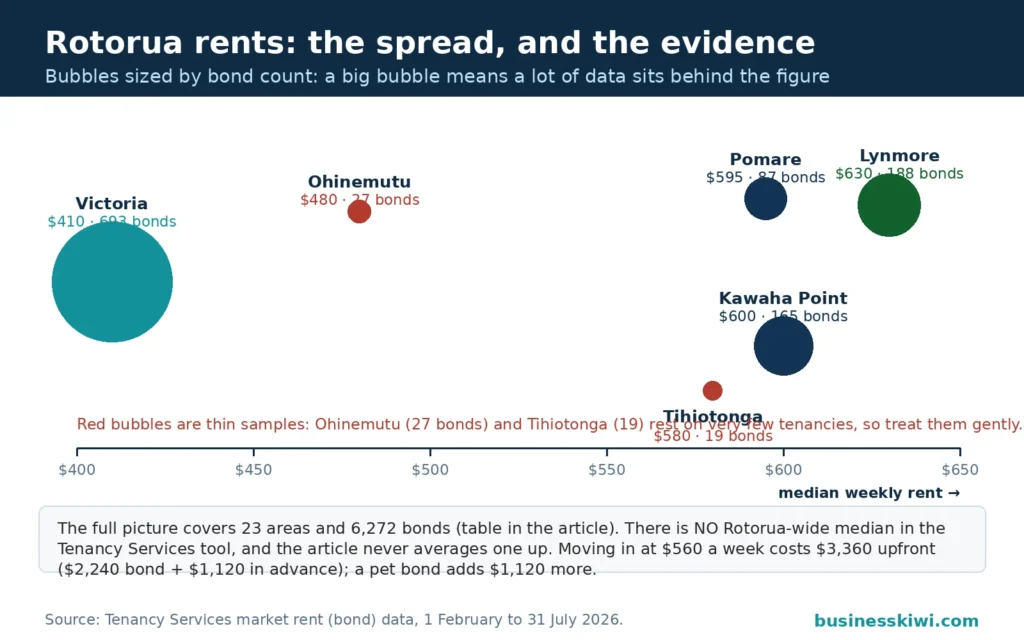
The cheapest medians sit in the inner city. Victoria, wrapping around the southern side of the central city, records a median of $410 a week across 693 bonds, the largest sample in Rotorua. The area the tool calls Rotorua, the central city itself, records $450 a week across 320 bonds, and Fenton Park, running south along the Fenton Street corridor, also records $450 across 256 bonds.
At the top of the range, Lynmore in the east records $630 a week across 188 bonds, with quartiles of $500 and $720. Kawaha Point, on the northern lake shore, records $600 across 165 bonds, and Springfield in the south records $580 across 260 bonds.
Most of the city sits between those poles. The big western suburbs, Mangakakahi, Utuhina, Western Heights and Pukehangi, record medians between $520 and $560 a week, each on several hundred bonds. Owhata in the east records $560 across 596 bonds, and Ngongotaha, at the north-western end of the lake, $530 across 369 bonds.
Two cautions. First, a median built on few bonds moves around: Tihiotonga records $580 a week, but on only 19 bonds, and Ohinemutu $480 on 27 bonds. Treat both as rough indications, not benchmarks. Second, the medians mix houses, flats and apartments, and the mix differs by area. Victoria’s low median reflects a stock with a great many flats; Lynmore’s high median reflects a stock that is almost all houses. The bedroom breakdowns below are where the useful comparisons live.
The same bond data method sits behind our Taupō rentals guide and our Auckland rentals guide, so figures across those guides can be compared on a like basis.
How to read these figures
Tenancy Services builds the market rent tool from bonds lodged in the six months being reported, excluding the most recent month, and updates it monthly. The headline bond count for an area covers all bonds. The breakdown rows count active bonds with complete information, by dwelling type and bedroom count, with a lower quartile, a median and an upper quartile for each row. Amounts are weekly rent.
The tool carries its own warning: the figures are a guide to the level of rents in an area, not a valuation of any individual property. Condition and heating move a specific rent within the range the quartiles describe.
One pattern needs explaining. In many areas the one-bedroom house median is higher than the two-bedroom house median. Rotorua has many small standalone dwellings, including minor dwellings behind or beside a main house, and a one-bedroom house is a different product from a one-bedroom flat. Compare like with like.
Rotorua rentals by area
The table gathers every Rotorua area the tool publishes for this period, in order of median rent. The sections after it work through the areas in groups.
The centre and the inner south
Rotorua (central) covers the central city itself: 320 bonds, median $450 a week, quartiles of $350 and $530. Its stock is mixed in a way no other area matches. Two-bedroom apartments record $540 across 72 bonds and one-bedroom apartments $460 across 43 bonds, while one-bedroom flats record just $285 across 38 bonds and two-bedroom flats $410 across 53 bonds. Houses are the minority: three-bedroom houses record $520 across 25 bonds. In the middle of town, the flat rows are the realistic starting point.
Victoria adjoins the centre and records the city’s lowest median, $410 a week, on its largest sample. The tool counts 155 one-bedroom flat bonds at $363 and 171 two-bedroom flat bonds at $400, far more flats than any other area. Its houses tell a different story: three-bedroom houses record $590 across 91 bonds, in line with the rest of the city.
Fenton Park runs south along the Fenton Street corridor, the strip long associated with motels and visitor accommodation. It records $450 a week across 256 bonds. Two-bedroom flats dominate, 90 bonds at $420. Three-bedroom houses record $563 across 28 bonds.
Glenholme, just south of the centre, is a more conventional residential area: 469 bonds, median $510. Three-bedroom houses are its backbone, 138 bonds at $580, with four-bedroom houses at $620 across 34 bonds and two-bedroom flats at $460 across 84 bonds.
Ohinemutu, the lakeside village area on the northern edge of the centre, records $480 a week, but on only 27 bonds, too few to read as a market pattern.
The west
The western side of Rotorua holds a large share of the city’s rental homes, most of them standalone houses on ordinary residential streets, and the medians cluster tightly.
Fordlands, an inner western area, records $480 a week across 206 bonds, houses only. Three-bedroom houses dominate, 112 bonds at $485, and two-bedroom houses record $465 across 40 bonds.
Koutu, on the lake side of the west, records $485 across 248 bonds. Three-bedroom houses record $515 across 126 bonds. Two-bedroom houses record an unusually low $368 across 33 bonds. Its lower quartile of $249 points to a wide spread of condition rather than a going rate to expect.
Mangakakahi records $520 across 464 bonds, one of the city’s deeper samples. Three-bedroom houses account for 228 bonds at $570, two-bedroom houses $390 across 60 bonds, and four-bedroom houses $620 across 28 bonds. Its two-bedroom flats, $385 across 44 bonds, are among the cheaper flat options in the city.
Utuhina, between the centre and the western suburbs, records $520 across 193 bonds, with three-bedroom houses at $560 across 85 bonds. Pukehangi, in the south-west, records $560 across 441 bonds, and its three-bedroom house row is one of the largest in the city: 287 bonds at $560, with four-bedroom houses at $650 across 31 bonds.
Sunnybrook records $573 across 145 bonds, with three-bedroom houses at $580 across 71 bonds. Selwyn Heights records $550 across 145 bonds, led by three-bedroom houses, 79 bonds at $560. Western Heights, the elevated north-western suburb, records $530 across 583 bonds, the city’s third-largest sample: three-bedroom houses at $560 across 280 bonds and two-bedroom flats at $370 across 68 bonds. Pomare records $595 across 87 bonds, but the tool publishes only two rows for it, three-bedroom houses (57 bonds at $600) and four-bedroom houses (12 bonds at $638), so its median reflects a family house stock and should not be compared with the flat-heavy inner areas.
The north and the lake shore
Fairy Springs, in the north-west on the way out of the city, records $533 a week across 190 bonds. Three-bedroom houses record $580 across 88 bonds and two-bedroom flats $390 across 24 bonds.
Kawaha Point, on the northern shore of Lake Rotorua, records $600 across 165 bonds, the second-highest area median in the city: three-bedroom houses at $600 across 86 bonds and four-bedroom houses at $640 across 15 bonds.
Ngongotaha sits at the north-western end of the lake, a township with its own centre, and records $530 across 369 bonds. Three-bedroom houses record $560 across 166 bonds and four-bedroom houses $620 across 29 bonds. Its two-bedroom flats, at $420 across 25 bonds, are at the cheaper end.
The east and the south
Owhata, the large eastern suburb, records $560 across 596 bonds, the city’s second-largest sample. Its three-bedroom house row, 324 bonds at $550, is the largest single row in Rotorua. One-bedroom houses record $600 across 135 bonds, a substantial segment that again reflects the small standalone dwelling stock.
Lynmore, also in the east, is the city’s most expensive area in this data: $630 a week across 188 bonds, quartiles of $500 and $720. Three-bedroom houses record $620 across 91 bonds, four-bedroom houses $700 across 41 bonds, and one-bedroom houses $695 across 23 bonds, the highest one-bedroom house median in Rotorua. Its flat rows are tiny, 8 and 9 bonds, and should be ignored. Lynmore’s premium over the western suburbs is consistent at every house size.
Hillcrest, in the south, records $550 across 143 bonds, houses only, with three-bedroom houses at $570 across 66 bonds. Springfield, also southern, records $580 across 260 bonds: three-bedroom houses at $600 across 122 bonds and four-bedroom houses at $690 across 31 bonds. Tihiotonga, the small southern area, records $580 on 19 bonds in total, with only a three-bedroom house row published, 8 bonds at $575. There is not enough data to say more.
What shapes the Rotorua market
Geothermal ground. Rotorua sits in an active geothermal field, and that reaches into ordinary renting in two ways. Some homes draw on geothermal heating, using heat from the ground and water below the city, which can make a house cheap to keep warm through winter. The other side is the sulphur in the air. The gas behind the city’s famous smell tarnishes and corrodes metal over time, so fittings, tapware and appliances in geothermal areas can have shorter lives than the same items elsewhere. Raise corrosion problems early, in writing.
Older stock and healthy homes. Much of Rotorua’s rental housing was built decades ago, and older houses are where the healthy homes standards bite hardest. Since 1 July 2025 every private rental has had to comply with all five standards: heating, insulation, ventilation, moisture ingress and drainage, and draught stopping. New and renewed agreements must include a signed compliance statement, and a landlord must provide compliance information within 21 days if a tenant asks. At a viewing, ask what fixed heating is in the main living room, whether insulation has been topped up, whether extractor fans vent outside, and whether there is a ground moisture barrier under the house.
Tourism and short stays. Rotorua is one of New Zealand’s longest-established visitor destinations, and part of its housing stock serves visitors rather than residents, from motels along Fenton Street to homes let short term. No official source publishes a Rotorua vacancy rate, so this guide puts no number on it. The bond data does show the resident market working at scale: more than five thousand bonds sit behind the area figures here.
Emergency housing has wound down. For several years Rotorua carried an outsized share of the country’s emergency housing, much of it in contracted motels. That has now formally ended. The Government announced in November 2025 that households in contracted emergency housing in Rotorua had reached zero, down from a peak of more than 240 households across 13 motels, and confirmed in December 2025 that the contracted motel use had shut down, with referrals into those motels having ceased on 15 June 2025. Households were moved into stable homes through work by HUD and MSD with local providers, iwi and the council, rather than released onto the private market in a single wave, and the motel strip is returning to visitor use.
The district behind the data. Bond data is the better guide to what renting costs now. The census, taken every five years, is the better guide to the size and shape of the housing stock itself, but it is not a rent source and this guide does not use it as one.

The money: bond, rent in advance and the total to get in
Tenancy Services recognises two kinds of bond. A general bond covers money owed at the end of a tenancy, including unpaid rent and damage claims. A pet bond covers pet damage beyond fair wear and tear where a landlord has consented to a pet. Both are held by Tenancy Services during the tenancy, not by the landlord.
The caps are firm. A general bond can be no more than four weeks’ rent, and a landlord cannot get around that by calling the extra money something else. A pet bond can be no more than two weeks’ rent, and only one can be charged per tenancy however many pets are approved. A landlord must lodge a bond with Tenancy Services within 23 working days, and the same timeframe applies to top-ups after a rent increase.
Rent in advance is capped separately: one or two weeks, depending on whether rent is paid weekly or fortnightly, never more than two, and the next payment cannot be asked for until the advance already paid has been used up.
On a real Rotorua figure: take a home at $560 a week, the Owhata and Pukehangi median. The maximum general bond is $2,240 and two weeks in advance is $1,120, so the total to have ready is $3,360. A maximum pet bond adds $1,120. At Lynmore’s median of $630 the same sums come to $3,780 before any pet bond.
Nothing else should be added to that list. Letting fees charged to tenants have been prohibited since 12 December 2018, including on renewal or extension, though an agent can charge the landlord. Key money is prohibited too. The single exception is an option fee to hold a property while you decide, capped at one week’s rent.
Rent increases, inspections and ending a tenancy
Rent increases. Rent can only go up once in any 12-month period, and not within the first 12 months of a tenancy. A fixed-term tenancy can only be increased if the agreement allows it. The landlord must give at least 60 days’ written notice stating the new rent and the day it takes effect. There is no legal cap on the size of an increase, which is why the market rent tool matters: if a landlord is charging substantially more than the rent for similar properties in the same area, a tenant can ask for a reduction and, if the landlord declines, apply to the Tenancy Tribunal for a market rent review.
Inspections. A landlord can inspect no more often than once every four weeks, between 8am and 7pm, with at least 48 hours’ notice and no more than 14 days’ notice. You do not have to be home. Photographs should document the property’s condition and not focus on your belongings.
Ending a periodic tenancy. Notice must be in writing. A tenant needs at least 21 days. A landlord can end a periodic tenancy with 90 days’ written notice without giving a reason, provided the notice is not retaliatory. A shorter 42-day notice is available only on three grounds: the owner or their family need the property as their main home, the property is genuinely employee or contractor housing as stated in the agreement and is needed for that purpose, or the property has been sold with vacant possession required. Fixed-term tenancies generally run their term unless both sides agree otherwise. A tenant experiencing family violence can withdraw from either kind of tenancy on at least two days’ written notice in the approved form with qualifying evidence, without financial penalty.
Pets. For a pet first kept on or after 1 December 2025, you must request the landlord’s consent. The landlord can set reasonable conditions, including a pet bond, and can refuse only on reasonable grounds; refusing without a valid reason can attract a financial penalty. You are liable for pet damage beyond fair wear and tear. Pets approved before 1 December 2025 need no new consent and no pet bond.
If things go wrong. Mediation and the Tenancy Tribunal are the route for disputes that talking does not settle. Applying to the Tribunal costs $29, as the main application page states.
Applying for a Rotorua rental
The Privacy Commissioner publishes staged guidance on what landlords and property managers may collect. At a viewing, the only information that should be needed is your name and contact details. You can be offered a full application form before a viewing, but you cannot be required to complete one at that stage.
When you apply, a landlord can collect your name and contact details, proof of identity, whether you are 18 or older, how many people would live at the property, the names only of occupants who will not be on the agreement, contact details for references, and your consent to contact referees and to a credit report and criminal record check. Pet ownership and smoking can be asked about where the property has restrictions on either, and a legal right to remain in New Zealand only for a fixed-term tenancy. Referees should not be contacted yet, and the checks should only be run once you are in negotiation about an offer.
If you are shortlisted, the landlord can ask for extra detail those checks need, such as a date of birth, and for evidence of your ability to pay the rent: one form in addition to a credit report, of your choosing, such as a pay slip, a letter from an employer or Work and Income, or evidence of rent paid in a previous tenancy. Detailed bank statements showing your spending should never be asked for. The same never list covers the characteristics protected under the Human Rights Act, including sex, relationship or family status, religious or ethical belief, race or ethnic or national origins, disability or illness, political opinion, employment status, and sexual orientation or gender identity. Experience of family violence, employment history and social media details should not be sought either. You must be told what is being collected and why, and you can access and correct information held about you.
Have identity documents, reference contacts and one form of income evidence ready before you start viewing, so a shortlist request does not stall.
Frequently asked questions
What is the median rent in Rotorua?
There is no single Rotorua median in the official data. Tenancy Services publishes area medians from bond data, and for 1 February 2026 to 31 July 2026 they run from $410 a week in Victoria to $630 in Lynmore. Most large suburbs sit between $520 and $580.
Which Rotorua areas are cheapest to rent in?
Victoria records the lowest area median at $410 a week, driven by its large stock of flats, followed by the central Rotorua area and Fenton Park at $450. For houses, two-bedroom houses in Koutu record $368 and in Mangakakahi $390.
How much money do I need before moving into a Rotorua rental?
At the legal maximums, four weeks’ rent as a general bond plus up to two weeks’ rent in advance. On a $560 a week home that is $2,240 plus $1,120, a total of $3,360. An approved pet can add a pet bond of up to two weeks’ rent. Letting fees and key money cannot be charged.
Does geothermal heating make a Rotorua rental cheaper to run?
It can. Some Rotorua homes use geothermal heat rather than a conventional system, and an efficient heat source costs less than heating a draughty home with a small heater. Ask what heating the property has before you sign, and expect sulphur tarnishing on metal fittings in geothermal areas.
Can a Rotorua landlord refuse my pet now?
Since 1 December 2025 a landlord can refuse a pet only on reasonable grounds and can set reasonable conditions, including a pet bond of up to two weeks’ rent. Pets approved before that date keep the earlier arrangements, with no new consent and no pet bond.
What can a landlord ask me when I apply?
Identity, contact details, who will live at the property, reference contacts, and consent to referee contact and to credit and criminal checks, which should only happen once an offer is being negotiated. Income evidence is one document of your choosing, at shortlist stage. Bank statements showing spending, employment history and questions about protected characteristics such as race, religion, family status or disability should never be asked for.
Sources
Tenancy Services, Ministry of Business, Innovation and Employment, Market rent tool and Market rent explained; Bonds; Charging a general bond; Charging a pet bond; Charging rent; Increasing rent; Healthy homes compliance; Inspections; Ending a periodic tenancy; Rules about pets; Letting fees and key money; How to apply to the Tenancy Tribunal, tenancy.govt.nz. All area figures are for 1 February 2026 to 31 July 2026 and were checked on 7 October 2026.
Ministry of Business, Innovation and Employment, New pet consent rules and pet bonds, mbie.govt.nz, 1 December 2025. Office of the Privacy Commissioner, Rental guidance for tenants and Rental guidance for landlords, privacy.org.nz. Beehive, New Zealand Government, Zero households in Contracted Emergency housing in Rotorua, 19 November 2025, and Government concludes contracted emergency housing in Rotorua, 15 December 2025, beehive.govt.nz.
Disclaimer
This article is general information about renting in Rotorua, based on official sources checked on 7 October 2026. It is not legal, financial or tenancy advice for your situation. Rents, rules and fees change, so confirm current figures with Tenancy Services before relying on them.
More guides like this one sit in our Real Estate hub.