Rental Properties in NZ: Finding, Applying and Your Rights as a Tenant

Renting is not a stopgap in New Zealand; it is how a large share of the country lives. Stats NZ’s reporting on the 2023 Census found that around a third of households, 34.0 percent, did not own the home they lived in or hold it in a family trust, and 565,974 households were paying rent. Yet many tenants sign agreements without knowing the rules behind them: what a landlord may charge, what an application form may lawfully ask, and how much notice either side must give.
This guide covers the national process from first search to final bond refund: the rules Tenancy Services publishes, the privacy limits the Privacy Commissioner sets for applications, and the steps available when something goes wrong. Rent figures for individual cities and districts sit in our separate local guides.
Quick answer
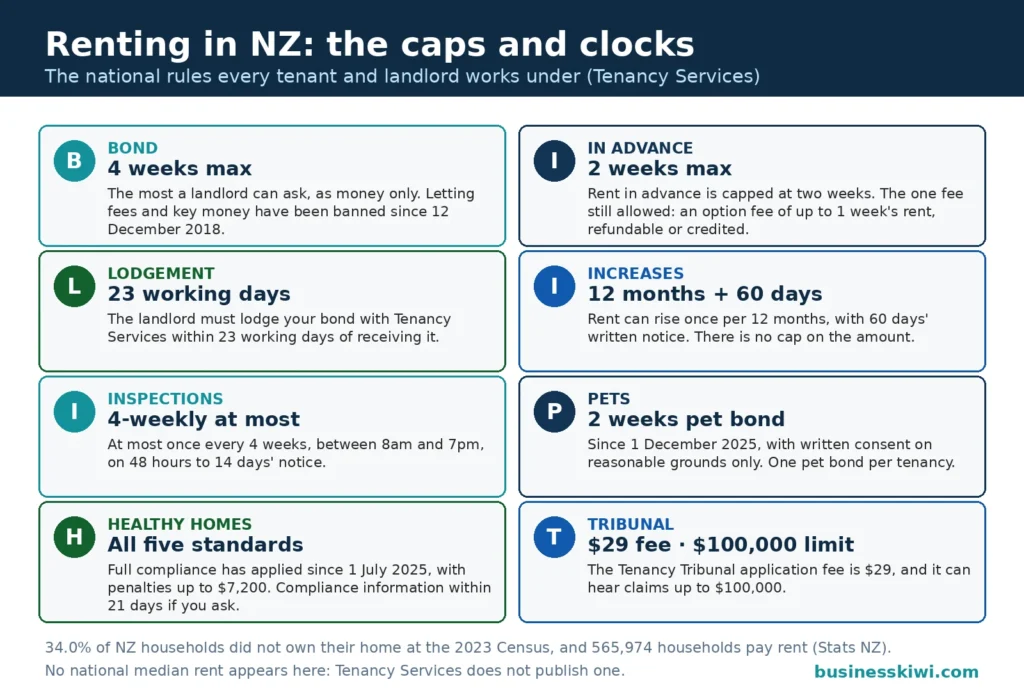
A landlord can charge you at most four weeks’ rent as a bond and two weeks’ rent in advance, and cannot charge a letting fee or key money. Your personal information is collected in stages as an application progresses, and some topics, such as employment status and spending habits, should never be asked about at all. Rent can rise only once in any 12 months, with at least 60 days’ written notice. Every rental has had to meet the healthy homes standards since 1 July 2025. Either side can end a periodic tenancy with written notice: 21 days from a tenant, 90 days from a landlord without a reason, or 42 days on specific grounds. Landlord and tenant disputes go to the Tenancy Tribunal, where the application fee is $29.
Finding a rental property
Start with the asking price, because it is more regulated than most people realise. Tenancy Services states that a rental property cannot be advertised without a rental price listed, and landlords cannot invite or encourage rental bidding.
Before you book a single viewing, check the rent against official data. Tenancy Services runs a market rent tool built from the bonds lodged with it. For each area it shows the lower quartile, median and upper quartile weekly rent, broken down by dwelling type and bedrooms, drawn from six months of bond data and updated monthly. Treat the result as a sense check rather than a verdict: Tenancy Services cautions that the tool should not be used on its own to decide the market rent of a particular property.
If you are house hunting in the country’s biggest market, our Auckland rentals guide works through suburb level medians and bond counts drawn from the same data. Our regional guides to Taupō rentals and Rotorua rentals do the same for those districts.
Viewing a property
A viewing is your chance to test the things a listing photo cannot show. Run the shower and taps. Look for a fixed heater in the main living room, and check for mould, condensation damage and draughts. Ask about healthy homes compliance, the tenancy type on offer, and the total move-in cost.
One privacy point applies from this very first step. The Office of the Privacy Commissioner advises that at a viewing, a landlord or property manager should only need your name and contact details, so they can follow up afterwards. Identity documents and referees belong to a later stage.

Applying: what a landlord can and cannot ask
Rental applications follow a staged model under the Privacy Act 2020, set out in the Privacy Commissioner’s guidance for tenants. The further your application progresses, the more a landlord may reasonably collect.
Some information sits outside the process entirely. The Privacy Commissioner advises that a landlord or property manager should never ask about characteristics protected under the Human Rights Act, including your sex, relationship or family status, religious or ethical beliefs, ethnic or national origins, disability or illness, political opinion, employment status, or sexual orientation or gender identity. Your spending habits are off limits too: a landlord cannot ask for bank statements showing your transactions. Nor can they ask about your employment history or social media accounts.
You have rights over whatever is collected. A landlord must take reasonable steps to make sure you know what is being collected, why, and who will receive it. You can ask to see the information held about you and have it corrected if it is wrong. You should not be disadvantaged for refusing to provide information that should never have been requested.
Tenancy types: periodic and fixed term
A periodic tenancy has no end date. It runs until either side gives the correct written notice to end it.
A fixed-term tenancy lasts for a set period stated in the agreement. The term must be more than 90 days to be a standard fixed term, and there is no maximum length. During the term, neither side can simply walk away: a fixed-term tenancy can generally only be ended early if both the landlord and the tenant agree, apart from limited situations set out in the law.
What surprises many tenants is what happens when the fixed term expires. If neither party gives proper written notice during the window known as the effective period, which runs from the 90th day before expiry to the 21st day before expiry, the tenancy does not end. It automatically becomes a periodic tenancy. Either side can prevent that by giving notice within the effective period, and no reason is required. The two sides can also agree in writing to renew or extend for a further fixed term. A short fixed-term tenancy, of 90 days or less, simply ends on the agreed date and does not convert.

The upfront costs, and the fees that are banned
At $600 a week in rent, the legal maximums add up to $3,600 before you have moved a single box: $2,400 of bond plus $1,200 of rent in advance.
Letting fees were prohibited from 12 December 2018. Before that date, letting agents and solicitors could charge tenants for the work of granting a tenancy: advertising, showing the property, vetting applicants, preparing the agreement. Those costs can now be charged to the landlord, but not to you, and the ban includes charges to renew or extend a tenancy. Key money, meaning any other payment demanded for granting or changing a tenancy, is also not allowed.
The single exception is the option fee: money you pay for the landlord to hold the property while you decide whether to take it. It cannot exceed one week’s rent, and if you go ahead, the landlord must refund it or put it towards your rent.
Nor can a landlord ask for security in other forms. Only a bond payment in money is allowed: no credit card details, no access to your bank account, and no personal item such as a car or laptop as a guarantee.
Signing the tenancy agreement
Read the agreement before you sign, and check the attachments. Landlords must include several signed statements in a new tenancy agreement. The insurance statement must say whether the property is insured and, if so, the excess amount for policies relevant to your liability for damage. An insulation statement must record whether there is insulation, where it is, what type it is and what condition it is in. A healthy homes compliance statement must set out the property’s current level of compliance with the healthy homes standards.
Do the initial inspection properly. Tenancy Services recommends that landlord and tenant inspect the property together at the start of the tenancy and complete and sign the property inspection report. That report is your baseline evidence for the bond refund at the other end, so note existing marks and damage, and keep dated photos.
Your bond: lodgement and getting it back
The bond is your money, held independently. Your landlord must give you a receipt for it and lodge it with Tenancy Services within 23 working days of receiving it. You should then receive a confirmation, with a tenant number to keep safe. If the rent goes up, the landlord can ask you to top the bond up to the new four week level, also lodged within 23 working days.
When the tenancy ends, tenants who have looked after the property, paid the rent in full and settled anything owing should expect the bond back. Refunds are now handled digitally: the landlord submits a refund request through Bond Hub or their property management software, and the tenants confirm it before it is processed. Tenancy Services says a completed refund application takes up to 10 working days to process. If the two sides cannot agree on how the bond should be split, either party can apply to the Tenancy Tribunal, and mediation is available first.
Rent increases
Rent cannot be increased whenever a landlord likes. For both periodic and fixed-term tenancies, there are two timing rules: no increase within 12 months of the tenancy start date, and no increase within 12 months of the last one taking effect. In a fixed-term tenancy, an increase during the term is only possible if the agreement allows it.
A landlord must give at least 60 days’ written notice of an increase, stating the new amount and the day it becomes payable. The notice can be given ahead of the 12 month mark, but the higher rent cannot take effect until the 12 months are up. There is no legal cap on the size of an increase. If the new rent looks out of step, check it against the market rent tool. Where rent is substantially higher than for similar properties in the area, a tenant can apply to the Tenancy Tribunal for a review.
Healthy homes standards
Since 1 July 2025, every rental property in New Zealand must comply with the healthy homes standards, and landlords must keep their properties up to standard for the whole tenancy. The five standards, in outline:
- Heating. At least one fixed heater that can directly heat the main living room and meets the minimum heating capacity required for that room.
- Insulation. Ceiling and underfloor insulation, compulsory in rental homes since 1 July 2019, brought up to the level the standard requires.
- Ventilation. A window or door that opens to the outside in each livable space, plus extractor fans in kitchens and bathrooms.
- Moisture ingress and drainage. Efficient drainage, guttering and downpipes for stormwater, surface water and ground water, and a ground moisture barrier where the home has an enclosed sub-floor.
- Draught stopping. Unreasonable gaps and holes that cause noticeable draughts must be blocked.
Breaches are not a technicality. Landlords who fail to meet their healthy homes obligations are in breach of the Residential Tenancies Act 1986 and may face financial penalties of up to $7,200. If you suspect your home falls short, ask for the compliance information first: the landlord must provide it within 21 days of your request.
Living there: inspections, maintenance and quiet enjoyment
Once you are in, the property is your home, and the law treats it that way. Your landlord has a right to inspect, but it is tightly fenced. Tenancy Services sets the limits: inspections between 8am and 7pm only, no more often than once every four weeks, and with notice given at least 48 hours beforehand and no more than 14 days in advance. Photos may be taken to document the property’s condition, but the Privacy Commissioner advises they should not focus on your personal belongings.
Maintenance is shared, but not equally. The landlord is responsible for keeping the property in a reasonable state of repair and dealing with maintenance promptly. Your side of the bargain is to keep the property reasonably clean and tidy, remove your rubbish, and tell the landlord as soon as possible when something is damaged or needs repair. Tenancy Services is explicit on one related point: a landlord cannot give you notice to end the tenancy because you asked for repair work to be done. A notice given in retaliation like that is an unlawful act. Behind all of this sits your right to quiet enjoyment: the landlord must not interfere with your reasonable peace, comfort and privacy.
Keeping a pet
The rules on pets changed on 1 December 2025, and they now start from consent rather than a blanket ban. If you want to start keeping a pet on or after that date, you must request your landlord’s written consent, unless your tenancy agreement already allows pets. The landlord must respond within 21 days and must say yes unless there are reasonable grounds to refuse. Tenancy Services gives examples: the property is not suitable for the pet (too small, or without adequate fencing), a council bylaw, body corporate rule or cross-lease term prohibits it, the pet is dangerous or disruptive, or you have broken pet conditions before.
Consent can come with reasonable conditions, and one of them may be a pet bond of up to two weeks’ rent, charged on top of the general bond and lodged with Tenancy Services like any other bond. Only one pet bond can be charged per tenancy, whatever the number of pets. In return, tenants are fully liable for pet damage beyond fair wear and tear. Pets that were lawfully at the property before 1 December 2025 need no new consent and cannot be charged a pet bond, although the damage liability still applies to damage caused after that date. Disability assist dogs sit outside these rules altogether: no permission or pet bond is required for them.
Ending a tenancy
The notice periods differ by who is giving notice and why. Every notice must be in writing, state the property address and the end date, and be signed:
The 42 day grounds are specific. They cover the owner or a family member needing the property as their main home (they must move in within 90 days of the tenancy ending and live there for at least 90 days), the property being needed for the landlord’s employees or contractors where the agreement says it is used for that purpose, and a sale under an unconditional agreement that requires vacant possession.
The family violence provision deserves emphasis, because it works differently from everything else in the table. A tenant, or a tenant whose dependant has experienced family violence during the tenancy, can withdraw with at least two days’ written notice in the approved form, supported by qualifying evidence. No agreement from the landlord is needed, there is no financial penalty, and it applies to fixed-term and periodic tenancies alike.
If things go wrong
Most tenancy problems are sorted out between the two parties first. Keep records: the agreement, the inspection report, rent receipts, photos and every email about the problem. If talking does not fix it, you can apply to Tenancy Services for help. Applications can lead to mediation, where a mediator helps both sides reach an agreement, or to a hearing at the Tenancy Tribunal.
The Tenancy Tribunal is the forum for disputes between landlords and tenants under tenancy law: bond disputes, rent arrears, property damage and more. It can hear claims of up to $100,000, and the application fee is $29. If you are on a benefit, Work and Income may be able to help with the fee, and if you succeed, the Tribunal can order the other party to repay it, provided you asked for that in your application. Not every housing dispute belongs there: disagreements between flatmates, or in private board arrangements, may fall outside tenancy law and belong in the Disputes Tribunal instead.
Help is available before things reach a hearing. Tenancy Services answers tenancy and bond questions on 0800 836 262 (0800 TENANCY). Citizens Advice Bureau offices and Community Law Centres offer free guidance. For privacy problems, the Office of the Privacy Commissioner is the place to complain once you have raised the issue with the landlord and not resolved it.
Frequently asked questions
How much can a landlord charge me before I move in?
At most, four weeks’ rent as a bond plus two weeks’ rent in advance. On a $600 a week rental, that is $3,600. Letting fees and key money have been banned since 12 December 2018. The only other permitted payment is an option fee of up to one week’s rent to hold the property while you decide, which must be refunded or credited to your rent if you take the tenancy.
Can a landlord ask for my bank statements when I apply?
No. The Privacy Commissioner advises that landlords should never ask about your spending habits, and bank statements showing your transactions are the example given. Once you are shortlisted, a landlord can ask for one other form of evidence that you can pay the rent, such as a pay slip or a letter from an employer or Work and Income. You choose which one to provide.
How often can my rent go up, and by how much?
Once in any 12 month period, and not within the first 12 months of the tenancy. There is no cap on the amount, but the landlord must give at least 60 days’ written notice, and in a fixed-term tenancy an increase is only possible if the agreement allows it.
My landlord wants to inspect the property every fortnight. Is that allowed?
No. Inspections are limited to once every four weeks at most, between 8am and 7pm, with at least 48 hours’ notice and no more than 14 days’ notice. A landlord who turns up outside those limits without your consent is breaching the rules on entry.
Can I keep a dog in my rental?
Since 1 December 2025 you need your landlord’s written consent, unless the agreement already allows pets, but the landlord must respond within 21 days and can only refuse on reasonable grounds, such as the property being unsuitable or a bylaw prohibiting pets. The landlord may charge a pet bond of up to two weeks’ rent, and you are liable for any pet damage beyond fair wear and tear.
Sources
Tenancy Services, Charging rent, tenancy.govt.nz
Tenancy Services, Market rent, tenancy.govt.nz
Tenancy Services, Letting fees and key money, tenancy.govt.nz
Tenancy Services, Charging a general bond, tenancy.govt.nz
Tenancy Services, How to apply for a bond refund, tenancy.govt.nz
Tenancy Services, Rent increases and reductions, tenancy.govt.nz
Tenancy Services, Expiry of a fixed-term tenancy, tenancy.govt.nz
Tenancy Services, Ending a periodic tenancy, tenancy.govt.nz
Tenancy Services, Healthy homes compliance, tenancy.govt.nz
Tenancy Services, Required statements for tenancy agreements, tenancy.govt.nz
Tenancy Services, Inspections, tenancy.govt.nz
Tenancy Services, General maintenance responsibilities, tenancy.govt.nz
Tenancy Services, Rules about pets, tenancy.govt.nz
Tenancy Services, How to apply to the Tenancy Tribunal, tenancy.govt.nz
Office of the Privacy Commissioner, Rental guidance for tenants, privacy.org.nz
Stats NZ, Housing in Aotearoa New Zealand: 2025, stats.govt.nz
Disclaimer
This article is general information about renting in New Zealand, based on official guidance published by Tenancy Services, the Privacy Commissioner and Stats NZ at the time of writing. It is not legal advice, and tenancy law and fees change over time. For your own situation, check the current rules at Tenancy Services or get advice from a Citizens Advice Bureau, Community Law Centre or lawyer.
For more guides on buying, selling and renting property, see our Real Estate hub.