Renting in Timaru: Area Rents, Upfront Costs and Tenant Rights

Timaru is a smaller rental market than the big cities, and that changes how you house-hunt. Fewer homes come up at any one time, the gap between the cheapest and dearest suburbs is narrower than in Auckland or Wellington, and a suburb median can rest on a handful of bonds. This guide works from the official record: the rents in Tenancy Services’ market rent tool, which is built from bonds lodged with Tenancy Services, set out area by area for the six months from 1 February 2026 to 31 July 2026, plus the tenancy rules as Tenancy Services publishes them.
Nothing here promotes a property manager or a listing site. The figures are what tenants actually agreed to pay on new tenancies in each area, not asking prices.
Quick answer
The tool does not publish a single median for Timaru as a whole, so there is no honest one-number answer. Across the 17 Timaru areas it lists, headline medians for the February to July 2026 period run from $350 a week in Redruth (on only 11 bonds, so treat it gently) to $530 a week in Gleniti. The areas with the deepest data, Seaview, Parkside, Highfield, West End and Marchwiel, post medians between $400 and $450 a week. Budget up to four weeks’ rent for bond and up to two weeks in advance: at $450 a week that is $2,700 before you move in, or $3,600 if a pet bond of two weeks is added.
How to read these numbers
Tenancy Services’ market rent figures come from bonds. When a tenancy starts, the landlord must lodge the bond with Tenancy Services, and the rent recorded on that bond feeds the tool. The tool is updated monthly and covers the previous six months, not including the most recent month, which is why the current window is 1 February to 31 July 2026. It shows weekly rent for each area as a lower quartile, a median and an upper quartile, and it breaks most areas down by dwelling type and bedroom count.
Three habits make the data more useful. First, look at the bond count beside every figure. That count is the sample size: a median built on 295 bonds, as in Seaview, is a sturdy guide, while one built on 8 or 11 bonds can swing on a couple of unusual homes. Second, read the quartiles as a range rather than fixating on the median. Half of new tenancies in an area sit between the lower and upper quartile, so the range tells you what a normal search there actually looks like. Third, compare like with like. A suburb median mixes flats, apartments and houses of every size, so the bedroom rows for houses are usually the better comparison for a family home.
The same bond-data method sits behind our Auckland rentals pillar and our guide to renting in Rotorua, and the pattern holds in all three places: the tool reports areas, never a whole-city figure, and we have not averaged the areas together here either.
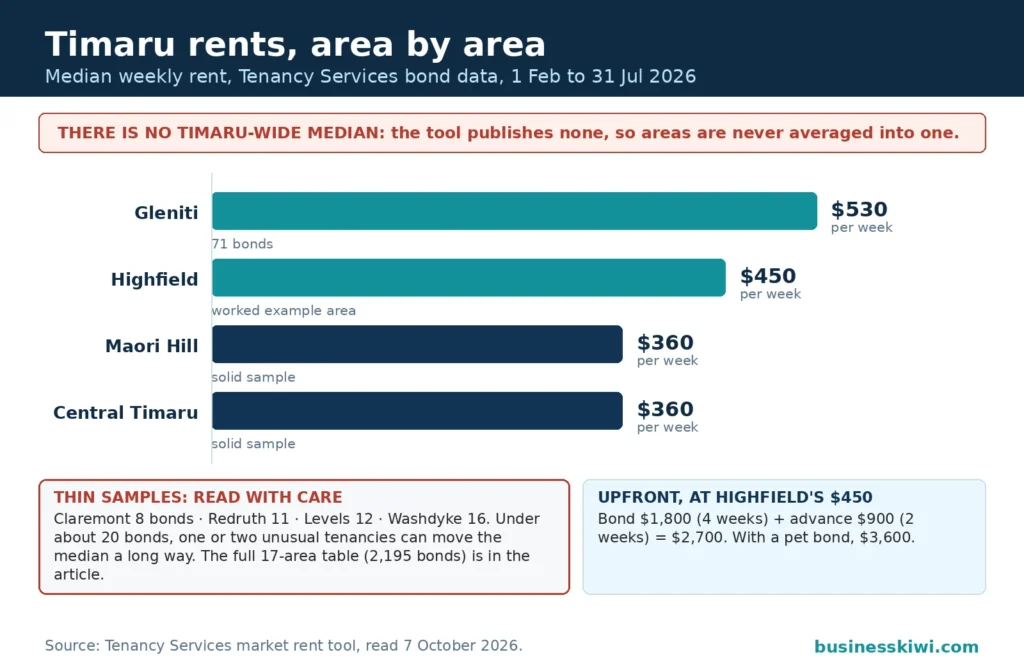
Timaru rents by area
Weekly rent, all dwelling types, 1 February 2026 to 31 July 2026, as published in the Tenancy Services market rent tool and read on 7 October 2026.
The 17 areas together account for 2,195 bonds lodged in the six months. Seaview recorded the most, at 295, followed by Parkside on 252 and Highfield on 244. At the other end, Claremont (8 bonds), Redruth (11), Levels (12) and Washdyke (16) are thin samples. Their medians are the tool’s published figures and are shown for completeness, but a single dearer or cheaper street can move them, so lean on the quartiles and on neighbouring areas if you are searching there.
What the table shows
Gleniti is the dearest area in the tool, with a $530 median on 71 bonds, and Glenwood ($460) and Highfield ($450) sit above the pack as well. The cheapest medians on solid samples are Maori Hill and central Timaru, both at $360, with Kensington close behind at $365 and Waimataitai at $370. Redruth’s $350 is lower still, but it rests on 11 bonds and covers an area of mostly industrial land with few homes, so it says less about a typical search than Maori Hill’s figure, which rests on 168.
The middle of the market is crowded and consistent. Marchwiel, Parkside, Seaview and West End all post a $400 median, each on more than 200 bonds, and Watlington sits just under at $395. If you are flexible about which side of town you live on, that cluster is the market’s centre of gravity: roughly $400 a week for the median new tenancy, with the middle half of homes falling between about $265 and $500 depending on the suburb.
Dwelling type matters more than suburb at the lower end. Timaru has a real stock of smaller flats in its central areas, and their medians sit far below house medians. One-bedroom flats post medians of $155 in Highfield (8 bonds), $158 in Kensington (18) and $160 in Parkside (32), and central Timaru’s flats post $190 for one bedroom (16 bonds) and $205 for two bedrooms (22). Two-bedroom flats are a common step into the market: medians run from $250 in Parkside (24 bonds) and $288 in Kensington (8) to $310 in Maori Hill (51) and $350 in West End (35). These rows mix older and smaller units with newer ones, so view any individual flat on its merits, but the pattern is genuine. Timaru’s cheapest way in is a small flat, not a small house.
One quirk deserves a warning. In several areas the published median for a one-bedroom house sits above the two-bedroom house median: Gleniti posts $545 for one bedroom (18 bonds) against $360 for two (11), and Highfield posts $550 (31) against $400 (41). Rows this small mix very different housing, and the one-bedroom rows appear to capture a narrow slice of homes. Do not read them as proof that smaller houses cost more. Use the three-bedroom rows, which carry the biggest samples, for suburb comparisons.
Three-bedroom houses, the family benchmark
Houses dominate Timaru’s rental stock, and three-bedroom houses carry the largest bond counts in most areas, which makes them the soundest comparison in the tool.
Marchwiel’s 115 bonds are the deepest sample, and its $420 median is a fair picture of the typical Timaru family rental. Highfield ($480 on 96 bonds) and Glenwood ($478 on 74) sit above it, and Gleniti’s $550 is the top of the table. At the lower end, Waimataitai ($390 on 55 bonds) and Maori Hill ($400 on 16) are the cheaper solid options. Washdyke’s row rests on six bonds and central Timaru’s on nine, so both are indicative only.
Two-bedroom houses, often the first step for couples and small households, post medians between $325 in Marchwiel (44 bonds) and $430 in Parkside (40), with Highfield at $400 (41), West End at $400 (46) and Seaview at $390 (48) in between. Four-bedroom houses are thinner on the ground: the published rows run from $440 in Marchwiel (11 bonds) to $555 in West End (20), with Highfield at $500 (24).
What you pay before you move in
The legal maximums are set nationally, and Tenancy Services publishes them. A landlord can ask for a bond of up to four weeks’ rent, and must lodge it with Tenancy Services within 23 working days of receiving it, giving you a receipt. Rent in advance is capped at two weeks: a landlord cannot require more than that, and cannot ask for the next payment until the rent already paid has been used up. If you keep a pet with the landlord’s consent under the rules that began on 1 December 2025, a pet bond of up to two weeks’ rent can be added, one per tenancy, on top of the general bond.
Worked through at Highfield’s $450 median, the maximum legal upfront cost looks like this:
Two other charges are simply not allowed. Letting fees have been prohibited since 12 December 2018: an agent can charge the landlord for their work, never the tenant, and that ban covers charges to renew or extend a tenancy as well. Key money, meaning any other payment demanded for granting or changing a tenancy, is also banned. The single exception is an option fee, paid to hold a property while you decide, which is capped at one week’s rent and must be refunded or credited to your rent if you go ahead. If a cost appears that is neither rent, bond, a pet bond nor an option fee, ask what it is before paying it.
Finding a rental in a smaller market
Timaru’s rental pool is a fraction of a big city’s, and the bond data shows the scale plainly: about 2,200 new tenancies across the whole town in six months, where a single large Auckland suburb can record more than that on its own. In practice that means fewer listings live at any moment, good homes go quickly, and some homes are let through local knowledge before they are widely advertised. Registering your interest with property managers, in general terms, and letting workplaces and community networks know you are looking are normal parts of a Timaru search, alongside the usual listing channels.
No official source publishes a vacancy rate for Timaru, and we have not repeated one from anywhere else. What the bond data can say is narrower: new tenancies are being signed in every area of town, in every size band, at a steady rather than frantic pace. Treat any claim about how tight the market is, from any source, as opinion unless it traces back to published data.
A few smaller-market habits help. Search by area cluster rather than one suburb, since the medians for Marchwiel, Parkside, Seaview and West End are effectively the same. Keep your documents ready so an application can go in the day you view. And use the quartiles in the table above when a rent looks high for its area: a landlord asking well above the upper quartile for a comparable home is asking you to pay more than three quarters of recent tenants in that suburb agreed to.

Applying, and what you can be asked
The Privacy Commissioner publishes guidance on what landlords and property managers may collect, and it works in stages. When you are only viewing a property, the landlord should need nothing more than your name and contact details. When you apply, they can ask for proof of identity, whether you are 18 or older, how many people would live at the property, the names of occupants who will not be on the agreement, contact details for referees, and your consent to contact referees and to run credit and criminal record checks later. Pet ownership and smoking can be asked about where the property has restrictions on either.
The deeper checks belong to the shortlist stage. If you are shortlisted and negotiating an offer, the landlord can collect what is needed to run the credit or criminal record check, and can ask for evidence that you can pay the rent. Alongside a credit report they may ask for one other form of evidence, such as a pay slip, a letter from an employer or Work and Income, or evidence of rent paid in a previous tenancy, and the choice of which form to provide is yours.
Some things should never be asked at any stage of choosing a tenant. The Commissioner’s list includes your employment status, employment history, spending habits or bank statements showing transactions, whether you have experienced family violence, your social media addresses, and the personal characteristics protected under the Human Rights Act, such as race, ethnic or national origins, religious or ethical belief, political opinion, disability, sexual orientation and relationship or family status. If an application form asks for any of those, the Commissioner’s guidance says you can question it, and you should not be disadvantaged for refusing information a landlord should not have sought in the first place.

The rules in brief
Bond. Up to four weeks’ rent, lodged with Tenancy Services within 23 working days, with a receipt for you. If your rent later increases, the landlord can ask you to top the bond up, and the top-up must be lodged within the same 23 working day window. Expect a notification confirming lodgement; Tenancy Services suggests checking with the landlord if none arrives within six weeks.
Rent rises. Rent can increase at most once in any 12 months, and not within the first 12 months of the tenancy. The landlord must give at least 60 days’ written notice stating the new amount and the day it takes effect. The law does not cap how much rent can rise by, which is exactly why the market rent table matters: if your rent sits well above what similar homes in your area achieve, you can negotiate, and the Tenancy Tribunal can review rent that substantially exceeds market rent for comparable properties.
Inspections. A landlord can inspect at most once every four weeks, between 8am and 7pm, with at least 48 hours’ notice and no more than 14 days’ notice. You do not have to be home, but you are entitled to be there, and photos taken during an inspection should not focus on your belongings.
Pets. Since 1 December 2025, you may keep a pet where the agreement allows it or the landlord consents in writing, and a landlord can only refuse a pet request on reasonable grounds. They may set reasonable conditions, and one condition can be a pet bond of up to two weeks’ rent, one bond per tenancy no matter how many pets you have. Tenants are liable for pet damage beyond fair wear and tear. Two carve-outs matter: no pet bond can be charged for a disability assist dog, and pets that were already being kept lawfully before 1 December 2025 do not need fresh consent and cannot have a pet bond charged for them.
Endings. On a periodic tenancy, a tenant gives at least 21 days’ written notice and needs no reason. A landlord can end a periodic tenancy without giving a reason on at least 90 days’ notice. A shorter 42-day notice is available only on stated grounds: the owner or their family needs the home as their principal place of residence, there is an unconditional sale requiring vacant possession, or the property is needed for the landlord’s employees or contractors and the agreement says so. A notice given because you exercised your rights is retaliatory and unlawful. Fixed-term tenancies roll over into periodic ones unless notice is given in the window between 90 and 21 days before the term ends, or both sides agree something else.
Disputes. If talking it through fails, applying to the Tenancy Tribunal costs $29, the fee Tenancy Services has published since 1 July 2026. If you succeed, the Tribunal can order the other party to reimburse the fee.
Healthy Homes in practice
Every rental property in New Zealand has had to meet the healthy homes standards since 1 July 2025, Timaru’s older housing stock included. The standards set minimums in five areas: heating, insulation, ventilation, moisture ingress and drainage, and draught stopping. A landlord who does not meet them is in breach of the Residential Tenancies Act and can face financial penalties of up to $7,200.
For a tenant, the practical lever is paperwork. Any new or renewed tenancy agreement must include a signed compliance statement setting out how the property measures up against each standard, and leaving it out can itself attract a penalty of up to $500 per tenancy. Read that statement before you sign, while you still have choices. In a town with older homes, the questions worth asking at a viewing follow directly from the five standards: what heating is fixed in the main living room, what insulation is in the ceiling and under the floor, whether the kitchen and bathroom extractors vent outside, and whether there are gaps or an open fireplace that should have been draught-stopped. If a home falls short once you are in, raise it with the landlord first, and Tenancy Services’ compliance team and the Tribunal sit behind that conversation.
A short word on Timaru itself
Most of what rents in Timaru is a standalone house. That is not an impression; it is what the bond data shows, with house rows dominating every area of the tool and three-bedroom houses the single largest group in most suburbs. Flats cluster in the central areas, around Parkside, Kensington, Seaview and the town centre, and apartments are a small slice everywhere. The town’s housing is largely older stock, which is why the Healthy Homes section above does real work here, and why viewing in winter tells you more than viewing in January.
Demand follows ordinary local life rather than any single boom: people moving for work, households forming and separating, tenants shifting between suburbs as their needs change. Because the pool is small, the market can feel tight for a particular kind of home, a modern three-bedroom house near a preferred school, say, while remaining ordinary for homes generally. The medians in this guide describe what tenants signed up to across a full six months, which is a steadier guide than any single week’s listings.
Frequently asked questions
What is the median rent in Timaru?
There is no single figure, because the Tenancy Services tool publishes areas, not a town-wide median, and we do not average areas into one. For February to July 2026 the dearest area median is Gleniti at $530 a week, the cheapest on a reasonable sample are Maori Hill and central Timaru at $360, and the busiest areas cluster at $400 to $450.
How much do I need before I can move in?
At most, four weeks’ rent as bond plus two weeks’ rent in advance. At $450 a week that is $2,700. Add up to two weeks more if a pet bond applies, taking it to $3,600. Letting fees and key money cannot be charged on top.
Why are some suburbs based on so few bonds?
Because fewer tenancies started there in the six months. Claremont recorded 8 bonds, Redruth 11 and Levels 12, so their medians can move sharply on a couple of homes. The article flags every thin sample, and the bedroom tables omit areas where the tool publishes no breakdown at all.
Can my landlord charge me a letting fee or a fee to renew?
No. Letting fees charged to tenants have been prohibited since 12 December 2018, including charges for renewing or extending a tenancy. The only holding payment allowed is an option fee of up to one week’s rent, which must be refunded or put towards your rent if you take the property.
How often can my rent go up, and by how much?
Once in any 12 months at most, never in the first 12 months of the tenancy, and only with at least 60 days’ written notice. There is no legal cap on the size of the increase, but the market rent figures for your area show what comparable homes achieve, and the Tenancy Tribunal can review a rent that substantially exceeds that level.
Sources
Tenancy Services, Market rent tool, tenancy.govt.nz
Tenancy Services, Preventing problems with bonds, tenancy.govt.nz
Tenancy Services, Charging a pet bond, tenancy.govt.nz
Tenancy Services, Rules about pets, tenancy.govt.nz
Tenancy Services, Rent increases and reductions, tenancy.govt.nz
Tenancy Services, Inspections, tenancy.govt.nz
Tenancy Services, Letting fees and key money, tenancy.govt.nz
Tenancy Services, Healthy homes compliance, tenancy.govt.nz
Tenancy Services, Compliance statement, tenancy.govt.nz
Tenancy Services, Tenancy law changes, tenancy.govt.nz
Tenancy Services, How to apply to the Tenancy Tribunal, tenancy.govt.nz
Office of the Privacy Commissioner, Rental guidance for tenants, privacy.org.nz
Disclaimer
This article is general information about renting in Timaru. It is not legal advice. The rent figures are medians and quartiles from Tenancy Services bond data for 1 February 2026 to 31 July 2026; they describe new tenancies signed in that period, they change as new data is published, and an individual home can fairly rent above or below its area’s figures. Check the current position on tenancy.govt.nz before relying on any figure or rule.
More property guides are in our Real Estate section.