Times Tables in NZ: Learning Order, Practice Methods and Curriculum Levels

Ask a room of New Zealand parents about times tables and you will usually get the same memory: standing in a classroom chanting “three times seven is twenty-one” while the teacher pointed at a wall chart. Tables are still learned at primary school here, and they still matter, but the way schools teach them, and the order they arrive in, looks quite different from the chant-and-test routine many of us grew up with.
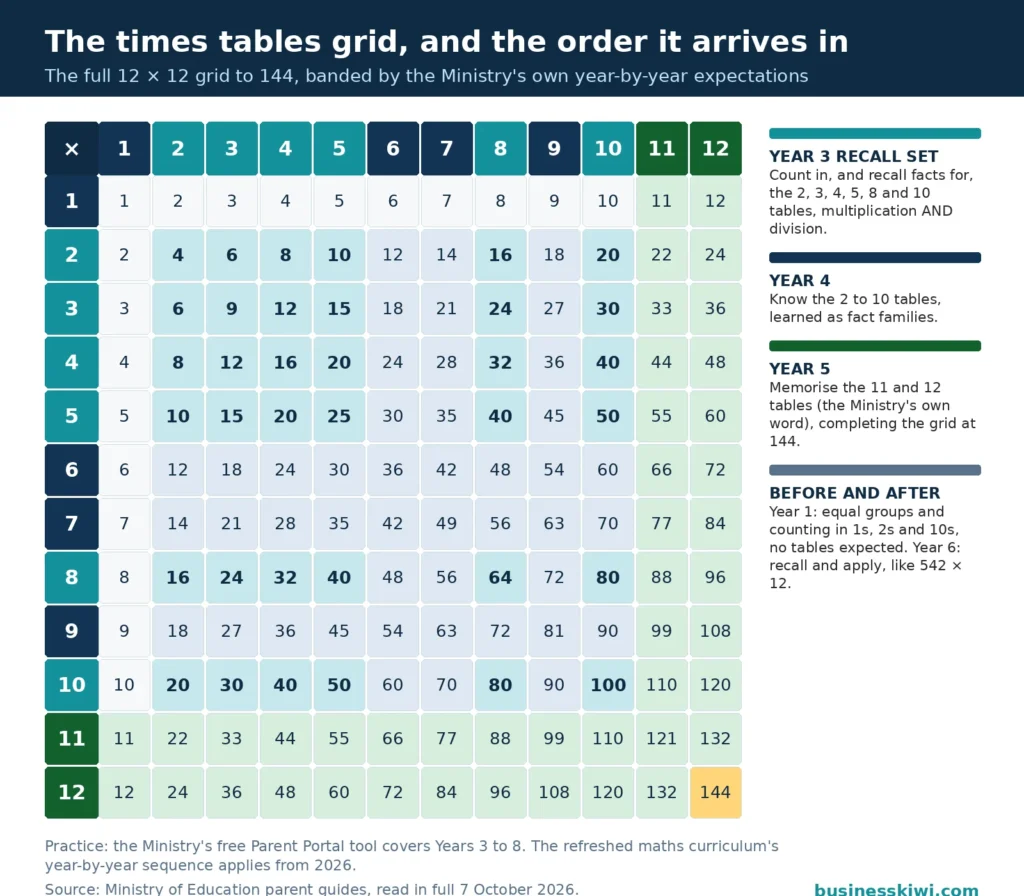
This guide pulls together what the Ministry of Education says children learn at each stage of primary school, the order the facts are usually tackled in, and the practice methods that help them stick. It also includes the full tables grid, so you can see at a glance what your child is working towards.
Quick answer
New Zealand children build times tables gradually across the primary years. The foundations are skip counting and equal groups in the junior school, then recall of the 2, 3, 4, 5, 8 and 10 times tables during Year 3, according to the Ministry of Education’s parent guide. By Year 4 children are expected to know the 2 to 10 times tables, the 11 and 12 times tables are memorised during Year 5, and by Year 6 children are recalling and applying the full set inside bigger calculations. At home, short and frequent practice, card and dice games, and everyday maths like doubling a recipe do more good than long drills.
Why times tables matter so much
Times tables are sometimes dismissed as old-fashioned rote learning, but fluent recall of multiplication facts is better understood as working equipment for almost everything that comes later in maths.
Fractions are the clearest example. Finding equivalent fractions, simplifying them, and adding fractions with different denominators all depend on spotting multiples and factors quickly. A child who knows that 24 is 3 × 8 and 4 × 6 and 2 × 12 has the raw material for fraction work already in hand. Division is the same facts run in reverse, and longer multiplication, area calculations, percentages and early algebra all assume that the single-digit facts no longer need to be worked out from scratch.
There is also a mental load argument. When a child solves a problem like 23 × 5, their attention needs to go on the method, not on counting up in fives on their fingers. Facts that come back instantly free up thinking space for the actual problem, and children tend to feel more confident about maths when they are not stalling on the basics. That confidence point shows up in Ministry parent material too, which links good maths skills with children seeing themselves positively as maths learners.
None of this means speed is everything. A child who can work out 7 × 8 from a known fact in a few seconds is in fine shape. The goal is facts that are both understood and readily available.
What the NZ Curriculum expects, and when
Until recently, the New Zealand Curriculum described maths learning in broad curriculum levels, each spanning several years of schooling. The refreshed mathematics and statistics curriculum, which schools have been required to use for Years 0 to 10 from 2026, is arranged differently. Learning is organised into phases, Phase 1 covering Years 0 to 3, Phase 2 covering Years 4 to 6, and Phase 3 covering Years 7 to 8, and within each phase the curriculum sets out a teaching sequence year by year. The Ministry has also published plain-language parent guides for each year level, and those guides are the clearest place to see what multiplication learning looks like at each age.
Here is the progression for times tables, drawn from the Ministry’s parent guidance for each year:
Two things are worth noticing. First, the Ministry’s official curriculum documents put increased focus on learning multiplication and division facts during Phase 2, the Years 4 to 6 band, so the middle primary years are when tables really consolidate. Second, multiplication and division are taught together from the start rather than division being bolted on years later.
Children do not all move at the pace of a table like the one above, and the curriculum sequence describes what teachers teach during each year rather than a pass or fail line for individual children. If your child is a year behind the sequence but progressing, that is common and usually manageable with steady practice.
The order that makes learning easier
Schools do not teach the tables in strict number order, because some tables are far easier than others. The usual sequence, which matches how the curriculum stages the facts, starts with the tables built on strong patterns and leaves the awkward ones until children have strategies to handle them.
Multiplying by 0 and by 1 sit outside this sequence because they are rules rather than facts to memorise: anything times 0 is 0, and anything times 1 is itself.
One more idea halves the whole job. Multiplication is commutative, which teachers usually introduce to children as turnaround facts: 3 × 8 and 8 × 3 give the same answer. Every fact a child learns in the early tables takes care of its mirror image in a later table, which is why the grid below is mostly familiar territory by the time the 7s arrive.
Strategies that make the hard facts stick
Alongside the order, schools teach children ways to derive a fact they have forgotten instead of being stuck. These strategies are not shortcuts around learning the facts. They are the bridge children use until recall becomes automatic, and the Ministry’s curriculum documents model them directly, for example by splitting 7 × 8 into 7 × 5 plus 7 × 3.
- Doubling. The 4s are double the 2s, and the 8s are double the 4s. A child who knows 2 × 8 = 16 can double it to 32 for 4 × 8, and double again to 64 for 8 × 8.
- Adding a group. If the 5s are secure, the 6s are one group more: 6 × 7 is 5 × 7 (35) plus 7, giving 42. The same trick builds the 3s from the 2s and the 12s from the 10s.
- Taking a group away. The 9s are one group less than the 10s: 9 × 8 is 80 minus 8, which is 72.
- Square numbers as landmarks. Facts like 6 × 6 = 36, 7 × 7 = 49 and 8 × 8 = 64 are memorable in themselves, and their neighbours can be reached from them. For 7 × 6, start from 7 × 7 and take away one group of 7: 49 minus 7 is 42. Or start from 6 × 6 and add one group of 6: 36 plus 6 is also 42.
- Splitting one number. For a fact with no other hook, split one side into friendlier parts: 7 × 8 becomes 5 × 8 plus 2 × 8, which is 40 plus 16, so 56.
At home it helps to ask “how could you work it out?” rather than only “what is it?” A child who can explain a strategy owns the fact in a way that chanting never quite delivers.
The full times tables grid
This is the complete 1 to 12 grid. Reading across a row gives that number’s table. Notice how the grid mirrors itself along the diagonal of square numbers: everything below the diagonal repeats what is above it, which is the turnaround idea in picture form.
A practical way to use the grid with your child: print it, and colour in the facts they already know cold. Because of the mirror effect, the confident area grows faster than children expect, and the facts left uncoloured are usually a small, named set you can target together.
How schools teach tables now
If your own schooling was built around chanting and weekly tests, the modern classroom approach may look surprisingly game-based. The refreshed curriculum expects explicit teaching of the facts, plenty of structured practice, and work with families of facts, arrays and table grids so that children see how facts connect. Ministry guidance for teachers talks about planning for a quality hour of maths a day in the primary years, and fact fluency is built inside that time through short, regular practice tasks rather than occasional marathon drills.
Understanding comes first in the sequence. Children meet multiplication as equal groups and as arrays, rows and columns of objects, before they are expected to recall anything. Skip counting on hundred boards and number lines turns into the 2s, 5s and 10s. Recall is then layered on top table by table, and division facts are practised alongside their multiplication partners.
That said, memorisation is genuinely part of the current curriculum. The Ministry’s own parent guide for Year 5 uses the word “memorise” for the 11 and 12 times tables. The difference from the old days is that memorisation is the last step of learning a fact, not the first and only step.

Practising at home: little and often
The home routine that works best is boringly simple: a few minutes most days beats a long session once a week. Facts consolidate through being revisited at spaced intervals, so five minutes in the car on three separate days teaches more than fifteen minutes in one sitting.
- Keep it small and specific. Work on one table, or even three or four sticky facts, at a time. Mixed quizzes across all tables are for checking, not for learning.
- Use games. Card and dice games where players multiply two flipped cards or rolled dice, board games with dice doubling, and quick-fire games in the car all appear in one form or another in the Ministry’s home activity suggestions for the middle and upper primary years.
- Use real life. Doubling and halving recipes is a Year 4 home suggestion from the Ministry, and it is proper multiplication practice. So is counting in 2s, 5s and 10s while walking or climbing stairs, working out the cost of four of something at the shops, or figuring out how many wheels the cars in a traffic jam have.
- Practise the turnaround and the division fact together. When 6 × 8 = 48 lands, ask for 8 × 6, then 48 ÷ 6 and 48 ÷ 8. Four facts, one memory.
- Use the Ministry’s free practice tool. The Ministry of Education’s Parent Portal includes a free, curriculum aligned online maths practice tool for children in Years 3 to 8, covering basic facts among other topics, so whānau can practise the same material school is teaching.
- Stay warm about it. The Ministry’s parent material repeatedly stresses being positive about maths, including for parents who did not enjoy it themselves. A child who hears “I was hopeless at maths too” has been handed an excuse; a child who hears “these ones are tricky, let’s find a way in” has been handed a strategy.
Division: the other half of every fact
Division is not a separate mountain to climb after multiplication. In the curriculum it is there from the start, framed as sharing and grouping, and the facts are learned as families: 4 × 5 = 20, 5 × 4 = 20, 20 ÷ 4 = 5, 20 ÷ 5 = 4.
This matters practically. A child who only knows the tables in the “times” direction often stalls on a question like 42 ÷ 7, even though the answer lives inside a fact they know. Asking “seven times what makes 42?” bridges the two. By Years 5 and 6, division questions with remainders, such as 118 ÷ 4, are solved with known facts plus a written method, so gaps in fact recall show up quickly. Mixing a few division questions into home practice, especially for the tables your child has just learned, closes that gap early.
When a child gets stuck
Nearly every child hits a wall somewhere in the 6s, 7s and 8s, because those tables have the weakest patterns and arrive when the easy wins are used up. A few things help.
First, shrink the problem. By the time a child reaches the 7s, turnaround facts mean the genuinely new facts are few: mainly 7 × 7, 7 × 8, and sometimes 6 × 7, 6 × 8 and 8 × 8. Written out as a short list on the fridge, the task looks manageable instead of endless. Second, teach a strategy for each sticky fact rather than drilling the whole table again; the splitting method described earlier handles 7 × 8, and doubling handles the 8s. Third, watch for anxiety rather than ability. Some children know more than timed tests reveal, and untimed practice at home, with emphasis on strategies, can prove that to them.
If progress stalls for a term or more, talk to the teacher. They can tell you which facts and strategies the class is working on, whether your child is behind the teaching sequence or just behind on recall speed, and what the school is doing about it. If you want structured help beyond the classroom, a private tutor experienced with primary maths can target the specific gaps, and it is worth asking any tutor how they build fact fluency rather than simply re-testing it.
Frequently asked questions
What times tables should my child know by the end of Year 4?
The Ministry of Education’s parent guide for Year 4 says children know the 2 to 10 times tables, and use fact families to connect multiplication and division. Children build towards that during the year, starting from the Year 3 set of the 2s, 3s, 4s, 5s, 8s and 10s. Individual children get there at different speeds, so treat the guide as the teaching target rather than a deadline your child has failed.
My child can chant the 5 times table but cannot answer 5 × 7 on its own. Is that normal?
Yes, and it is very common. Chanting shows a child knows the counting sequence, which is the starting point, while answering a fact out of order requires recall or a strategy. Bridge the gap by practising facts out of order, asking for turnarounds, and using strategies like “5 × 7 is half of 10 × 7”. Recall usually follows once the sequence no longer has to be recited from the beginning every time.
Should we learn the 11s and 12s, or stop at 10?
Learn them. The Ministry’s parent guide expects the 11 and 12 times tables to be memorised during Year 5, and by Year 6 children are using them inside bigger calculations. They are also less work than they look: the 11s follow a simple pattern up to 9 × 11, and the 12s can be built as 10s plus 2s.
How much practice at home is enough?
A few minutes most days is the sweet spot for most children. Short, spaced practice keeps facts fresh without turning maths into a battle, and mixing in games and real life counting keeps it painless. The Ministry provides a free online practice tool for Years 3 to 8 through its Parent Portal if you want ready-made material that matches the curriculum.
My child is in Year 6 and still struggles with the 7s and 8s. What should we do?
Target the few facts that are actually missing rather than restarting everything. Use strategies: doubling for the 8s, and splitting for facts like 7 × 8, then practise those facts plus their turnarounds and division partners in short bursts. Raise it with the teacher as well, since Year 6 work assumes these facts when children tackle larger multiplications and divisions, and the school may have support or practice structures already in place.
Sources
Ministry of Education, Mathematics and Statistics in Year 1, education.govt.nz
Ministry of Education, Mathematics and Statistics in Year 3, education.govt.nz
Ministry of Education, Mathematics and Statistics in Year 4, education.govt.nz
Ministry of Education, Mathematics and Statistics in Year 5, education.govt.nz
Ministry of Education, Mathematics and Statistics in Year 6, education.govt.nz
Ministry of Education, Mathematics and Statistics in Year 7, education.govt.nz
Ministry of Education, The New Zealand Curriculum: Mathematics and Statistics, Phase 1 (Years 0 to 3) and Phase 2 (Years 4 to 6), tahurangi.education.govt.nz
Ministry of Education, Our Story: Updating the National Curriculum, tahurangi.education.govt.nz
Ministry of Education, Parent Portal updated with new maths practice tool, beehive.govt.nz
Disclaimer
This article is general information for parents and caregivers about how times tables are taught and learned in New Zealand primary schools. Children’s progress varies widely, and the year by year expectations described here are the Ministry of Education’s teaching sequence, not a standard any individual child must meet on a set date. For advice about your own child’s progress, talk to their teacher, who knows their learning best.
More guides for parents, students and jobseekers are in our Jobs and Education section.