Leadership Development in NZ: Pathways, Qualifications and Costs

Most people become leaders by accident. They are good at the work, a vacancy opens up, and suddenly they are responsible for rosters, budgets, performance conversations and people who are having bad weeks. The skills that earned the promotion are rarely the skills the new job needs. Leadership development is the umbrella term for closing that gap, and in New Zealand it covers everything from a one-day workshop to a master’s degree.
That breadth is the first thing to understand. There is no single course called leadership development, no licence to lead, and no one register of approved providers. Instead there are four broad pathways: formal qualifications, short courses and micro-credentials, development inside your own workplace, and coaching or mentoring. Each does a different job. This guide explains what each pathway involves, what the verified options cost, and how to tell which one fits what you actually need.
The short answer
If you need a credential that employers recognise, choose a qualification listed on the New Zealand Qualifications and Credentials Framework (NZQCF), such as the New Zealand Diploma in Business at Level 5 with a leadership and management strand. If you need one specific skill, such as running difficult conversations or presenting to a board, a short course of one or two days is usually the faster and cheaper route. If you need experience, no course substitutes for acting roles, secondments and stretch projects inside your own organisation. And if the gap is about judgement, confidence or habits rather than knowledge, one-to-one coaching is the tool built for that. Most established leaders end up using all four at different points. The mistake is buying one pathway and expecting it to do another pathway’s job.

What leadership development actually covers
Providers use the words management and leadership loosely, sometimes interchangeably, but the distinction matters when you are choosing what to pay for.
Management skills are the mechanics of running a team or an operation: planning work, setting goals, rostering, budgets, recruitment, performance processes, and reporting. They are teachable in a classroom and testable in an assessment, which is why most formal qualifications lean this way.
Leadership capability is harder to package. It covers self-awareness, judgement under pressure, influencing people you have no authority over, setting direction, and leading change when the answer is not obvious. Courses address it through case studies, simulations and feedback rather than lectures. Development in this area often includes feedback tools. Two categories are common: 360-degree feedback, where colleagues, direct reports and your manager rate your behaviour against a set of competencies, and personality or work-style questionnaires, which produce a profile of your preferences. Treat both as conversation starters rather than verdicts. No government body endorses a particular commercial product, and a profile is only useful if a skilled facilitator helps you act on it.
Strategy sits across both camps. Senior roles need financial literacy, an understanding of governance, and the ability to read a market or a policy environment. That is why finance courses for non-financial managers and governance courses for directors appear in most leadership catalogues.
There is also a body of plain legal knowledge that anyone leading people in New Zealand needs, whatever their industry. Employment New Zealand publishes the framework employers and managers work inside: minimum employment rights covering written employment agreements, pay, breaks, holidays and leave, safe and fair workplaces, flexible working, and record keeping, along with the duty to act in good faith throughout the employment relationship. Leaders do not need to be employment lawyers, but they do need to know where the lines are before they handle a disciplinary process, a restructure or a flexible working request. Health and safety duties sit alongside employment law here. A short course on employment basics is unglamorous compared with a leadership retreat, yet it is the content most likely to keep a new manager and their employer out of trouble.

Pathway 1: Formal qualifications on the NZQCF
The NZQCF is the national framework maintained by NZQA. It has 10 levels, and every qualification and credential listed on it has been approved by NZQA or, for universities, through Universities New Zealand processes. Level 1 is the least complex and Level 10, a doctoral degree, is the most. In practical terms for leadership study:
- Levels 3 and 4 hold certificates, including entry-level business certificates aimed at team leaders and first-line managers.
- Levels 5 and 6 hold certificates and diplomas. This is where the main leadership and management diplomas sit, aimed at people leading teams and operations.
- Level 7 covers diplomas, bachelor’s degrees, graduate certificates and graduate diplomas.
- Level 8 covers bachelor honours degrees, postgraduate certificates and postgraduate diplomas.
- Level 9 is master’s degrees, and Level 10 is doctoral study.
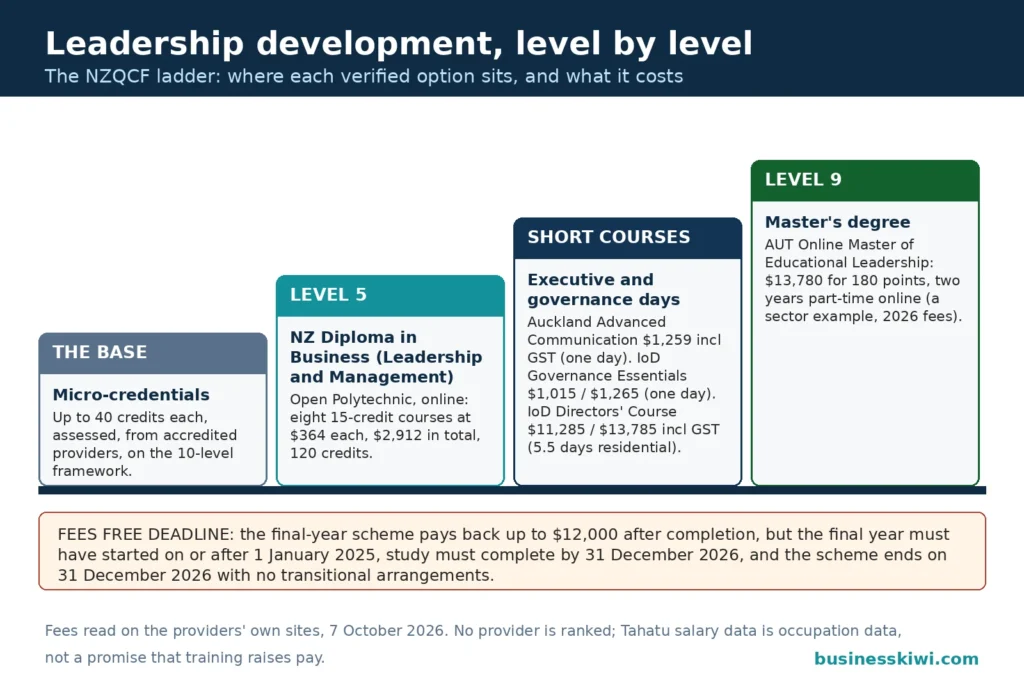
A worked example shows what the middle of the framework looks like. The New Zealand Diploma in Business (Level 5) (Leadership and Management) is a 120-credit qualification offered by a range of polytechnics and private providers. At Open Polytechnic, which delivers it fully online, the diploma is made up of eight 15-credit courses at $364 each, giving a total programme cost of $2,912 for domestic students at the time of checking. Courses run for 20 weeks, and Open Polytechnic puts the workload for one course at roughly 10 to 13 hours a week, which fits the general rule it publishes that each credit represents about 10 hours of study. You can take up to six years from first enrolment to finish, and student loans are available. That structure, a few hours a week over a year or two alongside a job, is typical of diploma-level study aimed at working adults.
At the top of the framework, leadership study becomes specialised by sector. AUT Online, for instance, offers a Master of Educational Leadership at Level 9: 180 points, delivered fully online over two years part-time, with full domestic fees listed at $13,780 for the 180 points based on 2026 fees, plus a student services levy. It is aimed at school and education leaders rather than business managers, which illustrates the pattern at postgraduate level. Beyond a general management degree, most Level 8 and 9 leadership programmes are built for a profession, such as education, health or the public sector.
Formal qualifications suit you if an employer or a promotion panel expects a credential, if you are changing sectors and need portable proof of capability, or if you want the structured grounding in finance, operations and people management that a diploma or degree forces you to complete. They are the slowest pathway, and the assessment load is real, but the credential does not expire and it travels with you between employers.
Work-based routes exist alongside classroom and online study. Some providers deliver diploma-level business qualifications through workplace assessment, where your actual management work generates the evidence. Where a programme interests you, the provider’s own programme page will say whether work-based delivery is offered, and NZQA’s register entry for the qualification will confirm its level and credits.
Pathway 2: Short courses and micro-credentials
Short courses are the volume end of the market. University executive education units, polytechnics, professional bodies and private providers all run them, typically over one or two days, in person or online, with a certificate of attendance or completion rather than a qualification.
The University of Auckland’s Executive and Professional Development unit describes its short courses as one or two day courses for professionals from entry level to senior executives. A concrete example: its Advanced Communication for Leaders course runs for one day, 9.00am to 4.00pm, in person, and was priced at $1,259 including GST for its October 2026 intake. That is a useful benchmark for university-run short courses: expect a focused topic, a practitioner facilitator, and a four-figure fee for a full day once GST is included.
Professional bodies run the governance end of this market. The Institute of Directors in New Zealand (IoD) is the main example. Its one-day Governance Essentials course was listed at $1,015 including GST for members and $1,265 for non-members. Its flagship Company Directors’ Course runs for five and a half days, residential, covering boardroom strategy, finance, directors’ legal duties, board dynamics and risk governance. Current bookable dates on the IoD’s own site were priced at $11,285 including GST for members and $13,785 for non-members, with earlier 2026 dates listed lower, so the exact fee depends on the date you book. Completing the course is a prerequisite for IoD chartered membership, and graduates receive the certificate in Company Direction. For aspiring or new directors it is the standard NZ governance credential, priced accordingly.
Micro-credentials are the regulated middle ground between a short course and a qualification. NZQA defines them as small, stand-alone awards with set learning outcomes. To be listed on the NZQCF a micro-credential must be up to 40 credits in size, sit at one of the framework’s levels, include an assessment component, be delivered by an accredited education provider, and be developed because there is evidence it is needed by employers, industry or communities. Although they stand alone, some micro-credentials can also form part of a programme leading to a qualification, so credits can sometimes stack. The assessment requirement is the key difference from an ordinary short course: a provider certificate confirms you attended, while an NZQA-listed micro-credential confirms you were assessed against stated outcomes.
If budget is the binding constraint, start lower down the price ladder before paying for any of this. Self-directed study will not give you a credential, but it builds the underlying knowledge cheaply, and our free online courses guide covers the no-cost options available to New Zealand learners.
Pathway 3: Development inside your own workplace
Employers develop more leaders through work itself than through any catalogue. The standard mechanisms are acting roles while a manager is away, secondments to another team or organisation, leading a project outside your usual scope, and formal internal programmes that larger employers run for identified talent. Mentoring, where a more experienced leader meets a developing one regularly over months, usually sits inside this pathway too, arranged internally rather than bought.
Government guidance to employers points the same way. Business.govt.nz, the government’s site for small business, advises employers to train their people as part of building a flexible, capable business, and its material for owners covers adapting your leadership style to the situation rather than managing everyone the same way. The practical reading of that advice is that development works best when it is planned: agree the skill or experience the person needs, create the opportunity, and review what changed. Unplanned exposure, being thrown in the deep end, produces survivors rather than leaders and can go badly for the team underneath.
How employers select people for funded development varies, but the patterns are consistent enough to plan around. Selection usually happens through performance and development reviews, succession planning for key roles, or nomination by a senior manager for a specific programme. Employers fund development that connects to a business need: a team leader about to take on a bigger span of control, a technical specialist moving into their first people role, a director pipeline for governance roles. If you are asking your employer to pay, the strongest case names the gap, the programme that fills it, the cost, and what you will do with the capability afterwards. Costs for internal development are mostly time rather than fees, which is why this pathway is often the first one offered and why its quality depends heavily on the manager running it.
Some bought-in training carries a funding angle for smaller businesses. The IoD notes that its Company Directors’ Course is registered with the Regional Business Partner Network, and directs businesses to their local Regional Business Growth Advisor to explore whether they are eligible for support. Registration does not guarantee funding, but it is worth a conversation before paying full price for management capability training.
Pathway 4: Coaching and mentoring
Executive coaching is one-to-one work with a trained coach, usually over a series of sessions across several months, focused on the leader’s own goals and behaviour: how they run meetings, handle conflict, make decisions, or step up from managing tasks to leading people. Unlike training, there is no curriculum. The coach questions, observes and gives feedback while the client does the work. Employers normally buy coaching for senior staff or for leaders at a transition point, such as a first executive role, because the per-person cost is higher than a course place and the benefit is individual. Coaching fees are not published as standard rates: coaches quote per engagement, so any figure in an advertisement should be treated as that coach’s own price, not a market standard.
Coaching is an unregulated occupation in New Zealand, so checking credentials matters. The International Coaching Federation (ICF) is the global professional body for coaching: it sets professional standards and a code of ethics and runs an independent credentialing programme for coaches. Its Australasia chapter covers Australia and New Zealand, and ICF lists a New Zealand Aotearoa branch, so NZ-based coaches can hold ICF credentials and belong to a local professional community. When you interview a coach, ask about their training, whether they hold a current credential, whether they work to a code of ethics, and whether they have supervision arrangements. Vague answers on those points are a warning sign.
Mentoring differs from coaching in one important way: a mentor is usually a more experienced practitioner in your field who shares experience and opens doors, while a coach is trained in the coaching process itself and need not come from your industry. Mentoring is often free or low cost, arranged through employers, industry associations or alumni networks, and it is the most underused option in this whole guide.
What it costs, and who usually pays
Pulling the verified figures together, the price ladder in New Zealand looks like this. A one-day university short course costs around $1,259 including GST, using the University of Auckland example checked for this guide. A one-day professional body course, the IoD’s Governance Essentials, costs $1,015 to $1,265 including GST depending on membership. A full NZQCF diploma in leadership and management, studied online part-time, costs $2,912 in total at Open Polytechnic, spread course by course. A five-and-a-half-day residential directors’ course costs $11,285 to $13,785 including GST. A specialist master’s degree, AUT’s Master of Educational Leadership, lists full domestic fees of $13,780 for the whole 180 points. Every one of those figures comes from the provider’s own published pages, checked on 7 October 2026, and providers revise fees regularly, so confirm the current price before you commit.
Two funding points are worth knowing. First, employer funding is the norm for executive short courses, governance programmes and coaching, because employers capture most of the benefit and the fees are set with a corporate buyer in mind. Individuals more often self-fund diplomas and degrees, where student loans are available for eligible domestic students. Second, Fees Free is in its final phase. As Fees Free’s own site states, it now covers the final year of a first tertiary qualification, or the final two years of work-based learning, paying back up to $12,000 after you complete. To be eligible, your final year must start on or after 1 January 2025 and you must complete your qualification or programme by 31 December 2026, when Fees Free ends, with no transitional arrangements. Applications are made through myIR after completion, and if you have a student loan the payment goes to your loan balance. If you are partway through a first diploma, that deadline is worth checking against your study plan.
Where a provider does not publish a fee, the course is usually priced on application or quoted per group. Before paying anything, ask what the fee includes (materials, catering, assessment, resits), whether GST is included, what the refund and deferral terms are, whether the course leads to an NZQA-listed credential or a provider certificate, and who facilitates it and with what experience. The answers separate serious providers from certificate sellers quickly.
How to choose
Start with the outcome, not the brochure. If a job advertisement or promotion framework asks for a qualification, only an NZQCF-listed qualification answers it. Tahatū, the government’s career information service, lists general manager roles as paying $82,000 to $169,000 a year, and notes training of up to two years as the typical preparation, which reflects how these jobs are actually filled: mostly by experience, with qualifications supporting rather than substituting for it. If the gap is a single skill, buy the single skill as a short course. If the gap is experience, negotiate an acting role or a project. If the gap is self-knowledge, get feedback or a coach.
Check recognition before you pay. NZQA’s website lets you search the framework for qualifications and credentials and check whether a provider is accredited to deliver them. A qualification or micro-credential listed on the NZQCF has been quality assured; a provider’s own certificate has not, which does not make it worthless, but you should pay accordingly. Be wary of any programme that borrows the language of levels and credits without appearing on the framework.
Be honest about time. Credits translate into hours at roughly 10 hours per credit, so a 120-credit diploma taken alongside full-time work is a commitment measured in years, not weekends. A five-day residential course demands a clear diary and an employer who will release you. Choosing the pathway you will actually finish beats choosing the most impressive one.
Finally, sequence it. A common pattern that works is a diploma or degree early in a management career for the grounding and the credential, short courses and governance training as scope grows, and coaching at senior levels where the problems stop being technical. There is no expiry date on starting.
For more study and career planning help, see the guides collected in our Jobs & Education hub.
Frequently asked questions
Do I need a qualification to become a manager in NZ?
No. There is no licence or mandatory qualification for management roles in New Zealand. Some employers and sectors expect one, and a qualification helps your application, but most managers are appointed on experience. Formal study is one pathway, not a legal requirement.
What is the difference between a short course and a micro-credential?
A short course ends with a provider’s certificate and usually involves no formal assessment. A micro-credential listed on the NZQCF is an assessed award of up to 40 credits, delivered by an accredited provider, and it can sometimes count toward a larger qualification. NZQA publishes the register of listed micro-credentials.
How much does leadership training cost in New Zealand?
Verified examples from providers’ own pages, checked in October 2026: $1,259 including GST for a one-day University of Auckland short course, $1,015 to $1,265 for the IoD’s one-day Governance Essentials, $2,912 in total for Open Polytechnic’s online Level 5 leadership and management diploma, and $11,285 to $13,785 for the IoD’s five-and-a-half-day Company Directors’ Course. Fees change, so confirm before enrolling.
Will my employer pay for leadership development?
Often, yes, especially for executive short courses, governance programmes and coaching, where employer funding is the norm. The usual route is a business case through your performance and development review: the gap, the programme, the cost, and how the organisation benefits. Some management training is registered with the Regional Business Partner Network, which can be worth exploring for smaller businesses.
Can I still get Fees Free for a leadership diploma?
Only within the closing window. Fees Free now pays back up to $12,000 for the final year of a first eligible qualification, but your final year must have started on or after 1 January 2025 and you must complete by 31 December 2026, when the scheme ends. Eligibility rules apply and most people qualify only if they are starting tertiary study for the first time. Check your position on the Fees Free website.
Sources
- NZQA, About the New Zealand Qualifications and Credentials Framework, nzqa.govt.nz
- NZQA, About micro-credentials, nzqa.govt.nz
- Open Polytechnic, New Zealand Diploma in Business (Level 5) (Leadership and Management), openpolytechnic.ac.nz
- AUT Online, Master of Educational Leadership, online.aut.ac.nz
- University of Auckland, Executive and Professional Development short courses, exec.auckland.ac.nz and shortcourses.auckland.ac.nz
- Institute of Directors in New Zealand, Company Directors’ Course and Governance Essentials, iod.org.nz
- Employment New Zealand, Employer rights and responsibilities, employment.govt.nz
- Business.govt.nz, Capacity and demand and training guidance, business.govt.nz
- Fees Free, feesfree.govt.nz
- Tahatū Career Navigator, General manager, tahatu.govt.nz
- International Coaching Federation, Australasia Chapter and New Zealand Aotearoa Branch, coachingfederation.org and icfaustralasia.com
Disclaimer
This article is general information about leadership development options in New Zealand. It is not career, education or financial advice, and it does not rank or recommend any provider. Fees were checked on providers’ own websites on 7 October 2026 and change over time. Confirm current fees, entry requirements and credential status with the provider and on NZQA’s framework before enrolling, and check Fees Free eligibility on the official Fees Free site.