Free Business Advice in NZ: Where to Get Real Help Without Paying

Search for free business advice and you will be offered a lot of it, much of it from people who would like to sell you something once the free part ends. That does not make all of it worthless, but it does mean the most trustworthy free help in New Zealand tends to come from a fairly short list of places: government services funded to support small business, Inland Revenue’s education programme, Work and Income if you are moving off a benefit into self-employment, and one national mentoring service whose mentors volunteer their time.
It helps to be clear about what free advice actually is. In most cases it is general guidance, education and a structured conversation with someone experienced. It can help you test an idea, write a business plan, understand your tax obligations, spot the gaps in how you run your operation, and decide what to do next. What it usually is not is a professional doing skilled work for you at no charge. Nobody is going to prepare your tax return, draft your contracts or manage your marketing for free, and any offer that sounds like that deserves a careful read of the terms attached.
There is also a time cost. A free workshop still takes an afternoon. A funded advice session still asks you to prepare, show up and do the follow-up work yourself. Used well, though, the channels below can carry a new or growing business a long way before it needs to pay for professional help, and they can make the paid help it eventually buys far better targeted.
Business.govt.nz: the free toolbox run by MBIE
The natural starting point is Business.govt.nz, the government’s small business website, run by the Ministry of Business, Innovation and Employment. It pulls guidance and tools from across government into one place, and the government’s Connected directory describes it as free to use for any member of the public, designed for small to medium businesses at any stage and any business structure.
Some of what it offers is reading material, written for owners rather than policy analysts. A lot of it, though, is genuinely practical tools. The Cash Flow Forecaster walks you through building a cash flow forecast so you can see the months where money gets tight before they arrive. The Employee Cost Calculator adds up the true cost of employing staff, which is the number you need before deciding whether you can afford to hire. ONECheck is a free tool that checks the availability of a business name, web domain and trade mark in a single search, which is worth doing before you spend anything on signage or a logo. The Funding Explorer brings together funding opportunities from across government in one place, with filters for sector and business goals, so you can check what support exists without visiting a dozen agency websites.
The site also carries short learning resources and videos on everyday topics such as understanding cash flow and how to price a job. None of this replaces a conversation with an advisor about your particular situation. What it does well is answer the standard questions quickly, at midnight if necessary, and give you the vocabulary and the numbers you need before you talk to anyone else. Its guidance on getting business planning advice is a good example: it explains that advisors can help you build, review and monitor a business plan, identify problems and opportunities, make better use of your resources, and connect you with funding and with their own networks.
If you are at the very beginning, work through the starting a business material first, use the tools to put rough numbers around your idea, and write down the questions the tools cannot answer. Those unanswered questions are exactly what the human channels below are for.
Inland Revenue: free tax education, seminars and advisory visits
Tax is where new businesses most often come unstuck, and it is also where one of the best free services sits. Inland Revenue states plainly that it runs free seminars and workshops across New Zealand on topics like getting started in business, GST, and becoming an employer. Its named workshops include Introduction to Business, a GST Workshop and an Employers workshop, and it has also recorded a series of seminars covering the questions its small and medium business community asks most often, so you can watch rather than attend where that suits you better.
Behind the workshops sits Inland Revenue’s Community Compliance team. According to Inland Revenue, its Community Compliance Officers offer tax education to new businesses and small organisations, and they work from most Inland Revenue offices as well as travelling regularly to other areas. For groups, you can request a seminar for your organisation on personal tax and entitlements topics such as Working for Families, KiwiSaver and child support.
The most underused option is the business advisory visit. Inland Revenue says you can request a visit to learn about the taxes you need to know about, record keeping, GST and employer returns, your KiwiSaver obligations, and when you need to file and make payments. These visits are available to individuals and organisations that are currently in business or considering setting up a business, and Inland Revenue notes they are also useful for sports clubs and other non-profit bodies, where voluntary office holders such as treasurers change frequently. To request one, you contact the Inland Revenue office closest to you.
Two limits are worth understanding. First, this is tax education, not personal tax advice. Inland Revenue will explain how the rules work and what your obligations are, but its staff will not design a tax structure for your circumstances or tell you which option saves you the most tax; that is the job of a tax agent or accountant who acts for you. Second, a workshop teaches the general rules that apply to everyone in the room. If your situation involves something unusual, such as a mix of employment and contracting income or a business you are buying rather than starting, treat the free session as groundwork and budget for specific advice on top of it.
The Regional Business Partner Network: a free first conversation, with possible funding behind it
If you already have a business and want someone to look at the whole operation rather than one topic, the Regional Business Partner Network is the main government channel. The network is a government-funded gateway delivered for the Ministry of Business, Innovation and Employment and Callaghan Innovation, and it works through Growth Advisors based around the country.
The core offer, as the government’s Connected directory describes it, is a discussion with a Regional Business Partner Growth Advisor to identify the support your business needs, connections to relevant providers, and, if you are eligible, funding to access expert advisory services. The support areas listed include HR, health and wellbeing, business continuity, cashflow and finance management, strategy and digital capability, along with management training to build the capability of owners and managers.
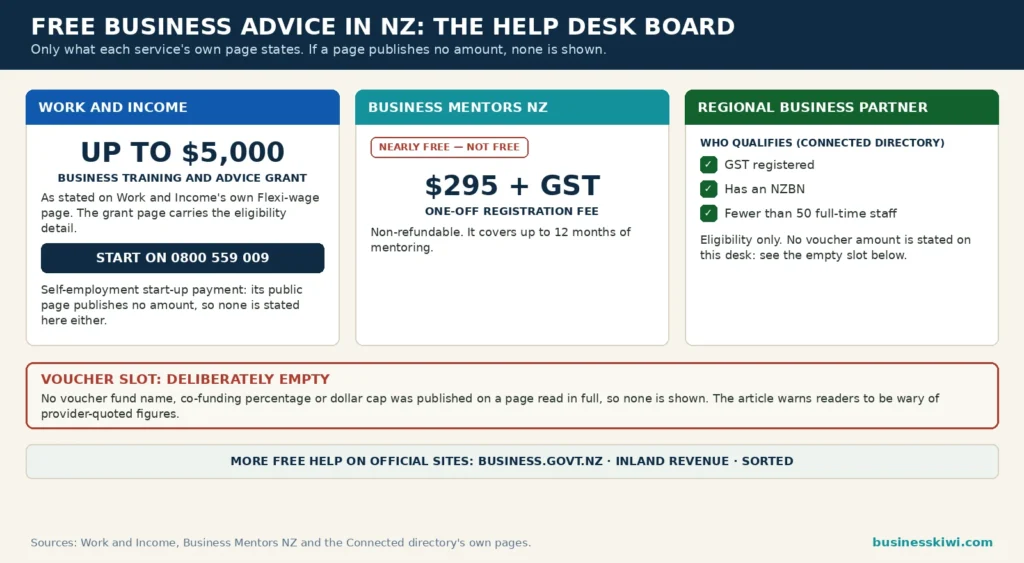
Eligibility matters here. Connected describes the network as being for businesses that are GST registered, have a New Zealand Business Number and employ fewer than 50 full-time equivalent staff. In other words, it is aimed at businesses that are already trading, not at people still sketching an idea, although registering and having the first conversation costs nothing. Think of that first meeting as a discovery or assessment session: you explain where the business is, where it hurts and where you want it to go, and the Growth Advisor maps that against the training, advice and funding they can connect you with, and gives you an action plan to work from.
Where funding is offered toward training or advisory services, it is co-funding rather than a blank cheque: the point of the scheme is to share the cost of building management capability, so expect to contribute part of the cost yourself and to choose from providers registered with the network. The exact funding available to an individual business is decided through that Growth Advisor process, so treat any specific dollar figure quoted by a training provider or coach with caution until your Growth Advisor has confirmed it. Providers market their own courses against the scheme, which is fine, but the allocation decision sits with the network, not with the provider trying to sell you the course.
For exporters and would-be exporters, the same conversation is also a sensible first step, because the network connects closely with NZTE, the government’s international business development agency.
Work and Income: funded advice for people starting from a benefit
Work and Income’s self-employment support is different in kind from everything above, because it is not a general public service. It is targeted help for people who are out of work and want to start a business or become a self-employed contractor instead. Its Start your own business page sets out the shape of it: advice and tools to help you plan, support and funding to set up your business, and help to find employees once you are trading, including no-fee recruitment services.
The advice-specific piece is the Business Training and Advice Grant. Work and Income says the grant helps with developing a business plan, training in business skills, advice and project reports. On its Flexi-wage page, Work and Income states that you may be able to get up to $5,000 to help you develop a business plan and/or train in business skills, advice and project reports. The money is paid so that an expert can work with you; it is funding to buy advice, before and while you are starting, rather than cash in your hand.
The eligibility bar is real. To get the grant you generally need to be out of work, aged 16 or older and not qualified to receive NZ Super, disadvantaged in the local labour market, and at risk of long-term benefit dependency, which usually means you are receiving a benefit or qualify for one, and you need to meet Work and Income’s residency criteria. You also need to be planning to start a new business, to be getting help from Work and Income to start it, and to intend to apply for Flexi-wage Self Employment for the same business. Applications start with a phone call to Work and Income on 0800 559 009.
Flexi-wage for self-employment itself is a subsidy to help with living costs while you are getting started, and the process around it doubles as structured advice. Work and Income needs to be satisfied that your business idea is viable: you will be asked for a business plan, your relevant skills and experience, market research, your thinking on marketing and competition, finance and operations, and compliance and risk planning, and your plan is sent to be independently assessed. If you receive the subsidy, Work and Income keeps in contact, you claim every four weeks, and you must provide a mid-project financial report within the first 12 to 20 weeks comparing your actual cash flow against your plan. That reporting discipline is, in effect, free business coaching with teeth.
Alongside these sits the Self-employment start-up payment, which helps with essential start-up costs such as furniture or the first lot of stock. It has its own eligibility rules, and you cannot get it if you are currently bankrupt or are restarting a business you have owned before. Work and Income’s public page for the payment does not publish a dollar figure, so be wary of any website that quotes you an exact amount; ask Work and Income directly what applies in your case.
None of this is a walk-in service for established businesses, and it is not meant to be. But if you are on a benefit, or close to qualifying for one, and self-employment is a genuine option, this is the most substantial package of free advice and funded support in the country, and it is worth a conversation before you spend your own money on business courses.
Local councils and regional economic development agencies
Below the national programmes sits a layer of local support that is easy to overlook. Councils and regional economic development agencies commonly employ business-facing staff whose job is to help local firms connect with the right support: pointing you to the programmes described above, running or hosting workshops and networking events, helping you understand council processes such as consents and licences, and passing on local market and workforce information.
What is on offer varies a lot between districts, and some national programmes are delivered locally through regional partner organisations, including chambers of commerce and economic development agencies, so your first local contact may also be the doorway to the Regional Business Partner Network. The practical move is simple: check your council’s website for its business or economic development section, and if there is a named business advisor or economic development officer, ask them a direct question. Local advisers usually know which workshops, mentors and funding rounds are live in your area right now, which is the sort of detail national websites are worst at.
Treat local help as navigation and connection rather than deep expertise. A council advisor is unlikely to restructure your finances, but they can save you weeks by telling you which door to knock on first.
Business Mentors New Zealand: twelve months of mentoring for a registration fee
The closest thing New Zealand has to free one-to-one business advice is Business Mentors New Zealand. It is a mentoring service that matches small business owners, startup founders and social enterprise executives with an experienced businessperson who acts as a sounding board and guide. Business Mentors says its Mentors gift their time and knowledge, have no financial or emotional investment in your business, and are screened and inducted before being matched.
The process runs through people, not an app. Mentor Coordinators are the first point of contact: Business Mentors says it has 17 agencies located across New Zealand, so every region is represented, and the service is closely aligned with the NZTE Regional Business Partnership. After you register, your local coordinator discusses your needs and matches you with a Mentor whose skills and experience are relevant. Business Mentors describes the rhythm as a couple of meetings in the first month to set direction and agree an action plan, settling into roughly monthly meetings after that, for a service of up to 12 months. You and your Mentor work on the plan between sessions, and the coordinator checks in from time to time to make sure the match is working.
Now the honest part about cost. The mentoring itself is provided by volunteers, but the service is not entirely free: Business Mentors charges a one-off registration fee of $295 plus GST, which it describes as a small contribution towards a supported delivery service, and the fee is non-refundable. For up to twelve months of regular meetings with an experienced operator, that is close to free by any commercial measure, but it is not zero, and the article would be misleading you if it pretended otherwise.
A mentor is not a consultant. They will share experience, challenge your thinking, help you set goals and suggest actions, but they will not do the work, and their advice is general experience rather than regulated professional advice. For owners who feel isolated, which is a large share of small business owners at some point, having someone independent to test decisions against is often the real value.
Sorted: free money guidance for the self-employed
Personal and business money blur together when you work for yourself, which is why Sorted, the free money guidance service, is worth a look even though it is aimed at personal finances. Its guidance for people switching to self-employment covers the issues that catch new operators out: putting money aside as you earn so the tax bill is not a shock, dealing with provisional tax in the first year, keeping KiwiSaver contributions going when there is no employer contributing for you, and thinking through ACC cover and insurance when sick leave no longer exists.
Sorted will not tell you how to run your business, and its material itself makes the point that a good accountant makes a real difference. Used in its lane, though, it helps you build the money habits, separate accounts and savings buffers that make the difference between a business that survives its first tax year and one that does not.
There is also free official help for employment problems specifically. Employment New Zealand provides a free mediation service to help employers and employees resolve employment relationship problems confidentially, and its Early Resolution service is a free phone-based service that tries to sort out a workplace issue early and informally, before it needs a formal process. If your burning question is about a staff problem rather than business strategy, those services, not a business advisor, are the right first call.
The free first chat: banks, accountants and lawyers
Outside the official channels, it is common practice for banks, accountants and law firms to offer an introductory meeting at no charge. Business.govt.nz itself lists your accountant among the standard places to get advice, and a first conversation is a normal part of how professional firms win clients. There is nothing wrong with taking up these offers; they can be genuinely useful for scoping a problem and getting a feel for whether you like working with someone.
Just go in with your eyes open. A free introductory chat is also a sales conversation. The firm is assessing you as a future client at the same time as you are assessing them, the advice you get will stay general because they have not yet dug into your records, and anything ongoing, preparing returns, reviewing contracts, setting up structures, will be quoted and charged. Compare more than one firm, ask what the ongoing service costs before you commit, and do not mistake a friendly free hour for a professional engagement.
What free advice cannot do
Free help has hard edges, and knowing where they are protects you from relying on the wrong thing.
Tax is the clearest example. Inland Revenue’s seminars and advisory visits teach you the rules and your obligations, but Inland Revenue does not act as your tax agent. Decisions about business structure, what to claim, and how to arrange your affairs within the law are yours, and if you pay an accountant or tax agent, their job is to apply the rules to your situation and stand behind that advice. A workshop answer is general information, not a ruling on your circumstances.
Legal questions are similar. General guidance can explain that a contract should be in writing or that a lease matters, but nobody in a free channel should be drafting your terms of trade, reviewing your commercial lease or advising on a dispute. That work belongs with a lawyer, and getting it done properly at the point it matters, before you sign, is usually much cheaper than fixing a bad document later.
Financial advice about investments, insurance products and KiwiSaver fund choices is regulated advice in New Zealand, and it comes from licensed financial advisers, not from mentors, growth advisors or seminar presenters. General education, such as Sorted’s material, can explain how products work; it cannot tell you which product is right for you.
Finally, free advice does not transfer responsibility. A mentor’s suggestion, a workshop example or a growth advisor’s action plan still leaves the decision, and the consequences, with you. If a decision is large or hard to reverse, that is the signal to pay for advice that is specific to you and backed by a professional relationship.

How to get the most out of a free session
Free sessions reward people who turn up prepared, and Business.govt.nz’s guidance on meeting an advisor is a good checklist to steal from. Before your first meeting, it suggests thinking through what your business goals are, what is important to the business, what decisions you are trying to make, what you need help with, and what type of advice you need. That sounds basic, but walking in with three sharp questions gets you far more than walking in with a general feeling that things could be better.
The same guidance says you should be able to explain what your business does, who your customers are and why they buy from you, who your competitors are, the opportunities or problems you face, and your short and long-term goals. Take your financial information with you, and your existing business plan if you have one. Advisors cannot help with numbers they cannot see, and a surprising amount of free advice time is wasted because the owner left the figures at home.
Business.govt.nz also names the common mistakes, and they are worth quoting in spirit: not getting help when you need it, only seeking help when you are looking for funding, getting too emotionally attached to the business to hear feedback, and not reviewing your business plan regularly. Free help works best as a habit through the life of the business, used when you are choosing a direction, not only when something has already gone wrong.
After any session, write down the actions agreed, put dates on them, and do them before the next one. Mentors and advisors give their best time to people who act on it, and several of these services have waiting lists or eligibility windows that will not wait for you.
Choosing the right channel for your question
The channels above are not interchangeable, so match the question to the door.
If you need the basics explained and tools to model the numbers, start with Business.govt.nz and work through it yourself. If the question is about tax obligations, GST or becoming an employer, go to Inland Revenue’s seminars, webinars or an advisory visit. If you are trading already and want an experienced outsider to assess the whole business and connect you with training or co-funded expertise, register with the Regional Business Partner Network and ask for a Growth Advisor discussion. If you are out of work and want to start a business, talk to Work and Income first, because the Business Training and Advice Grant and Flexi-wage support have to be arranged before you start, not claimed afterwards. If you want a long-term sounding board, apply to Business Mentors New Zealand and budget the registration fee. If the problem is an employment dispute, use Employment New Zealand’s Early Resolution or mediation services. And if the decision is specific, expensive or hard to undo, a tax position, a lease, a structure, treat the free channels as your preparation and pay a professional for the final answer.
Used in that order, free advice stops being a lucky dip and becomes a system: learn the basics free, test your thinking free, and spend money only where free help genuinely runs out.
Frequently asked questions
Is there really such a thing as free business advice in NZ?
Yes, mainly through government-funded services. Business.govt.nz’s guidance and tools are free to anyone, Inland Revenue runs free seminars, workshops and advisory visits, the Regional Business Partner Network offers a free initial discussion with a Growth Advisor, and Work and Income can fund advice for eligible people starting a business from a benefit. What free advice does not usually include is a professional doing skilled work for you at no charge.
How do I get a Regional Business Partner Growth Advisor?
You register your business with the Regional Business Partner Network and ask for a discussion with a Growth Advisor. The government’s Connected directory describes the network as being for businesses that are GST registered, have a New Zealand Business Number and have fewer than 50 full-time equivalent staff. The Growth Advisor identifies what support you need, connects you with providers, and can arrange funding toward expert advisory services if you are eligible.
Does the Regional Business Partner Network give out vouchers?
The network can provide funding toward expert advisory services and management training for eligible businesses, arranged through your Growth Advisor after they have assessed what your business needs. Funding is a contribution toward costs rather than full payment, and what an individual business can access is decided through that process, so confirm the specifics with your Growth Advisor rather than relying on figures quoted by training providers.
Is Business Mentors New Zealand actually free?
Nearly. The mentors volunteer their time, and mentoring runs for up to 12 months, but Business Mentors New Zealand charges a one-off registration fee of $295 plus GST, which is non-refundable. It describes the fee as a small contribution towards a supported delivery service.
Can Inland Revenue give me free tax advice for my business?
Inland Revenue provides free tax education: seminars and workshops on topics such as getting started in business, GST and becoming an employer, recorded seminars, and business advisory visits from its Community Compliance Officers covering record keeping, returns and KiwiSaver obligations. That is general education about your obligations, not personalised advice on your tax position. For advice that applies the rules to your circumstances, you need an accountant or tax agent.
I am on a benefit. Can Work and Income pay for business advice?
Possibly. The Business Training and Advice Grant can pay for an expert to help with developing a business plan, business skills training, advice and project reports, and Work and Income states you may be able to get up to $5,000. It is tied to starting a new business with Work and Income’s help and intending to get Flexi-wage Self Employment, and eligibility includes being out of work and disadvantaged in the labour market. Call Work and Income on 0800 559 009 to check your situation.
When should I pay for advice instead of using free help?
When the decision is specific to your circumstances, expensive or hard to reverse. Free channels are excellent for learning the rules, testing an idea and finding your gaps. Paying an accountant, lawyer or other professional makes sense for things like choosing a business structure, taking a position on a tax question, signing a commercial lease, or getting regulated financial advice about investments or insurance.
Sources
- Business.govt.nz, “Helping Kiwi businesses succeed” (homepage): https://www.business.govt.nz/
- Business.govt.nz, “Getting business planning advice”: https://www.business.govt.nz/strategy-and-performance/creating-a-business-plan/getting-business-planning-advice
- Inland Revenue, “Seminars and business advice”: https://www.ird.govt.nz/contact-us/general/seminars-and-business-advice
- Inland Revenue, “I am starting a new business”: https://www.ird.govt.nz/situations/i-am-starting-a-new-business
- Connected (connected.govt.nz), “Running your business”: https://www.connected.govt.nz/support-for-business/guidance-for-businesses/running-your-business/
- Work and Income, “Start your own business”: https://www.workandincome.govt.nz/work/start-your-own-business
- Work and Income, “Business Training and Advice Grant”: https://www.workandincome.govt.nz/products/a-z-benefits/business-training-and-advice-grant.html
- Work and Income, “Flexi-wage for self-employment”: https://www.workandincome.govt.nz/products/a-z-benefits/flexi-wage-self-employment.html
- Work and Income, “Self-employment start up payment”: https://www.workandincome.govt.nz/products/a-z-benefits/self-employment-start-up-payment
- Business Mentors New Zealand, “FAQs”: https://www.businessmentors.org.nz/faqs
- Sorted, “Switching to self-employed? There’s lots to consider”: https://sorted.org.nz/blog/switching-to-self-employed-theres-lots-to-consider/
This article is general information about where to find free business advice and support in New Zealand. It is not business, tax, legal or financial advice for your situation. Programmes, eligibility criteria and funding change over time, so check the details with the organisation concerned before relying on them, and consider professional advice for decisions that are significant to your business.