Pest Control Jobs NZ: Pay, Training and How to Get Started
The short answer
Pest control technicians in New Zealand usually earn $24 to $34 an hour, chances of finding work are good, and most people qualify within one to two years. There is no university degree involved. The usual path is to start as a trainee with an employer, then complete the New Zealand Certificate in Pest Operations (Level 3) while you work, and hold a full Class 1 driver licence.
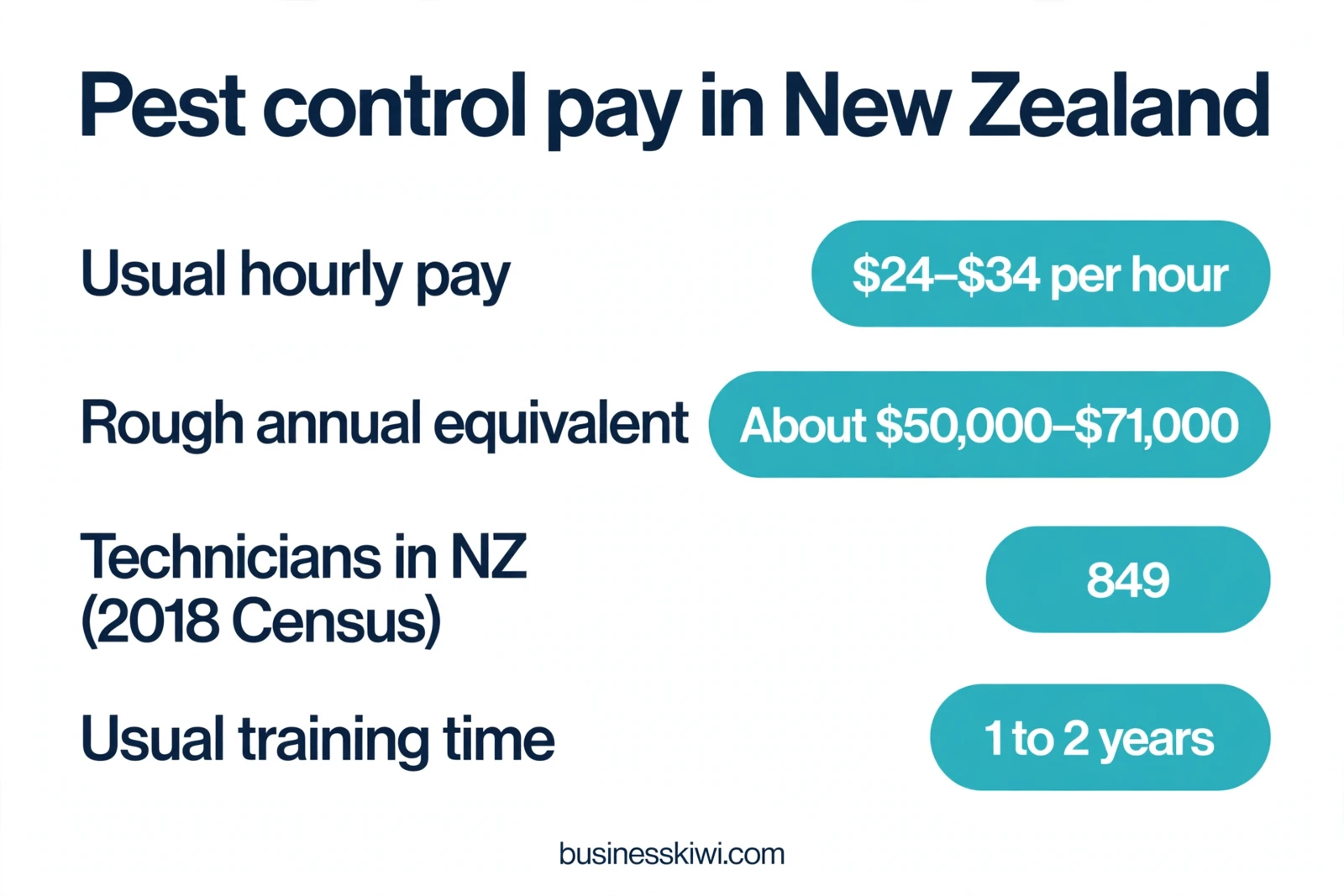
If you need one number to budget with, use $24 to $34 an hour. Worked out from that range, a standard 40 hour week comes to roughly $50,000 to $71,000 a year before tax. That annual figure is arithmetic from the hourly range, not a published salary, and real earnings vary with hours, overtime, callouts and whether the role is urban or rural. This guide covers what the job actually involves, what it pays, how to qualify, what the work is like day to day, and how to find a first role.
What a pest control technician actually does
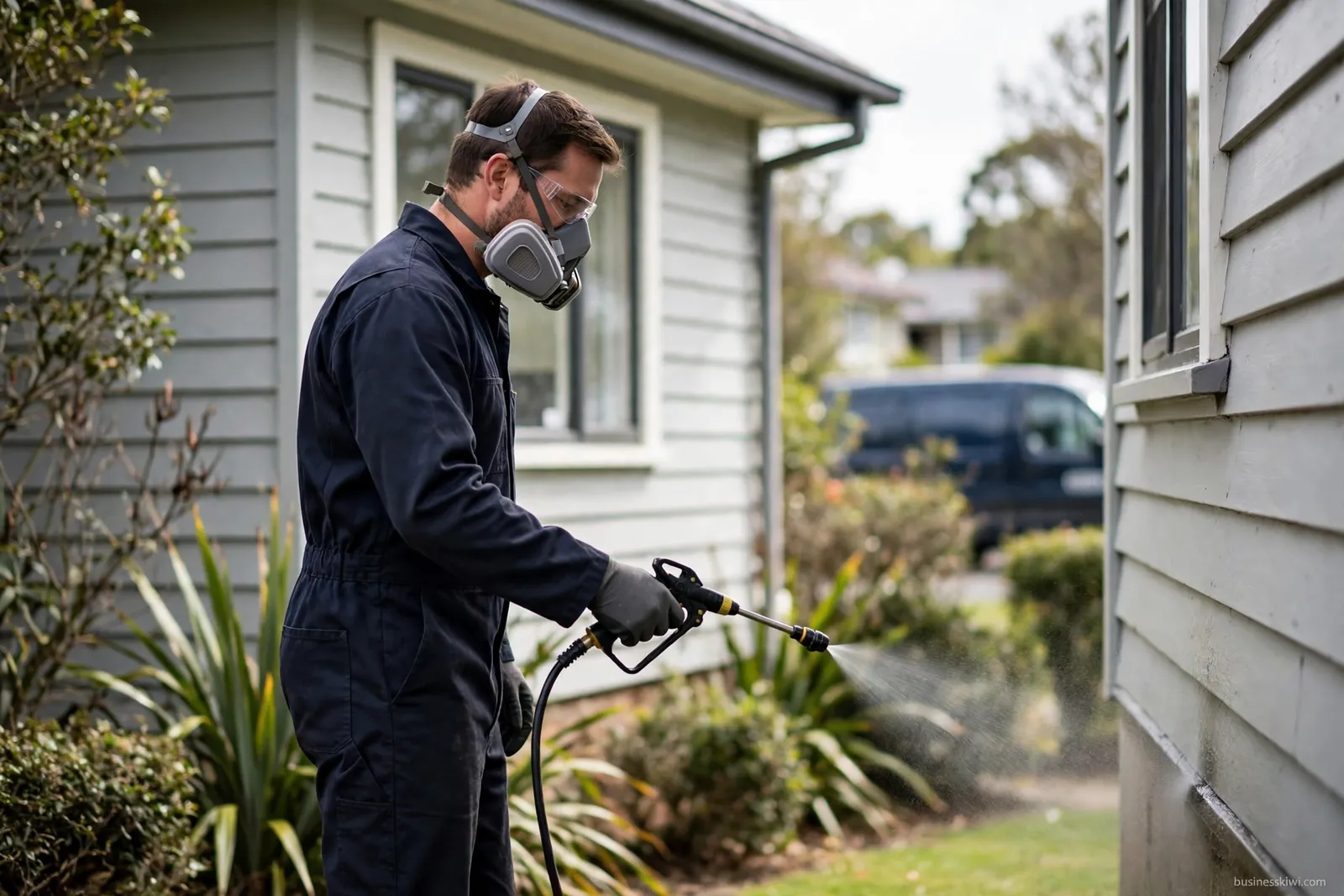
A pest control technician identifies and removes pests from buildings and properties. The pests are the familiar ones: rats and mice, cockroaches, ants, bed bugs, fleas, flies, wasps, spiders, stored product pests, and birds where they cause problems. The work is not simply spraying. A technician inspects a building or property for signs of pests, works out which pest is present and why it is there, then builds a control plan for that specific situation and carries it out.
The Pest Management Association of New Zealand (PMANZ) describes the job in practical terms. Pests do not just happen. For an infestation to develop inside a building, pests must have got in, found somewhere to hide and breed, and found food, warmth and usually water. A good technician works out how each of those things happened, because the answer decides the treatment. The same species in a different building can need a different approach, so the work is situational. The technician chooses the treatment, the application equipment and the places to treat once on site, based on the pest and the location.
A working day can include some or all of the following: inspecting premises for signs of infestation, identifying the pest and developing a control plan, controlling pests with chemicals, traps or shooting, advising customers on prevention, and keeping records of what was done. Some technicians provide specialist services to food manufacturers and to airline and shipping importers and exporters, where pest control is part of biosecurity and food safety rather than comfort. Keeping records of what was done is part of the job, and technicians record visits, treatments and findings as the day goes on.
The clients expect three things, and PMANZ is blunt about them. First, the pest gone, quickly. Second, an explanation of how the problem arose, in plain language. Third, advice on how to stop it coming back, including proofing and housekeeping. Many clients hold a service agreement, which they treat as insurance against a recurrence, and they expect the technician to be available if the problem returns. A technician who only treats and never explains will not keep those clients.
Urban or rural: two different jobs
Pest control in New Zealand splits into two streams, and the qualification reflects that split. Urban pest control is the work most people picture: homes, restaurants, shops, factories, hospitals, offices and food premises. Rural pest operations cover farms, forests, conservation land and regional council work: possums, stoats, ferrets, rabbits, pest plants, and the monitoring that goes with them.
The New Zealand Certificate in Pest Operations (Level 3) has strands in Urban Pest Control, Rural Pest Control and Rural Pest Monitoring. The urban strand covers identifying, controlling and monitoring pests commonly found in a built environment. The rural strands cover pest animal operations in the field, operating vehicles in a rural environment, and monitoring pest populations. NZQA lists the qualification as 40 to 60 credits, status current, and notes it can lead on to the New Zealand Certificate in Pest Management (Level 4).
The employers differ too. Urban technicians mostly work for pest control companies serving homes and businesses. Rural work sits with the Department of Conservation, regional councils, and contractors working on conservation and biosecurity programmes. A school leaver choosing between the two should know that the day looks very different: a city round of short visits to kitchens and roof spaces, versus long days outdoors in rough country, sometimes in bad weather, with traps, toxins and monitoring work. Both paths start from the same Level 3 certificate, and the strand you choose shapes where you end up.
How much do pest control technicians earn in NZ
Tahatū, the government careers service, states that pest control technicians usually earn $24 to $34 an hour. Worked out from that hourly range, a standard 40 hour week comes to roughly $50,000 to $71,000 a year before tax. That annual figure is arithmetic from the hourly range, not a published salary, and real earnings vary with hours, overtime, callouts and whether the role is urban or rural.
| What the figure is | Amount | Source |
|---|---|---|
| Usual hourly pay | $24 to $34 per hour | Tahatū (careers.govt.nz) |
| Rough annual equivalent, 40 hours a week | About $50,000 to $71,000 | Worked out from the hourly range above |
| Technicians working in NZ (2018 Census) | 849 | Tahatū (careers.govt.nz) |
| Usual training time | 1 to 2 years | Tahatū (careers.govt.nz) |
A few things sit behind the range. Trainees start at the lower end while they learn on the job and work towards the Level 3 certificate. Qualified technicians with experience, and those who take on supervisory work or specialist jobs such as bird control or work at heights, sit higher. Rural roles with the Department of Conservation or a regional council are salaried positions, and they are different jobs with different duties. Self-employed technicians set their own rates and carry their own costs, so their take-home pay depends on how much work they win and how efficiently they run the business.
Pay is only part of the picture. Most urban roles come with a work vehicle, and many employers provide the tools, protective gear and training. Evening and weekend work is common, and summer is the busy season, so overtime and longer hours can lift earnings in the warmer months. Anyone comparing this job with other trades should compare the hourly rate with the hours actually worked, not with a salary figure alone.
How to become a pest control technician
There is no single front door into this job. Most people enter as a trainee with a pest control company and qualify while they work. The steps below are the standard route for urban work.
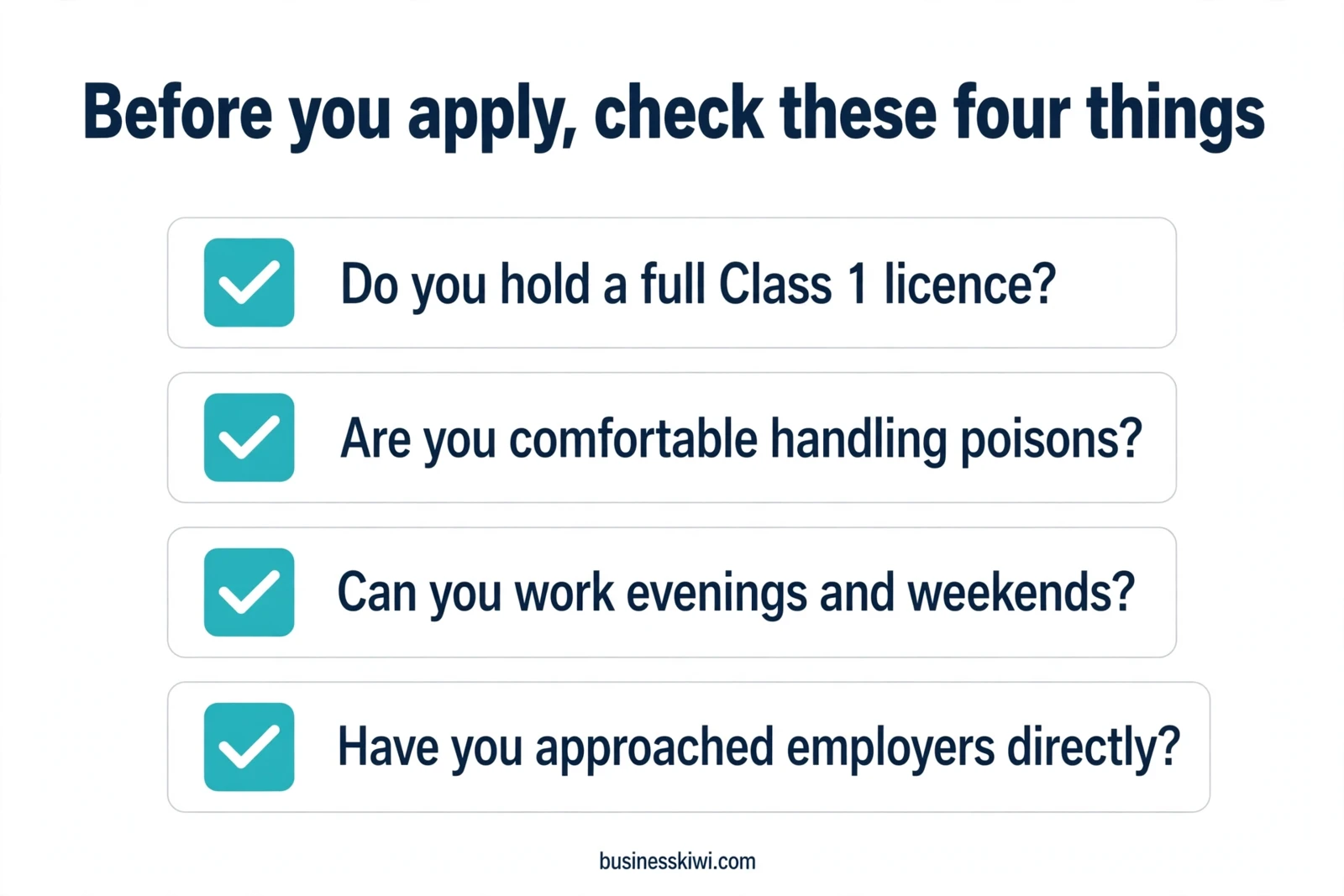
1. Check you meet the basics. There are no specific secondary school requirements, though Tahatū notes that NCEA Level 2 English, biology, chemistry and maths are useful. Useful experience includes outdoor work with animals and work with chemicals and poisons. You need to be comfortable with the physical side of the job and with handling poisons carefully. A full Class 1 driver licence is required to become qualified, so a learner or restricted licence will need to be upgraded.
2. Approach employers directly. Tahatū advises that many pest control technician vacancies are not advertised, and the best way to find work is to approach employers directly. The four largest employers are Rentokil, Ecolab, Genus and Flick Anticimex. Smaller local firms also take on trainees. A short CV and a cover letter that shows you understand what the job involves will do more than a generic application. Our NZ CV template and cover letter guide explain the format New Zealand employers expect.
3. Start as a trainee. Without a qualification, you can only work when supervised by someone qualified in pest management. As a trainee you work alongside a qualified technician, learn the pests, the products, the safety rules and the paperwork, and build up the practical assessments for the certificate.
4. Complete the Level 3 certificate while you work. The qualification is the New Zealand Certificate in Pest Operations (Level 3), in the Urban Pest Control strand for city work or the Rural Pest Control strand for field work. Careerforce states the expected duration for the Level 3 certificate is 7 months, with an enrolment fee of $230. The training is on the job, which means you earn while you learn and do not need a student loan for the qualification itself.
5. Register with the industry body. You can register with the Pest Management Association of New Zealand. Registration is not a legal licence to practise, but it signals to employers and customers that you meet the industry’s standards, and PMANZ works with Careerforce and training providers on the qualification.
6. Keep building. The Level 3 certificate can lead to the New Zealand Certificate in Pest Management (Level 4), and experienced technicians move into supervisory roles, specialist work or their own business. Our guide to registering as a sole trader explains the business side for anyone thinking about working for themselves.
A note on timing: the best time to look for work is in the warmer months, October to April, when most pests breed and demand rises. A short-term role taken in spring can turn into a permanent job if you prove reliable.
The qualification in detail
The qualification is straightforward, but the delivery options confuse people, so here is how it fits together.
| Pathway | What it is | Time and cost (as published) |
|---|---|---|
| NZ Certificate in Pest Operations (Level 3), Urban Pest Control strand | The standard qualification for city and commercial pest control work; delivered on the job through Careerforce | About 7 months; $230 enrolment fee (Careerforce) |
| NZ Certificate in Pest Operations (Level 3), Rural Pest Control strand | The field-based strand for farms, forests and conservation land | 18 weeks full time on campus at Land Based Training; $1,869 |
| NZ Certificate in Pest Management (Level 4) | The next step up, with strands in Pest Animal and Pest Plant | Builds on the Level 3 certificate (NZQA) |
| Urban Pest Management Level 3 course (Cleaning Systems) | A provider-delivered version of the urban Level 3 certificate, run with Careerforce and PMANZ | About 7 months including 3 days of online training; $3,800 including GST |
A few details matter. The urban certificate is usually done while employed, with a workplace mentor or observer overseeing the practical assessments. Cleaning Systems, which delivers the urban programme with Careerforce and PMANZ, requires an approved observer for enrolment: a workplace manager, a qualified technician, or one of its recommended independent observers for sole traders. The rural strand can be done as a full-time campus course. Land Based Training runs an 18 week on-campus programme in Palmerston North and Hastings for $1,869, with open entry, and notes that firearms are not used in its programme. Note that the rural certificate and the urban certificate are different strands of the same Level 3 qualification, so the strand you pick should match the work you want to do.
The qualification also meets regulatory requirements. Cleaning Systems states that its programme meets the requirements of the EPA’s Hazardous Substance (Hazardous Property Controls) Notice 2017, which is what allows a graduate to work as a qualified urban pest management contractor. That is the point of the certificate: it is the credential that lets you work without supervision and take responsibility for choosing and applying treatments.
What the job is really like day to day
Pest control is physical, outdoor and often solitary work, and anyone considering it should hear that plainly before applying.
Hours vary. Technicians work varied hours, including evenings and weekends, and longer hours in summer when pests are most active. Urban technicians drive from job to job across a local area, often alone, with a vehicle carrying treatment equipment. Rural technicians can spend whole days in the field, sometimes in remote country, and may travel or stay away overnight depending on the programme.
The places are varied too. Urban work takes you into restaurant kitchens, shops, factories, hospitals and homes. Rural work takes you into bush, farmland and conservation areas in all weather. The work can be dirty and cramped: roof spaces, subfloors, wall cavities and service ducts are normal workplaces. Protective clothing is part of the job and can be hot, and the chemicals used can be hazardous if they are not handled correctly.
Fitness matters. Tahatū states that technicians need a good level of fitness, spend long periods on their feet, and need to carry containers of chemicals. They need to be comfortable in confined spaces or at heights, and to have no breathing problems or allergies to pests or dust. If you have asthma or a dust allergy, this is a genuine obstacle rather than a minor detail, and it is worth checking with a doctor before committing to training.
The personal qualities the job rewards are specific. Technicians need to be careful and accurate, especially when dealing with poisons, and able to work out doses and mix chemicals correctly. They need to be good communicators, because much of the job is explaining a problem and a solution to a worried customer. They need to work well alone and solve problems on the spot, since the plan often changes once you see the actual building. And they must not be squeamish, because the work involves rats, cockroaches, wasps and dead animals as a matter of routine.
Safety, chemicals and the law
Pest control is a regulated job, and the safety rules are a real part of the work rather than background paperwork. Three sets of rules matter most.
First, the Health and Safety at Work Act 2015. Under the Act, the business (the PCBU) has the primary duty to keep workers safe, and workers must have the training and supervision they need to work safely with hazardous substances. That is why trainees work supervised and why the Level 3 certificate exists: it is the evidence that a technician can handle pesticides and poisons safely and legally.
Second, the rules for the products themselves. Every pesticide has a label and a safety data sheet, and both must be followed. The label states how the product can be used, at what rate, and on what. WorkSafe also publishes guidance on restricted entry intervals for pesticides: after a pesticide is applied, there is a period during which people must not enter the treated area unless they are wearing appropriate personal protective equipment. The interval is stated on the product label and safety data sheet, and the person in charge of the area must make sure nobody enters before it ends and that signs are put up for indoor application areas. A technician who does not understand restricted entry intervals is a risk to customers, not just to themselves.
The controls WorkSafe sets out are practical. Keep people out of a treated area during the restricted entry interval unless they are wearing the right protective equipment. Put signs up for indoor application areas. Follow the product label and safety data sheet exactly, including the rate and where the product can be used. Wear overalls, gloves, face masks and respirators where required, and store and maintain the gear correctly. A technician who cuts corners with chemicals puts customers, children, pets and other workers at risk, and the consequences for the business can include prosecution.
Third, personal protective equipment. Overalls, gloves, face masks and sometimes respirators are standard, and the gear must be used, stored and maintained correctly. Our health and safety courses guide explains the training available for workers who handle hazardous substances, and our health and safety management guide covers how a small business runs its safety system day to day.
None of this is optional. A technician who cuts corners with chemicals puts customers, children, pets and other workers at risk, and the consequences for the business can include prosecution. Employers check this carefully at hiring, which is why Rentokil and other large employers require pre-employment medical, reference and criminal background checks, and why a clean driving record matters: the job is mostly driving.
Who employs pest control technicians
Tahatū names the four largest employers as Rentokil, Ecolab, Genus and Flick Anticimex. These are national companies with branches across the country, and they take on trainees, run the qualification through Careerforce, and offer a path into supervisory and management roles. Rentokil’s own job listings describe the role as residential and commercial work, keeping customer premises pest free, with training and qualification provided and a full driver licence required.
About a third of pest control technicians are self-employed, according to Tahatū. That is a high share for a trade, and it reflects how the work is structured: a van, equipment, a customer list and a reputation are enough to start. Self-employment brings flexibility and higher hourly rates, but also the costs of the vehicle, insurance, chemicals, licensing and finding customers. Anyone weighing that path should read the business side first.
Rural work has different employers again: the Department of Conservation, regional councils, and contractors on biosecurity and conservation programmes. NZQA lists the employment pathways from the Level 3 certificate as pest monitors, pest control contractors, Department of Conservation rangers, regional council biosecurity officers and urban pest control technicians. These roles are salaried, often advertised on government job boards, and usually want the rural strand of the certificate plus field experience.
The 2018 Census counted 849 pest control technicians working in New Zealand. That is a small workforce, which is part of why demand stays good: a small pool, steady demand from food businesses and households, and a steady flow of people leaving the role after a short time once they realise what the job involves. Tahatū also notes that a number of technicians are reaching retirement, which opens up work for newcomers.
Where the career can go
Pest control is a small industry, so the career ladder is short but real. The usual moves are: trainee to qualified technician, then to senior technician or supervisor, then into management or into your own business. Specialisation is the other direction: rats and possums, insects, or birds. Bird control, for example, involves installing nets, spikes and deterrents, clearing fouling and working at heights, and it is a distinct skill set with its own licences for elevated work platforms.
The Level 4 certificate in Pest Management is the formal next step for people who want to manage pest operations rather than just carry them out. Beyond that, the skills transfer: biosecurity officers, conservation rangers, environmental health officers and hunters or trappers are the similar jobs Tahatū lists, and the field skills, chemical knowledge and customer skills from pest control carry into each of them.
Starting your own business is the most common ambition in the trade, and about a third of technicians already work for themselves. The honest version is that it takes more than technical skill: you need customers, insurance, a vehicle, chemical storage that meets the rules, and the paperwork to prove you are qualified. Doing the Level 3 certificate, working for an established company for a few years, and learning how the business side works before going out alone is the path most people take.
How to find pest control work in NZ
The practical steps, in order:
Apply directly to employers. Many vacancies are never advertised. Contact the large employers and local firms in your area, and ask about trainee roles. A short CV and cover letter that show you know what the job involves will stand out, because many applicants do not. Our NZ CV template and cover letter guide set out the format New Zealand employers expect.
Time it for the warm months. October to April is when most pests breed and demand rises. A short-term role taken in spring can become permanent if you prove reliable through the busy season.
Get the licence sorted. A full Class 1 driver licence is required to qualify, and most employers want a clean driving record. If you are still on a learner or restricted licence, work on upgrading it before you apply.
Be ready for the checks. Large employers run pre-employment medical assessments, reference checks and criminal background checks. None of this is unusual for a job that involves driving, chemicals and entering people’s homes.
Consider the rural route separately. If field work appeals more than city rounds, look at the rural strand of the Level 3 certificate and at Department of Conservation and regional council roles. The campus-based rural programmes at providers such as Land Based Training are a way in for people without an employer yet.
Do not pay for training you do not need. The urban certificate is usually done on the job with your employer, with Careerforce, and the enrolment fee is $230. Provider-delivered versions cost more because they include the training delivery and assessment. Check what each option includes before you pay, and check that the provider is working with Careerforce and PMANZ.
Is pest control a good job?
It depends on what you want from work. The case for it is clear: no degree needed, training takes one to two years, chances of finding work are good, demand is steady and rising, and the pay of $24 to $34 an hour is fair for work that does not need a university education. There is a genuine path to running your own business, and the work is varied, outdoors and independent.
The case against it is just as clear: the work is dirty, physical and sometimes unpleasant. You will handle poisons, crawl through roof spaces, work in bad weather and deal with customers who are upset about rats in their kitchen. Hours are irregular, summer is long, and the chemicals carry real risk if they are handled badly. About a third of technicians are self-employed, which means income can be uneven, and the small size of the industry means there are fewer rungs on the ladder than in a big trade.
The people who do well in this job are the ones who like working alone, do not mind getting dirty, are careful with detail and like solving a different problem at every address. If that sounds like you, and the safety side does not put you off, it is a solid trade with a short training path and steady demand. If you want regular hours, clean work and a large employer with a long career ladder, look elsewhere.
If you are weighing this trade against other options, the Jobs and Education section has more career guides to compare it with.
Frequently asked questions
How much do pest control technicians earn in NZ?
Tahatū states that pest control technicians usually earn $24 to $34 an hour. Worked out from that range, a standard 40 hour week comes to roughly $50,000 to $71,000 a year before tax. Trainees start lower, qualified and experienced technicians earn more, and self-employed technicians set their own rates.
What qualifications do I need to become a pest control technician in NZ?
To become qualified you need the New Zealand Certificate in Pest Operations (Level 3), in the Urban Pest Control strand or the Rural Pest Control strand, plus a full Class 1 driver licence. You can start as a trainee without the qualification, but you can only work supervised by someone qualified until you hold it.
How long does it take to train as a pest control technician?
Tahatū states that one to two years of training is usually required. Careerforce states the expected duration for the Level 3 certificate is 7 months when done on the job, while a full-time campus programme for the rural strand takes 18 weeks.
Do I need a licence to do pest control in New Zealand?
There is no single government licence for pest control technicians. What you need is the Level 3 certificate, which is the qualification that allows you to work unsupervised, and a full Class 1 driver licence. You can also register with the Pest Management Association of New Zealand. The products you use are controlled under hazardous substances rules, and your employer must make sure you are trained and supervised to handle them.
Is pest control a dangerous job?
It carries real risks, mainly from the chemicals used and the places worked in. The Health and Safety at Work Act 2015 requires employers to train and supervise workers handling hazardous substances, and every pesticide has a label and safety data sheet that must be followed. Technicians wear protective clothing and follow restricted entry intervals after treatments. The job is safe when the rules are followed and risky when they are not.
Can I start my own pest control business in NZ?
Yes, and about a third of pest control technicians are self-employed. You need the Level 3 certificate, a vehicle, insurance, compliant chemical storage and customers. Most people work for an established company for a few years first, to learn the trade and the business side, before going out alone.
When is the best time to look for pest control work?
The warmer months, October to April, when most pests breed and demand is highest. Many vacancies are not advertised, so approaching employers directly is the most effective way to find work, and a short-term role in spring can lead to a permanent job.
A note on the figures in this guide
Pay, training and employment details in this guide were checked against Tahatū, Careerforce, NZQA, Cleaning Systems, Land Based Training, PMANZ and WorkSafe at the time of writing, in November 2026. The annual pay figure is arithmetic from Tahatū’s published hourly range, not a published salary. Rules, fees and qualification details can change, so check the current pages at Tahatū, Careerforce, NZQA and the training provider before you enrol or apply.
This guide is general information only. It is not career, legal or safety advice. Pest control involves hazardous substances and the rules around them change. Check the current guidance from WorkSafe and the training provider, and talk to an employer or adviser before you enrol or apply.